Carb Code Bell Ringer
Biology Warm-Up Time: 5-7 Minutes
Carb Code Bell Ringer
Name:
Date:
Period:
Key Focus: Carbohydrate functions, 1:2:1 atomic ratio, and monomer vs. polymer synthesis. Total: 10 Pts
1 Molecular Anatomy: Atomic Ratio & Structure
3 Points
Hexose Ring (Glucose)
O C C C C C
C₆H₁₂O₆
A. Which three elements make up every carbohydrate molecule?
,
,
B. What is the characteristic fixed ratio of Carbon : Hydrogen : Oxygen?
C
: H
: O
2 Subunit Spectrum: Monomer to Polymer
4 Points
Complete the chart comparing carbohydrate tiers. Use the word bank below.
Word Bank: Starch • Monosaccharide • Glucose • Polysaccharide • Sucrose
Level
General Scientific Term
Primary Example(s)
Single Unit (Monomer)
Two Units (Dimer)
Disaccharide
Many Units (Polymer)
Cellulose, Glycogen, Starch
3 Function Finder: Purpose in Living Things
2 Points
Write the letter of the carbohydrate that best matches each biological role.
1. Short-Term Cellular Fuel
Broken down during cellular respiration to immediately yield ATP energy.
2. Plant Cell Wall Rigidity
Forms tough, fibrous structural cross-links supporting plant stems and leaves.
A. Glucose B. Cellulose C. Hemoglobin D. Phospholipid
4 Real-World Application: The Pasta Principle
1 Point
Marathon runners often "carbo-load" by eating complex polysaccharides (like pasta or rice) the night before a race rather than consuming pure simple sugars 5 minutes before. Explain why in terms of energy release rate and polymer structure.
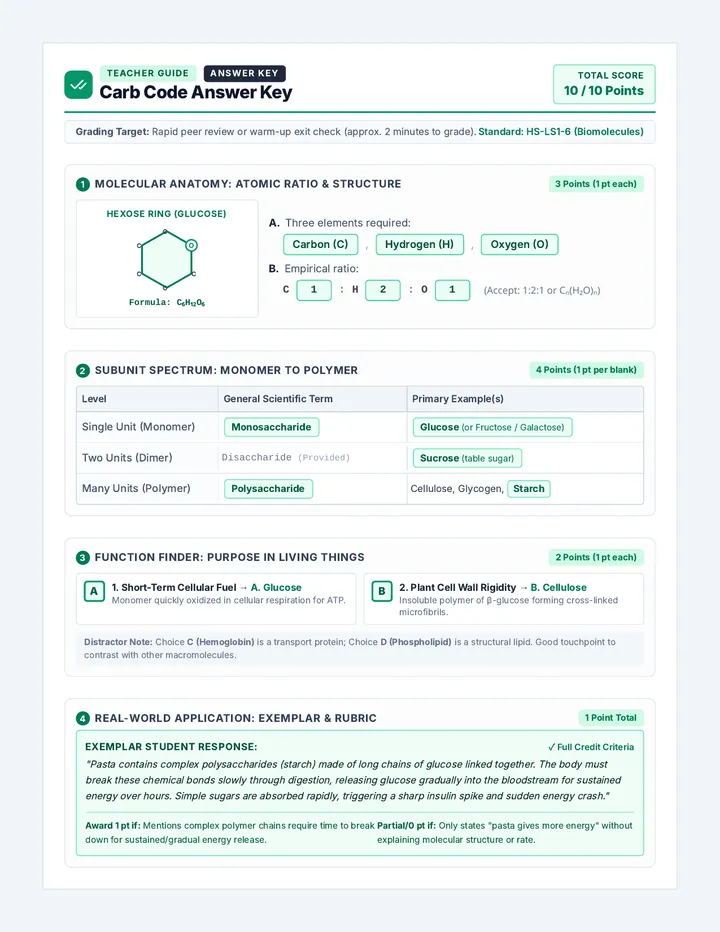
Carb Code Answer Key
Teacher Guide Answer Key
Carb Code Answer Key
Total Score
10 / 10 Points
Grading Target: Rapid peer review or warm-up exit check (approx. 2 minutes to grade). Standard: HS-LS1-6 (Biomolecules)
1 Molecular Anatomy: Atomic Ratio & Structure
3 Points (1 pt each)
Hexose Ring (Glucose)
O C C C C C
Formula: C₆H₁₂O₆
A. Three elements required:
Carbon (C) , Hydrogen (H) , Oxygen (O)
B. Empirical ratio:
C 1 : H 2 : O 1 (Accept: 1:2:1 or Cₙ(H₂O)ₙ)
2 Subunit Spectrum: Monomer to Polymer
4 Points (1 pt per blank)
Level
General Scientific Term
Primary Example(s)
Single Unit (Monomer)
Monosaccharide
Glucose (or Fructose / Galactose)
Two Units (Dimer)
Disaccharide (Provided)
Sucrose (table sugar)
Many Units (Polymer)
Polysaccharide
Cellulose, Glycogen, Starch
3 Function Finder: Purpose in Living Things
2 Points (1 pt each)
A
1. Short-Term Cellular Fuel → A. Glucose
Monomer quickly oxidized in cellular respiration for ATP.
B
2. Plant Cell Wall Rigidity → B. Cellulose
Insoluble polymer of β-glucose forming cross-linked microfibrils.
Distractor Note: Choice C (Hemoglobin) is a transport protein; Choice D (Phospholipid) is a structural lipid. Good touchpoint to contrast with other macromolecules.
4 Real-World Application: Exemplar & Rubric
1 Point Total
Exemplar Student Response: ✓ Full Credit Criteria
"Pasta contains complex polysaccharides (starch) made of long chains of glucose linked together. The body must break these chemical bonds slowly through digestion, releasing glucose gradually into the bloodstream for sustained energy over hours. Simple sugars are absorbed rapidly, triggering a sharp insulin spike and sudden energy crash."
Award 1 pt if: Mentions complex polymer chains require time to break down for sustained/gradual energy release. Partial/0 pt if: Only states "pasta gives more energy" without explaining molecular structure or rate.