Students master the National Electrical Code (NEC) requirements for outlet box fill, calculating volume allowances for conductors, clamps, and devices to ensure electrical safety and compliance.
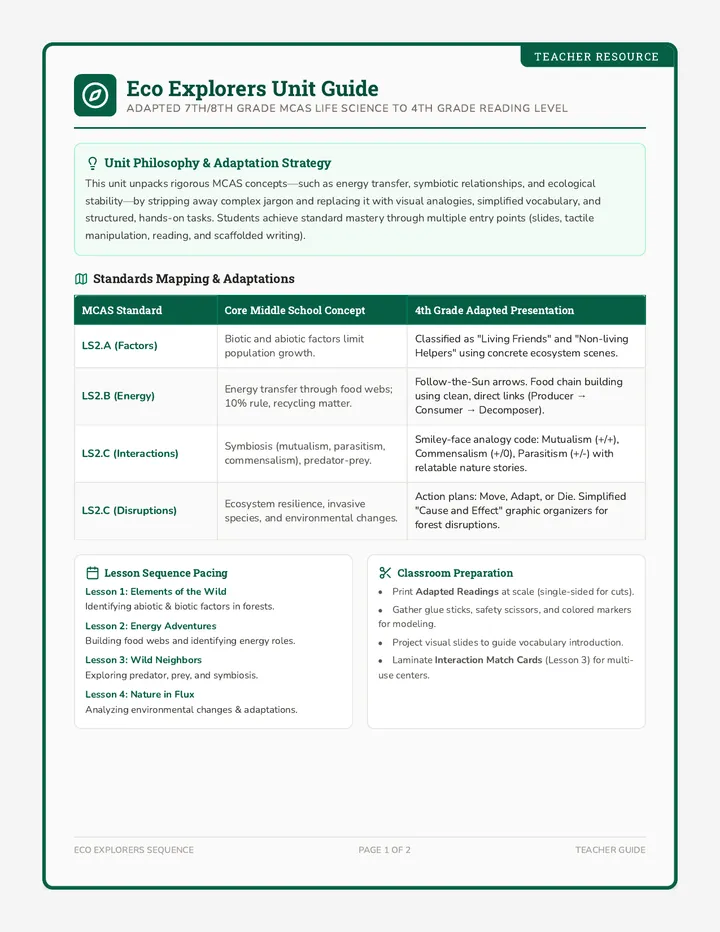
A comprehensive lesson on food chains, producers, and consumers, featuring differentiated reading passages, graphic organizers, and assessments designed for 5th-grade learners at various levels.
Explores the Moon's role as a testing ground for Mars exploration and a unique platform for deep space astronomy, focusing on the Gateway station and long-duration missions.
Students explore the world of artificial intelligence and robotics, learning how to design and "train" a virtual robot using online tools. They will understand the relationship between hardware, software, and data training.
A comprehensive set of tools to help 6th-grade students master the Cornell note-taking method specifically for science concepts, featuring a guided template and instructional supports.
A comprehensive review of mitosis using a 'Cell Copy Shop' theme, differentiated for Life Skills and Modified Curriculum students to understand how cells make identical copies of themselves.
A lesson exploring the greenhouse effect, how human activities amplify it, and the role of fossil fuels in climate change.
A foundational lesson on the essential terminology and workflow of video post-production, covering everything from basic cuts to technical specifications.
A comprehensive guide for students participating in a STEM tower building challenge, focusing on structural engineering, recycled material innovation, and scientific explanation.
A 30-minute introductory lesson on DNA structure, base pairing rules, and the fundamentals of translation for 10th-grade Biology students.
An interactive Earth Science lesson where students visualize and draw the relationship between mantle convection currents and plate boundary movements.
A comprehensive project-based lesson where students design a multi-channel advertising campaign, including target market analysis, competitive positioning, and creative execution across social media and video.
A lesson introducing four major biomes (Rainforest, Desert, Grassland, and Ocean) designed for high-interest, low-readability (Hi-Lo) instruction. This lesson bridges 2nd-grade reading levels with content suitable for a 14-year-old student.
A project-based lesson where students design and build 3D models of sustainable farming landscapes to demonstrate their understanding of soil conservation and regenerative agriculture techniques.
A deep dive into plate tectonics focusing on subduction zones and the explosive geological activity of the Ring of Fire. Students will explore the mechanics of plate movement and its global impact.
Explores the scientific goals of the Artemis missions, including lunar geology, the search for water ice, and using the Moon as a stepping stone for deep space exploration.
Focuses on the Artemis II mission's role in driving technological advancements that benefit life on Earth, from water purification to advanced materials.
A fun, interactive game where students try to identify technology from the 1990s and earlier, comparing 'vintage' tech to modern equivalents.
A guided exploration of the San Andreas Fault based on the 'How The Earth Was Made' documentary, focusing on plate boundary mechanics and seismic history.
An introductory lesson on the Earth's atmosphere and how air temperature changes due to factors like location, texture, and color, adapted for 2nd-grade readers.
A comprehensive look at buoyant force, Archimedes' Principle, and the physics of sinking and floating through guided inquiry and technical reading.
A comprehensive review of evolutionary biology concepts including natural selection, mechanisms of evolution, evidence of common ancestry, and rates of evolution designed for EOC exam preparation.
A hands-on lesson where students analyze real-world citizen science data to track bird migration through New England, integrating math, geography, and biology.
An in-depth look at the snow leopard's unique adaptations and survival strategies in the Himalayan mountains.
A comprehensive GED science lesson on tectonic activity, focusing on seismic wave analysis, seismograms, and the Richter scale. Students will learn to calculate S-P intervals and interpret map data to locate epicenters and volcanic hotspots.
A lesson exploring the specialized roles of red and white blood cells, their production in bone marrow, and their vital functions in oxygen transport and immune defense. Includes differentiated reading materials for various reading levels.
A GED Science lesson focusing on the interpretation of maps, charts, and seismic data through the lens of volcanoes and earthquakes. Students will analyze tectonic movements and volcanic indicators to build data literacy skills.
A complete lesson on magnetism featuring an informational reading passage and a comprehension quiz designed to mirror standardized testing formats.
A comprehensive introduction to radiometric dating, explaining how scientists use radioactive isotopes to determine the absolute age of rocks and fossils, and comparing it to relative dating methods.
A lesson for 2nd graders to understand the impacts of global warming on New Zealand's environment, focusing on glaciers, sea levels, and moisture.