Conceptual Charge Dynamics Guide
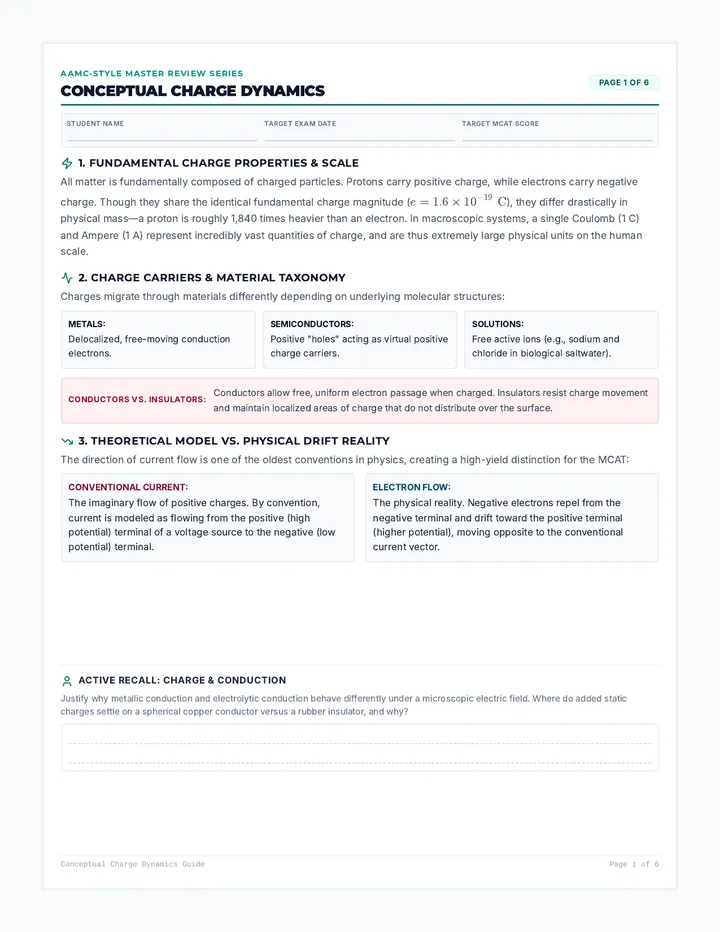
AAMC-Style Master Review Series
Conceptual Charge Dynamics
Page 1 of 6
Student Name
Target Exam Date
Target MCAT Score
1. Fundamental Charge Properties & Scale
All matter is fundamentally composed of charged particles. Protons carry positive charge, while electrons carry negative charge. Though they share the identical fundamental charge magnitude (\(e = 1.6 \times 10^{-19}\text{ C}\)), they differ drastically in physical mass—a proton is roughly 1,840 times heavier than an electron. In macroscopic systems, a single Coulomb (1 C) and Ampere (1 A) represent incredibly vast quantities of charge, and are thus extremely large physical units on the human scale.
2. Charge Carriers & Material Taxonomy
Charges migrate through materials differently depending on underlying molecular structures:
Metals: Delocalized, free-moving conduction electrons.
Semiconductors: Positive "holes" acting as virtual positive charge carriers.
Solutions: Free active ions (e.g., sodium and chloride in biological saltwater).
Conductors vs. Insulators:
Conductors allow free, uniform electron passage when charged. Insulators resist charge movement and maintain localized areas of charge that do not distribute over the surface.
3. Theoretical Model vs. Physical Drift Reality
The direction of current flow is one of the oldest conventions in physics, creating a high-yield distinction for the MCAT:
Conventional Current: The imaginary flow of positive charges. By convention, current is modeled as flowing from the positive (high potential) terminal of a voltage source to the negative (low potential) terminal.
Electron Flow: The physical reality. Negative electrons repel from the negative terminal and drift toward the positive terminal (higher potential), moving opposite to the conventional current vector.
Active Recall: Charge & Conduction
Justify why metallic conduction and electrolytic conduction behave differently under a microscopic electric field. Where do added static charges settle on a spherical copper conductor versus a rubber insulator, and why?
Conceptual Charge Dynamics Guide Page 1 of 6
AAMC-Style Master Review Series
Potential Energy & Field Landscapes
Page 2 of 6
1. Electrostatic Potential Energy Trends
Electric potential energy (\(U\)) represents the total work required to transport a test charge from an infinite distance to a specific location in an electric field. The stability of a system depends on minimizing this energy:
Energy Increases When: Like charges (positive-positive, negative-negative) are forced closer together, or opposite charges are pulled apart. System instability rises as like charges repel.
Energy Decreases When: Opposite charges are pulled closer by attraction, or like charges repel apart naturally. System stability is achieved when potential energy is minimized.
2. Voltage Potential & Spontaneous Directionality
Electric potential (\(V\)), or voltage, is defined as the electrical potential energy *per unit charge* (\(V = U/q\)). Different locations in space around a source charge will have different electric potential values. Spontaneous charge movement is always driven by the thermodynamically favored reduction of system potential energy:
Positive Test Charges: Spontaneously migrate from regions of High Potential → Low Potential to decrease potential energy.
Negative Test Charges: Spontaneously migrate from regions of Low Potential → High Potential to decrease potential energy.
3. Special Cases: Dipole Torque & Translational Immunity
An electric dipole consists of equal and opposite charges separated by a small fixed distance \(d\). When placed inside a uniform external electric field, the dipole behaves as a unique rotational system:
Rotational Alignment (Torque): The field exerts equal and opposite forces on the ends of the dipole, creating a torque that twists the dipole until its dipole moment vector aligns parallel to the external field.
Translational Immunity: Because the opposing forces on the positive and negative ends are equal and point in opposite directions, they cancel. The dipole experiences zero net translational force regardless of its orientation with respect to the electric field vector.
Active Recall: Potential & Work
Explain why no work is performed when moving an electric charge along a circular equipotential path centered around a point charge, while massive work is required to move it radially inward or outward.
Conceptual Charge Dynamics Guide Page 2 of 6
AAMC-Style Master Review Series
Magnetism & Lorentz Dynamics
Page 3 of 6
1. Magnetic Field Origins, Poles & Units
Magnetic fields represent a velocity-dependent phenomenon generated exclusively by charges in motion. Magnetic field lines emerge from the North pole and sink into the South pole. The SI unit is the Tesla (T), where 1 Tesla = 10,000 gauss.
Diamagnetic: Possess no unpaired electrons (fully paired). Slightly repelled by external magnetic fields.
Paramagnetic: Possess some unpaired electrons. Align weakly and temporarily with external fields.
Ferromagnetic: Possess persistent magnetic domains. Align strongly, creating permanent magnets.
2. The Work-Energy Rule & Lorentz Forces
External magnetic fields exert forces on moving point charges. The direction of this force is determined by the Right-Hand Rule and is always perpendicular to velocity:
The Zero-Work Rule: Because the magnetic force vector is always perpendicular to the velocity vector, magnetic fields do exactly zero physical work on a free charge and can never alter its speed.
Centripetal Balance: When a charge enters a magnetic field perpendicularly, the constant perpendicular magnetic force acts as a centripetal force, guiding the charge into uniform circular motion.
The Lorentz Force: The combined force vector representing the sum of both the electrostatic force and the magnetic force acting on a moving body within a dual-field environment.
3. Biological Mirror: MRI & Hemodynamic Ions
MRI Proton Alignment: Water protons carry quantum spin, aligning parallel or antiparallel inside an MRI scanner. Radiofrequency pulses temporarily tilt this alignment; as they relax back into parallel alignment, they release signature energy profiles to map internal soft tissues.
Electromagnetic Flowmeters: Flowing blood contains sodium and chloride ions that experience magnetic forces as they cross external fields. Ions deflect to opposite blood vessel walls, generating voltage proportional to cardiac output.
Active Recall: Magnetic Fields & Work
In your own words, why does a magnetic force fail to perform work or alter the kinetic energy of a moving electron? Contrast this with how an electric field can accelerate an electron and perform work.
Conceptual Charge Dynamics Review Page 3 of 6
AAMC-Style Master Review Series
Circuits, Resistance, & Instrumentation
Page 4 of 6
1. Ohm's Law & Geometric Conductor Scaling
Ohm's Law states current is directly proportional to voltage and inversely proportional to resistance. Resistance represents opposition to charge flow, and is governed entirely by the physical dimensions of the conductor:
Dimensional Proportionalities: Resistance is directly proportional to conductor length (longer paths = more collisions) and resistivity, but inversely proportional to cross-sectional area.
The Area/Diameter Relationship: Conductor cross-sectional area is proportional to diameter squared (\(A \propto d^2\)). Therefore, doubling conductor diameter decreases internal resistance by exactly 4x.
2. Kirchhoff's Laws & Resistor Networks
Circuit networks are governed by conservation principles: Kirchhoff's Junction Rule (conservation of charge) and Loop Rule (conservation of energy):
Series Resistors: Charges pass through all resistors sequentially. Current remains constant throughout the loop. Total equivalent resistance is strictly additive.
Parallel Resistors: Charges choose separate parallel pathways. Voltage remains constant. Equivalent resistance decreases with each added lane; total is smaller than the smallest resistor.
3. MCAT Diagnostic Instrumentation Meters & Units
Medical and physical laboratories utilize distinct diagnostic tools, creating high-yield circuit design constraints:
Ammeters: Inserted in series to measure current. Must possess negligible resistance to avoid dropping potential.
Voltmeters: Inserted in parallel to measure voltage drops. Must possess infinitely large resistance to avoid drawing current.
Ohmmeters: Inserted around a resistive element to measure resistance. They are self-powered and utilize negligible internal resistance.
TIME: SECONDS • CHARGE: COULOMBS • WORK: JOULES
Active Recall: Instrumentation & Safety
A student accidentally places an ammeter in parallel with a high-resistance lamp. Predict the consequences on the ammeter and the circuit, comparing this to voltmeter placement.
Conceptual Charge Dynamics Review Page 4 of 6
AAMC-Style Master Review Series
Advanced Capacitance & Biological Cables
Page 5 of 6
1. ADVANCED CAPACITANCE & DIELECTRICS
Inserting an insulating dielectric always increases capacitance. However, the energy, charge, and voltage response depends on the circuit state:
Connected Battery: Voltage remains constant. Stored charge and total energy both increase as the battery pumps more charge.
Disconnected Battery: Charge remains constant. Voltage and total stored energy both decrease as the electric field is weakened.
2. Ideal EMF vs. Terminal Voltage & Internal Resistance
Ideal voltage sources are modeled as having zero internal resistance, providing a constant electromotive force (emf). However, real batteries possess a small internal resistance (\(r_{int}\)). When current is actively flowing, internal heat loss reduces the output voltage, resulting in a lower supplied terminal voltage. Ground connections define potential zero (0 V).
3. BIOLOGICAL MIRROR: CELLULAR CHARGE SEPARATION
Animal cells utilize lipid bilayers as micro-capacitors. The hydrophobic core acts as a high-resistance insulator. Active ion pumps polarize this boundary, placing excess positive sodium ions outside and leaving a relative negative environment inside to establish a resting potential.
Active Recall: Pathophysiology of Demyelination
In patients with Multiple Sclerosis (MS), autoimmune destruction of myelin occurs. Predict the physical effects on membrane resistance, membrane capacitance, and overall velocity of neuronal signaling.
Conceptual Charge Dynamics Review Page 5 of 6
AAMC-Style Master Review Series
High-Yield Equation Sheet
Page 6 of 6
1. Current Definition
\( I = \frac{Q}{\Delta t} \)
\( I \): Current (Amperes), \( Q \): Charge (Coulombs), \( \Delta t \): Time (Seconds)
2. Ohm's Law
\( V = I \times R \)
\( V \): Voltage (Volts), \( I \): Current, \( R \): Resistance (Ohms)
3. Resistance & Resistivity TEMP SENSITIVE
\( R = \rho \frac{L}{A} \)
\( \rho \): Resistivity, \( L \): Conductor Length, \( A \): Cross-Sectional Area.
Critical Concept: Resistance increases with increasing temperature.
4. Resistor Power Dissipation
\( P = I V = I^2 R = \frac{V^2}{R} \)
\( P \): Power (Watts or Joules/sec) dissipated as non-conservative thermal heat.
5. Capacitance Formula
\( C = \frac{Q}{V} \)
\( C \): Capacitance (Farads), \( Q \): Charge, \( V \): Potential Difference (Volts)
6. Energy Stored by Capacitors
\( U = \frac{1}{2} C V^2 = \frac{1}{2} Q V = \frac{1}{2} \frac{Q^2}{C} \)
\( U \): Stored Electric Potential Energy (Joules) inside dielectric field.
Active Recall: Test-Day Mental Scaling Practice
A cardiac stimulator discharges a capacitor through blood vessels. If the vessel diameter drops to half its value (vasoconstriction) and the temperature rises, explain mathematically how this alters the resistance and power dissipation.
Conceptual Charge Dynamics Review Page 6 of 6