Atomic Charges Bell Work TINY PARTICLES
Formative Assessment • Bell Work
Name:
Date:
1. Label the Atomic Parts
Identify components A, B, and C in the diagram.
- - n + + n + A B C
A Particle:
B Particle:
C Particle:
2. Complete the Particle Matrix
Subatomic Particle Charge (+ / - / 0) Location in Atom Proton Neutron Electron
3. Challenge: Net Charge
An atom has exactly 6 protons, 6 neutrons, and 6 electrons.
Overall Net Charge:
Brief Explanation:
CUT ALONG DOTTED LINE TO DIVIDE TICKETS
TINY PARTICLES
Formative Assessment • Bell Work
Name:
Date:
1. Label the Atomic Parts
Identify components A, B, and C in the diagram.
- - n + + n + A B C
A Particle:
B Particle:
C Particle:
2. Complete the Particle Matrix
Subatomic Particle Charge (+ / - / 0) Location in Atom Proton Neutron Electron
3. Challenge: Net Charge
An atom has exactly 6 protons, 6 neutrons, and 6 electrons.
Overall Net Charge:
Brief Explanation:
Atomic Charges Answer Key TINY PARTICLES (ANSWER KEY)
Teacher Reference • Formative Assessment Key
Class Average:
Subject: Physical Sci / Chemistry
1. Label the Atomic Parts
Identify components A, B, and C in the diagram.
- - n + + n + A B C
A Particle: Electron
B Particle: Proton
C Particle: Neutron
2. Complete the Particle Matrix
Subatomic Particle Charge (+ / - / 0) Location in Atom Proton + (Positive) Inside Nucleus Neutron 0 (Neutral) Inside Nucleus Electron - (Negative) Outside Nucleus
3. Challenge: Net Charge
An atom has exactly 6 protons, 6 neutrons, and 6 electrons.
Overall Net Charge: Neutral (0 / No Net Charge)
Brief Explanation: Protons (+6) and electrons (-6) perfectly balance.
TEACHER INSTRUCTIONAL COMPANION
Pedagogical Guide & Assessment Rubric
Total Points: 11
Common Misconceptions
Neutral vs. Negative: Students often conflate "Neutron" (Neutral, 0) with "Negative" because they share physical phonics. Reinforce: Neutr-on = Neutr-al, whereas Electron = Negative.Proton Location: Some believe protons orbit the nucleus since electrons "sit" still. Stress that the dense core is home to protons/neutrons, which carry 99.9% of the mass.Neutron Mass: Students occasionally believe neutrons have no mass because they have no charge. Reinforce that protons and neutrons have virtually identical massive weight.
Classroom Warm-up Hack
Before cutting, have students snap fingers for positive charge (protons), clasp hands for neutral (neutrons), and wave arms in a circle for orbiting negative electrons. This muscle memory primes them perfectly for this bell work.
Point Breakdown & Rubric
Task Criteria Points 1. Labels A=Electron, B=Proton, C=Neutron. (1 pt each) / 3 pts 2. Matrix Correct charge (+, 0, -) and location (inside/outside nucleus). (1 pt per row item) / 6 pts 3. Challenge Identifies "Neutral/0" (1 pt) and explains positive balances negative (1 pt). / 2 pts
Remedial Quick Action (< 7 Pts)
Students struggling with charge identification should draw a large + on a index card and a - on another. Call out "electron" or "proton" and have them hold up the matching card to build immediate visual recall.
Atomic Architecture Slides PHYSICAL SCIENCE WARM-UP
ATOMIC ARCHITECTURE
A quick diagnostic review of protons, neutrons, electrons, and the balances of electrical charge.
Let's build a foundation.
Get ready to launch
THE ATOMIC NUCLEUS
CORE MASS
Protons (Positive)
Carry a +1 charge. Reside in the dense central core and determine the element's identity.
0
Neutrons (Neutral)
Carry zero charge. Act as nuclear "glue" to hold positive protons together inside the core.
N + N + N
Protons & Neutrons together are called nucleons .
Slide 2 of 4
THE ELECTRON CLOUD
OUTER SHELLS
NUCLEUS - -
-
Electrons (Negative)
Carry a -1 charge. Whiz around outside the nucleus inside custom tracks (energy levels).
Massless Specters
Practically zero weight! It takes over 1,800 electrons to match the mass of just one single proton.
Electrons fly at roughly 1% of the speed of light .
Slide 3 of 4
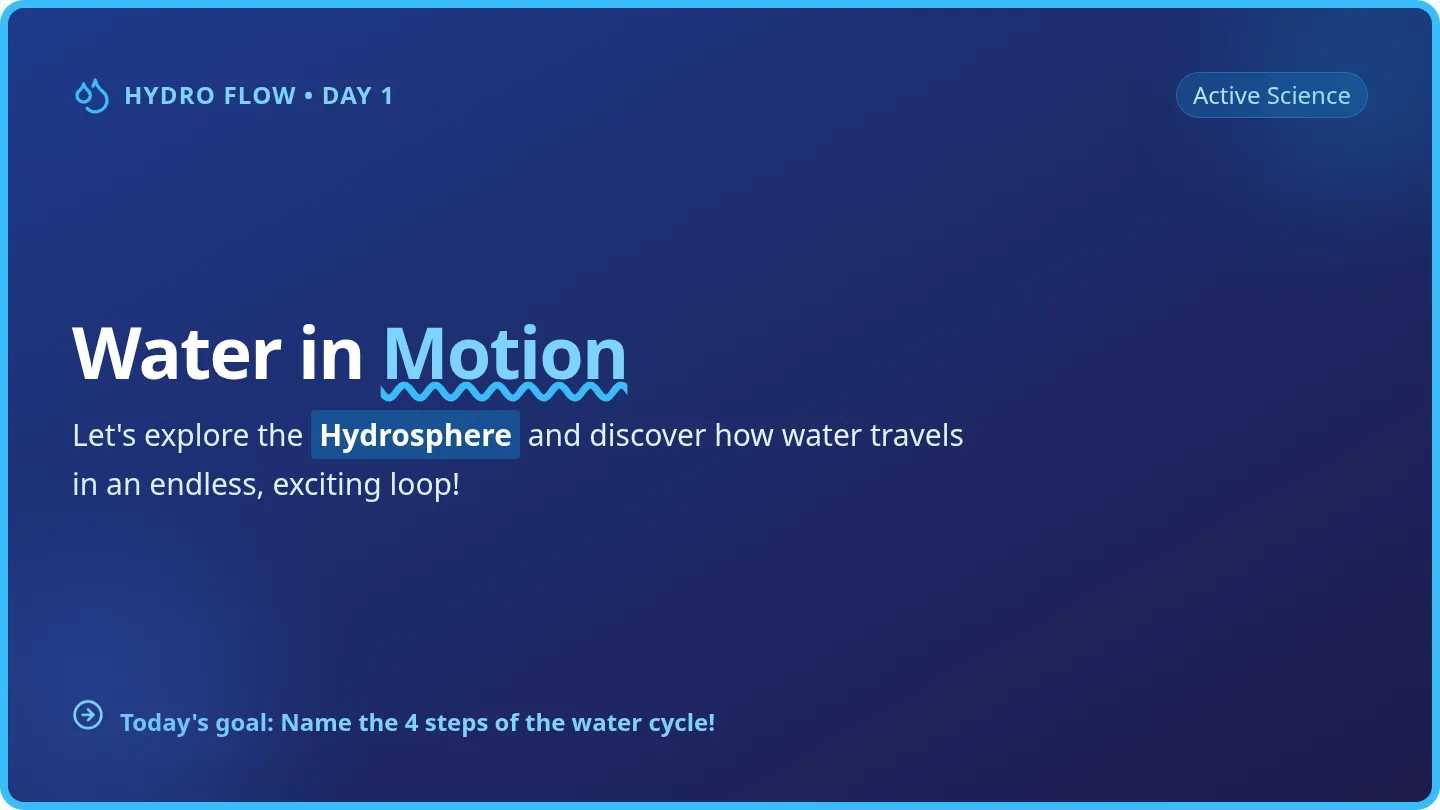
ELECTRICAL BALANCE
NET CHARGES
PROTONS
+6
Positive Charges
NET CHARGE: 0
Neutral Atom
ELECTRONS
-6
Negative Charges
Quick Test Challenge:
If an atom gains an extra electron (6 Protons, 7 Electrons), what is the new net charge? (-1 charge / Anion)
When protons and electrons balance out perfectly, the atom is neutral .
Slide 4 of 4