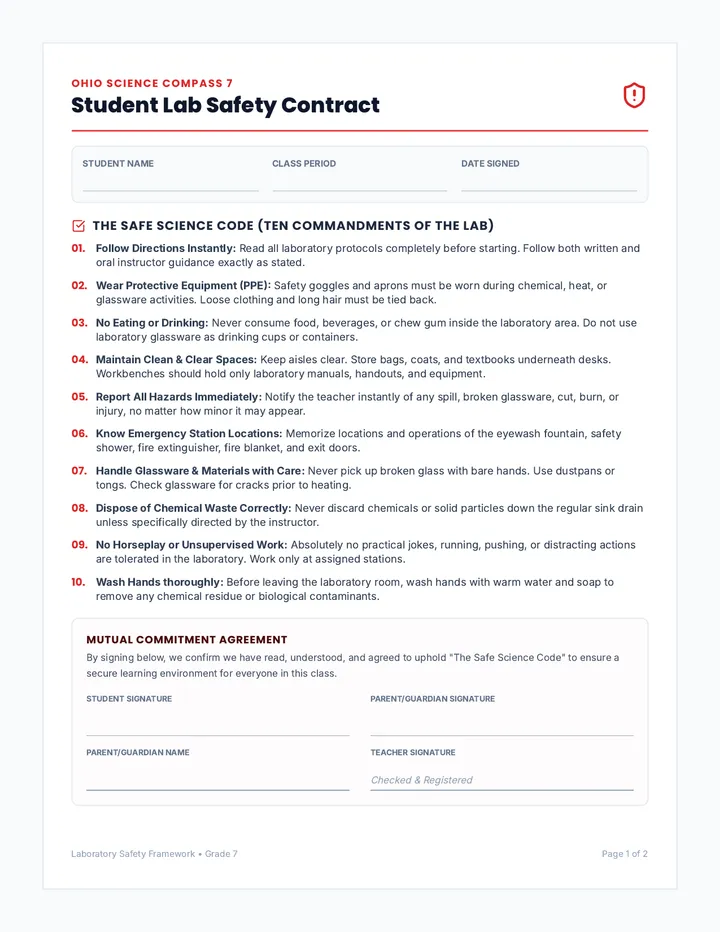
A fast-paced, movement-based 45-minute lesson where students master laboratory cleanliness, floor hazard prevention, glassware safety, and eye wash response. Through hands-on station scenarios, a formal safety charter/quiz, and a collaborative escape puzzle, students become certified safety responders.
A classmate carrying a hot flask of water trips over an oversized backpack protruding into the main center aisle. The flask shatters, splashing scalding fluid onto a partner who was sitting on an un-tucked stool.
CORRECT ACTIONS & ADVANCED DUO ANALYSIS:
Egress Metric: OSHA and fire codes require a minimum clear width of 36 inches (3 feet) for lab pathways to allow safe, simultaneous double-lane emergency evacuations.
All backpacks and jackets must be completely stowed under tables or in designated cubbies—never left on the floor.
Stools must be pushed fully under the counter when standing to prevent blind-side tripping.
STATION POSTING SHEETS • FOR TACTICAL DUOS
STATION 3
SPILL CHEMISTRY & DESK BOUNDS
REF: HAZARD SEC-C
SCENARIO: Table Edge Cascade
Your lab table is crowded with papers, pencil cases, and chemical tubes. An open tube of acidic solution is placed exactly on the outer 2 inches of the table. A sudden hand gesture knocks the tube off, splashing chemical liquid.
CORRECT ACTIONS & ADVANCED DUO ANALYSIS:
Table Boundary Rule: Keep all chemical containers and glass at least 6 inches away from any table edge to prevent accidental elbow-knocks.
For plain water spills, wipe up immediately with paper towels to prevent slippery surfaces.
For chemical or acid spills: do not touch or wipe. Alert the teacher immediately. They will use a specialized chemical neutralizer kit (sodium bicarbonate for acids) to prevent toxic fumes.
STATION 4
EYE PROTECTION & FLUSHING THERAPEUTICS
REF: HAZARD SEC-D
SCENARIO: Goggles Around Neck
During an active heating reaction, an unexpected boil-over ejects corrosive droplets toward your face. Your safety goggles were hanging around your neck or forehead because "they fogged up."
CORRECT ACTIONS & ADVANCED DUO ANALYSIS:
Goggles must be securely sealed over your eyes at all times during active labs. Forehead/neck placement provides zero splash protection.
Physiological Flush Rule: If splashed, instantly alert your partner and use the eyewash. Eyelids must be held open wide.
Flush continuously for 15 to 20 minutes. Chemicals absorb rapidly into eye tissue; long flushing is biologically required to dilute the chemical deep within the conjunctival sac.
C The glass will undergo complete sublimation directly into a toxic white vapour.
Q2. To comply with egress safety regulations during emergency evacuations, lab aisles must maintain:
A At least 12 inches of width by storing backpacks horizontally on the center line.
B A minimum of 36 inches (3 feet) of clear width by stowing all backpacks and stools.
C No width restrictions, provided stools can be folded or stacked on counter rims.
Q3. If a concentrated acid spill occurs on the lab bench, why is alerting the teacher preferred over instant wiping?
A Wiping immediately is highly flammable and triggers immediate electrical table fires.
B Water dilution of acids is endothermic, creating thick freezing crystalline blockages.
C Acids react with paper towels and skin; they require specific chemical neutralizing agents.
Q4. What is the spatial "Table Edge Safety Boundary" and why do we implement it in active laboratories?
A Keeping vessels 6 inches from the table edge to prevent accidental bumps and drops.
B Keeping glassware 1 inch from edges so that steam can circulate into ceiling ducts.
C Arranging all cables along table edges to guarantee ground-level electrical loops.
Q5. Why must chemical splashes in the eye be flushed for a full, continuous 15-20 minutes?
A The physical water pressure takes exactly 20 minutes to reactivate cornea pigments.
B Chemicals diffuse deep into ocular tissues; prolonged irrigation is needed to dilute them.
C It allows the eyewash internal computer system to register a full safety evacuation.
D Water absorbs atmospheric nitrogen over 15 minutes, which acts as a sterile bandage.
To disarm bypass vent B, you must match each laboratory spill or hazardous waste item to its correct, scientifically-mandated containment receptacle or protocol.
Item 1: Cracked Glass Beaker Unused but structurally fragile.
[ _ ]
Item 2: Saturated Solvent Towels Towels used for flammable spills.
[ _ ]
Item 3: Concentrated Acid Floor Spill Severe corrosive floor pooling.
Dispose inside heavy Chemical / Biohazard Waste Bin.
B
Dispose inside green and white Glass Disposal box.
C
Dispose inside standard classroom wastebasket.
D
Clear area instantly; teacher treats with specialized chemical powder.
MASTER ESCAPE OVERRIDE PANEL
Transcribe your final decoded values below to form the master system bypass string. Check your safety procedures carefully—any mismatch will trigger safety lockdown alerts!
Key 1 (Transit Word Problem)
[ ____ ]
Key 2 (Pathway Exit)
[ ____ ]
Key 3 (Disposal Match)
[ ____ ]
MASTER SYSTEM OVERRIDE BYPASS:
___ - ___ - _____
STATUS: Puzzles 1-3 complete SYSTEM STAGE OVERRIDE UNLOCKED