Lenny.com
Explore
Create
ActivitiesNewMathEnglish Language ArtsScience & EngineeringSocial StudiesGlobal LanguagesHealth & Physical EducationSpecial EducationCounseling & Life SkillsArts & CreativityESL
Lenny.com
Lenny.com
Explore
Create
ActivitiesNewMathEnglish Language ArtsScience & EngineeringSocial StudiesGlobal LanguagesHealth & Physical EducationSpecial EducationCounseling & Life SkillsArts & CreativityESL
Lenny.com
Lenny.com

Solutions

Lenny for EducatorsLenny for SchoolsLenny for Districts

Product

ExploreSign inCreateSupportAbout

Resources

Getting startedMTSS Acceleration Program

Newsletters

School Funding Newsletter

© 2026 Lenny Learning Inc.

TermsPrivacyAccessibility
LinkedInInstagramX
Lenny

Nuclear Physics

Atomic structure, radioactive decay processes, and the binding energy of nuclei. Examines nuclear fission, fusion, and their applications in energy production and medicine.

Science & EngineeringLife ScienceLiving ThingsAnimalsPlantsBody SystemsTraitsAdaptationsCellsEcosystemsHeredityGenes to TraitsCell DivisionPhysicsComparing MaterialsShapes and PropertiesMagnetsMagnetismLightSoundLight and SoundMatterStates of MatterChanges of StateMixturesPhysical and Chemical ChangeHeating and CoolingHeat and Thermal EnergyEnergyForce and MotionElectrical CircuitsAtoms and MoleculesPeriodic TableMotion in One DimensionMotion in Two DimensionsScalars and VectorsForces and Laws of MotionCircular Motion and GravityMomentum and ImpulseWork, Energy, and PowerWavesElectromagnetic WavesGeometric OpticsElectricity and MagnetismSimple Harmonic MotionThermodynamicsNuclear PhysicsEarth Science & AstronomyWeatherWater CycleRocks and MineralsFossilsEarth's FeaturesEarth's ResourcesEarth's StructureWeather and ClimateEarth EventsFossils and Geologic TimePlate TectonicsHuman ImpactsAstronomyChemistryUnits and MeasurementAtomic StructurePeriodic TrendsChemical BondingNomenclatureMolecular StructureIntermolecular ForcesThe MoleStoichiometryProperties of GasesSolutionsChemical ReactionsBalancing EquationsEnergy ChangesRates of ReactionsEquilibriumAcids and BasesQuantum ModelBiologyClassificationCell StructureThe Chemistry of LifeBiomoleculesCellular TransportCell EnergyCell Growth and DivisionDNAProtein SynthesisMeiosis and Sexual ReproductionPatterns of InheritanceMulticellular OrganismsEvolutionEcologyBiodiversityComputer ScienceAlgorithms and Computational ThinkingProgramming LanguagesComputing SystemsNetworks and InternetData AnalysisCybersecurityAI and Machine LearningSoftware Design and DevelopmentBlockchainEngineering & AIDesigning ExperimentsEngineering PracticesDesign ThinkingEngineering Design ProcessMechanical EngineeringElectrical EngineeringMaterials and StructuresCAD and 3D DesignRoboticsArtificial Intelligence BasicsVibe CodingMachine LearningAI Ethics and SocietySystems ThinkingEntrepreneurship & InnovationEntrepreneurial MindsetBusiness Idea DevelopmentBusiness Plan BasicsMarketing & Customer DiscoveryFinancial Management for Startups

Videos

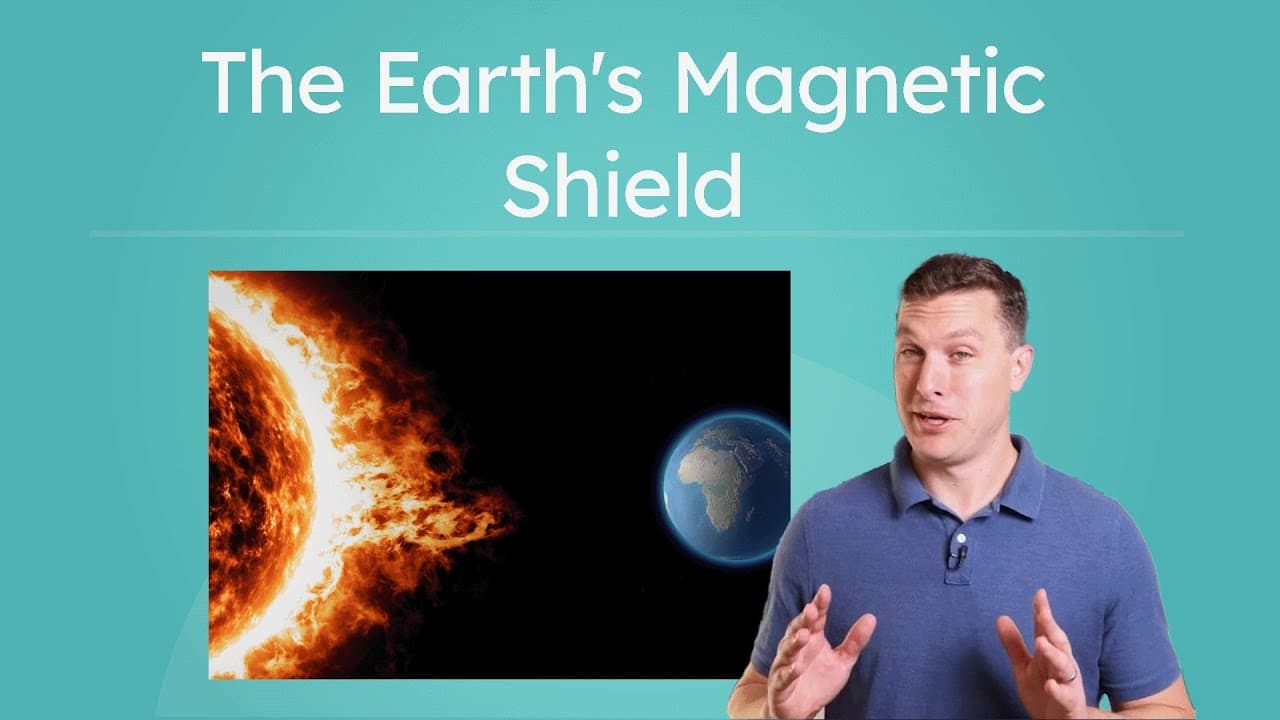
Earth's Magnetic Shield and the Right-Hand Rule

Earth's Magnetic Shield and the Right-Hand Rule

This educational video explores the critical role of Earth's magnetic field in protecting our planet from harmful solar radiation and introduces the physics concept of the Right-Hand Rule. The lesson begins by visualizing the sun as a massive nuclear reactor and explains how Earth's magnetic shield deflects solar wind, creating phenomena like the Aurora Borealis while preventing the radiation damage seen on barren worlds like the Moon and Mars. The second half of the video transitions into a practical physics tutorial on electromagnetism. It breaks down how magnetic fields exert force on moving charges and teaches students how to use the Right-Hand Rule to determine the direction of that force. The presenter uses clear, step-by-step examples with on-screen graphics to demonstrate how to position fingers to represent charge, field, and force vectors. For educators, this video serves as a bridge between Earth science and physics concepts. It provides a real-world application for abstract electromagnetic principles, making it an excellent resource for high school physics units on magnetism or earth science units on planetary habitability. The visual demonstrations of 3D spatial reasoning (using the hand) are particularly helpful for students who struggle with vector directions.

Miacademy & MiaPrep Learning ChannelMiacademy & MiaPrep Learning Channel

7mins 57s

Understanding the Strange World of Quantum Mechanics

Understanding the Strange World of Quantum Mechanics

This engaging video introduces students to the fundamental and often counterintuitive principles of quantum mechanics. Through clear narration and helpful analogies, it breaks down complex topics such as wave-particle duality, the observer effect, the Heisenberg Uncertainty Principle, and energy quantization. The video uses visual demonstrations, like the double-slit experiment and car speedometer analogies, to make these abstract concepts accessible to high school students. Key themes include the strange behavior of subatomic particles, the difference between continuous and quantized energy, and how observation fundamentally alters quantum systems. The video also explores practical applications of these theories, explaining how quantum mechanics allows us to determine the composition of stars through spectroscopy, improves television displays with Quantum Dots (QLED), and powers the future of quantum computing. Ideally suited for high school physics and chemistry classrooms, this video bridges the gap between theoretical science and real-world technology. It provides a solid conceptual foundation for understanding atomic structure and modern technology, making it an excellent resource for introducing a unit on modern physics or electron configurations.

Miacademy & MiaPrep Learning ChannelMiacademy & MiaPrep Learning Channel

10mins 18s

From Nebula to White Dwarf: The Life Cycle of a Star

From Nebula to White Dwarf: The Life Cycle of a Star

This educational video takes students on a cosmic journey through the life cycle of an average-sized star, similar to our own Sun. It begins by explaining the birth of stars within stellar nebulas, detailing how gravity pulls gas and dust together to form protostars. The narrator simplifies complex astrophysical concepts, such as nuclear fusion, using clear animations to show how hydrogen atoms fuse into helium to release the immense energy that powers stars. Key themes include the transformation of matter and energy, the influence of gravity in space, and the stages of stellar evolution. The video explicitly differentiates between average-sized stars and massive stars, focusing on the specific path of average stars as they evolve from main sequence stars into expanding red giants. It concludes by describing the final stages of death for these stars: the shedding of outer layers to form planetary nebulas and the cooling of the core into a white dwarf. This resource is highly valuable for middle school science classrooms as it breaks down abstract space concepts into digestible stages. The clear definitions, visual diagrams of atomic fusion, and step-by-step lifecycle flowcharts make it an excellent tool for visual learners. Teachers can use this video to introduce units on astronomy, matter and energy, or the history of the universe, providing a solid foundation for understanding the life expectancy and eventual fate of our own solar system.

Miacademy & MiaPrep Learning ChannelMiacademy & MiaPrep Learning Channel

7mins 46s

Introduction to Modern Physics: Quantum Mechanics and Relativity

Introduction to Modern Physics: Quantum Mechanics and Relativity

This video serves as an engaging introduction to the transition from Classical Physics to Modern Physics, covering the major scientific shifts that occurred in the early 20th century. It begins by contrasting pre-1900s physics (electricity and magnetism) with the revolutionary discoveries that followed, specifically addressing the limitations of classical theories in explaining phenomena like the nature of light. The instructor uses historical anecdotes, such as Max Planck's advisor advising him against studying physics, to highlight how drastically the scientific landscape changed. The content explores three pillars of Modern Physics: Quantum Mechanics, Special Relativity, and General Relativity. It breaks down complex concepts using accessible animations and analogies, explaining the Photoelectric Effect (wave-particle duality), the Michelson-Morley experiment (disproving the luminiferous aether), and the counter-intuitive nature of time dilation. The video also touches upon the Big Bang theory as an application of General Relativity to cosmology. For educators, this video is an excellent conceptual overview that bridges the gap between standard mechanics and advanced theoretical physics. It provides a narrative structure to physics history, making it ideal for introducing a unit on modern physics or light. The included true/false assessment at the end offers immediate checking for understanding, while the clear visualizations of electromagnetic waves and the twin paradox help demystify abstract ideas for high school students.

Miacademy & MiaPrep Learning ChannelMiacademy & MiaPrep Learning Channel

9mins 17s

The Building Blocks of Matter: Exploring Particle Physics

The Building Blocks of Matter: Exploring Particle Physics

This educational video provides a comprehensive introduction to particle physics, delving deeper than the standard model of protons, neutrons, and electrons to explore the fundamental building blocks of the universe. The narrator guides viewers through the "particle zoo," explaining how protons and neutrons are actually composite particles made of quarks, while electrons belong to a different family called leptons. The video clarifies the distinction between fermions (matter builders) and bosons (force carriers), offering clear analogies to explain how forces operate at the subatomic level. Key themes include the structure of the atom, the Standard Model of elementary particles, and the four fundamental forces of nature: electromagnetic, strong nuclear, weak nuclear, and gravitational. The video breaks down complex concepts like fractional charges in quarks, the pairing of leptons with neutrinos, and the role of particle accelerators in discovering new particles like the Higgs boson. It also addresses current gaps in scientific knowledge, such as the hypothetical nature of the graviton. For educators, this video serves as an excellent bridge between basic chemistry/physics concepts and advanced modern physics. It uses clear graphics and simple math (adding fractions for quark charges) to demystify abstract concepts. The content is valuable for high school physics and chemistry classrooms to deepen students' understanding of matter, introduce the concept of fundamental forces, and spark interest in contemporary scientific research.
Miacademy & MiaPrep Learning ChannelMiacademy & MiaPrep Learning Channel

12mins 40s

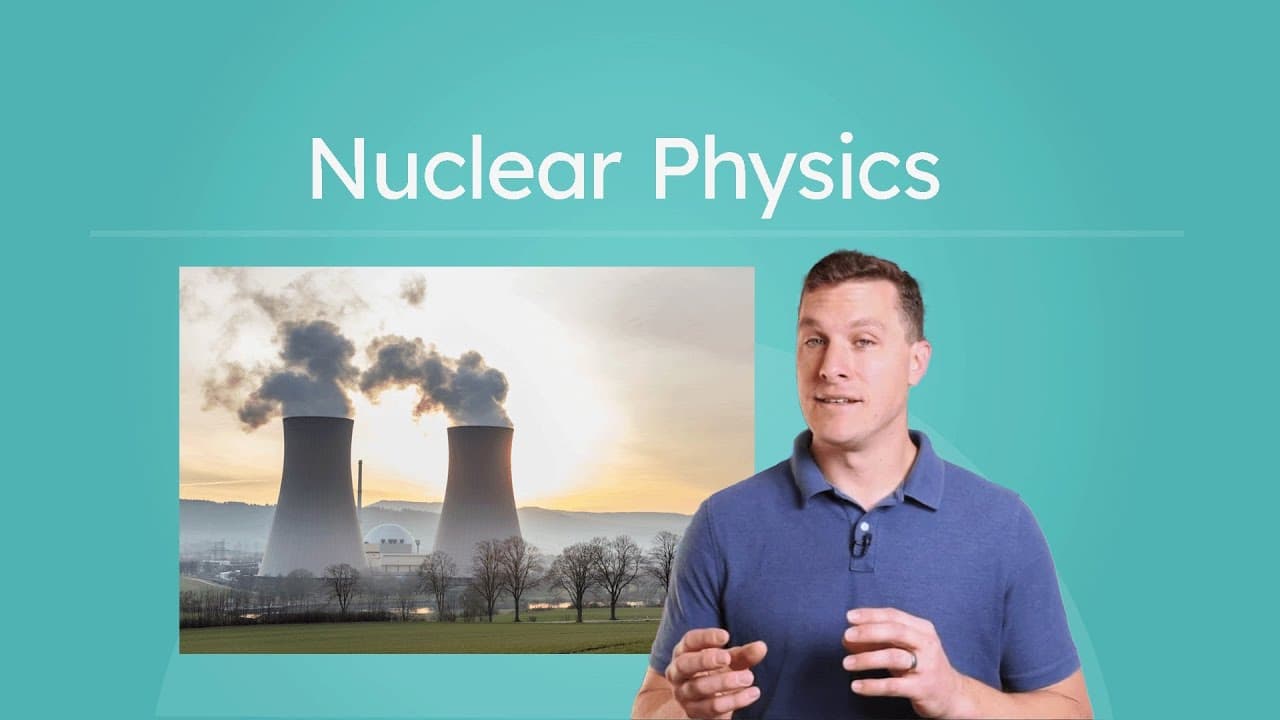
How Nuclear Physics Works: Fission, Fusion, and Energy

How Nuclear Physics Works: Fission, Fusion, and Energy

This educational video provides a clear and accessible introduction to the fundamentals of nuclear physics, explaining the mechanisms behind the sun's energy, nuclear power, and atomic weapons. The lesson begins by distinguishing nuclear reactions from chemical burning, debunking the misconception that the sun "burns" like a fire. It breaks down atomic structure to explain the opposing forces within a nucleus: the electromagnetic force pushing protons apart and the strong nuclear force holding them together.

Miacademy & MiaPrep Learning ChannelMiacademy & MiaPrep Learning Channel

7mins 27s

Materials

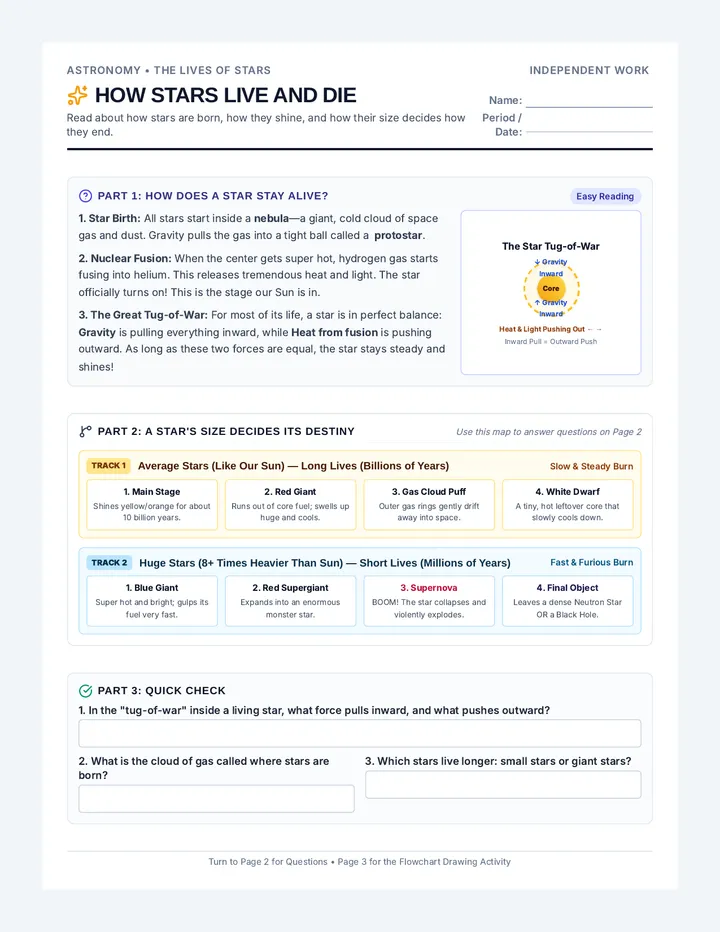
Cosmic Lifelines Worksheet

Cosmic Lifelines Worksheet

A student-friendly three-page astronomy worksheet on star life cycles, featuring accessible reading passages, an intuitive balance diagram, scaffolded questions, mystery star cases, and an open blank flowchart drawing canvas on Page 3 for students to draw both star paths.

M

Megan.Tanner

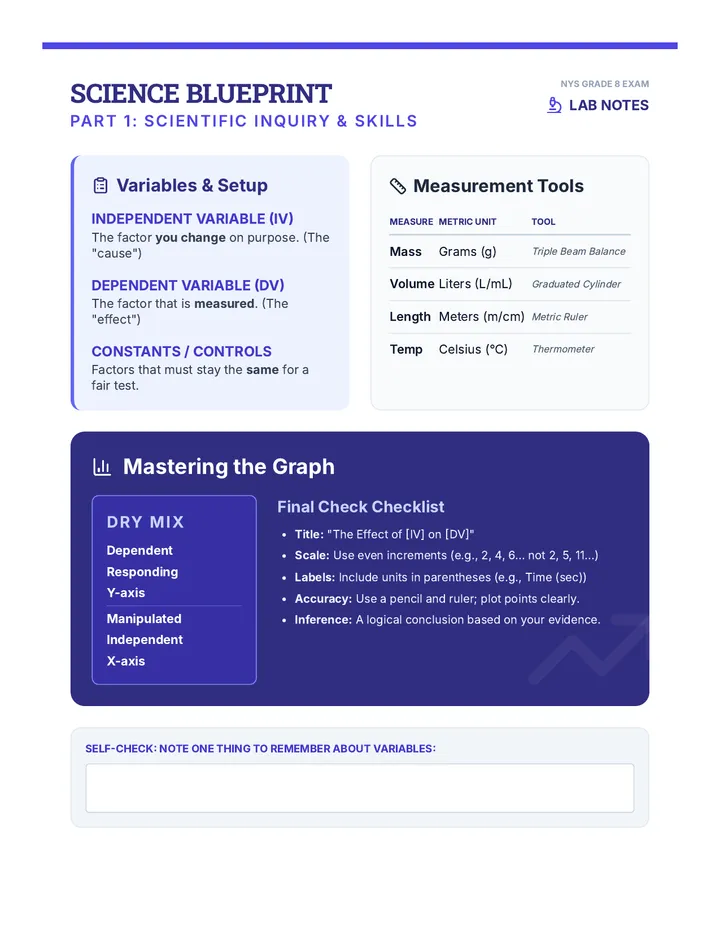
NYS Science Power Pack Study Guide

NYS Science Power Pack Study Guide

A fully optimized 4-page science study guide for the 8th-grade NYS science exam, featuring tight layout, fixed character encoding for chemical formulas with <sub> tags, improved student self-check areas, and clear domain summaries.

AW

Austin WIllis

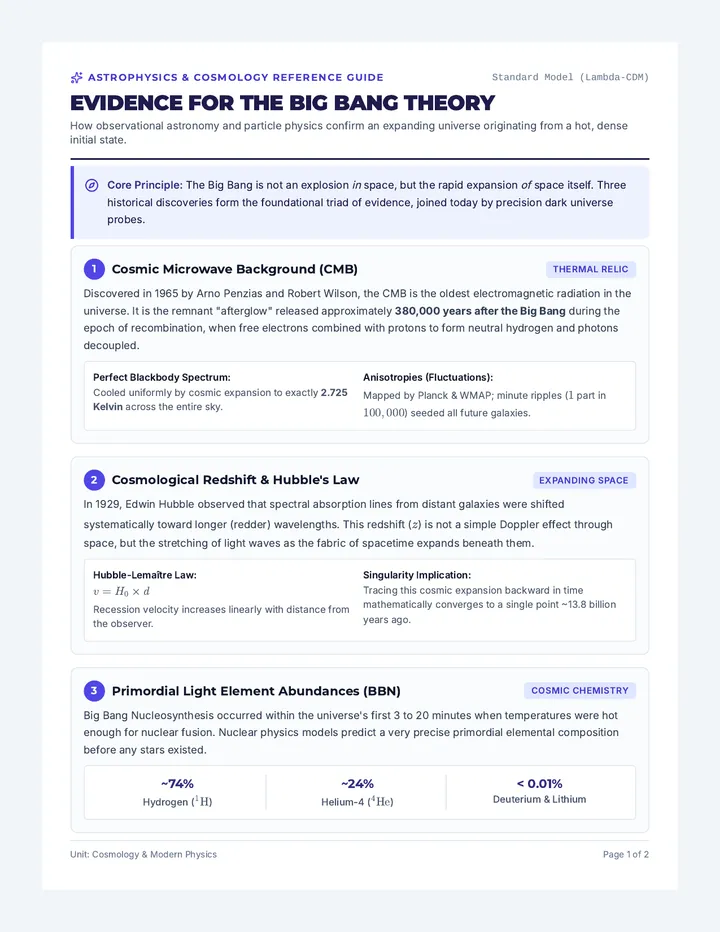
Big Bang Evidence Guide

Big Bang Evidence Guide

A comprehensive two-page scientific reference and study guide on the empirical evidence supporting the Big Bang Theory and the modern Dark Universe framework, including the Cosmic Microwave Background, cosmological redshift, primordial element abundance, dark matter, and dark energy.

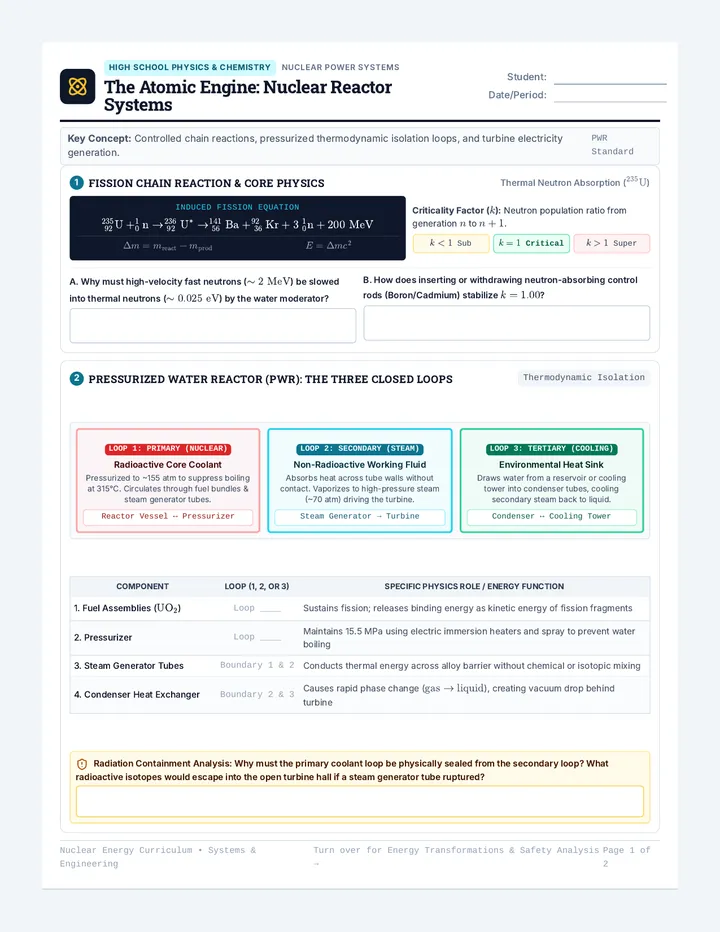
Atomic Engine Worksheet

Atomic Engine Worksheet

A comprehensive two-page high school physics and chemistry worksheet exploring nuclear reactor operations, detailing fission chain reactions, the three closed thermal cooling loops, and turbine-driven electrical generation with diagram analysis, energy transfer tracing, and engineering scenario questions.

Sequences

Mission Scoring Rubric

Physics Frontiers Research Project

A partner-based research project for 9th-grade conceptual physics students focusing on diverse topics from celestial mechanics to the physics of dance. Students move through a structured research process with mandatory teacher checkpoints for source reliability.

C

ckroeker

13
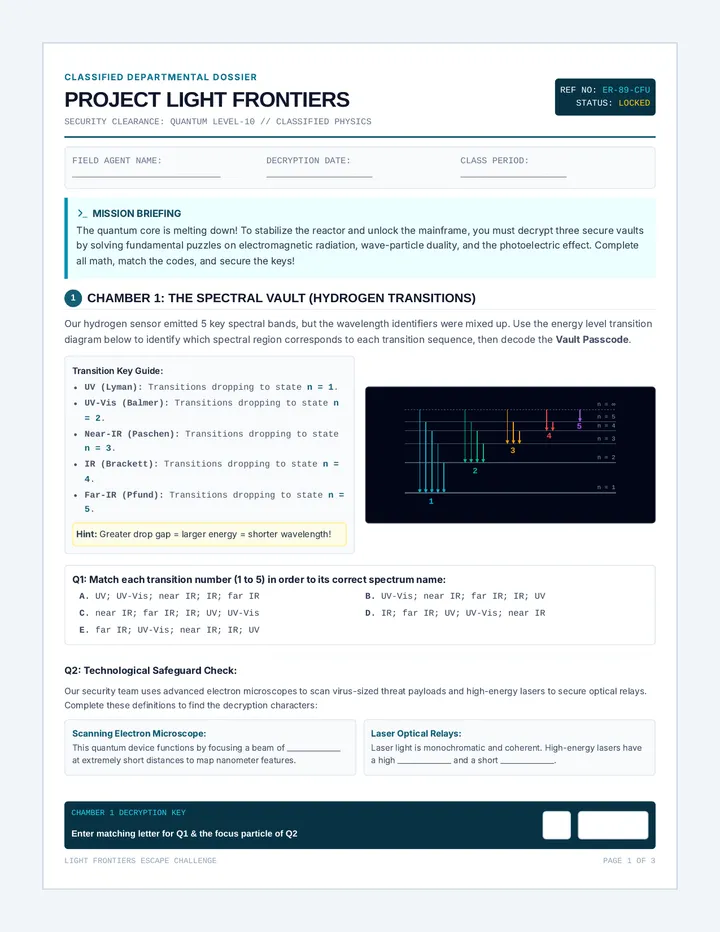
Quantum Escape Room Worksheet

Light Frontiers

A comprehensive physics sequence exploring the dual nature of light, the electromagnetic spectrum, and the interactions of radiation with matter, including the photoelectric effect and polarization.

OM

Olutoyin Makinde

18
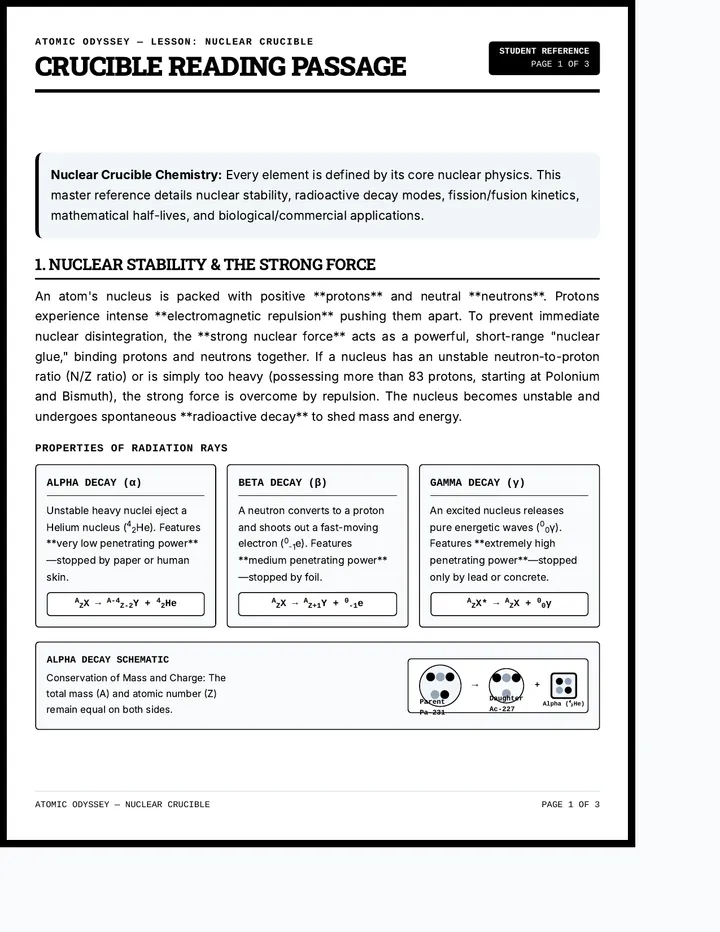
Crucible Reading Passage

Atomic Odyssey

A comprehensive, highly engaging chemistry exploration of nuclear processes, including radioactive decay, nuclear stability, fission, fusion, half-life calculations, and modern nuclear technologies. Studentsrotate through four interactive stations to master atomic chemistry.

OM

Olutoyin Makinde

7
Stellar Dawn Slides

Cosmic Stellar Journeys

A multi-day, scaffolded astronomy sequence designed for special education students exploring how stars are born, live, and transform. The sequence uses chunked text, visual anchor cards, and step-by-step comprehension checks to connect stellar life cycles with cosmic matter.

S

Shelby.Toll

6
TSIA2 Prep Tracker Handout

TSIA2 Science Daily Prep

A comprehensive 20-day daily practice sequence designed to prepare students for the TSIA2 Math and ELAR assessments. Each day features high school science-themed questions with detailed explanations, hints, and a robust tracking system.

P

psreed75

5
Artemis Launch Slides

Lunar Legacy

A two-part educational series exploring the Artemis II mission with a focus on how space research drives technological innovation for Earth and expands our scientific understanding of the Moon.

KJ

Katia Jones

11

Lessons

Atomic Archives Guided Notes

Atomic Archives

A comprehensive lesson connecting nuclear chemistry (isotopes) to climate science (greenhouse gases, ice cores, and carbon dating). Students explore how atomic mass influences molecular vibrations and how isotope ratios serve as ancient thermometers.

CB

Chloe Brown

4
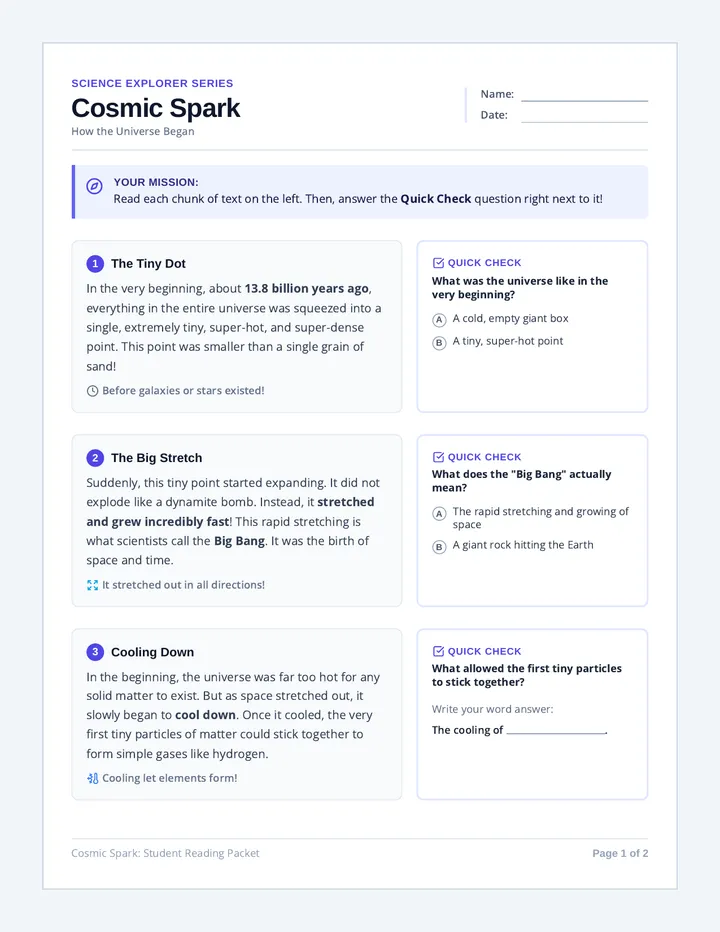
Cosmic Spark Reading

Cosmic Spark

A scaffolded science lesson introducing the Big Bang Theory. Designed with chunked text, visual cues, and immediate comprehension checks to support special education students in understanding the origin and expansion of our universe.

S

Shelby.Toll

5
Physics Final Study Guide Packet

Conceptual Physics Final Prep

A comprehensive 3-page study guide covering Radioactive Decay, Geophysics, Waves, and Momentum for a 9th grade Conceptual Physics final exam.

C

ckroeker

3
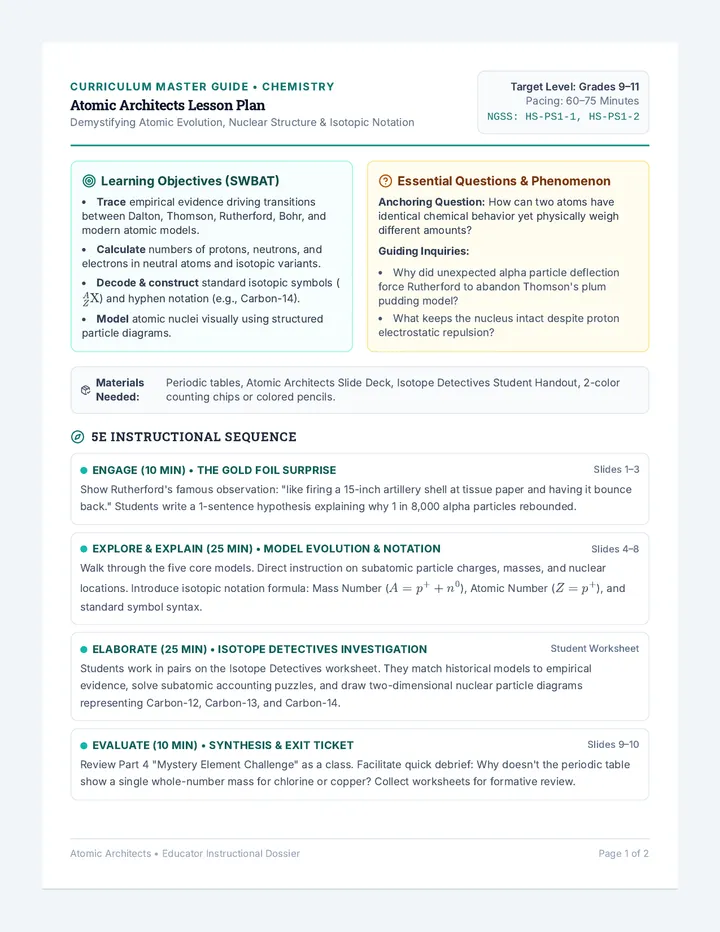
Atomic Architects Lesson Plan

Atomic Architects

A comprehensive chemistry lesson exploring the evolution of atomic models, subatomic particle accounting, isotope notation, and nuclear diagrams. Students investigate historical experiments from Thomson to Rutherford, master isotope notation drills, and solve quantitative atomic mass problems.

CB

Chloe Brown

9
Ice Pulse Slides

Ice Pulse

A high school lesson exploring the relationship between deuterium isotopes in ice cores and historical greenhouse gas levels to reconstruct past climates. Students analyze isotopic data to understand how scientists decode Earth's climate history from the deep freeze.

CB

Chloe Brown

5
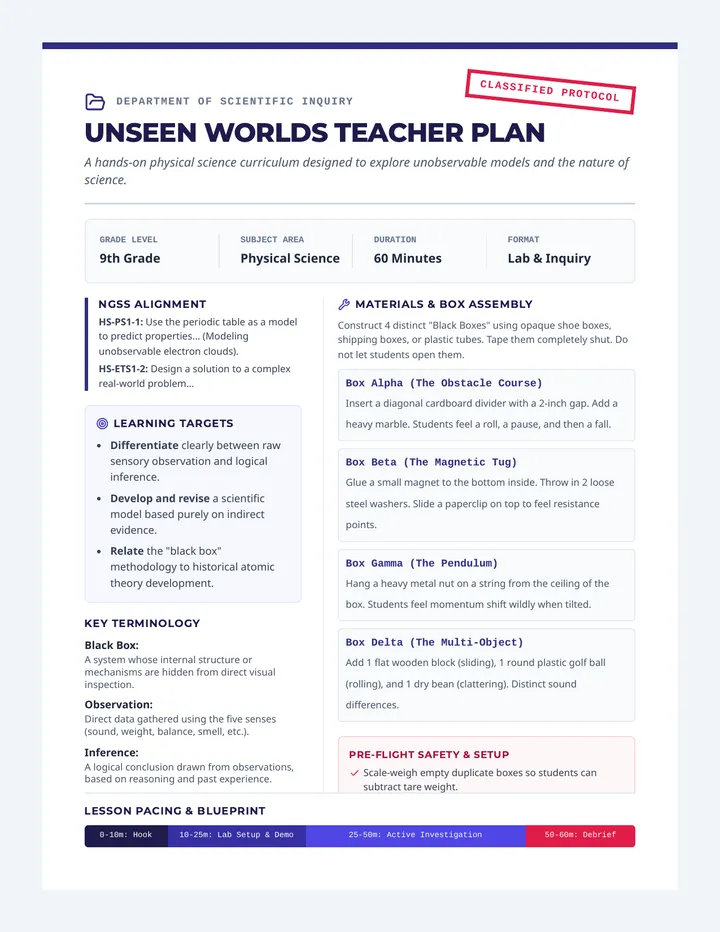
Unseen Worlds Teacher Plan

Black Box Mystery

An inquiry-based science lesson where 9th-grade students investigate sealed "black boxes" to develop observation, inference, and modeling skills. Students learn how scientists study unobservable phenomena like atomic structure, dark matter, and deep ocean floors without direct visual access.

CR

Christy Rougeau

4