Lenny.com
Explore
Create
ActivitiesNewMathEnglish Language ArtsScience & EngineeringSocial StudiesGlobal LanguagesHealth & Physical EducationSpecial EducationCounseling & Life SkillsArts & CreativityESL
Lenny.com
Lenny.com
Explore
Create
ActivitiesNewMathEnglish Language ArtsScience & EngineeringSocial StudiesGlobal LanguagesHealth & Physical EducationSpecial EducationCounseling & Life SkillsArts & CreativityESL
Lenny.com
Lenny.com

Solutions

Lenny for EducatorsLenny for SchoolsLenny for Districts

Product

ExploreSign inCreateSupportAbout

Resources

Getting startedMTSS Acceleration Program

Newsletters

School Funding Newsletter

© 2026 Lenny Learning Inc.

TermsPrivacyAccessibility
LinkedInInstagramX
Lenny

Inference And Theme

Textual analysis techniques for identifying underlying messages and drawing logical conclusions from implicit details. Connects textual evidence to universal life lessons and central motifs.

English Language ArtsPhonics & Reading FoundationsLetter IdentificationLearn Letters A-ZLowercase and Uppercase LettersConsonants and VowelsLetter-Sound AssociationsLetter-Sound Associations: LowercaseLetter-Sound Associations: UppercaseBeginning and Ending SoundsRhymingBlending And SegmentingShort VowelsShort Vowel SoundsConsonant BlendsConsonant DigraphsBlends, Digraphs, and TrigraphsDigraphs, Blends, and Silent LettersLong Vowel SoundsLong Vowel PatternsShort and Long VowelsShort and Long Vowel PatternsSilent EVowel SoundsVowel TeamsR-Controlled VowelsDiphthongs: Oi, Oy, Ou, OwVariant VowelsVariant, Diphthong, And R Vowel PatternsSoft G And CSight WordsIrregular WordsWord RecognitionSyllablesSyllable TypesTwo-Syllable WordsMultisyllabic WordsPhoneme ManipulationDecodable TextsVocabularyAction WordsQuestion WordsNouns and AdjectivesClassify WordsCompound WordsSynonyms and AntonymsHomophonesHomophones and HomonymsShades of MeaningContext CluesPrefixes and SuffixesGreek and Latin RootsAnalogiesIdioms and AdagesForeign Words and ExpressionsWord Choice and UsageReference SkillsReading ComprehensionRead-Along Literary TextsRead-Along Informational TextsReality vs. FictionStory ElementsCharacterSequenceMain IdeaCause And EffectCompare And ContrastReading StrategiesText StructureAuthor's PurposeAuthor's Purpose And ToneAuthor's PerspectivePoint Of ViewThemeInference And ThemeInference And AnalysisPoetry ElementsLiterary DevicesAnalyzing LiteratureAnalyzing Informational TextsComparing TextsAudience, Purpose, And ToneBusiness DocumentsNovel StudyNonfiction Book StudyGrammar & MechanicsSentencesNounsVerbsAdjectivesPronounsCapitalizationPunctuationContractionsConjunctionsPrepositionsArticlesAdjectives And AdverbsVerb TypesVerb TensePronouns And AntecedentsPronoun TypesSubject-Verb AgreementDirect And Indirect ObjectsSentences, Fragments, And Run-OnsPhrases And ClausesCommasSemicolons, Colons, And CommasDashes, Hyphens, And EllipsesSpellingAbbreviationsFormattingVerb Tense And MoodMisplaced ModifiersWritingDescriptive DetailsCreative WritingOpinion WritingTopic SentencesOrganizing WritingLinking WordsSentence VarietyIntroductions And ConclusionsPersuasive And Opinion WritingExpository WritingPersuasive StrategiesDeveloping And Supporting ArgumentsTopic Sentences And Thesis StatementsSummarizingResearch SkillsEditing And RevisingActive And Passive Voice=Writing Clearly And ConciselyDebate & Public SpeakingPublic Speaking BasicsPersuasive TechniquesClaims and EvidenceTypes of ArgumentsReasoning TypesLogical FallaciesTopic ResearchOrganizing EvidenceDebate Speech OrganizationAttacking and Defending ArgumentsClash and EngagementImpact CalculusQuestioning and Cross-ExaminationCritical ThinkingInformal LogicFormal LogicInductive Reasoning

Videos

How Character Actions Drive Stories

How Character Actions Drive Stories

This educational video explores the critical role that character actions play in storytelling. Through humorous narration and simple animations, it explains how stories are driven by the decisions and behaviors of their characters rather than just the events that happen to them. The narrator uses contrasting examples—a kingdom where no one does anything versus one bustling with activity—to demonstrate how character agency moves a plot forward. The video delves into deeper literary analysis concepts, such as how actions reveal character traits, motivations, and values. It uses accessible analogies, like how a character reacts to a storm, to show that external events matter less than the internal choices characters make in response. It also covers complex ideas like deceptive appearances (using the Big Bad Wolf) and character development arcs (using Maui from Disney's Moana) to illustrate how actions can show change over time. For teachers, this video is an excellent tool for introducing character analysis and narrative writing. It moves beyond simple character descriptions (what they look like) to inferential thinking (what their actions say about them). It provides a framework for students to discuss character motivation, conflict response, and dynamic character arcs, making it applicable for both reading comprehension and creative writing lessons.

Khan AcademyKhan Academy

4mins 1s

How to Master Close Reading and Literary Analysis

How to Master Close Reading and Literary Analysis

This engaging video introduces students to the concept of "Close Reading"—a critical strategy for literary analysis. Through a humorous narrative featuring a host who initially misunderstands the term literally, the video breaks down what it truly means to read actively. It explains that close reading involves re-reading, thinking critically while reading, and viewing a text with a "writer's eye" to understand word choice, structure, and patterns.

Miacademy & MiaPrep Learning ChannelMiacademy & MiaPrep Learning Channel

5mins 18s

How to Use Text Clues to Make Inferences

How to Use Text Clues to Make Inferences

In this engaging animated lesson, a narrator visits the study of "Sherlock Bones," a fictional dog detective residing at 221B Barker Street, to learn the art of making inferences. Through a playful homage to Sherlock Holmes, the video demystifies the cognitive process of inference by comparing it to detective work. Sherlock Bones demonstrates how to observe details to deduce facts about a person, and then applies this same logic to reading a text passage, showing students how to combine textual evidence with their own background knowledge to understand implied meanings. The video explores key themes of reading comprehension, specifically the skill of "reading between the lines." It distinguishes between explicit statements and implicit conclusions, using a specific text example involving a character named Uncle Paleo and a house fire. The lesson breaks down the formula for inference: Text Clues + Background Knowledge = Inference. It emphasizes that while an inference is a conclusion based on evidence, it must be the most likely explanation among several possibilities, supported by the strongest clues. For educators, this video serves as an excellent hook or foundational lesson for teaching inference and close reading skills. The detective metaphor provides a concrete, relatable framework for an abstract mental process. It models the exact internal monologue a proficient reader should have—questioning the text, identifying evidence, and connecting it to real-world understanding. This resource is particularly effective for visual learners and students who struggle to move beyond literal comprehension.

Khan AcademyKhan Academy

3mins 34s

Exploring Indigenous American Literature: Traditions and Modern Voices

Exploring Indigenous American Literature: Traditions and Modern Voices

This educational video provides a comprehensive introduction to Indigenous American literature, bridging the gap between ancient oral traditions and contemporary written works. The lesson begins by grounding the viewer in the geography and history of the Badlands (Makoshika) and the Lakota people, establishing the deep ancestral connections to the land. It transitions into defining Indigenous peoples and exploring the rich diversity of over 500 recognized nations in North America, moving beyond monolithic stereotypes to highlight unique cultures like the Cherokee, Navajo, and Iroquois. The video explores two main categories of literature: traditional storytelling lore and contemporary Indigenous literature. Through the lens of traditional lore, it examines common characteristics such as creation stories, deep respect for nature, and moral teachings, using the Iroquois story "The Creation of Turtle Island" as a primary example. The analysis then shifts to contemporary literature, discussing how modern authors like Louise Erdrich and Joseph Bruchac weave historical trauma—including colonization, disease, and forced relocation—into narratives that address current social injustices while celebrating cultural resilience. For educators, this video serves as an excellent anchor for units on American literature, US history, or cultural studies. It provides concrete examples of literary analysis, asking students to identify themes and symbolism, while also fostering social-emotional learning through discussions of identity, injustice, and the power of storytelling. The video includes built-in pause points for reflection and reading activities, making it a ready-made tool for sparking classroom dialogue about the enduring legacy and vitality of Indigenous cultures.
Miacademy & MiaPrep Learning ChannelMiacademy & MiaPrep Learning Channel

9mins 57s

Understanding Explicit and Implicit Ideas in Text

Understanding Explicit and Implicit Ideas in Text

This engaging educational video clarifies the difference between explicit and implicit ideas using a relatable medium: text messaging. Through the analysis of a conversation between two friends, the host demonstrates how readers process information that is directly stated versus information that must be inferred using logic and background knowledge. The video breaks down reading comprehension strategies by defining "explicit" as clear, surface-level information and "implicit" as conclusions drawn from evidence. It uses concrete examples—like inferring time of day or emotional context from a mother using a child's full name—to make abstract literary concepts accessible and memorable for students. Teachers can use this video to introduce or reinforce standards related to citing textual evidence and making inferences. The modern context of text messaging serves as an excellent bridge to help students understand that they already perform complex literary analysis in their daily digital lives, empowering them to apply these skills to academic texts.

Miacademy & MiaPrep Learning ChannelMiacademy & MiaPrep Learning Channel

3mins 56s

How Authors Develop Themes in Fiction

How Authors Develop Themes in Fiction

This educational video provides a clear and engaging exploration of literary themes, defining them as the link between big world ideas and the specific actions within a text. The narrator breaks down the abstract concept of "theme" into tangible elements, explaining that themes are not just simple morals but complex messages intentionally woven into fiction by authors. Using popular cultural references like *The Lord of the Rings*, *Harry Potter*, and *Moana*, the video demystifies how literary analysis works in a way that is accessible to students. The content is structured around four primary methods authors use to develop themes: the repeated use of symbols, changes in setting, specific dialogue (including "sage" characters), and character actions. Each method is illustrated with concrete examples—such as a girl who loves airplanes seeing birds everywhere to symbolize flight, or a character retreating to a mountain where the weather reflects their internal state. The video also emphasizes the value of re-reading, noting that themes often only become clear once a reader has finished the story and can look back at the complete picture. For educators, this resource serves as an excellent foundation for units on literary analysis and close reading. It moves beyond simply asking "what is the theme?" to asking "how do we know?" This approach encourages critical thinking and evidence-based argumentation. Teachers can use this video to introduce the concept of theme before starting a novel study, or as a tool to help students revise their own creative writing by consciously incorporating symbols and meaningful settings.

Khan AcademyKhan Academy

5mins 31s

Materials

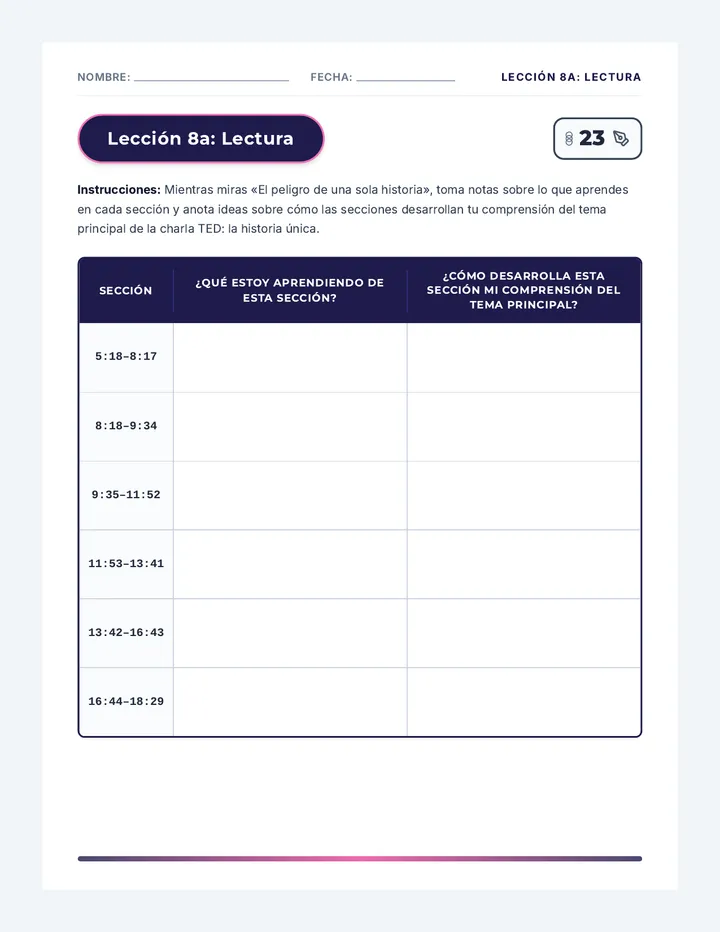
Historia Única Hoja de Trabajo

Historia Única Hoja de Trabajo

Guía y hoja de trabajo en español para el análisis de la charla TED «El peligro de una sola historia» de Chimamanda Adichie, que incluye una tabla de toma de notas por marcas de tiempo y una consigna de escritura rápida con renglones de respuesta.

N

nlewis

First Day Feelings Reading Worksheet

First Day Feelings Reading Worksheet

An adapted reading passage of Patty Hansen's 'The First Day of Middle School' with enlarged, readable text scaled to fit each page, complete with chunked passage text, comprehension check, and emoji reflection organizer.

PL

Patrick l

Quote Analysis Log Worksheet

Quote Analysis Log Worksheet

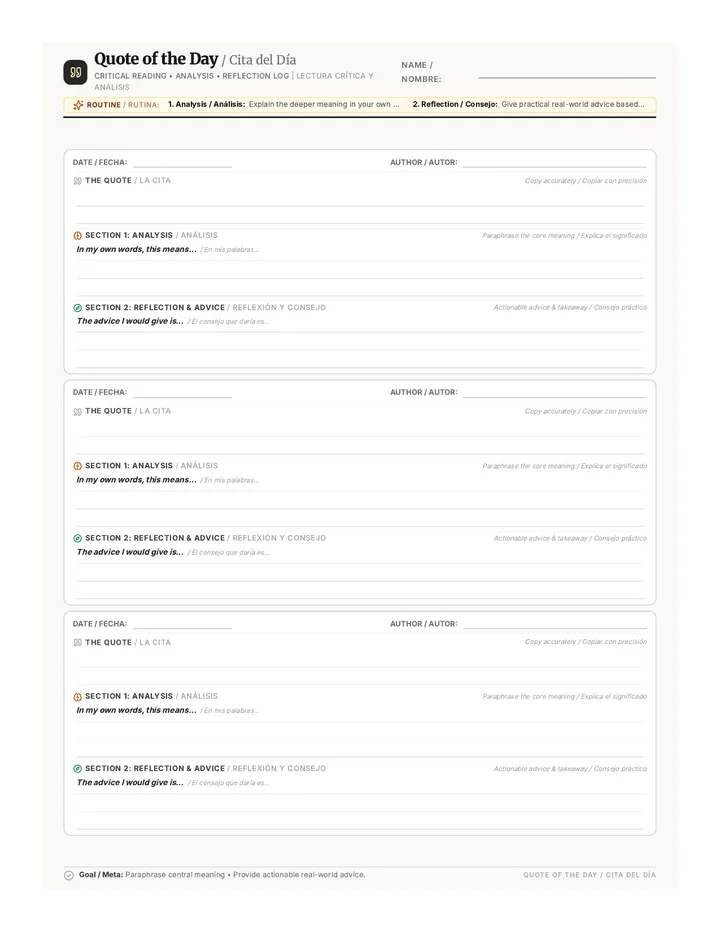
A printable bilingual (English / Spanish) 3-entry quote analysis worksheet featuring separated analysis and reflection sections with expanded 3-line writing spaces and pre-printed sentence starters.

C

Christina

Morning Spark Student Packet

Morning Spark Student Packet

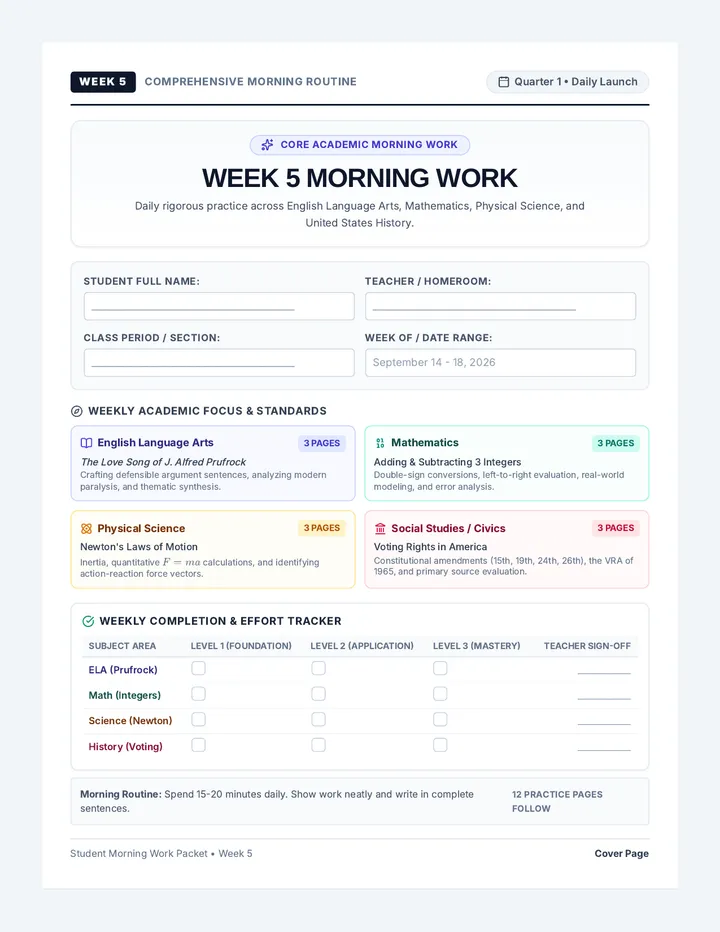
A complete 13-page student morning work packet for Week 5, beginning with an all-inclusive Cover Page and Weekly Progress Tracker, followed by 12 differentiated practice pages across four core subjects (ELA, Mathematics, Science, and US History) with scaffolded, moderate, and independent tiers.

K

kyle.hill

ILEARN Caminos Blueprint Guide

ILEARN Caminos Blueprint Guide

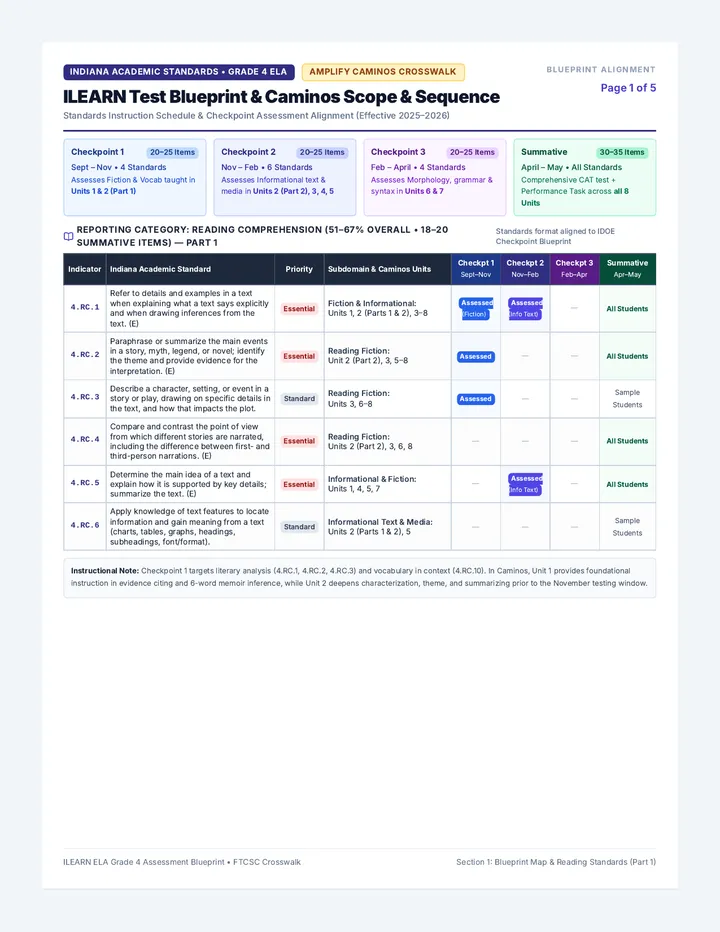
Comprehensive Grade 4 ILEARN Test Blueprint and Amplify Caminos Scope & Sequence crosswalk. Formatted to match the state ILEARN checkpoint blueprint, showing exactly when Indiana Academic Standards (Reading, Vocabulary, Writing, Grammar, and Communication) are taught across Units 1–8 and assessed in Checkpoints 1, 2, 3, and the Summative Assessment.

A

Amy.Hacker

Giver Chapters 14-15 One Pager-REVISED-v2-FINAL

Giver Chapters 14-15 One Pager-REVISED-v2-FINAL

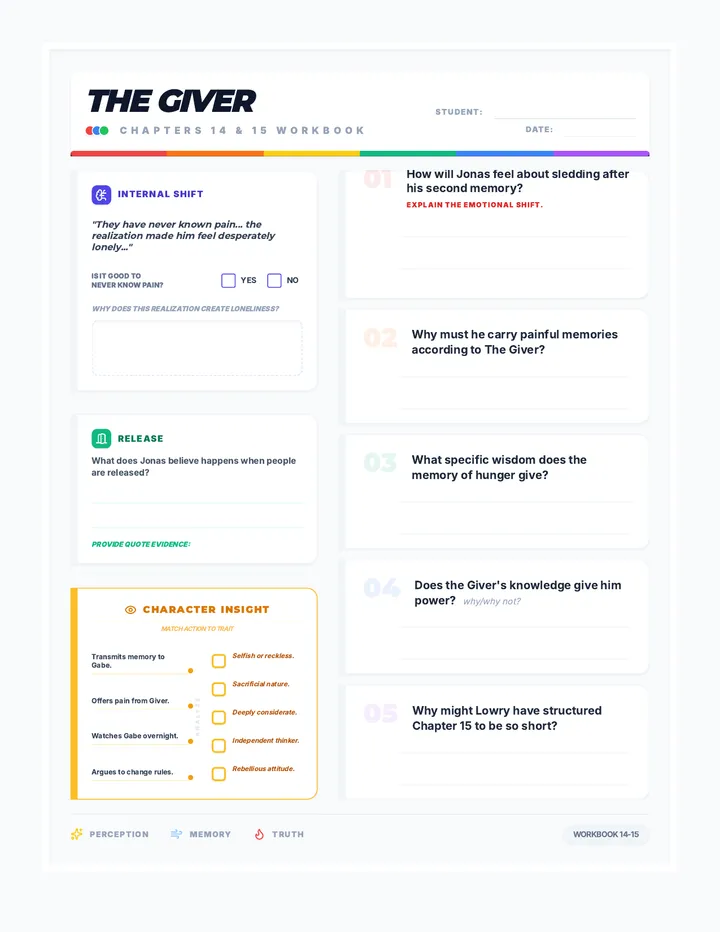
A final, refined one-page workbook for Chapters 14-15 of The Giver. This version has been strictly optimized for height by reducing margins and padding to ensure everything fits perfectly on a single page, while featuring a vibrant full-spectrum rainbow theme to represent Jonas's awakening to color and deep memory.

BC

Brenda Coombs

Sequences

Invention Quest Slides

Frindle Frenzy Novel Study

A 9-day novel study for 'Frindle' by Andrew Clements, aligned to 3rd Grade ELAR TEKS, focusing on character development, vocabulary, and plot analysis.

LH

Lucy Hellerman

56
Value Vault Teacher Guide

Metamorphosis Mastery

An 8-week deep dive into Kafka's Metamorphosis for special education students, focusing on abstract thinking, social value, and the human condition through high-engagement activities and visual organizers.

C

Ceeasia.walker

58
Prophecy and Power Slides

Shadows and Crowns

A series of lessons exploring Shakespeare's Macbeth, specifically designed for 10th-grade emergent bilingual students to master complex characterization and thematic elements.

DC

Dylan Clark

30
Question Anatomy Slides

Insight Investigators

A 6-week reading intervention unit for 5th graders focused on making inferences, analyzing questions, and using text evidence. Themes include mysteries, sports (baseball and basketball), and dragons to engage high-interest readers.

MK

Meg Keene

48
Copenhagen Clues Slides

Resistance Chronicles

A 9-day novel study for Number the Stars centered on 5th Grade ELAR TEKS, focusing on character development, plot analysis, and historical context through the lens of a Resistance Secret File.

LH

Lucy Hellerman

79
Detective Nutmeg Story Document

Story Investigators

A series of lessons focused on developing reading comprehension through mystery stories, with tiered assignments for different grade levels.

JJ

Julie Johns

30

Lessons

Stamina Navigator Student Tracker

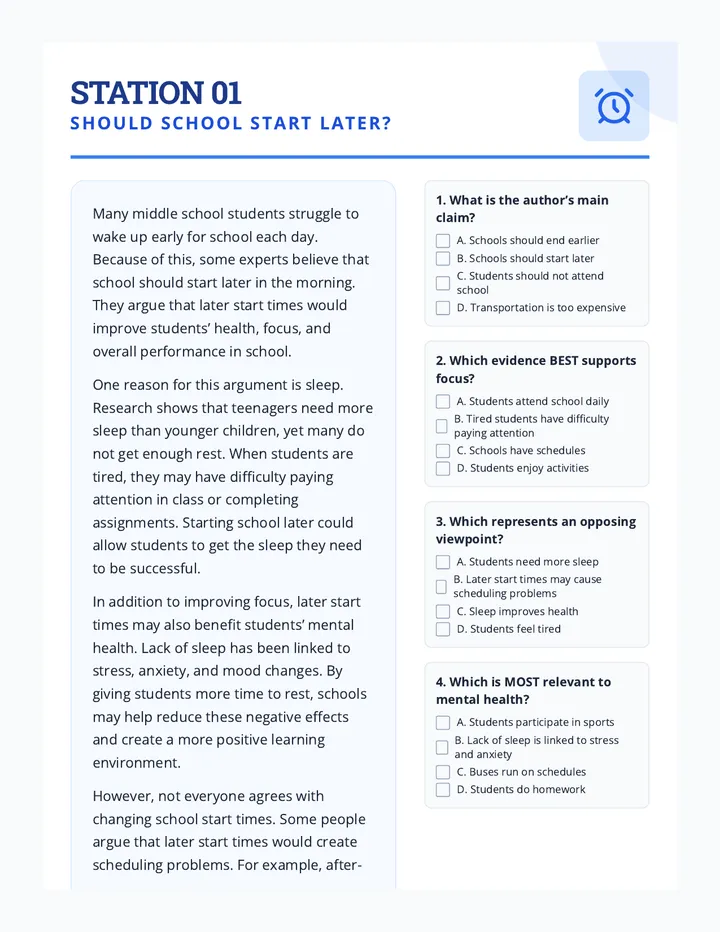
EOG Stamina Stations

A comprehensive 6-station test-preparation rotation designed to build stamina and teach time management for the NC 6th Grade ELA EOG. Features 52 standards-aligned multiple-choice questions across informational, fictional, and poetic texts with a built-in stamina-break tracking system.

D

destiny.lanier

10
Reading Relay Posters

Reading Relay

A set of literacy stations designed to build comprehension, argumentative analysis, and theme identification skills through six diverse reading passages.

D

destiny.lanier

7
Awakening Words Bell Ringer

Stolen Seconds

A comprehensive lesson exploring Tanith Lee's 'Awake,' a subversion of Sleeping Beauty, focusing on structural choices and source material transformation (RL.5 and RL.9). Students will analyze character conflict and the concept of 'the gift of time.'

V

vivianbelarmino

25
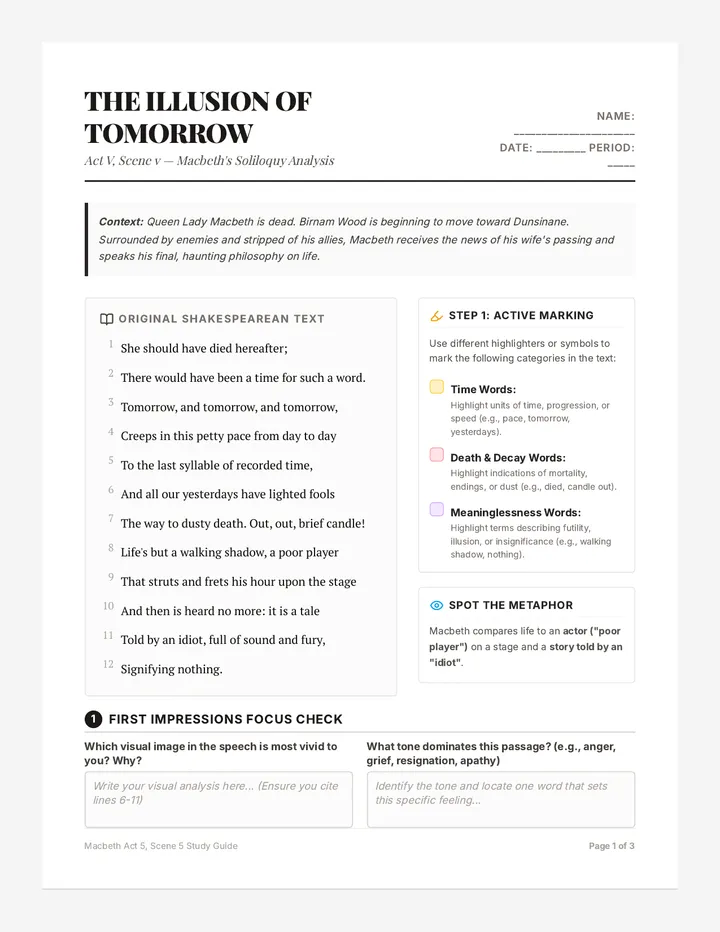
Tomorrow Speech Worksheet

The Illusion of Tomorrow

A comprehensive 10th-grade ELA lesson analyzing Macbeth's famous 'Tomorrow, and tomorrow, and tomorrow' speech from Act 5, Scene 5. Students explore Macbeth's psychological state—whether he is depressed, defeated, or finally realizing the truth of his ambitions—using textual annotation, group evidence organizers with scaffolded sentence stems, a Philosophical Four Corners debate, and a reflective exit ticket.

EC

Erin Cloutier

5
Narrative Navigator Slides

Journal Journey Cultural Bridge

An advanced 8th-grade ELA lesson exploring the intersection of Filipino and American identities through personal narrative. Students analyze the immigrant experience, master advanced vocabulary via a 'Quiz Bee,' and draft narratives that bridge their cultural heritage with their current journey.

V

vivianbelarmino

13
Progression Annuelle Grammaire Guide Pedagogique

Portrait de Monstre

Une leçon complète pour étudier la structure du portrait d'un personnage imaginaire (l'ogre) à travers l'analyse d'un texte littéraire et documentaire. Elle comprend des fiches de lecture, d'analyse de structure et de vocabulaire pour guider les élèves vers la rédaction autonome de leur propre créature légendaire.

LP

LAURENT PERCHE

24