Photon Physics Worksheet Photon Physics
Lesson 1: The Electromagnetic Spectrum and Photons
Physics: Atomic Structure
Name: __________________________
Date: ___________________________
Fundamental Constants & Equations
Speed of Light ($c$): $3.00 \times 10^8 \text{ m/s}$
Planck’s Constant ($h$): $6.626 \times 10^{-34} \text{ J}\cdot\text{s}$
Wave Equation: $c = \lambda \nu$
Photon Energy: $E = h\nu$ or $E = \frac{hc}{\lambda}$
Part 1: Wave Relationships
Use the wave equation to explore the inverse relationship between wavelength ($\lambda$) and frequency ($\nu$).
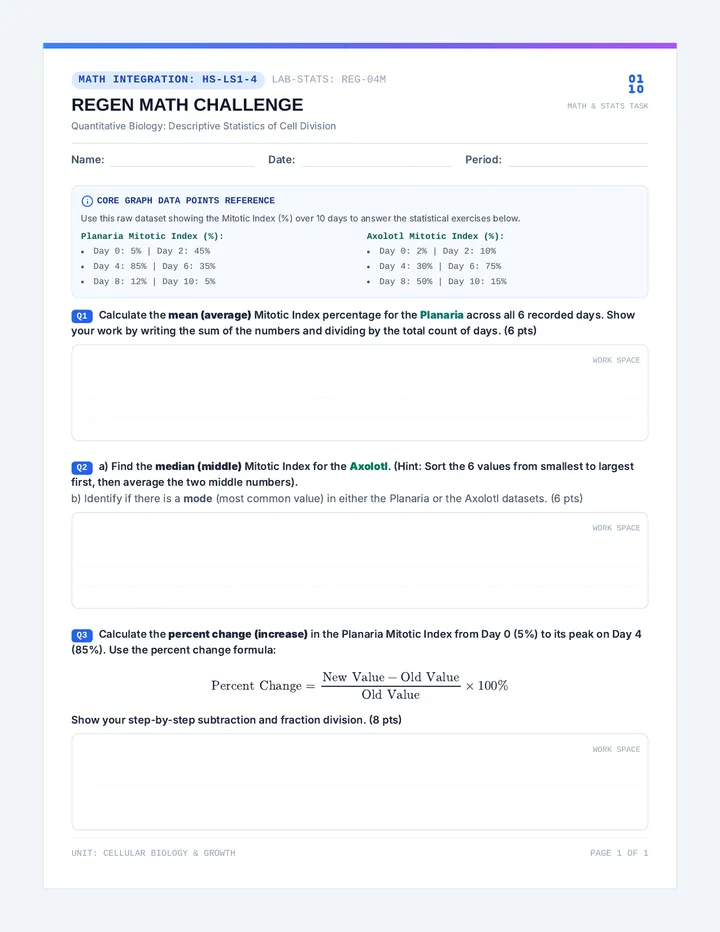
1. A green laser pointer emits light with a wavelength of $532 \text{ nm}$. Calculate its frequency.
(Hint: $1 \text{ nm} = 10^{-9} \text{ m}$)
2. An FM radio station broadcasts at $98.1 \text{ MHz}$ ($1 \text{ MHz} = 10^6 \text{ Hz}$). What is the wavelength of these radio waves?
Part 2: Quantized Energy
Calculate the energy of individual photons for different regions of the EM spectrum.
3. Calculate the energy (in Joules) of a single photon of violet light with a frequency of $7.5 \times 10^{14} \text{ Hz}$.
4. A photon has an energy of $3.3 \times 10^{-19} \text{ J}$. Identify the color of this light by first finding its wavelength in nanometers.
Red: 620-750nm
Blue: 450-495nm
Part 3: Thinking Critically
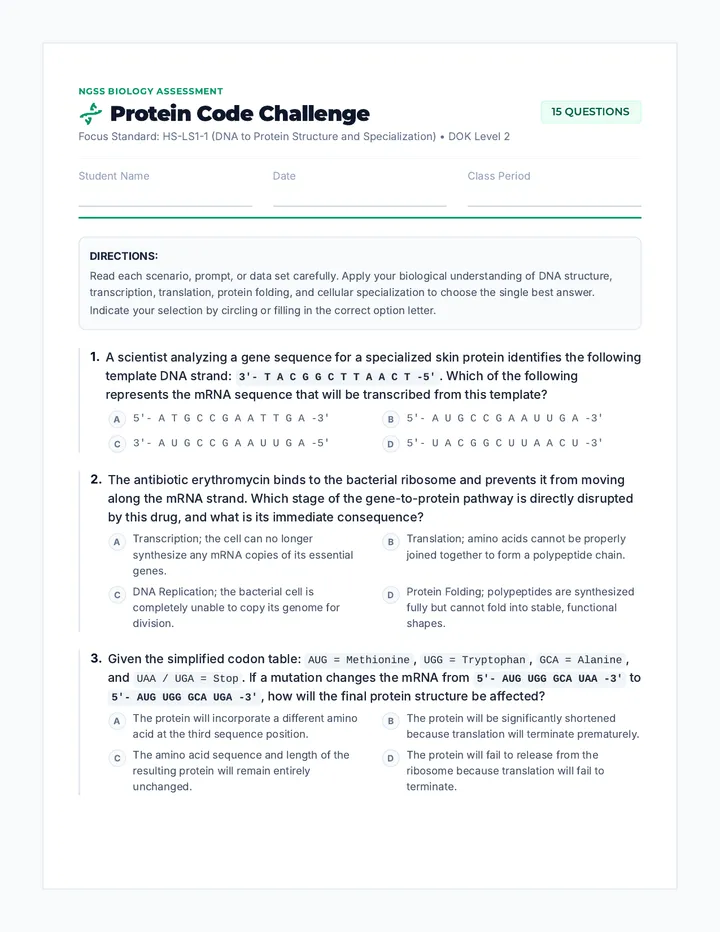
5. In terms of frequency and energy, explain why ultraviolet (UV) radiation is capable of causing sunburn while visible light is not.
Photon Power Slides Photon Power
The Physics of Light and Energy
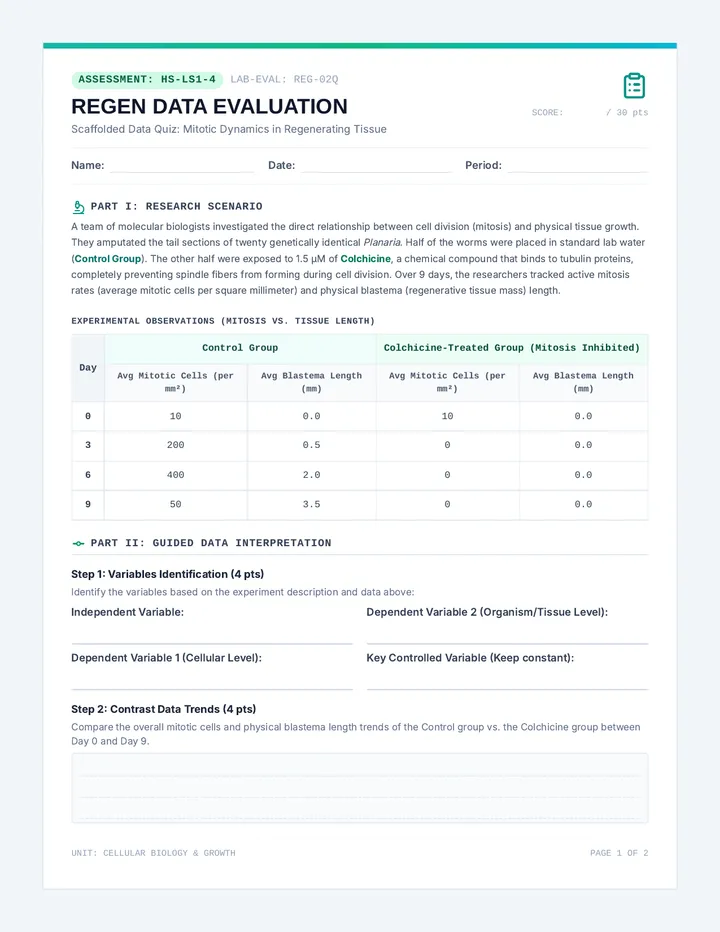
Wavelength Frequency Energy
Light as a Wave
All electromagnetic radiation travels at the same speed in a vacuum: the speed of light ($c$).
\[ c = \lambda \nu \]
"As wavelength increases, frequency must decrease."
c
$3.00 \times 10^8 \text{ m/s}$
λ
Wavelength (meters)
ν
Frequency (Hertz, $\text{s}^{-1}$)
Light as a Particle
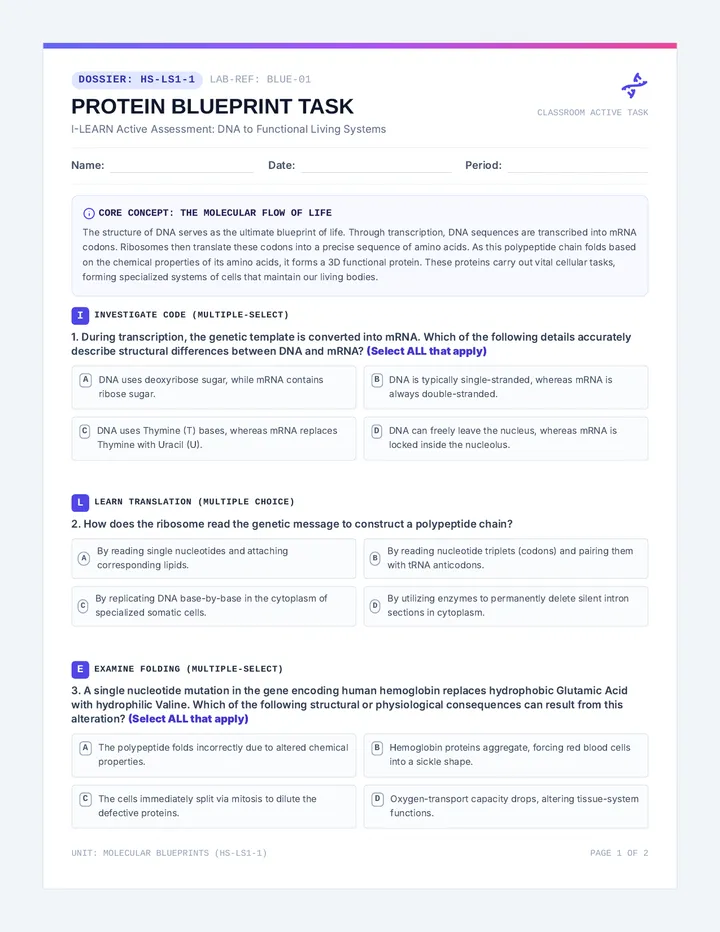
Max Planck and Albert Einstein discovered that light isn't just a wave—it comes in discrete "packets" of energy called photons.
\[ E = h \nu \]
Key Takeaway
Energy is directly proportional to frequency.
Higher Frequency ($\nu$) = Higher Energy ($E$)
Blue light has more energy per photon than red light.
Quick Challenge
If an X-ray has a very high frequency, what does that tell us about its wavelength and its energy?
Wavelength
Very Short
Energy
Very High
Wave Master Teacher Guide Teacher Guide: Wave Master
Lesson 1: The Electromagnetic Spectrum and Photons
Instructional Goals
Define the relationship between wavelength ($\lambda$) and frequency ($\nu$).
Calculate photon energy using Planck’s constant ($h$).
Understand the dual nature of light (wave-particle duality).
Pacing (50 min)
5m: Hook (Prism Demo)
15m: Direct Instruction (Slides)
20m: Guided Practice (Worksheet)
10m: Review & Exit Ticket
Worksheet Answer Key
1. Green Laser Frequency ($532 \text{ nm}$)
$\nu = c / \lambda = (3.00 \times 10^8 \text{ m/s}) / (532 \times 10^{-9} \text{ m}) = \mathbf{5.64 \times 10^{14} \text{ Hz}}$
2. FM Radio Wavelength ($98.1 \text{ MHz}$)
$\lambda = c / \nu = (3.00 \times 10^8 \text{ m/s}) / (98.1 \times 10^6 \text{ Hz}) = \mathbf{3.06 \text{ m}}$
3. Violet Photon Energy ($7.5 \times 10^{14} \text{ Hz}$)
$E = h \nu = (6.626 \times 10^{-34} \text{ J}\cdot\text{s}) \times (7.5 \times 10^{14} \text{ Hz}) = \mathbf{4.97 \times 10^{-19} \text{ J}}$
4. Identify Color ($E = 3.3 \times 10^{-19} \text{ J}$)
Step 1: Find Frequency.
$\nu = E/h = 4.98 \times 10^{14} \text{ Hz}$
Step 2: Find Wavelength.
$\lambda = c/\nu = 6.02 \times 10^{-7} \text{ m} = \mathbf{602 \text{ nm}}$ (Orange/Yellow region)
Common Misconceptions
Students often confuse wavelength and frequency relationships. Emphasize that as waves get "squished" (shorter wavelength), they "hit" more often (higher frequency).
Pro-Tip
Remind students to always convert nanometers to meters ($10^{-9}$) before plugging values into the speed of light equation.
Glow Science Slides Spectral Fingerprints
Evidence for Quantized Energy
The Spectra Spectrum
Continuous Spectrum
Produced by hot, dense objects (like the core of a star). All wavelengths of visible light are present.
Line (Emission) Spectrum
Produced by hot, thin gases. Only specific, discrete wavelengths are emitted. Each element is unique.
How Atoms Make Light
P+
Step 1: Excitation
Energy (heat/electricity) pushes an electron to a higher energy shell.
Step 2: Relaxation
The electron falls back down, releasing the energy as a single photon of light.
Today's Investigation
We will use Flame Tests to observe the colors of different metal ions. Then, we will view them through a diffraction grating to see their unique spectral lines.
Lithium (Red)
Copper (Green)
Sodium (Orange)
Spectral Fingerprints Lab Report Lab: Spectral Fingerprints
Investigating Atomic Emission
Name: __________________________
Date: ___________________________
Objective
Identify unknown metal ions by their characteristic flame color and sketch the line spectra produced by various elements.
Part A: Flame Observations
Metal Salt Metal Ion Observed Flame Color LiCl Li+ NaCl Na+ CuCl2 Cu2+ SrCl2 Sr2+ Unknown #___ ?
Part B: Emission Spectra
Look through the diffraction grating/spectroscope. Sketch the specific lines you see. Use colored pencils if available.
Hydrogen (Gas Tube)
400nm500nm600nm700nm
Helium (Gas Tube)
400nm500nm600nm700nm
Mercury (Gas Tube)
400nm500nm600nm700nm
Analysis & Conclusions
1. Why did different metals produce different colors? Relate your answer to energy levels and photons.
2. Explain why the light seen through the spectroscope appeared as distinct lines rather than a continuous rainbow.
3. Based on your observations, identify your Unknown and explain your reasoning.
Flame Test Setup Guide Teacher Guide: Flame Test Safety & Setup
Lesson 2: Spectral Fingerprints
Materials Needed
Bunsen burners (one per station)
Nichrome wires or wooden splints (soaked in water overnight)
$1.0 \text{ M}$ solutions or solid salts of:
LiCl, NaCl, KCl, CaCl2, SrCl2, CuCl2
Small beakers of $6 \text{ M } \text{HCl}$ (for cleaning wires)
Diffraction gratings or hand-held spectroscopes
Gas discharge tubes (H, He, Ne) and high-voltage power supplies
Safety Protocols
Goggles and aprons are mandatory.
Tie back long hair; loose clothing is a fire hazard.
Ensure the classroom is well-ventilated.
Copper and Strontium compounds are toxic; do not ingest.
Handle high-voltage power supplies with extreme care. Do not touch discharge tubes while powered.
Expected Lab Results
Lithium (Li+)
Carmine Red / Magenta
Sodium (Na+)
Intense Yellow-Orange
Potassium (K+)
Light Lilac (faint)
Calcium (Ca2+)
Brick Red / Orange-Red
Strontium (Sr2+)
Bright Red / Crimson
Copper (Cu2+)
Blue-Green / Emerald
Teaching Tip: The Transition
When students view the gas tubes through spectroscopes, they will see lines . Challenge them to explain why they don't see a rainbow. This is the moment to introduce the concept that electrons can only exist in certain "rungs" of a ladder. If they could be anywhere, we'd see every color. Because they are stuck on rungs, we only see specific colors.
Quantum Leap Slides Quantum Leaps
The Bohr Model of the Atom
Niels Bohr's Big Idea (1913)
1
Electrons orbit the nucleus in fixed energy levels (shells).
2
Electrons cannot exist between levels. They must "jump" from one to another.
3
Energy is absorbed or emitted exactly equal to the difference between levels.
The Math of the Jump
We can calculate the energy of an electron in any level ($n$) of a Hydrogen atom:
\[ E_n = -2.18 \times 10^{-18} \text{ J} \left( \frac{1}{n^2} \right) \]
$\Delta E = E_{\text{final}} - E_{\text{initial}}$
Why negative?
Zero energy is defined as the electron being completely removed from the atom. As it gets closer to the nucleus, it becomes more stable (lower energy, thus negative).
Predicting Color
Transitions ending at $n=2$ produce Visible Light (The Balmer Series).
$n=3 \rightarrow n=2$
Red Light
$n=4 \rightarrow n=2$
Cyan Light
$n=6 \rightarrow n=2$
Violet Light
Bohr Transition Map Worksheet Transition Mapper
Lesson 3: The Bohr Model & Energy Levels
Name: __________________________
Date: ___________________________
Bohr's Equation for Hydrogen
\[ E_n = -R_H \left( \frac{1}{n^2} \right) \]
Where $R_H = 2.18 \times 10^{-18} \text{ J}$
Task 1: Calculate the Energy Jump
Calculate the energy of the photon emitted ($\Delta E = |E_{final} - E_{initial}|$) for the following transitions in a Hydrogen atom.
Transition Initial Energy ($E_{in}$) Final Energy ($E_{fin}$) Energy Emitted ($\Delta E$) $n=3 \rightarrow n=2$ $-2.42 \times 10^{-19} \text{ J}$ $-5.45 \times 10^{-19} \text{ J}$ $n=4 \rightarrow n=2$ $-1.36 \times 10^{-19} \text{ J}$ $-5.45 \times 10^{-19} \text{ J}$ $n=2 \rightarrow n=1$ $-5.45 \times 10^{-19} \text{ J}$ $-2.18 \times 10^{-18} \text{ J}$
Task 2: Identify the Color
Using the energy values from Task 1, determine which transition corresponds to the colors observed in the hydrogen emission spectrum. Use the constant $h = 6.626 \times 10^{-34} \text{ J}\cdot\text{s}$ and $c = 3.00 \times 10^8 \text{ m/s}$.
Red Line ($\lambda = 656 \text{ nm}$)
Show your verification here:
Matching Transition: ________________
Blue-Green Line ($\lambda = 486 \text{ nm}$)
Show your verification here:
Matching Transition: ________________
Atomic Architecture Teacher Guide Teacher Guide: Atomic Architecture
Lesson 3: The Bohr Model and Energy Transitions
Key Objectives
Identify the specific energy of an electron in a hydrogen energy level ($n$).
Use the difference in energy between levels to determine photon wavelength.
Connect the abstract energy shells to the visible spectral lines of hydrogen.
Worksheet Key: Transition Mapper
$n=3 \rightarrow n=2$
$\Delta E = |-5.45 \times 10^{-19} - (-2.42 \times 10^{-19})| = \mathbf{3.03 \times 10^{-19} \text{ J}}$
$\lambda = hc/E \approx 656 \text{ nm}$ (Red Line)
$n=4 \rightarrow n=2$
$\Delta E = |-5.45 \times 10^{-19} - (-1.36 \times 10^{-19})| = \mathbf{4.09 \times 10^{-19} \text{ J}}$
$\lambda = hc/E \approx 486 \text{ nm}$ (Blue Line)
$n=2 \rightarrow n=1$
$\Delta E = |-2.18 \times 10^{-18} - (-5.45 \times 10^{-19})| = \mathbf{1.63 \times 10^{-18} \text{ J}}$
$\lambda = hc/E \approx 121 \text{ nm}$ (UV - Lyman Series)
Mathematical Hurdles
Students often struggle with negative signs in the Bohr energy equation. Emphasize that we are looking for the magnitude of change ($\Delta E$). A photon's energy must be positive.
Concept Check
Ask: "Why don't transitions ending at $n=1$ show up in our flame test?" Answer: They release so much energy that the photon is in the Ultraviolet range, which our eyes cannot see.
Light Interaction Slides Light Interactions
Absorption vs. Emission
Absorption
Emission
What is Absorption?
When a cold, thin gas is placed in front of a continuous light source, it "steals" specific wavelengths.
The Fraunhofer Effect:
Black lines appear in an otherwise complete rainbow.
Absorption Spectrum
Kirchhoff's Laws of Spectroscopy
1. Continuous
A hot, dense object produces a complete rainbow.
2. Emission
A hot, thin gas produces discrete bright lines.
3. Absorption
A cold gas in front of a hot source produces dark lines.
Mystery of the Solar Spectrum
"Why does the Sun's spectrum have thousands of black lines?"
The Answer:
The Sun's core is a hot, dense source, but its cooler atmosphere absorbs specific frequencies.
The Result:
We can tell exactly what elements are in the Sun without ever touching it.
Spectrum Identification Worksheet Spectrum Identification
Lesson 4: Kirchhoff's Laws & Light Interactions
Name: __________________________
Date: ___________________________
Part 1: Identifying Spectrum Types
Match the physical scenario to the type of spectrum it would produce.
A. A hot, dense iron rod glowing orange-white.
B. Light from a star passing through a cool hydrogen cloud.
C. A glass tube filled with neon gas excited by high voltage.
Part 2: Spectral Fingerprinting
Compare the "Unknown Gas" spectrum below to the reference spectra of known elements. Identify which elements are present in the mixture.
Hydrogen
Helium
Mercury
UNKNOWN
Identify the elements in the mixture and explain how you determined this:
Part 3: Comparative Analysis
If the same hydrogen gas cloud is heated (emitting light) versus cooled (absorbing light from a background star), how will the positions of the lines compare?
Stellar Spectra Slides ✨
✨
✨
✨
Cosmic Chemists
Spectroscopy in the Universe
One Periodic Table, One Universe
Because atomic energy levels are the same everywhere in the universe, a Hydrogen atom in a distant galaxy emits the exact same wavelengths as one in our lab.
"Spectroscopy is our only way to 'touch' the stars."
We can determine:
Chemical Composition
Temperature
Motion (Redshift/Blueshift)
Motion in the Lines
When a star moves away from us, its spectral lines shift toward the Red end of the spectrum.
When it moves toward us, they shift toward the Blue.
Observed λ ≠ Resting λ
At Rest
Redshifted (Moving Away)
Your Mission
"An unknown signal has been received from a star in the Andromeda Galaxy. We need you to identify the elements present and determine if the star is moving toward or away from Earth."
Time to analyze the data.
Mystery Star Analysis Worksheet Analysis: Mystery Star X-42
Capstone: Spectroscopy in Astronomy
Astrophysicist: __________________________
Station: ___________________________
Signal Briefing
We have received a high-resolution absorption spectrum from a star located in a nearby galaxy. Your mission is to identify the elements in the star's atmosphere and determine the star's velocity relative to Earth.
Spectral Data Comparison
Reference: Hydrogen (At Rest) Laboratory Standard
Reference: Helium (At Rest) Laboratory Standard
OBSERVED SPECTRUM: STAR X-42 Captured via Space Telescope
1. Composition
Identify the elements present in the star's atmosphere based on the line patterns:
2. Velocity & Direction
Is the star moving toward or away from Earth? Explain your evidence:
Conclusion
What does the existence of these specific elements tell us about the age or type of this star?
Cosmic Lab Teacher Guide Teacher Guide: Cosmic Lab
Lesson 5 & Sequence Capstone
Mystery Star X-42 Answer Key
1. Composition Results
"The star contains both Hydrogen and Helium."
Explanation: All reference lines for Hydrogen and Helium appear in the star's absorption spectrum, albeit shifted slightly.
2. Velocity & Direction
"The star is Redshifted (Moving Away)."
Evidence: Every absorption line in the observed spectrum is shifted toward the longer wavelength (red) end of the rainbow compared to the laboratory standards.
Sequence Debrief: Connecting the Dots
"How does this prove the atom is quantized?"
Remind students of the journey:
1. Light has discrete energy (Photons).
2. Atoms emit specific colors (Flame Tests).
3. Math predicts those colors using fixed shells (Bohr Model).
4. We see those shells reflected in the light of stars (Astronomy).
Conclusion: If the atom weren't quantized, the universe would have no color—just a continuous, blurry mess. The precision of the spectral lines is the physical proof of quantum mechanics.
Extended Research
Have students research how the "Big Bang" was discovered using the same redshift principles they used in this lab.
Modern Physics
Briefly introduce the Quantum Mechanical Model (Probability Clouds) to explain why the Bohr model isn't perfect for heavier elements.