Momentum Basics Slides Physics: Unit 4.1
Momentum Basics
Mass, Velocity, and the Direction of Motion
PHYSICS LABS
The Big Question
A Slow-Moving Semi
Mass: 25,000 kg
Speed: 2 m/s (4.5 mph)
A Fast-Moving Bullet
Mass: 0.01 kg
Speed: 400 m/s (900 mph)
Which is harder to stop? Why?
What is Momentum?
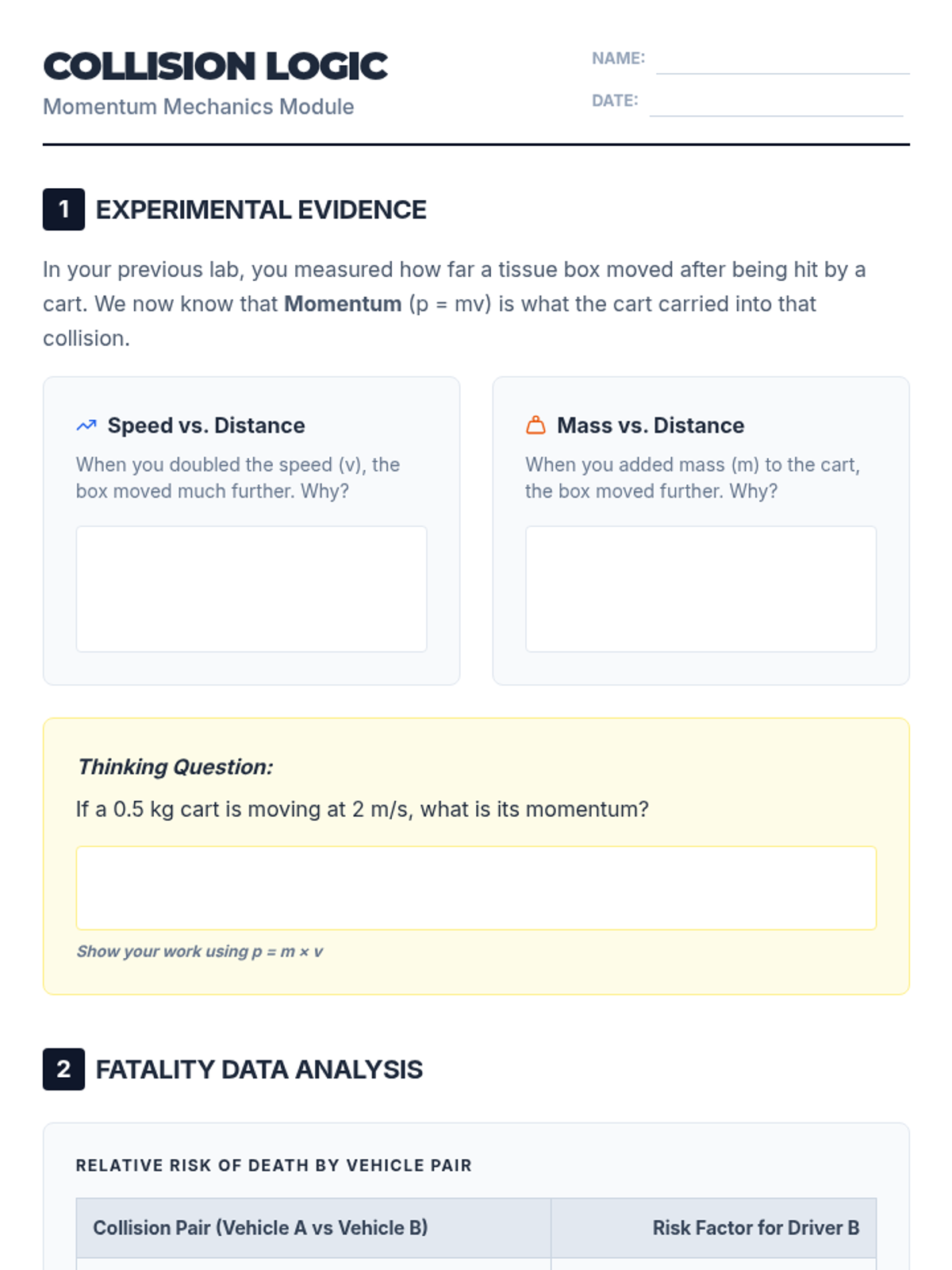
Momentum is "mass in motion." It describes how much "oomph" an object has and how difficult it is to bring it to rest.
p = mv
p = Momentum (kg·m/s)
m = Mass (kg)
v = Velocity (m/s)
Direct Relationship
If mass doubles, momentum doubles.

If velocity doubles, momentum doubles.

Vector Quantity
Direction matters! A car going North has different momentum than a car going South, even at the same speed.
Crunching the Numbers
Guided Practice
Example 1: The Bowling Ball
A 6.0 kg bowling ball rolls down the lane at 4.0 m/s. What is its momentum?

p = ?
m = 6.0 kg
v = 4.0 m/s
Example 2: The Fast Pitch
A 0.15 kg baseball is thrown at 40 m/s. What is its momentum?

p = ?
m = 0.15 kg
v = 40 m/s
Vectors: Direction is Key
Because velocity is a vector, momentum is also a vector.
Standard convention:
Right / East = Positive (+)
Left / West = Negative (-)
Up / North = Positive (+)
Down / South = Negative (-)
Compare These:
A
10 kg moving 5 m/s Right
+50 kg·m/s
B
10 kg moving 5 m/s Left
-50 kg·m/s
They have the same magnitude (size) of momentum, but opposite directions!
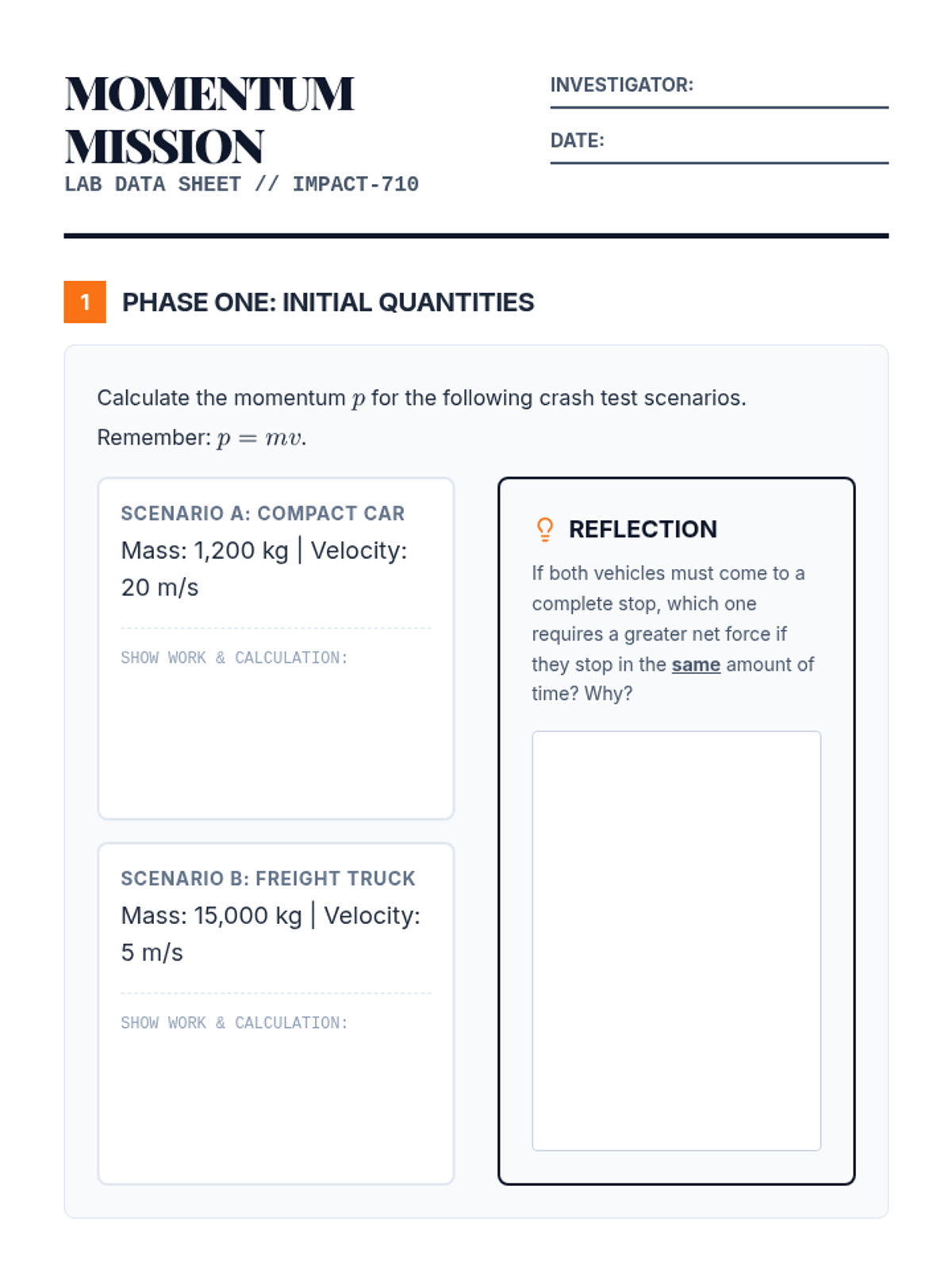
Momentum Matchup Worksheet Momentum Matchup
Unit 4.1: Linear Momentum Practice
Name:
Date:
p = mv
p : Momentum (kg·m/s)
m : Mass (kg)
v : Velocity (m/s)
Remember: Direction matters! (Right/Up is +, Left/Down is -)
Part 1: Basic Calculations
Show your work for each problem. Don't forget units!
1. A 1,200 kg car is traveling East at 25 m/s. Calculate its momentum.
Answer:
2. A 0.05 kg tennis ball is served West at 50 m/s. Calculate its momentum.
Answer:
Part 2: The Great Comparison
For each pair, calculate both momenta and circle the object with the greater magnitude of momentum.
Object A
A 0.5 kg bird flying at 20 m/s.
Object B
A 2,000 kg boulder at rest.
Object C
A 5.0 kg cat running at 10 m/s.
Object D
A 10 kg dog walking at 5 m/s.
Explain why Pair B resulted in the outcome it did:
Part 3: Thinking Vectors
3. Two skaters, Sarah (55 kg) and Tom (80 kg), are gliding toward each other. Sarah is moving at 4 m/s to the Right. Tom is moving at 3 m/s to the Left.
A) Calculate Sarah's momentum:
B) Calculate Tom's momentum:
C) If they collide and stick together, which way will they move? Justify your answer using your calculations above.
Impulse Theorem Slides Physics: Unit 4.2
The Impulse Theorem
Force, Time, and Changing Momentum
The "Follow Through"
Why does a coach tell you to follow through when you swing a baseball bat or kick a soccer ball?
"The ball is already gone! Why keep swinging?"
It’s all about the time of contact.
Physics in Motion
Connecting Force and Momentum
Step 1
Start with Newton's Second Law: F = ma
Step 2
Remember acceleration is change in velocity over time: a = Δv / Δt
Step 3
Substitute: F = m(Δv / Δt)
F Δt = m Δv
The Impulse-Momentum Theorem
What is Impulse?
Impulse (J)
J = F Δt
Impulse is the product of the average force applied and the time interval over which it acts.
Units: Newton-seconds (N·s)
Change in Momentum (Δp)
Δp = m(vf - vi)
Impulse always equals the change in an object's momentum.
Units: kg·m/s (which is equal to N·s!)
Applying the Theorem
A car moving at 20 m/s hits a wall and stops in 0.1 seconds.
If the same car hits a giant hay bale and stops in 2.0 seconds...
Case 1: The Wall
Short time (Δt) =
MASSIVE FORCE
Case 2: The Hay Bale
Long time (Δt) =
SMALLER FORCE
The Change in Momentum (Δp) is the SAME in both cases!
Impulse Impact Worksheet Impulse Impact
Unit 4.2: FΔt = mΔv Practice
Name:
Date:
Impulse (J)
J = F · Δt
Momentum Change (Δp)
Δp = m · Δv
The Theorem
F · Δt = m · Δv
1. Basic Impulse
A soccer player kicks a stationary 0.45 kg ball with an average force of 600 N. The player's foot is in contact with the ball for 0.02 seconds.
A) Calculate the impulse applied to the ball:
B) What is the final velocity of the ball?
2. Safety Engineering
A 1,500 kg car traveling at 15 m/s crashes into a concrete barrier and comes to a complete stop.
A) Calculate the change in momentum (Δp):
B) If the collision takes 0.15 seconds, what is the average force of impact?
C) If an airbag increases the stopping time to 0.80 seconds, what is the new average force?
3. Sports Follow-Through
A tennis player hits a 0.06 kg ball traveling at 20 m/s toward them. They return the ball at 30 m/s in the opposite direction.
Pro-tip: Since the ball changes direction, one velocity must be negative! (vi = -20 m/s, vf = +30 m/s)
A) Calculate the change in momentum (Δp):
B) If the racquet applies 150 N of force, how long was the contact time?
Reflect:
Explain in one sentence why a boxer "moves with the punch" (moves their head in the same direction the punch is traveling) to avoid injury.
Graphing Force Slides Physics: Unit 4.3
Graphing Force & Time
Visualizing Impulse and Momentum Change
The "Area Under the Curve"
In physics, a Force vs. Time graph is a visual representation of how a force changes over a collision.
The Golden Rule:
Area = Impulse (J)
Calculating the area under the line gives you the total change in momentum.
Area = J
Force (N)
Time (s)
Scenario 1: Constant Force
The Rectangle
If the force is perfectly steady for the whole time, the graph is a rectangle.
Area = Base × Height
In physics terms:
Impulse = Δt × F
Example Graph:
Force = 10 N
Time = 4 s
Impulse = 4s × 10N = 40 N·s
Scenario 2: Increasing/Decreasing Force
The Triangle
Many collisions start small, peak, and then end. For a steady increase or decrease, use a triangle.
Area = ½ × Base × Height
In physics terms:
Impulse = ½ × Δt × Fpeak
Example Graph:
Fpeak = 200 N
Δt = 0.2 s
Impulse = ½(0.2s)(200N) = 20 N·s
Estimating Complex Collisions
In the real world, graphs aren't perfect shapes. They look like "blobs" or curves.
How to solve:
Count the squares on the grid.
Estimate what fraction of a square the curve covers.
Break the shape into multiple smaller rectangles and triangles.
Real-World Collision Data
Graph Grab Worksheet Graph Grab
Unit 4.3: Analyzing Force-Time Graphs
Name:
Instructions:
For each graph below, calculate the total Impulse (J) applied during the time interval. Show all area calculations (Rectangle: A=bh, Triangle: A=½bh).
Graph A: Constant Thruster
20 N
0
0
5 s
1. Calculation Space
Determine the impulse applied by this constant 20 N thruster.
Total Impulse (J):
Graph B: Hammer Strike
500 N
0
0.4 s
2. Calculation Space
Determine the impulse applied by this 0.4s hammer strike.
Total Impulse (J):
Graph C: Two-Stage Ignition
100 N
0
6 s
3s
3. Calculation Space
Hint: Split this into a triangle (0-3s) and a rectangle (3-6s).
Total Impulse (J):
4. Final Challenge:
A 2 kg object is at rest. It is subjected to the force shown in Graph A (Impulse = 100 N·s). What is the final velocity of the object?
Stopping Power Slides Advanced Physics Lab
Stopping Power
Integrating Kinematics and Momentum
Runaway Train Scenario
A runaway train car (mass = 40,000 kg) is rolling down a track at 15 m/s. You need to stop it before it reaches the end of the line.
The Engineering Limit:
The emergency brakes can only apply a maximum force of 80,000 N.
The Critical Questions:
1. How much time will it take to stop?
2. How much distance will it travel?
Building Your Toolkit
1. Momentum Tools
F Δt = m Δv
Use this to find the STOPPING TIME.
2. Kinematics Tools
d = ½(vi + vf)t
Use this to find the STOPPING DISTANCE.
The Workflow
1 Identify your variables (m, vi, vf, F).
2 Calculate the time (t) using Impulse-Momentum.
3 Use the time to find the distance (d).
Let's Solve It!
Step 1: Solve for Time (t)
F · t = m · Δv
(80,000)t = (40,000)(15)
t = 7.5 seconds
Step 2: Solve for Distance (d)
d = ½(15 + 0)(7.5)
d = 7.5 × 7.5
d = 56.25 meters
Crucial Rule: Force is applied OPPOSITE to motion, so it should be negative mathematically if you want to be formal!
The Engineering Application
"If the impulse is the same, how do we save lives?"
By increasing the stopping distance and time, we reduce the peak force on the passenger.
Airbags (Increases t)
Crumple Zones (Increases d)
Soft Landing Mats (Increases t)
Runaway Train Worksheet Runaway Train Challenge
Unit 4.4: Multi-Step Stopping Problems
Name:
Scenario A: The Freight Car
A 50,000 kg freight car is moving at 12 m/s. An emergency brake applies a constant force of 60,000 N to bring it to a stop.
Step 1: Solve for Time (t)
How long does it take the car to stop?
Time: ___________ s
Step 2: Solve for Distance (d)
How far does it travel during braking?
Distance: ___________ m
Scenario B: The Space Capsule
A 4,000 kg space capsule is returning to Earth. To slow down from 200 m/s to 100 m/s, the retro-rockets fire for 5.0 seconds.
Step 1: Solve for Force (F)
What average force did the rockets apply?
Force: ___________ N
Step 2: Solve for Distance (d)
How far did the capsule travel during this firing?
Distance: ___________ m
Engineering Inquiry
The freight car in Scenario A is approaching a station that is exactly 65 meters away. Based on your calculations, does the car stop in time? Explain your answer and state exactly how many meters of "buffer room" the train has (or how many meters it overshoots the station).
Physics License Exam Physics License Exam
Momentum & Impulse Proficiency
Examinee:
ID NO: 401-MOMENTUM
Section I: Theory & Definition
1. Define momentum in terms of its component variables.
2. Why is impulse considered a vector? Provide an example.
Section II: Field Calculations
3. A 0.2 kg hockey puck is sliding at 15 m/s. A player uses their stick to apply a force of 120 N directly against the motion of the puck for 0.05 seconds.
Impulse (J):
Δp (Change in Mom.):
Final Velocity (vf):
4. Which has more momentum: a 0.5 kg drone flying at 40 m/s OR a 1,500 kg parked car? Show your proof.
Section III: Telemetry Interpretation
Force vs. Time Telemetry
100 N
0.8 s
5. Analyze the telemetry above:
Break the shape into parts if necessary to find the total impulse.
Final Impulse: ___________ N·s
Section IV: Engineering Synthesis
6. You are designing a "soft landing" system for a 10 kg sensitive instrument. The instrument can withstand a maximum force of only 20 N. If the instrument hits the ground with 50 kg·m/s of momentum, what is the minimum stopping time your system must provide to prevent the instrument from breaking?
EXAM ENDS - WAIT FOR EVALUATION
Momentum Teacher Key Resource Unit Guide: Momentum & Impulse
Sequence Overview & Teacher Answer Key
Lesson Sequence Map
Lesson 1
p = mv Basics
Lesson 2
Impulse Theorem
Lesson 3
Graphing F-t
Lesson 4
Stopping Power
Lesson 5
License Exam
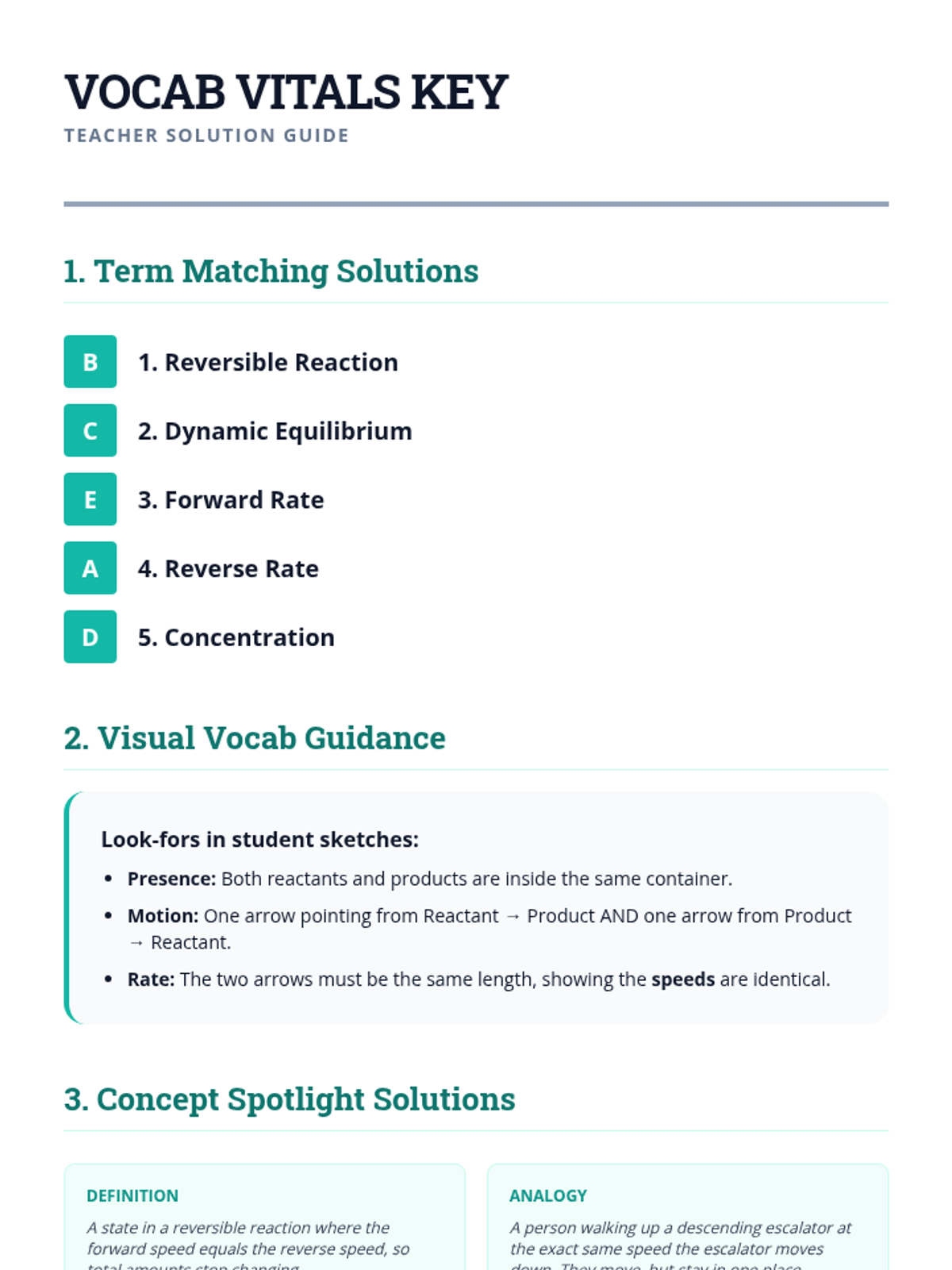
Worksheet 1: Momentum Matchup
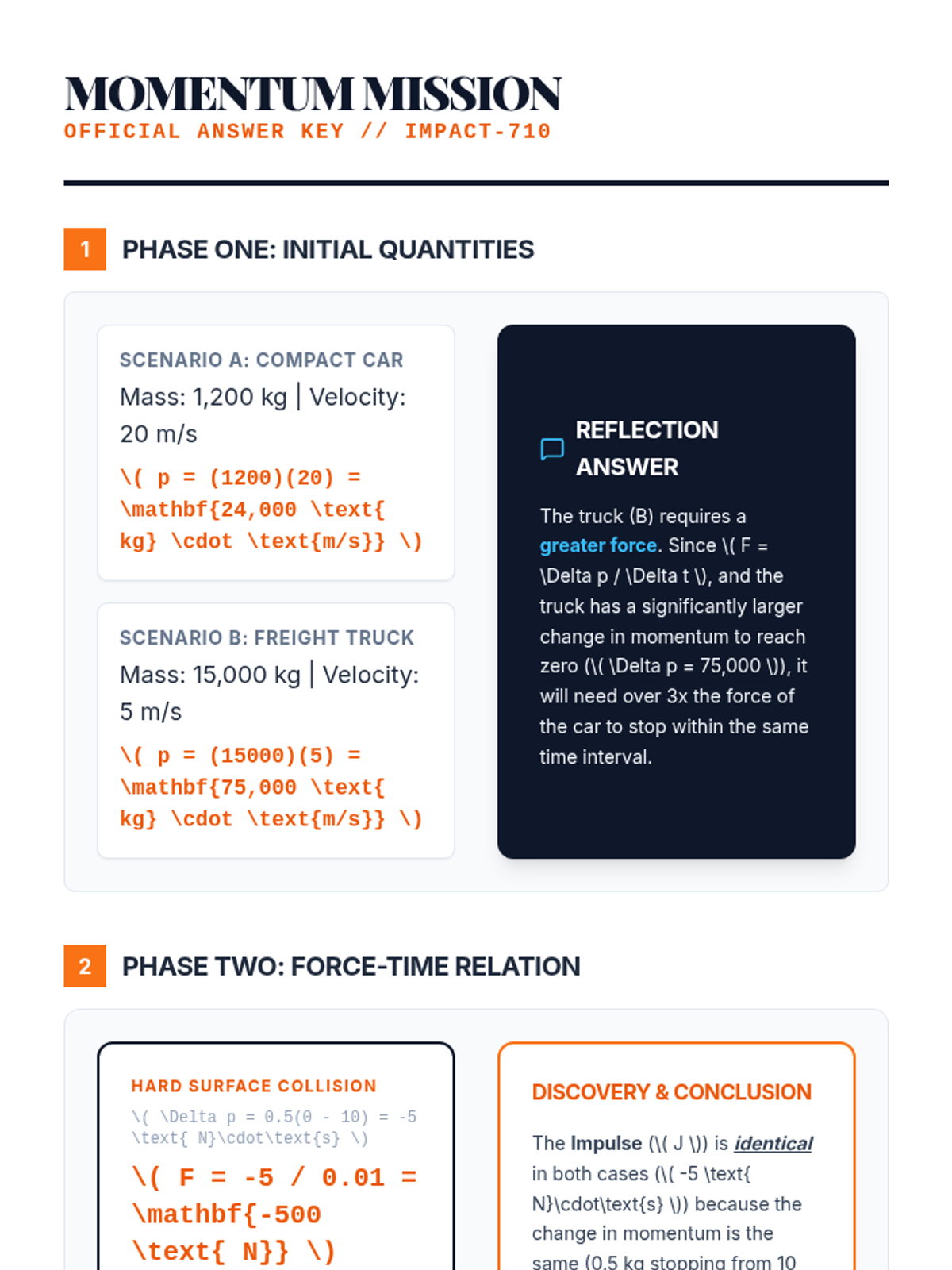
1. Car: (1,200 kg)(25 m/s) = 30,000 kg·m/s East
2. Tennis Ball: (0.05 kg)(-50 m/s) = -2.5 kg·m/s (or 2.5 kg·m/s West)
Comparison A: Bird (10 kg·m/s) > Boulder (0 kg·m/s).
Comparison B: Cat (50 kg·m/s) = Dog (50 kg·m/s). Explanation: Momentum depends on both m and v; half the mass moving twice as fast has equal momentum.
3. Skaters: Sarah = +220 kg·m/s; Tom = -240 kg·m/s. Conclusion: They move Left because Tom's momentum magnitude is greater.
Worksheet 2: Impulse Impact
1. Soccer Ball: A) J = (600N)(0.02s) = 12 N·s. B) 12 = (0.45)(v) → v = 26.67 m/s.
2. Car Crash: A) Δp = (1500)(0 - 15) = -22,500 kg·m/s. B) F = -22500 / 0.15 = 150,000 N. C) F = -22500 / 0.8 = 28,125 N.
3. Tennis: A) Δp = (0.06)(30 - (-20)) = (0.06)(50) = 3.0 kg·m/s. B) 3.0 = (150)t → t = 0.02 s.
Worksheet 3: Graph Grab
1. Graph A: (5s)(20N) = 100 N·s.
2. Graph B: ½(0.4s)(500N) = 100 N·s.
3. Graph C: Triangle = ½(3s)(100N) = 150. Rect = (3s)(100N) = 300. Total = 450 N·s.
4. Final Challenge: Δp = 100. 100 = (2 kg)(vf - 0) → vf = 50 m/s.
Worksheet 4: Runaway Train
Scenario A: t = (50000 × 12) / 60000 = 10 s. d = ½(12 + 0)(10) = 60 m.
Analysis: Yes, it stops. Buffer = 65m - 60m = 5 meters buffer.
Scenario B: Δp = (4000)(100 - 200) = -400,000 kg·m/s. F = -400,000 / 5 = 80,000 N. d = ½(200 + 100)(5) = 750 m.