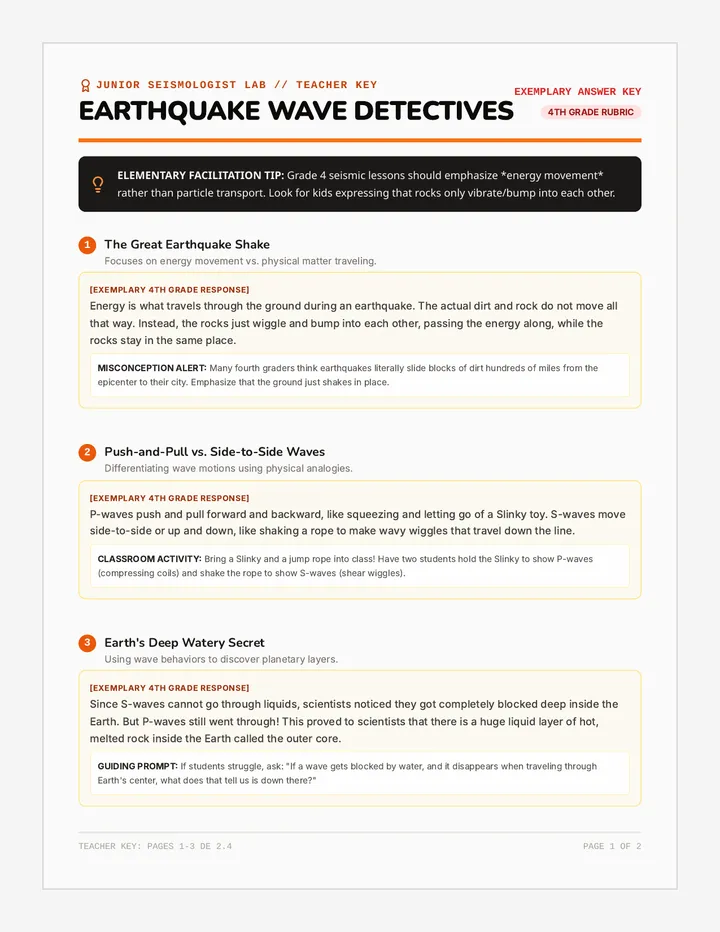
Fossil Finder Answer Key Answer Key: Fossil Finders (Condensed)
Repeating Schedule Key
Page 1: Formation Flowchart
2. Buried By: Sediment, mud, sand, or silt. (Must happen quickly!)
3. Minerals Replace: Bone, wood, or shell. (Slow process over millions of years).
4. Revealed By: Erosion, wind, rain, or weathering.
Page 2: Environmental Riddles
Case #1: Mountain Mystery
Past Environment: Tropical, Jungle, or Warm Rainforest.
Evidence: Palm leaves and ferns only grow in warm/wet climates, not snowy mountains.
Case #2: Prairie Secret
Past Environment: Ocean, Shallow Sea, or Underwater.
Evidence: Coral and seashells are marine organisms that live in saltwater.
Extinction Question
We study them to understand how environments changed in the past and how those changes caused species to disappear (failure to adapt).
Page 3: Adaptations
Mammoth Analysis
Environment: Cold, Snowy, Ice Age, or Tundra.
Sketch Area: Students should draw a Mammoth or similar extinct animal with visible adaptations (thick fur, tusks, etc.)
This key is designed to be used for quick debriefs at the end of each period.
Fossil Finder Student Packet Copied Copy Field Journal
FOSSIL
FINDERS
Texas Science Mission: TEKS 4.10B
Lead Investigator
Period / Class
Briefing: How Fossils Form
Most living things that die just rot away. To become a fossil, an organism must be buried quickly by sediment like mud or sand. Over millions of years, minerals replace the bone or wood, turning it into stone. This "fossil record" acts like a diary of Earth's history!
The Formation Flowchart
1. Organism Dies
Step One
2. Buried By...
3. Minerals Replace...
4. Revealed By...
START EXPEDITION
Evidence Lab
Landscape Riddles
Reading the Land
Fossils are clues to the past environment. If you find a fossilized shark tooth in a dry desert, you know that area used to be an ocean. Earth's surface is always changing!
Environmental Detective Report
Case #1: The Mountain Mystery
Clue Found
"We found fossils of tropical palm leaves and giant ferns on a snowy mountain top."
Likely Past Environment
My Evidence
Case #2: The Prairie Secret
Clue Found
"While digging in a grassy field in Kansas, we found fossilized coral reefs and seashells."
Likely Past Environment
My Evidence
Why do scientists study fossils of EXTINCT animals?
Adaptation Lab
Lost Worlds
Mammoth vs. Elephant
The Woolly Mammoth is an extinct relative of the modern Elephant. Look at these clues:
Small ears to keep heat in.
Thick fur to survive ice and snow.
Large tusks to clear snow away.
Analysis Question:
If Mammoths had thick fur and small ears, what kind of environment did they live in?
Field Illustration
Sketch an extinct animal you learned about today.
Mission Accomplished
You've successfully decoded Earth's prehistoric past. Turn this journal in to your Lead Researcher (Teacher).
Time Logged
Certified Fossil Finder
Fossil Finder Answer Key Copied Copy Answer Key: Fossil Finders (Condensed)
Repeating Schedule Key
Page 1: Formation Flowchart
2. Buried By: Sediment, mud, sand, or silt. (Must happen quickly!)
3. Minerals Replace: Bone, wood, or shell. (Slow process over millions of years).
4. Revealed By: Erosion, wind, rain, or weathering.
Page 2: Environmental Riddles
Case #1: Mountain Mystery
Past Environment: Tropical, Jungle, or Warm Rainforest.
Evidence: Palm leaves and ferns only grow in warm/wet climates, not snowy mountains.
Case #2: Prairie Secret
Past Environment: Ocean, Shallow Sea, or Underwater.
Evidence: Coral and seashells are marine organisms that live in saltwater.
Extinction Question
We study them to understand how environments changed in the past and how those changes caused species to disappear (failure to adapt).
Page 3: Adaptations
Mammoth Analysis
Environment: Cold, Snowy, Ice Age, or Tundra.
This key is designed to be used for quick debriefs at the end of each period.
Detective Vocabulary Glossary Lead Detective's Resource
Fossil Finder Glossary
Unit Reference Sheet
Prehistoric Terminology
Fossil
The preserved remains or traces of an organism (plant or animal) that lived long ago.
Sediment
Small pieces of rock, mud, and sand that settle in layers at the bottom of water or on land.
Paleontologist
A scientist who studies fossils to learn about organisms that lived in the past.
Environment
The surrounding area where a plant or animal lives, including the weather and other living things.
Extinct
A type of plant or animal that has died out completely and no longer exists on Earth.
Adaptation
A body part or behavior that helps an organism survive in its environment.
Erosion
The process of wind, water, or ice wearing away and moving rocks and soil.
Evidence
Information or clues that prove something happened or show that an idea is true.
Permineralization
The process where minerals fill in the empty spaces of a bone or wood, turning it into rock.
Climate
The average weather pattern of a specific place over many, many years.
Detective's Note: Use this glossary to help you decode the secrets in your Field Journal! If you find a word in the readings that you don't know, check here first.
Verified Evidence
Fossil Finder Sub Plan Fossil Finder Sub Plan
4th Grade Science • 1-Day Repeating Schedule
Classes
4 Periods
Lesson Overview
Today, you lead 4 classes through the Fossil Finder Independent Mission . Students analyze fossil "clues" to reconstruct past environments (TEKS 4.10B).
Required Materials
Field Journal Packets
Detective Glossaries (Reference sheets)
Answer Key (separate 1-page guide)
Key Vocabulary
Fossil: Preserved remains of an organism.
Sediment: Layers of mud/sand covering remains.
Environment: Area where an organism lived.
Extinct: Species no longer living on Earth.
Adaptation: Body part helping survival.
Evidence: Clues used to prove the past.
60-Minute Period Schedule
0-5 Min: Mission Briefing
Distribute Field Journals and Glossaries . Tell students they are "Deep Time Detectives" using clues to solve environmental riddles.
5-45 Min: Independent Mission
Students complete the 3-page packet independently. Walk around to help with the "Case Studies" on Page 2.
45-55 Min: Forensic Debrief
Go over Page 2 (Mountain/Prairie cases) as a class. Use the Answer Key to confirm the evidence they found.
55-60 Min: Gear Check
Collect materials. Ensure Glossaries are collected—they are used for every class!
Daily Log (Attendance & Notes)
Class Period 1
Class Period 2
Class Period 3
Class Period 4
Please leave this sheet for the regular teacher. Thank you for your hard work today!
Fossil Finder Sub Plan Fossil Finder Sub Plan
4th Grade Science • 1-Day Repeating Schedule
Classes
4 Periods
Lesson Overview
Today, you lead 4 classes through the Fossil Finder Independent Mission . Students analyze fossil "clues" to reconstruct past environments (TEKS 4.10B).
Required Materials
Field Journal Packets
Detective Glossaries (Reference sheets)
Answer Key (separate 1-page guide)
Key Vocabulary
Fossil: Preserved remains of an organism.
Sediment: Layers of mud/sand covering remains.
Environment: Area where an organism lived.
Extinct: Species no longer living on Earth.
Adaptation: Body part helping survival.
Evidence: Clues used to prove the past.
60-Minute Period Schedule
0-5 Min: Mission Briefing
Distribute Field Journals and Glossaries . Tell students they are "Deep Time Detectives" using clues to solve environmental riddles.
5-45 Min: Independent Mission
Students complete the 3-page packet independently. Walk around to help with the "Case Studies" on Page 2.
45-55 Min: Forensic Debrief
Go over Page 2 (Mountain/Prairie cases) as a class. Use the Answer Key to confirm the evidence they found.
55-60 Min: Gear Check
Collect materials. Ensure Glossaries are collected—they are used for every class!
Daily Log (Attendance & Notes)
Class Period 1
Class Period 2
Class Period 3
Class Period 4
Please leave this sheet for the regular teacher. Thank you for your hard work today!
Fossil Finder Student Packet Copied Copy Field Journal
FOSSIL FINDERS
Mission: Prehistoric Evidence • TEKS 4.10B
Lead Investigator
Period / Class
How Fossils Form
Becoming a fossil is a rare event. An organism must be buried quickly by layers of sediment (mud or sand). Over millions of years, water carrying minerals seeps into the remains. The minerals replace the bone or wood, turning it into stone. Finally, erosion from wind and rain wears away the rock to reveal the fossil!
The Formation Flowchart
1
Organism Dies
2
Quickly buried by...
3
Slowly replaced by...
4
Finally revealed by...
Word Bank
Sediment
Layers of mud or sand covering remains.
Erosion
Wind and rain wearing away rock.
Extinct
Species no longer living on Earth.
Adaptation
Body part helping a species survive.
Environment
The area where an animal lived.
Use these words in your report!
Evidence Lab
Landscape Riddles
Reading the Land
Fossils show us what an environment used to look like. Since organisms need specific conditions to survive, their fossils are clues. For example, palm trees only grow in warm, wet jungles. Finding them on a cold mountain proves that land was once a hot rainforest! Likewise, seashells in a dry field prove that area was once covered by an ocean.
Case #1: The Mountain Mystery
Mountain Top Site
"We found fossils of tropical palm leaves and giant ferns on a snowy mountain top."
Likely Past Environment
My Evidence (Why?)
Case #2: The Prairie Secret
Kansas Prairie Site
"While digging in a grassy field in Kansas, we found fossilized coral reefs and seashells."
Likely Past Environment
My Evidence (Why?)
Why do scientists study fossils of EXTINCT animals?
(Hint: Think about how species respond to climate change over time.)
Adaptation Lab
Lost Worlds
Survival Secrets
Scientists study extinct species to see how Earth's changes affected life. When an environment changes, animals must have adaptations (special body parts) to survive. If they cannot adapt, they may go extinct. Comparing fossils to modern animals shows how they handled their world.