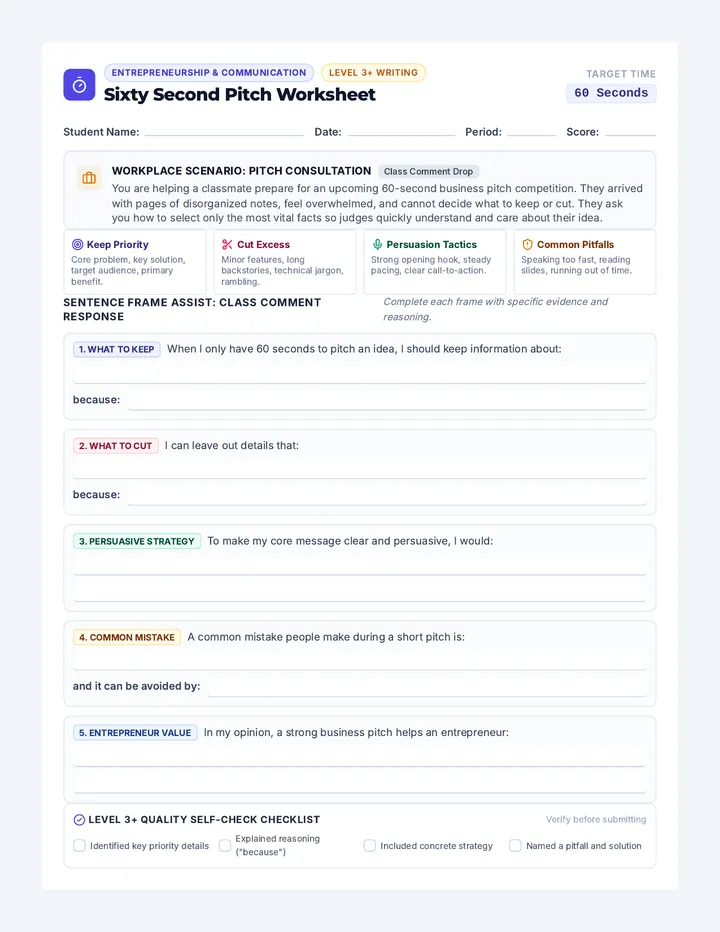
Sixty Second Pitch Worksheet
Entrepreneurship & Communication High School Studio
The 60-Second Pitch Blueprint
Level 3+ Strategic Writing
Student Name:
Date:
Period:
Product Idea:
Workplace Scenario Briefing
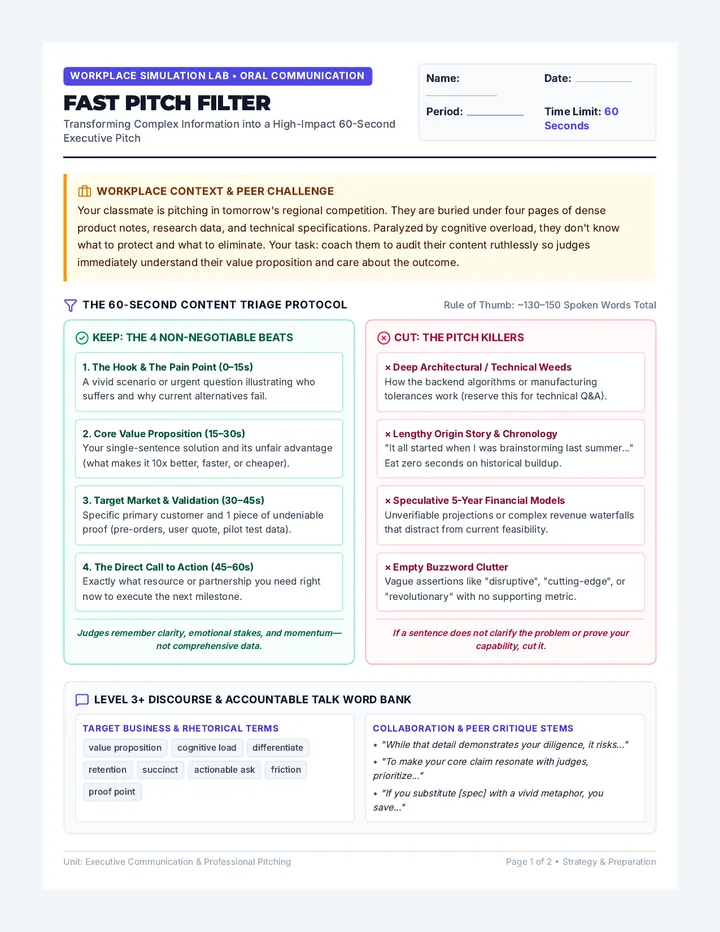
You are coaching a fellow founder preparing for an ultra-competitive 60-second venture pitch. Overwhelmed by pages of technical notes, they risk cognitive overload and judge fatigue. Your objective is to apply strategic triage: eliminate noise, avoid message distortion, and isolate the decisive elements that convince judges to back the product.
The Strategic Content Filter
Prioritizing high-leverage data under tight time constraints
MUST KEEP (High-Impact Signals)
- • The Hook: A catalytic opening stat or customer reality.
- • Core Pain Point & Solution: Who suffers & how you cure it.
- • Value Proposition: The unique commercial advantage.
- • The Ask / CTA: Exact capital, partnerships, or commitment needed.
MUST CUT (Message Distortions)
- • Technical Jargon: Circuitry, code syntax, or manufacturing logs.
- • Extended Backstory: Long personal origin stories or tangents.
- • Exhaustive Feature Lists: Secondary perks better saved for Q&A.
- • Vague Generalities: Empty claims like "everyone will buy this."
Pitch Architecture Glossary
Incorporate at least 3 terms into your writing
Value Proposition: Statement detailing what problem is solved, who benefits, and why it outperforms rival alternatives.
Ex: Solar charger providing non-stop festival battery life.
Message Distortion: When original meaning is degraded, lost, or misunderstood during communication due to jargon or clutter.
Ex: Drowning judges in specs so they miss the user benefit.
Target Market (B2C vs. B2B): Consumers directly (B2C: music fans) vs. enterprise organizations (B2B: event venues buying fleet charging).
Ex: Identifying demographic profile & purchasing power.
The Ask / Call to Action: Explicit funding requirement, pilot user count, or advisory request closing the pitch.
Ex: Seeking $5,000 seed funds for our initial 50 units.
Model Level 3+ Writing Exemplar Analyze how each claim is reinforced with rationale
”
Strategic Triage: Distinguishes vital core from feature bloat.
Audience Empathy: Safeguards investor cognitive load.
Execution Control: Replaces rushed pace with drilled clarity.
Unit 1: High-Stakes Entrepreneurial Pitching Page 1 of 2 • Foundations & Analysis
Writing Lab & Peer Defense Protocol
Strategic Pitch Response & Justification
60-Second Constraint
The Prompt
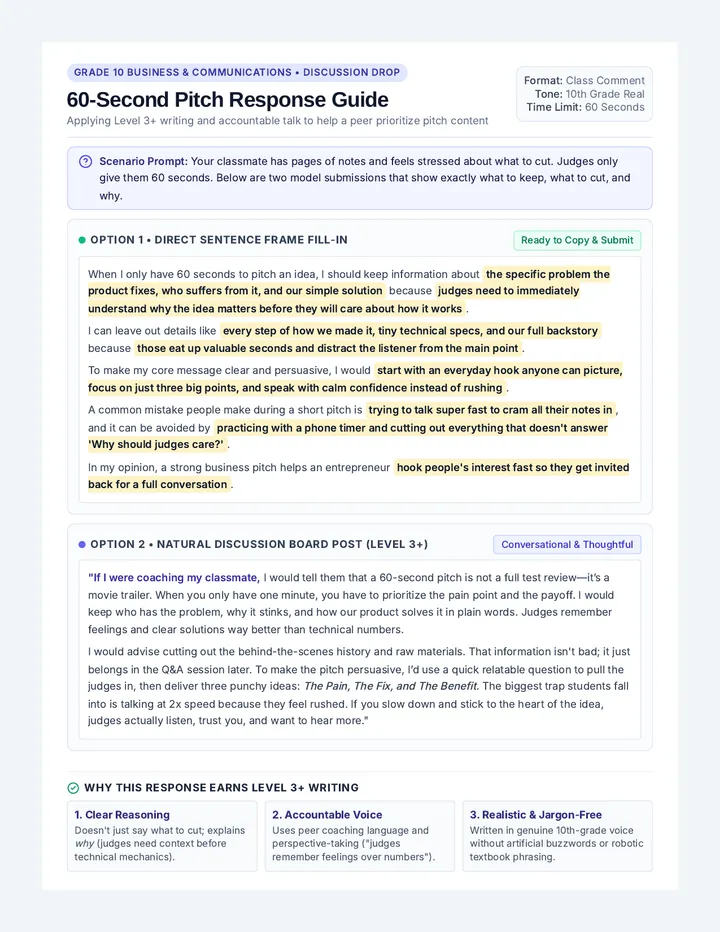
Imagine you have only 60 seconds to pitch a new product. How would you decide which information to keep or leave out? What strategies would you use to make your core message clear and persuasive?
Sentence Frame Assist (Level 3+ Structure)
“When I only have 60 seconds to pitch an idea, I should keep information about because . I can leave out details that because . To make my core message clear and persuasive, I would . A common mistake people make during a short pitch is , and it can be avoided by . In my opinion, a strong business pitch helps an entrepreneur .”
Your Level 3+ Written Response Provide thorough rationales for every tactical choice
Accountable Talk Protocol & Peer Defense
Active Listening & Constructive Feedback
Step 1: Justify Your Core Strategy Why does your selection guard against message distortion?
Step 2: Peer Constructive Feedback Reviewer: ________
Use: “I agree with keeping [X] because...” or “To clarify the ask...”
Accountable Talk Stems: • “The evidence that supports cutting that is...” • “How might an investor interpret your value proposition?” • “I challenge the priority of [X] because...”
Unit 1: High-Stakes Entrepreneurial Pitching Page 2 of 2 • Synthesis & Peer Defense