Pitch Polish Response Guide
Grade 10 Business & Communications • Discussion Drop
60-Second Pitch Response Guide
Applying Level 3+ writing and accountable talk to help a peer prioritize pitch content
Format: Class Comment
Tone: 10th Grade Real
Time Limit: 60 Seconds
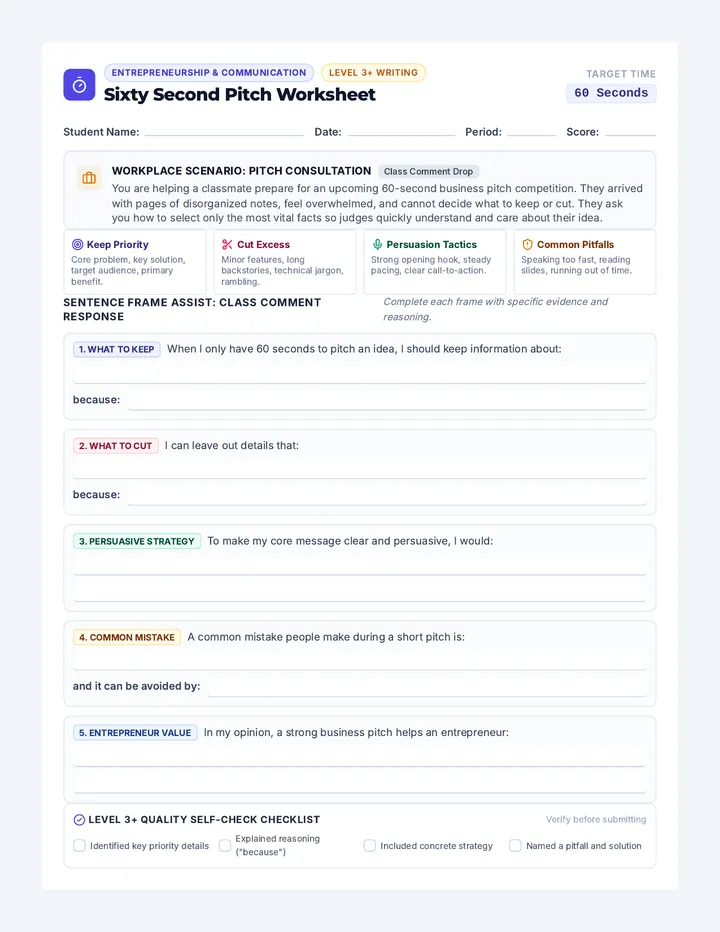
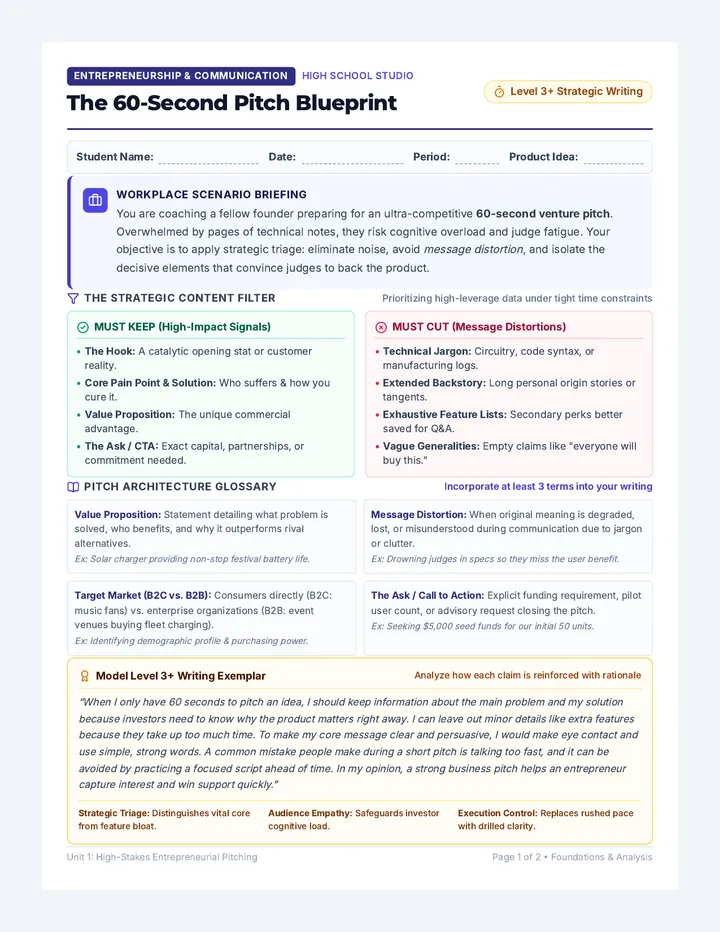
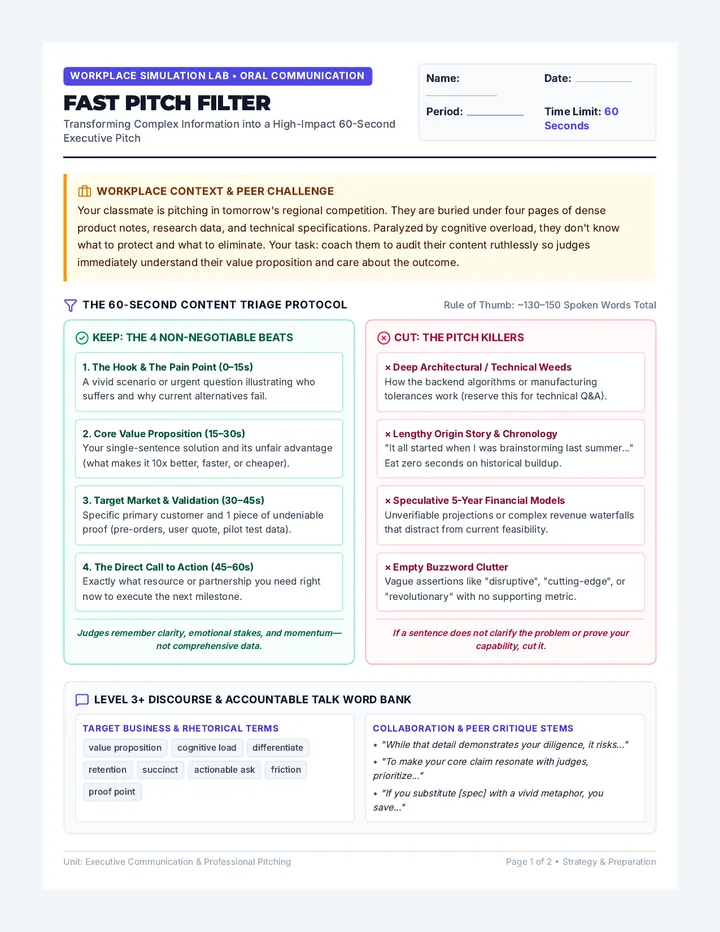
Scenario Prompt: Your classmate has pages of notes and feels stressed about what to cut. Judges only give them 60 seconds. Below are two model submissions that show exactly what to keep, what to cut, and why.
Option 1 • Direct Sentence Frame Fill-In
Ready to Copy & Submit
When I only have 60 seconds to pitch an idea, I should keep information about the specific problem the product fixes, who suffers from it, and our simple solution because judges need to immediately understand why the idea matters before they will care about how it works.
I can leave out details like every step of how we made it, tiny technical specs, and our full backstory because those eat up valuable seconds and distract the listener from the main point.
To make my core message clear and persuasive, I would start with an everyday hook anyone can picture, focus on just three big points, and speak with calm confidence instead of rushing.
A common mistake people make during a short pitch is trying to talk super fast to cram all their notes in, and it can be avoided by practicing with a phone timer and cutting out everything that doesn't answer 'Why should judges care?'.
In my opinion, a strong business pitch helps an entrepreneur hook people's interest fast so they get invited back for a full conversation.
Option 2 • Natural Discussion Board Post (Level 3+)
Conversational & Thoughtful
"If I were coaching my classmate, I would tell them that a 60-second pitch is not a full test review—it’s a movie trailer. When you only have one minute, you have to prioritize the pain point and the payoff. I would keep who has the problem, why it stinks, and how our product solves it in plain words. Judges remember feelings and clear solutions way better than technical numbers.
I would advise cutting out the behind-the-scenes history and raw materials. That information isn't bad; it just belongs in the Q&A session later. To make the pitch persuasive, I’d use a quick relatable question to pull the judges in, then deliver three punchy ideas: The Pain, The Fix, and The Benefit. The biggest trap students fall into is talking at 2x speed because they feel rushed. If you slow down and stick to the heart of the idea, judges actually listen, trust you, and want to hear more."
Why This Response Earns Level 3+ Writing
1. Clear Reasoning
Doesn't just say what to cut; explains why (judges need context before technical mechanics).
2. Accountable Voice
Uses peer coaching language and perspective-taking ("judges remember feelings over numbers").
3. Realistic & Jargon-Free
Written in genuine 10th-grade voice without artificial buzzwords or robotic textbook phrasing.
Handout & Action Plan
The 60-Second Pitch Triage Sheet
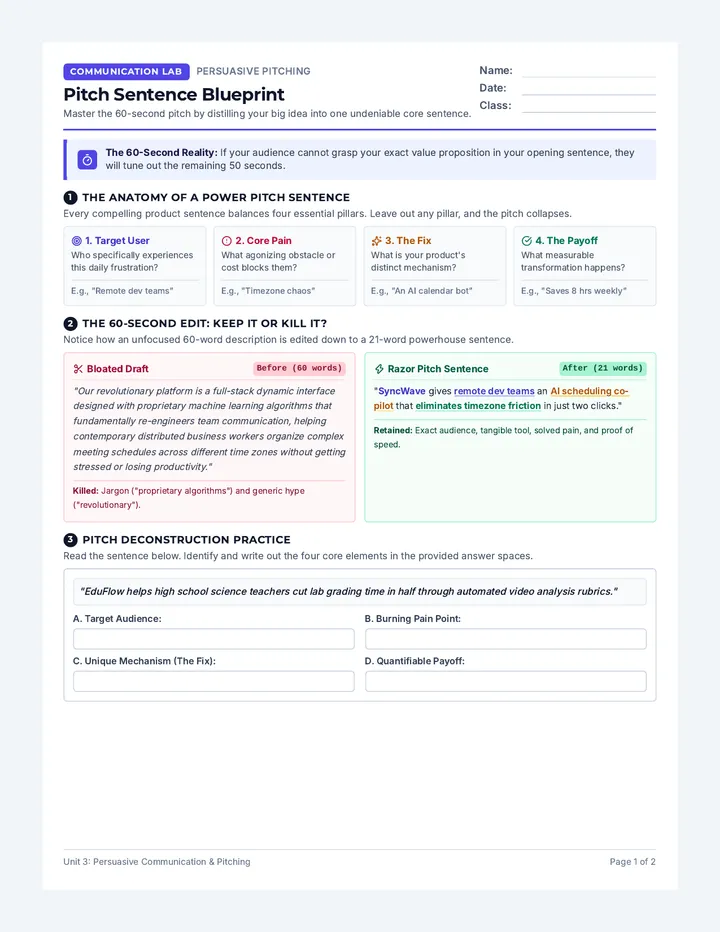
A step-by-step strategy to help your partner cut pages of notes into one sharp minute
Step 1: The Note Filter (What Stays vs. What Goes)
Keep These (The Core 4)
-
- The Frustration: What exact problem makes people annoyed, tired, or broke?
-
- The Simple Fix: What does your product do in one plain, easy sentence?
-
- The Main Benefit: Why is your solution way better than doing nothing?
-
- The Clear Ask: What do you want judges to do next (vote, ask questions, support)?
Cut These (Save for Q&A)
- ✕ Origin Story: "I was sitting in my room on a Tuesday..." (Too long!).
- ✕ Manufacturing Details: Factory steps, code lines, or parts lists.
- ✕ Tiny Financial Specs: Multi-year projected revenue spreadsheets.
- ✕ Confusing Jargon: Buzzwords that cloud the main point.
Step 2: The 60-Second Timing Blueprint
0:00 – 0:10
The Hook
Grab attention with a relatable question or pain point.
0:10 – 0:30
Problem & Fix
State who needs help and how your product delivers it.
0:30 – 0:50
The Edge
Show why this is smarter, faster, or easier than rivals.
0:50 – 1:00
The Close
A memorable final line and clear call to action.
Accountable Talk Stems to Say Out Loud to Your Classmate
To Validate:
"I can tell you put a lot of work into this. Let's find your top three strongest sentences."
To Suggest Cuts:
"This detail is interesting, but does the judge need it in the first 60 seconds or in the Q&A?"
To Check Clarity:
"If a 5th grader heard this pitch, what is the one big thing they would say our product does?"
Partner Practice & Quick Notes Box Write notes directly below
Classmate's Core Problem:
The 1 Thing to Cut:
Timed Practice 1: _____ sec Timed Practice 2: _____ sec Final Verdict: Ready! [ ]