Wealth and Dream Slides Grade 11 ELA • 70-Minute Block
PA Standards: CC.1.3.11-12.A & B
The Great Gatsby • Weeks 4–6
Gatsby, Wealth &
The American Dream
Investigating how material extravagance masks existential longing in F. Scott Fitzgerald's Jazz Age masterpiece.
Pacing: 70 Minutes
Objective: Analyze Theme & Status
Evidence-Based Reasoning
Opening Protocol • 7 Minutes
Classroom Do Now
Does having more money automatically make someone happier?
Prompt: In your packet, write a 3–4 sentence response. Consider:
What money can realistically buy (security, luxury, access)
What money cannot solve (genuine love, peace of mind, identity)
How modern society equates net worth with personal value
Turn & Talk Partner Share: 2 minutes after silent writing Be prepared for cold call share-outs!
Learning Opportunity 1 • Text Study
The Architecture of Opulence
West Egg Palace
A colossal replica of the Hôtel de Ville in Normandy, equipped with a marble swimming pool, forty acres of manicured lawn, and a private beach.
"A factual imitation of some Hôtel de Ville in Normandy..." (Ch. 1)
The Spectacle Machine
Cream-colored Rolls-Royce, hydroplanes, crates of fresh Florida oranges juiced by electric machines, and live full-orchestra weekend bashes.
"People were not invited—they went there." (Ch. 3)
Key Question: Why must Gatsby make his wealth so theatrical and public?
Learning Opportunity 2 • Sorting Activity
15 Minutes • Critical Analysis
Activity Protocol: "Rich or Successful?"
Examine the 6 real-world and character scenarios on Page 1 of your handout. Categorize each into one of four columns:
1. Looks Successful
Flashy markers, social clout, luxury facade
2. Actually Successful
Inner peace, fulfillment, genuine relationships
3. Could Be Both
Financial abundance aligning with moral purpose
4. Not Enough Info
External clues do not reveal true status
Turn to Page 1 of your Student Packet Gatsby Connection: Where does Jay Gatsby belong?
Four Corners Debate • 18 Minutes
Whole-Class Discussion
Core Philosophical Statement
"Anyone in America can achieve the American Dream if they work hard enough."
Corner 1
Corner 2
Corner 3
Corner 4
Rule: Each group must cite 1 text example and 1 modern example! PA Standard: CC.1.4.11-12.C
Synthesis & Context • 15 Minutes
Historical Shift
The Founding Ideal
Traditional American Dream
Rooted in Benjamin Franklin's virtues: thrift, industry, honesty
Independent self-reliance and moral integrity
Success measured by family stability and civic respect
The 1920s Distortion
The Jazz Age Dream
Obsession with overnight wealth, bootlegging, speculation
Status signaled through lavish parties and luxury brands
Gatsby's belief that money can erase five years of reality
Synthesis Discussion: Did Gatsby corrupt the American Dream, or did the 1920s corrupt Gatsby?
Wrap-Up • Final 8 Minutes
Daily Formative Assessment
Complete Both Prompts on the Back of Your Handout
Prompt 1 (Wealth Theme):
"Gatsby's wealth is important because _______________________________________."
Prompt 2 (American Dream):
"Gatsby's American Dream is different from the traditional American Dream because _______________________________________."
Turn in to the classroom bin on your way out! Next Class: Chapter 3 In-Class Reading & Facades
Wealth and Dream Packet The Great Gatsby • Grade 11 ELA PA Core: CC.1.3.11-12.A & B • 70-Min Block
Gatsby, Wealth & The American Dream
Name: ______________________ Date: __________ Period: ____
Do Now (7 Mins)
Does having more money automatically make someone happier? Why?
Consider what material wealth can purchase versus what it cannot resolve. Provide 2–3 reasons.
Learning Opportunity 2
"Rich or Successful?" Sorting Activity
15 Minutes • Critical Analysis
Categorize each scenario below by placing a checkmark in one column, then write your quick rationale.
Scenario / Observation Looks Actual Both Unsure Brief Justification 1. A tech executive earns $800k, drives luxury sports cars, but sleeps 4 hours and has no close friends.
|
|
|
|
| 2. A community teacher lives in a modest apartment, mentors youths, and expresses deep daily gratitude. |
|
|
|
|
|
| 3. Jay Gatsby hosts 500 guests with live orchestras and champagne towers, yet stands solitary on the dock. |
|
|
|
|
|
| 4. Tom and Daisy Buchanan live in East Egg inherited wealth, traveling carelessly while ruining lives. |
|
|
|
|
|
Textual Connection • Jay Gatsby Analysis
Based on your sorting above, is Jay Gatsby "rich," "successful," or both? Cite one specific detail from Chapter 1–3 (his mansion, cars, or library) to support your claim.
Unit: Gatsby & Modernism Lesson 1 • Page 1 of 2 PA Standard CC.1.3.11-12.B (Evidence)
Part II: Four Corners & Thematic Synthesis
PA Standard: CC.1.4.11-12.C
Debate Claim
"Anyone can achieve the American Dream if they work hard enough."
AGREE
DISAGREE
IT DEPENDS
UNSURE
Corner Justification & Text Evidence:
Explain your stance. Provide at least one piece of text evidence from Gatsby or historical context.
Synthesis Comparison Table
Traditional American Dream
Defined by modest self-sufficiency, civic virtue, moral dignity, and gradual improvement over generations.
Appearance Reality Slides Wednesday In-Class Reading • 70 Min Block
PA Standards: CC.1.3.11-12.A, B & C
Chapter 3 Guided Close Reading
Appearance vs. Reality:
The Great Facade
Investigating the rumors, the uncut library books, and the manufactured persona of Jay Gatsby.
Focus: Chapter 3 Reading
Method: What You See vs. True
Analysis: Owl Eyes & Illusion
Do Now • 6 Minutes
Personal Reflection
Can you always tell who someone really is?
Quickwrite: Think of how people curate images on social media or in public spaces.
What cues do we use to judge whether someone is genuine or artificial?
Why do individuals construct elaborate personas for public view?
Write 2–3 sentences in Part 1 of your investigation guide.
Turn & Talk: Share your thoughts with an elbow partner (90 seconds). Next up: Chapter 3 Read-Aloud!
In-Class Reading • 25 Minutes
Chapter 3 Guided Protocol
Passage A: The Carnival
Pages 39–43
Observe Nick entering Gatsby's garden. Note the orchestra, floating rumors ("He killed a man"), and guests who were never invited.
Passage B: Owl Eyes
Pages 45–46
The Gothic library scene: A drunken spectator discovers Gatsby's library contains real books, but with uncut pages!
Passage C: The Host
Pages 47–50
Nick meets the host without realizing it. Gatsby's famous smile: an irresistible piece of reassuring theater.
Annotation Task: Underline every rumor or sensory detail that seems theatrical. PA Standard: CC.1.3.11-12.B
Close Reading Focus • Textual Evidence
The High Gothic Library
"About that. As a matter of fact you needn't bother to ascertain. I ascertained. They're real... Absolutely real—have pages and everything. I thought they'd be a nice durable cardboard... Didn't cut the pages, though. A regular Belasco. What thoroughness!"
Theatrical Genius (David Belasco):
Belasco was a famous Broadway producer known for hyper-realistic stage sets. Gatsby bought genuine antique books so the set wouldn't collapse under casual inspection.
The Uncut Pages:
In the 1920s, book pages were folded and needed to be sliced open with a paper knife to be read. Gatsby owns the library, but has never opened a single page!
Question: Is Gatsby an authentic intellectual, or a master stage director?
Appearance Reality Guide The Great Gatsby • Chapter 3 In-Class Reading PA Core: CC.1.3.11-12.B & C • 70-Min Block
Appearance vs. Reality: The Manufactured Man
Name: ______________________ Date: __________ Period: ____
Do Now (6 Mins)
Can you always tell who someone really is? Explain why or why not.
Think about social facades and curated personas. Provide 2–3 sentences of reflection.
Learning Opportunity 1
Chapter 3 Close Reading Evidence Tracker (20 Mins)
Active Annotation
The Rumor Mill (Pages 43–44):
List two contradictory rumors Gatsby's guests circulate about his past:
The Library Discovery (Page 45):
What does Owl Eyes discover about the books? Why does it surprise him?
Learning Opportunity 2
"What You See / What's Really There" Matrix
PA Standard: CC.1.3.11-12.C
Contrast the public perception with the underlying truth using clues from Chapters 1–3.
Element What People See (The Facade) What May Actually Be True (The Reality) Gatsby is rich
|
| Gatsby throws huge parties |
|
|
| Gatsby knows everyone |
|
|
| Gatsby is confident |
|
|
Unit: Gatsby & Modernism Lesson 2 • Page 1 of 2 Pennsylvania Core Standards Aligned
Part II: Textual Analysis & Synthesis
PA Standard: CC.1.3.11-12.A & D
Passage Analysis • The Library
"A regular Belasco. It's a triumph. What thoroughness! What realism! Knew when to stop too—didn't cut the pages. But what do you want? What do you expect?" (Chapter 3)
1. Historical Allusion Analysis:
David Belasco was a famed Broadway producer famous for building ultra-realistic stage sets. Why does Owl Eyes compare Gatsby to Belasco? What does this reveal about Gatsby's entire lifestyle?
2. Symbolism of the "Uncut Pages":
Explain the symbolic meaning of having real books that have never been cut or read. How does this connect to Gatsby's identity?
Synthesis
Why does Fitzgerald repeatedly contrast appearance and reality?
Synthesize your discussion on Jazz Age society, Gatsby's hidden past, and the American Dream.
Daily Exit Ticket (8 Mins) PA Standard: CC.1.4.11-12.C
Complete the prompt with specific evidence:
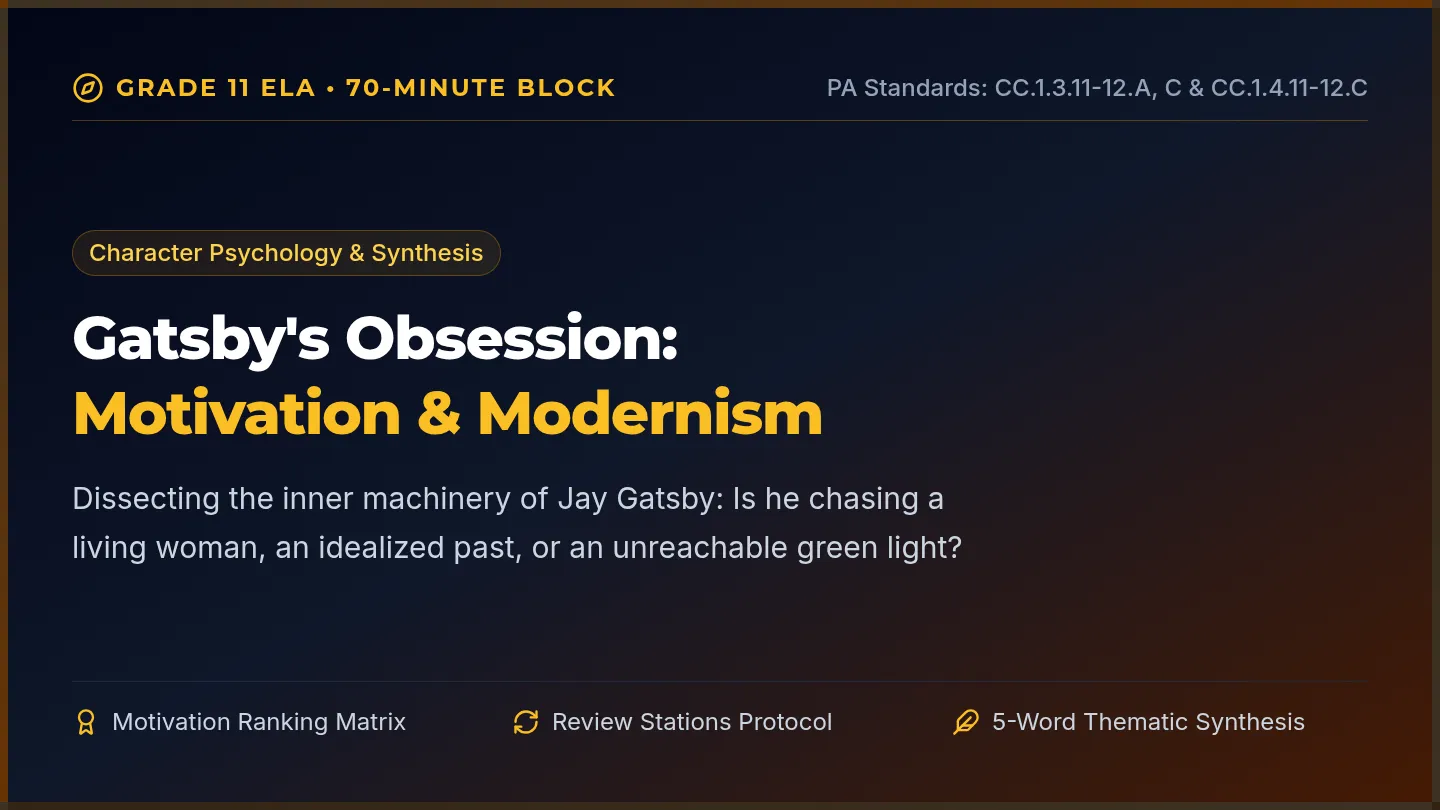
Gatsby Motivation Slides Grade 11 ELA • 70-Minute Block
PA Standards: CC.1.3.11-12.A, C & CC.1.4.11-12.C
Character Psychology & Synthesis
Gatsby's Obsession:
Motivation & Modernism
Dissecting the inner machinery of Jay Gatsby: Is he chasing a living woman, an idealized past, or an unreachable green light?
Motivation Ranking Matrix
Review Stations Protocol
5-Word Thematic Synthesis
Do Now • 6 Minutes
Classroom Opening
What would you be willing to do to achieve your biggest life goal?
Self-Reflection: Consider ambition, ethics, and boundaries.
Would you sever contact with your family to reinvent yourself?
Would you break laws or build a false facade to win back someone you lost?
Write 2–3 sentences in Part 1 of today's packet.
Turn & Talk: Share one ethical boundary you would never cross. Next: The 6 Drivers of Jay Gatsby
Learning Opportunity 1 • The 6 Drivers
What Fuels the Machine?
1. Love
An undying, obsessive devotion to winning back Daisy Fay Buchanan.
2. Wealth
The thrill of material accumulation and sheer financial dominance.
3. Status
Desire for aristocratic validation from Old Money elites like Tom Buchanan.
4. Revenge
Avenging the humiliation of being rejected when he was a penniless soldier.
5. Reinvention
Erasing James Gatz from North Dakota and creating an immortal persona.
6. The Dream
Belief that human will can conquer time, class barriers, and destiny.
Next Step: Rank these 1 through 6 on Page 1 of your packet with textual citations!
Learning Opportunity 2 • 15 Minutes
Motivation Ranking Protocol
Rules of the Evidence Trial
1
Rank 1 to 6: Decide which driver is #1 (strongest) down to #6 (least influential).
2
Text Citation Requirement: For your #1 and #2 ranks, cite a specific action, object, or line of dialogue from the novel.
3
Partner Defense: Defend your ranking to your table group. Did anyone rank Status above Love?
Turn to Page 1: Motivation Ranking Matrix PA Standard: CC.1.3.11-12.B (Evidence)
Synthesis Inquiry • 12 Minutes
The Core Mystery
Is Gatsby chasing a person, a dream, or an image?
Motivation Review Packet The Great Gatsby • Grade 11 ELA PA Core: CC.1.3.11-12.B & C • 70-Min Block
Gatsby's Motivation & Thematic Synthesis
Name: ______________________ Date: __________ Period: ____
Do Now (6 Mins)
What would you be willing to do to achieve your biggest life goal?
Consider ethics, personal relationships, and identity reinvention. Provide 2–3 sentences.
Learning Opportunity 2
Motivation Ranking & Textual Evidence Matrix (18 Mins)
Rank 1 (Highest) to 6 (Lowest)
Determine which factor drives Gatsby most. Provide specific novel evidence for your top 3 ranks.
Rank Driver Operational Definition Specific Text Evidence / Chapter Scene Love Reclaiming Daisy Buchanan as his romantic destiny.
|
|
| Wealth | Material accumulation and sensory extravagance. |
|
|
| Status | Social validation from the Old Money aristocracy. |
|
|
| Revenge | Overcoming the shame of past poverty and rejection. |
|
|
| Reinvention | Erasing James Gatz to live as a self-created myth. |
|
|
| American Dream | Proving anyone can rewrite fate through willpower. |
|
Synthesis Question
Is Gatsby chasing a person, a dream, or an image?
Select one option and defend your claim using at least one piece of textual evidence.
Unit: Gatsby & Modernism Lesson 3 • Page 1 of 2 PA Standard CC.1.3.11-12.C
Part II: Review Stations & Thematic Mastery
PA Standard: CC.1.3.11-12.A
Review Stations
Open-Note Station Rotation Findings (16 Mins)
4 Stations • 4 Mins Each
Station 1: Symbols (Green Light & Valley)
What does the green light across the bay symbolize for Gatsby?
Station 2: Wealth (East Egg vs. West Egg)
How does Fitzgerald contrast inherited wealth with "new money"?
Station 3: Modernism & Isolation
How does Gatsby's loneliness in a crowd reflect Modernist themes?
Station 4: Character Motivation
Why does Daisy stay with Tom despite Gatsby's grand display?
Synthesis Challenge Strict Rule: Exactly 5 Words
"Gatsby in 5 Words"
Summarize the core tragedy or theme of Jay Gatsby in exactly five words: