A comprehensive 6th-grade reading comprehension lesson exploring the biological science and ecological wonder of autumn leaf changes. Students analyze text structure, uncover domain-specific vocabulary, and cite text evidence across multiple question formats.
Match each term to its definition (write letter A-D)
1. Chlorophyll Letter: [ ]
2. Carotenoids Letter: [ ]
3. Anthocyanins Letter: [ ]
4. Abscission Layer Letter: [ ]
A. Red pigment newly made from trapped autumn sugars.
C. Green pigment that continuously breaks down in sunlight.
B. Cork-like cell barrier that cuts the leaf stem cleanly.
D. Yellow/orange pigment hidden under green all summer.
THE AMBER CANOPY • COMPREHENSION PRACTICE Standards: CCSS RI.6.1, RI.6.2, RI.6.4, RI.6.5
Part 1: Text Analysis (Circle one answer per question)
1. [Central Idea] Which statement best expresses the central idea of the entire passage?
A. Autumn frost freezes green leaves, forcing them to turn orange and fall.
B. Leaf color change is an active survival process that prepares trees for winter.
C. Anthocyanins are the primary food source trees use during cold winter storms.
D. Trees lose leaves because strong autumn windstorms physically rip them off twigs.
2. [Vocabulary] In Paragraph 3, what is the meaning of the word "photoperiod"?
A. The chemical reaction that produces green chlorophyll in direct sunlight.
B. The exact temperature drop that occurs during the first frost of winter.
C. The duration of daylight hours an organism receives each day.
D. The period when fallen leaves decompose into organic compost.
3. [Text Structure] How does Paragraph 4 use cause-and-effect structure to explain red leaves?
A. It contrasts red leaves with yellow leaves across different plant species.
B. It shows how blocked leaf veins trap sugars, causing anthocyanins to form.
C. It lists the chronological dates when leaves change in northern states.
D. It explains the problem of bug infestations and offers autumn as a solution.
4. [Inference] Based on Paragraph 5, why is sealing the twig with the abscission layer essential?
A. It prevents destructive moisture loss and shields internal tissues from infection.
B. It ensures that the leaf stays securely attached through high winter gales.
C. It allows tree roots to absorb extra rainwater during heavy winter blizzards.
D. It stimulates new green chlorophyll buds to begin unfurling immediately.
Part 2: Citing Textual Evidence (RI.6.1)
2-3 sentences • Cite Paragraph #
5. In Paragraph 4, the author compares anthocyanins to "botanical sunscreen." Explain why the tree produces this sunscreen right before dropping its leaves. Cite one direct phrase from the text.
Part 3: Extended Synthesis Response (RI.6.1, W.6.9)
Full paragraph response
6. Many people believe that leaves changing color and falling is simply a sign of decay and death. Using details from across the passage, explain why autumn foliage is actually an act of living survival.
Misconception 2: "Red leaves were also hiding under the green all summer." Scientific Clarification: Anthocyanins (red/purple) are newly manufactured in late autumn using trapped sugars to act as protective sunscreen while nutrients are reclaimed.
Misconception 3: "Falling leaves mean the tree has died or been hurt." Scientific Clarification: Leaf dropping (abscission) is an active defense preventing dehydration and winter branch breakage from heavy snow loads.
Differentiation Pathways for Tiered Learners
Striving Readers (Tier 2)
Provide pre-highlighted paragraph numbers matching each question.
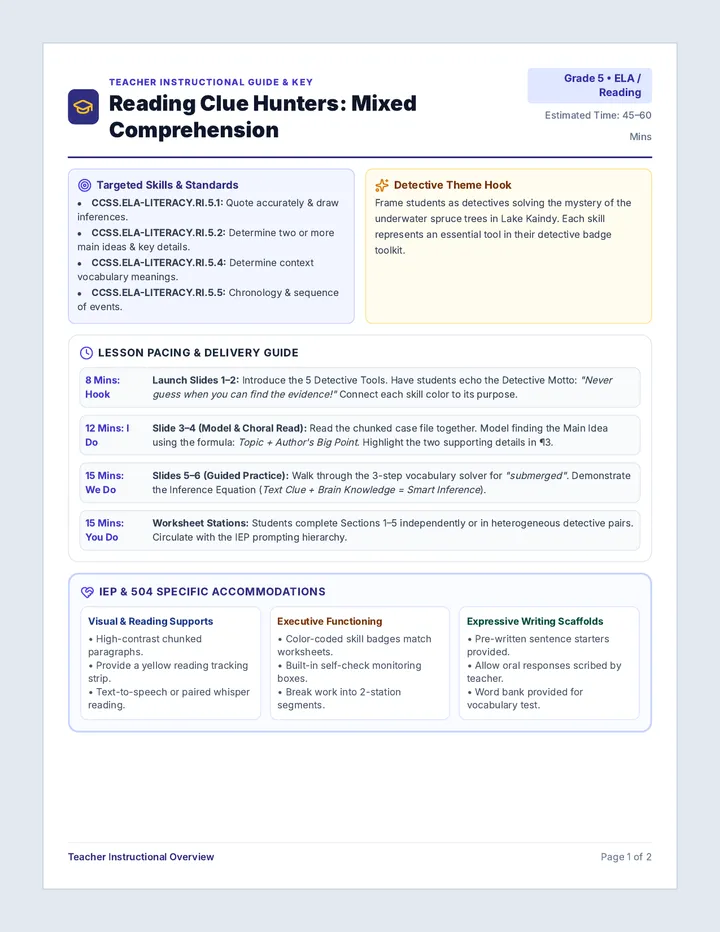
Use the visual pigment chart on Slide 2 as a desktop anchor sheet.
Partner read with a bilingual peer during the guided second read.
Use physical leaf samples to illustrate the abscission stem break.
Advanced Learners
Ask students to compare deciduous dormancy to animal hibernation.
Challenge students to research how climate change and warming autumns affect foliage timing.
Formative Assessment Checkpoints
Quick Check (Minute 15): After reading Paragraph 3, do a cold call: "Point to the word in paragraph 3 that tells us what triggers leaf change." 90% of students should point to "daylight" or "photoperiod".
Mid-Worksheet Circulation (Minute 35): Check Question 3 on student worksheets. If students confuse cause and effect with chronological order, redirect them to the transition words in Paragraph 4.
Exit Ticket Check (Minute 55): Review student written responses to Question 6 using the 4-point rubric in the Answer Key.
Exemplar Student Response:
"The author compares anthocyanins to 'botanical sunscreen' because they protect leaf cells from intense sunlight while the tree recovers nutrients. Paragraph 4 states that anthocyanins act by 'shielding vulnerable cells from harsh ultraviolet light so the tree can scavenge every last drop of reusable nitrogen and phosphorus.' This allows the tree to safely store food before winter."
• 1 pt: Clearly explains the protective function of sunscreen (guards against harsh sunlight/UV).
• 1 pt: Connects to nutrient recovery (reabsorbing nitrogen, phosphorus, or sugars).
• 1 pt: Accurately cites direct phrase or quotation from Paragraph 4.
Exemplar Student Response (RACE Framework):
"Although many people believe autumn foliage is just the forest dying, the text proves that leaf drop is an essential survival strategy. In Paragraph 1, the author explains that leaf change is a 'masterclass in living strategy' that allows deciduous trees to endure freezing winter conditions. In Paragraphs 4 and 5, the passage explains that trees actively reclaim vital nitrogen and phosphorus before creating an 'abscission layer' to seal their twigs. Without dropping broad leaves, the tree would suffer 'life-threatening moisture loss during frozen winter droughts' and broken branches from heavy snow. Therefore, colorful autumn leaves represent active biological preservation, not passive death."
4-Point Extended Response Analytic Rubric
Score 4: Advanced
States clear claim refuting the decay myth; integrates at least 2 direct quotes/citations; synthesizes nutrient reclamation and moisture protection flawlessly.
Score 3: Proficient
States clear claim; includes accurate text evidence from the passage; explains how leaf loss protects the tree against winter freezing or dehydration.
Score 2: Developing
States a basic claim; mentions colors or leaves falling but lacks specific text citations or confuses the biological mechanisms involved.
Score 1: Emerging
Minimal response; does not address the prompt; relies on personal opinion rather than informational text facts.