Useful Words Teacher Guide
Kindergarten Structured Literacy
Useful Words Teacher Guide
Orthographic Mapping Approach
Moving Beyond Visual Memorization
The Classroom Launch: Introducing "Useful Words"
Instead of telling young learners they must "memorize sight words by looking at them," introduce them as Useful Words—special tools that appear in almost everything we say, hear, read, and write!
Teacher Launch Script: "Readers, today we are starting an exciting mission! We are going to learn some of the most useful words in the whole world. Do you know why they are useful? Because we use them dozens of times every single day when we talk and read! Our brain doesn't just take a photograph of them—we are going to be word detectives. We will listen to their sounds, see which letters match those sounds, and learn the secret keys that make them work!"
Why Rote Memorization Struggles
- • Human visual memory treats words like arbitrary pictures (requires 50–100+ exposures).
- • Students confuse similar shapes (e.g., was/saw, where/there, on/no).
- • Does not build decoding pathways to read novel words.
The Orthographic Mapping Advantage
- • Connects speech sounds (phonemes) directly to letters (graphemes).
- • Most "sight words" are fully or mostly regular (e.g., at, in, can, it).
- • Brain binds sounds and spellings into instant sight memory in 1–4 exposures.
The 5-Step Explicit Teaching Routine (7–10 Mins Daily)
Explicit • Systematic • Multi-sensory
1
Say & Isolate Sounds (Speech to Print)
Say the word aloud in a natural sentence. Have students echo it. Tap out the phonemes together using finger-tapping or felt chips (e.g., for "and": /a/ - /n/ - /d/ = 3 sounds).
2
Map with Sound Boxes (Elkonin Boxes)
Draw one box for each sound heard. Push a chip or token into each box as students say the individual sounds aloud before introducing any letters.
3
Link Sounds to Letters (Regular Parts First)
Prompt: "What letter makes the /s/ sound in 'said'?" Write the letters students already know in their corresponding sound boxes. Celebrate what makes sense!
4
Discover the "Heart Part" (The Tricky Spell)
Identify the part that doesn't follow expected phonics rules yet (e.g., the 'ai' in said making /e/). Place a small red heart above that specific grapheme: "We learn this part by heart!"
5
Write, Say, & Apply in Context
Students trace the word with two fingers (skywriting while spelling out letter names), write it on dry-erase boards, and immediately read/complete a simple shared sentence.
Kindergarten High Frequency Word Guide • Section 1: Pedagogical Framework Page 1 of 3
Classroom Application
High-Impact Interactive Routines
Active Student Engagement
1. Tap It, Map It, Graph It
Every student gets a 3-box mapping strip with magnetic chips and a dry-erase marker.
Tap: Tap chin or arm for every sound.
Map: Push chip into box for each phoneme.
Graph: Replace chip with matching letter.
Best for: Daily whole-group phoneme-grapheme work.
2. Heart Word Detectives
Turn students into detectives hunting for which letters follow our sound rules and which need a "heart."
Clue 1: "Which sound do we know?" (e.g. th in the)
Clue 2: "What does the e sound like?" (sounds like /uh/)
Solve: Glue a mini paper heart over the e.
Best for: De-mystifying irregular / high-utility words.
3. "Useful Word" Flash Hunt
Connect isolated words immediately to connected text inside giant shared reading big books.
Search: Give a student a highlighter tape wand.
Frame: Frame the target useful word in the text.
Verify: Choral read the full sentence to hear its meaning.
Best for: Generalizing target words into real literature.
4. Rapid Dictation & Skywrite
Encoding (spelling) cements orthographic mapping much faster than visual recognition alone.
Arm Muscle: Say letter names while air-writing large.
Whiteboard: Write word from sound memory.
Check: "Dot the regular sounds, heart the surprise!"
Best for: Fast 3-minute review and daily warm-ups.
Strategic Sequence for Kindergarten Useful Words
Group A: 100% Decodable No Heart Needed
Words: at, in, it, on, up, an, can, and, got, had
Teach as soon as the corresponding short vowels and consonants are introduced. Students use standard sounding out!
Group B: "One-Heart" Words 1 Tricky Part to Learn
Words: the, a, is, his, as, to, do, of, into
is/his: /s/ says /z/ (very common rule). the: 'th' is regular; 'e' is schwa /uh/. to/do: 'o' says /oo/.
Group C: Open Syllable Family Long Vowel Patterns
Words: he, she, we, me, be, go, no, so
Teach together in families! "When a vowel is at the end of a short door, it shouts its own name!"
Transform Your Word Wall into a "Sound Wall / Useful Word Bank"
Organize words by their vowel sound or phonics pattern, NOT by the first letter. Sorting the, that, this under 'T' alongside tiger confuses young decoders.
Kindergarten High Frequency Word Guide • Section 2: Routines & Word Sequence Page 2 of 3
Step-by-Step Lesson Script
Classroom Modeling: Teaching "THE"
Exemplar Dialogue
Teacher & Student Classroom Interaction
Teacher: "Our useful word today is in almost every story we read: the! Listen: I pet the cat. What word?"
Students: "The!"
Teacher: "Let's tap the sounds in the: /th/ ... /uh/. How many sounds did your fingers feel?"
Students: "Two sounds!"
Teacher: "Two sounds! I will draw two sound boxes on my board. First sound is /th/. What team of two letters makes /th/?"
Students: "T and H!"
Teacher: "Yes! T-H goes in our first box. It plays right by our sound rules, so it gets a green dot!"
Teacher: "Now, the second sound is /uh/. In this useful word, that sound is spelled with the letter e! That's a little surprising, isn't it? Because that letter doesn't make its usual sound here, we put a little heart above the e. That means: we learn that one little letter by heart!"
Teacher: "Let's skywrite it: T - H - (touch heart) E! Read it: the!"
Visual Sound Map:
th
e
● Green dot: Regular sound /th/
♥ Heart: The tricky part (letter e says /uh/)
Common Pitfalls vs. Science of Reading Alternatives
Traditional Outdated Practice
Explicit "Useful Words" Practice
Using "word shape" outline boxes (tall, short, fall letters).
Use sound boxes based on phonemes, not visual exterior silhouettes.
Telling kids: "You just have to memorize it; it doesn't make sense."
Show students that most parts do follow rules; isolate only the unique part.
Sending home rings of 50 isolated flashcards for drills.
Provide decodable sentence strips and sound-mapping cards for meaningful practice.
Quick 1-Minute Progress Check (Formative Assessment)
Check both reading (decoding) AND spelling (encoding) to ensure true orthographic mapping:
1. Sound Tap Student can tap exact count of sounds in spoken word.
2. Heart Identify Student points out which letter is the "heart part".
3. Dictation Check Student writes word accurately in a 3-word dictated sentence.
Kindergarten High Frequency Word Guide • Section 3: Scripts & Best Practices Page 3 of 3
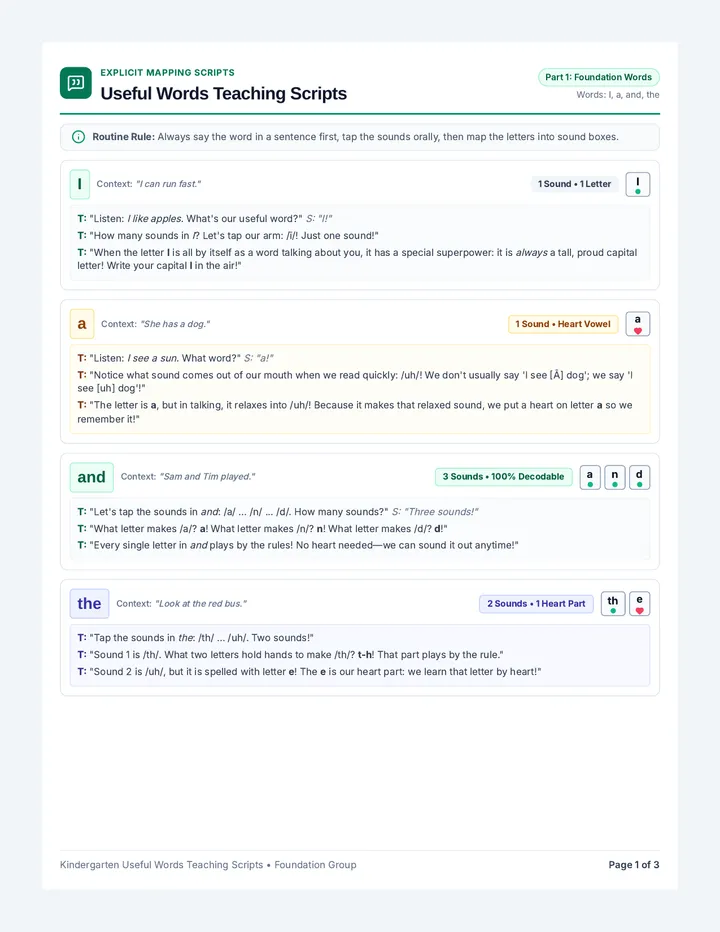
Useful Words Teaching Scripts
Explicit Mapping Scripts
Useful Words Teaching Scripts
Part 1: Foundation Words
Words: I, a, and, the
Routine Rule: Always say the word in a sentence first, tap the sounds orally, then map the letters into sound boxes.
I Context: "I can run fast."
1 Sound • 1 Letter
I
T: "Listen: I like apples. What's our useful word?" S: "I!"
T: "How many sounds in I? Let's tap our arm: /ī/! Just one sound!"
T: "When the letter I is all by itself as a word talking about you, it has a special superpower: it is always a tall, proud capital letter! Write your capital I in the air!"
a Context: "She has a dog."
1 Sound • Heart Vowel
a
T: "Listen: I see a sun. What word?" S: "a!"
T: "Notice what sound comes out of our mouth when we read quickly: /uh/! We don't usually say 'I see [Ā] dog'; we say 'I see [uh] dog'!"
T: "The letter is a, but in talking, it relaxes into /uh/! Because it makes that relaxed sound, we put a heart on letter a so we remember it!"
and Context: "Sam and Tim played."
3 Sounds • 100% Decodable
a
n
d
T: "Let's tap the sounds in and: /a/ ... /n/ ... /d/. How many sounds?" S: "Three sounds!"
T: "What letter makes /a/? a! What letter makes /n/? n! What letter makes /d/? d!"
T: "Every single letter in and plays by the rules! No heart needed—we can sound it out anytime!"
the Context: "Look at the red bus."
2 Sounds • 1 Heart Part
th
e
T: "Tap the sounds in the: /th/ ... /uh/. Two sounds!"
T: "Sound 1 is /th/. What two letters hold hands to make /th/? t-h! That part plays by the rule."
T: "Sound 2 is /uh/, but it is spelled with letter e! The e is our heart part: we learn that letter by heart!"