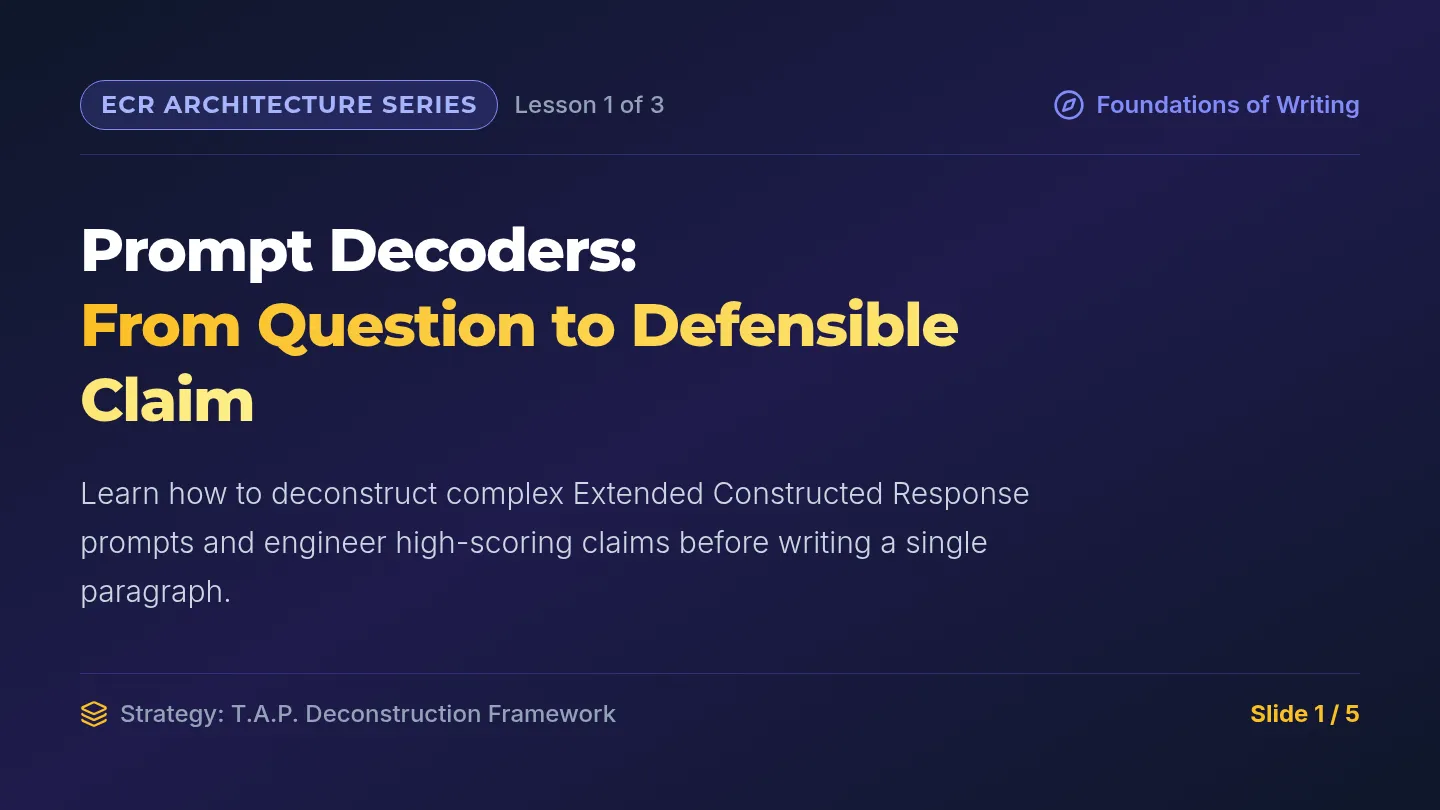
Prompt Decoder Slides ECR Architecture Series Lesson 1 of 3
Foundations of Writing
Prompt Decoders:
From Question to Defensible Claim
Learn how to deconstruct complex Extended Constructed Response prompts and engineer high-scoring claims before writing a single paragraph.
Strategy: T.A.P. Deconstruction Framework
Slide 1 / 5
What Makes an ECR Stand Out?
Anatomy of Success
1. Clear Claim
Directly answers every part of the prompt with a firm, arguable stance grounded in the passage.
The Foundation
2. Text Evidence
Direct quotes or key facts precisely selected to prove the claim, not just pad word count.
The Building Blocks
3. Elaboration
Your original commentary explaining how and why the evidence proves your big idea.
The Glue & Power
Key Insight: Most lost points on ECRs happen in the first 2 minutes by misreading what the prompt is actually asking!
The T.A.P. Dissection Strategy
Step 1: Decode Before Writing
T
Topic
What is the subject matter or central concept?
Ask: "What specific issue or event in the text am I investigating?"
A
Audience
Who is reading this piece and what tone is expected?
Rule: Formal academic voice; clear, objective, and authoritative.
P
Purpose & Task
What action verb dictates what you must accomplish?
Look for: Analyze, explain, argue, evaluate, compare, defend.
Action Habit: Circle the topic, box the task verbs, and underline required evidence types.
Model Prompt Breakdown
Teacher Modeling
Sample Middle School ECR Prompt:
“Based on the passage, explain how urban tree canopies benefit city residents and why communities should invest in neighborhood planting programs. Support your response with evidence from the text.”
Task 1 Explain the physical/social benefits of trees.
Task 2 Justify why funding should be invested.
The Two-Part Requirement:
If you only describe shade without justifying community investment, you cap your score at 50%!
Notice how multi-part prompts require a compound claim with two distinct focus areas.
The Defensible Claim Formula
Engineering Your Claim
Formula for Claim Success:
[Restate Prompt Question] + [Specific Stance / Big Idea] + [Reason 1] + [Reason 2]
Weak & Incomplete Claim
“Urban trees are very good for cities and everyone likes them because they look nice.”
× Fails to address community investment; too vague.
Strong Defensible Claim
“Urban tree canopies benefit city residents by reducing dangerous heat islands, which justifies neighborhood investment because it protects public health and lowers energy costs.”
✓ Addresses both tasks; sets up two clear body paragraphs.
Ready for Student Practice: Open your Claim Builder Worksheet to test this formula!
Claim Builder Worksheet Argument Architecture Series • Lesson 1 Student Practice Document
Claim Builder Worksheet
Deconstructing Multi-Part Prompts & Engineering Defensible Claims
Name:
Date:
Class:
Period:
Strategy Anchor: The T.A.P. Deconstruction Framework
T – Topic What specific subject, event, or problem is the prompt centered on?
A – Audience & Tone Academic evaluator. Requires formal diction, no casual slang, objective tone.
P – Purpose & Tasks Identify all action verbs (explain, argue, compare). Multi-part prompts require compound claims!
Part 1: Prompt Dissection Drills
Read each prompt. Identify the Topic, Audience, and Task Verbs, then note whether the prompt contains multiple tasks.
Prompt A: “Read the article on screen time. Write an extended response explaining how excessive digital screen use affects adolescent sleep cycles and evaluate whether school districts should implement digital wellness policies.”
Topic:
Key Task Verbs:
Number of Tasks & Goals:
Prompt B: “After reading about deep-sea exploration, analyze the environmental risks of seabed mining and explain why international oversight is essential to marine conservation.”
Topic:
Key Task Verbs:
Number of Tasks & Goals:
Part 2: Claim Quality Diagnostic
Evaluate the student claim below written in response to Prompt A. Label it Weak or Strong , then explain why.
“Screens are bad for teenagers because they stay up late watching videos and don't sleep well.”
Rating:
Strong Weak
Critique (What is missing based on Prompt A's requirements?):
Middle School ECR Practice • Prompt & Claim Architecture Page 1 of 2
Argument Architecture Series • Lesson 1 Independent Application
Passage-Based Claim Formulation
Informational Passage: The Highway Barrier Problem Lexile: 880L • Word Count: 195
Every year, tens of thousands of large animals are struck by vehicles on North American highways, costing millions of dollars in damages and causing severe human injuries. Beyond direct collisions, highways create ecological “fractures.” When a six-lane highway cuts through an ecosystem, it divides animal populations, preventing natural migration, foraging, and genetic diversity.
In response, engineers in Banff National Park created over 40 wildlife overpasses—massive bridge structures covered in native soil, grass, and trees. Wildlife cameras documented over 150,000 crossings by elk, wolves, and bears, reducing vehicle-wildlife collisions by more than 80 percent. While critics point to the steep initial price tag of roughly $4 million per overpass, wildlife biologists calculate that avoiding vehicle collisions and preserving predator-prey ecosystems easily saves regional municipalities millions over several decades.
Evidence Bridge Slides ECR Architecture Series Lesson 2 of 3
Evidence & Elaboration
The Evidence Bridge:
Framing Proof & Engineering Commentary
Stop “quote dropping.” Learn how to introduce textual proof seamlessly and write deep commentary that answers the ultimate question: “So what?”
Strategy: Lead-In + Evidence + Commentary Triad
Slide 1 / 5
The “Quote Drop” Trap vs. The Evidence Sandwich
Structural Flaw
The Floating Quote Trap
A quote dumped into the paragraph with no lead-in speaker, context, or following analysis.
“Trees reduce heat. 'Studies show asphalt temperatures drop by 20 degrees.' Trees are helpful.”
× Disconnected, abrupt, lacks analytical control.
The Evidence Sandwich
Top Bun: Lead-In / Contextual Anchor
The Meat: Precise, Cited Text Evidence
Bottom Bun: Two Sentences of Deep Commentary
✓ Seamlessly guides the reader from claim to proof.
Golden Rule: A quote should never stand alone as its own independent sentence without context.
The 3-Tier Elaboration Ladder
Levelling Up Commentary
Level 1: The Echo (Score 1-2: Restatement)
“This quote shows that temperatures drop 20 degrees when there are trees.”
Critique: Merely summarizes what the text already told us.
1
Level 2: The Cause & Effect (Score 3: Proficient)
“This 20-degree drop occurs because thick foliage blocks direct radiation from baking city streets.”
Success: Explains the scientific mechanism behind the fact.
2
Level 3: The Impact & “So What?” (Score 4: Exemplary)
“Consequently, mitigating extreme heat shields vulnerable residents from heatstroke while drastically trimming household cooling costs.”
Mastery: Proves why this evidence directly justifies the central claim.
3
Target Goal: Combine Level 2 (Mechanism) with Level 3 (Impact) for every piece of evidence!
Retire “This Shows That”
Elevating Academic Diction
Stems for Mechanism & Analysis
• “This detail reveals that...”
• “By emphasizing [X], the author highlights...”
• “This data point illustrates the direct link between...”
Stems for Impact & “So What?”
• “Consequently, this outcome proves that...”
Elaboration Lab Worksheet Argument Architecture Series • Lesson 2 Student Skill Lab
Elaboration Lab Worksheet
Overcoming Quote Dropping & Constructing Analytical Commentary Bridges
Name:
Date:
Class:
Period:
The 2-Sentence Commentary Rule
Sentence 1: Mechanism (How it works) “This data illustrates...” / “By explaining this, the author shows that...”
Sentence 2: Impact / So What? (Why it matters) “Consequently, this outcome proves that...” / “Without this shift, readers realize...”
Part 1: The Quote Repair Clinic
Read the flawed student draft below. Notice the dropped quote that lacks lead-in and analytical follow-through.
Flawed Student Draft:
“Schools need longer lunch periods so students can eat healthy meals. 'Studies show 40% of kids throw away untouched fruit when lunch is under 20 minutes.' This shows kids need more time to eat.”
Rewrite the draft using an integrated lead-in and a Level 2 & 3 commentary bridge:
Part 2: The Commentary Ladder Drill
Given the evidence piece below, draft two levels of commentary to see how analytical depth increases your score.
Given Evidence:
“Pedestrian-only downtown zones increased local shop revenue by 32 percent within six months of street closures.”
Level 2 Commentary (Explain the mechanism: Why did revenue increase?):
Level 3 Commentary (Address the “So What?”: Why does this justify pedestrian policies?):
Middle School ECR Practice • Evidence & Elaboration Page 1 of 2
Argument Architecture Series • Lesson 2 Passage Analysis & Application
Passage Application: Acoustic Ecology
Informational Excerpt: The Roar of the City Lexile: 920L • Word Count: 210
Chronic urban noise is more than an annoyance; researchers now recognize it as a serious public health hazard. Medical studies confirm that prolonged exposure to traffic sounds above 65 decibels elevates cortisol (the stress hormone) and impairs reading comprehension in middle school students attending roadside campuses by nearly 14 percent. Constant background rumble prevents children from distinguishing speech sounds, leading to cognitive fatigue.
To combat this “invisible pollutant,” urban planners are testing “living sound barriers”—thick vegetative walls composed of dense ivy, cedar shrubs, and porous clay cores. Unlike traditional concrete sound walls, which merely bounce acoustic waves toward opposite neighborhoods, vegetative walls absorb sound energy, reducing ambient decibels by 8 to 12 dB. Furthermore, city arborists note that these green walls trap airborne particulate matter, improving air quality for nearby schoolyards.
Full Response Writing Packet Argument Architecture Series • Lesson 3 Summative Writing Assessment
Full Response Writing Packet
Informational Text, Prompt, and Architectural Planning Blueprint
Name:
Date:
Class:
Period:
Informational Source: Hidden Underfoot – The Soil Plastic Dilemma Lexile: 940L • Word Count: 215
For decades, commercial farmers have rolled out thin black polyethylene film across millions of crop acres. This “plastic mulch” warms spring soil, suppresses invasive weeds, and conserves irrigation water, increasing crop yields by up to 30 percent. However, as ultraviolet sunlight and heavy farm machinery shred these thin sheets, microscopic plastic fragments—microplastics—leach permanently into the soil.
Agricultural soil scientists recently discovered that high concentrations of microplastics stunt earthworm reproduction by 45 percent and disrupt the microscopic fungal networks that deliver vital nitrogen to plant roots. In response, agricultural innovators have developed 100% plant-based hemp and cornstarch mulches that decompose into organic compost within one growing season. While these biodegradable films currently cost approximately 20 percent more per acre, environmental economists argue that preserving healthy soil biology avoids catastrophic fertilizer costs and prevents plastic runoff into regional drinking reservoirs.
Extended Constructed Response Prompt:
“Based on 'Hidden Underfoot,' explain how microplastics threaten agricultural soil ecosystems and evaluate whether commercial farmers should transition to biodegradable alternative mulches. Support your response with evidence from the text.”
Architectural Pre-Writing Blueprint
Central Defensible Claim (Answer both tasks with 2 clear reasons):
Body Paragraph 1: Soil Ecosystem Threats Quote + Mechanism Commentary Note:
Body Paragraph 2: Biodegradable Transition Stance Quote + “So What?” Impact Note:
Middle School ECR Practice • Extended Constructed Response Page 1 of 2
Argument Architecture Series • Lesson 3 Independent Drafting Arena
Final Constructed Response
Pre-Flight & Editing Checklist Check boxes as you review your response
Defensible 2-part claim No dropped quotes Level 2 & 3 commentary Academic transitions
WRITING CANVAS Organized Multi-Paragraph Response
Middle School ECR Practice • Extended Constructed Response Page 2 of 2
ECR Evaluation Rubric Guide Argument Architecture Series • Lesson 3 Evaluation & Feedback Tool
ECR Evaluation Rubric Guide
Standards-Based 4-Point Analytical Scoring Guide & Mentor Model
Total Possible: 16 Points
Criteria
4 – Exemplary
3 – Proficient
2 – Developing
1 – Emerging
Claim & Task Focus
Clear, defensible compound claim thoroughly answering all parts of the prompt with two reasons.
States a clear claim addressing the main prompt tasks; shows consistent purpose.
Addresses only one part of prompt or states an overly general opinion without specific direction.
Missing, off-topic, or simply restates prompt as an incomplete thought.
Evidence Integration
Seamlessly integrates 2+ highly relevant direct quotes with speaker context; zero dropped quotes.
Includes 2 relevant text evidence pieces with basic lead-ins and appropriate placement.
Evidence is sparse (1 piece), dropped without attribution, or only loosely relevant.
Lacks direct text evidence; relies entirely on unsupported personal opinion.
Elaboration & Analysis
Insightful 2-sentence commentary explaining both mechanism (how) and impact (“so what?”).
Explains how evidence supports the claim; moves beyond mere quote summarizing.
Level 1 commentary; merely repeats or paraphrases the quote (“This shows that...”).
No commentary provided; quotes are left to speak for themselves.
Organization & Conventions
Purposeful multi-paragraph flow, sophisticated transitions, formal tone, near-flawless mechanics.
Organized with clear paragraphs and transitions; minor errors do not impede clarity.
Inconsistent paragraphing, repetitive transitions, or errors that occasionally cause confusion.
Unorganized single block; frequent convention errors hinder overall meaning.
Annotated Mentor Model Excerpt (Soil Plastic Prompt) Score: 4 / 4 (Exemplary)
[1. Defensible Sub-Claim] The ongoing degradation of conventional plastic mulches unleashes catastrophic biological damage beneath farmland topsoil. [2. Integrated Evidence] As documented by agricultural soil scientists, microplastic contamination “stunts earthworm reproduction by 45 percent and disrupts the microscopic fungal networks that deliver vital nitrogen to plant roots.” [3. Mechanism Commentary] This alarming statistic reveals that plastic fragments physically poison subterranean decomposers while simultaneously severing natural nutrient pathways necessary for plant sustenance. [4. Impact / “So What?”] Consequently, without immediate transition toward biodegradable alternatives, farmers face compounding long-term expenses from biological soil death that vastly exceed the 20 percent upfront price difference.