TSIA Precision Edit Worksheet
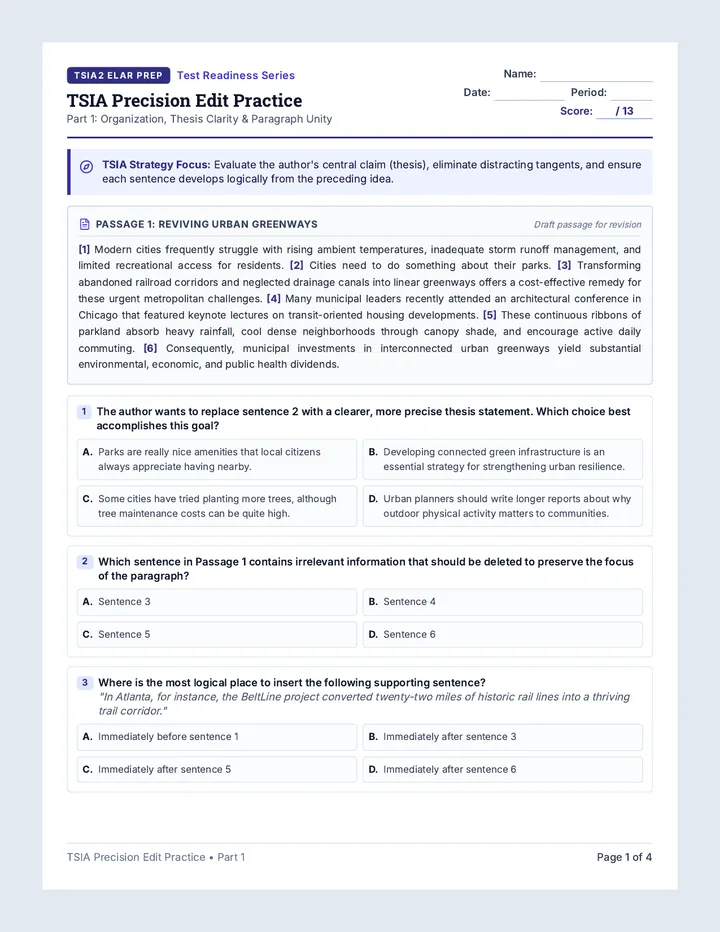
TSIA2 ELAR Prep Test Readiness Series
TSIA Precision Edit Practice
Part 1: Organization, Thesis Clarity & Paragraph Unity
Name:
Date: Period:
Score: / 13
TSIA Strategy Focus: Evaluate the author's central claim (thesis), eliminate distracting tangents, and ensure each sentence develops logically from the preceding idea.
Passage 1: Reviving Urban Greenways Draft passage for revision
[1] Modern cities frequently struggle with rising ambient temperatures, inadequate storm runoff management, and limited recreational access for residents. [2] Cities need to do something about their parks. [3] Transforming abandoned railroad corridors and neglected drainage canals into linear greenways offers a cost-effective remedy for these urgent metropolitan challenges. [4] Many municipal leaders recently attended an architectural conference in Chicago that featured keynote lectures on transit-oriented housing developments. [5] These continuous ribbons of parkland absorb heavy rainfall, cool dense neighborhoods through canopy shade, and encourage active daily commuting. [6] Consequently, municipal investments in interconnected urban greenways yield substantial environmental, economic, and public health dividends.
1 The author wants to replace sentence 2 with a clearer, more precise thesis statement. Which choice best accomplishes this goal?
A. Parks are really nice amenities that local citizens always appreciate having nearby.
B. Developing connected green infrastructure is an essential strategy for strengthening urban resilience.
C. Some cities have tried planting more trees, although tree maintenance costs can be quite high.
D. Urban planners should write longer reports about why outdoor physical activity matters to communities.
2 Which sentence in Passage 1 contains irrelevant information that should be deleted to preserve the focus of the paragraph?
A. Sentence 3
B. Sentence 4
C. Sentence 5
D. Sentence 6
3 Where is the most logical place to insert the following supporting sentence?
"In Atlanta, for instance, the BeltLine project converted twenty-two miles of historic rail lines into a thriving trail corridor."
A. Immediately before sentence 1
B. Immediately after sentence 3
C. Immediately after sentence 5
D. Immediately after sentence 6
TSIA Precision Edit Practice • Part 1 Page 1 of 4
TSIA2 ELAR Prep
Part 2: Sentence Boundaries & Transitions
Run-ons, comma splices, sentence combination & logical transitions
Passage 2 • Questions 4–6
TSIA Strategy Focus: Identify comma splices (independent clauses joined by only a comma). When combining sentences, use subordinating clauses to clearly highlight cause, contrast, or result.
Passage 2: The Architecture of Deep Sleep Draft passage for editing
[1] Sleep was once viewed as an inactive state of cognitive downtime, modern neuroimaging demonstrates that the brain undergoes intense metabolic reorganization during rest. [2] During slow-wave sleep, the brain activates the glymphatic system. [3] This specialized waste-clearance pathway flushes out neurotoxic proteins accumulated throughout waking hours. [4] Neural oscillations in the hippocampus transfer newly acquired data to the neocortex, where memories are permanently archived. [5] Chronic sleep deprivation prevents this neural transmission from occurring efficiently. [6] Individuals who sleep fewer than six hours per night frequently struggle with memory consolidation and emotional regulation. [7] Consistent, high-quality sleep represents a biological prerequisite for peak intellectual performance.
4 Which of the following is the best way to revise sentence 1 to correct the comma splice?
A. Sleep was once viewed as an inactive state of downtime; however, modern neuroimaging demonstrates intense metabolic reorganization during rest.
B. Sleep was once viewed as an inactive state of downtime, and modern neuroimaging demonstrates intense metabolic reorganization during rest.
C. Sleep was once viewed as an inactive state of downtime modern neuroimaging demonstrating intense metabolic reorganization.
D. Because sleep was once viewed as an inactive state of downtime, yet modern neuroimaging demonstrates intense reorganization.
5 Which of the following is the most effective way to combine sentences 2 and 3 into a single cohesive sentence?
A. During slow-wave sleep, the brain activates the glymphatic system, a specialized pathway that flushes out neurotoxic proteins accumulated during waking hours.
B. Activating the glymphatic system during slow-wave sleep, neurotoxic proteins are flushed out by this specialized pathway accumulated in waking hours.
C. The brain activates the glymphatic system during slow-wave sleep, and it is a pathway, and it flushes out neurotoxic proteins.
D. During slow-wave sleep, the glymphatic system is activated, while this pathway flushes neurotoxic proteins accumulated by waking up.
6 Which transition should be added to the beginning of sentence 6 to establish the clearest logical relationship with sentence 5?
A. As a result,
B. In contrast,
C. Similarly,
D. Nevertheless,
TSIA Precision Edit Practice • Part 2 Page 2 of 4
TSIA2 ELAR Prep
Part 3: Grammar & Usage Precision
Subject-verb agreement, pronoun references & sophisticated punctuation
Passage 3 • Questions 7–9
TSIA Strategy Focus: Identify the true grammatical subject by ignoring intervening prepositional phrases. Replace vague pronouns ("this," "which") with explicit noun phrases.
Passage 3: Unlocking Deep-Sea Mysteries Draft passage for editing
[1] Covering over seventy percent of the globe, the ocean floor remains one of Earth's least understood frontiers. [2] A diverse array of autonomous robotic submersibles equipped with hypersensitive acoustic sensors have revealed towering volcanic ridges and hydrothermal vents. [3] These benthic ecosystems support extremophilic organisms that metabolize hydrogen sulfide rather than sunlight. [4] Marine biologists were surprised to discover thriving colonies of tube worms and crustaceans near scalding mineral chimneys. [5] Researchers brought these specimens to laboratories to analyze their cellular adaptations, which has generated significant enthusiasm. [6] Such biological discoveries may yield novel pharmaceuticals; furthermore, they provide vital clues regarding how early life originated on Earth. [7] Continued funding for oceanic exploration is critical for both ecological stewardship and medical advancement.
7 Which change is needed to correct the subject-verb agreement error in sentence 2?
A. Change have revealed to has revealed
B. Change equipped to equipping
C. Change remains to remain
D. Change sensors to sensing
8 Sentence 5 concludes with "which has generated significant enthusiasm." Which revision most effectively eliminates the vague pronoun reference?
A. ...laboratories to analyze their cellular adaptations, an investigation that has generated significant enthusiasm.
B. ...laboratories to analyze their cellular adaptations, and this situation is very exciting.
C. ...laboratories to analyze their cellular adaptations, which made people enthusiastic.
D. ...laboratories, where they analyzed their adaptations, generating that enthusiasm.
9 How should the underlined portion of sentence 6 be punctuated?
"Such biological discoveries may yield novel pharmaceuticals; furthermore, they provide vital clues..."
A. pharmaceuticals, furthermore,
B. pharmaceuticals; furthermore, (No change)
C. pharmaceuticals; furthermore
D. pharmaceuticals, furthermore;
TSIA Precision Edit Practice • Part 3 Page 3 of 4
TSIA2 ELAR Prep
Part 4: Mixed TSIA2 Test Simulation
Cumulative revision and editing synthesis under test conditions
Passage 4 • Questions 10–13
Passage 4: The Resurgence of Print Culture Full simulation passage
[1] When e-readers gained popularity in the late 2000s, critics predicted the demise of physical books. [2] Print sales have steadily rebounded over the past decade, independent bookstores are experiencing sustained revenue growth. [3] Cognitive research indicates that readers demonstrate superior retention when engaging with physical pages compared to illuminated screens. [4] The tactile sensation of turning pages provide distinct spatial markers that assist the brain in mapping information. [5] Digital screens often foster superficial browsing; readers tend to skim rather than deeply absorb complex arguments. [6] Therefore, physical books will probably remain around for a while because people buy them.
10 Which revision of sentence 2 corrects the comma splice and establishes an effective contrast with sentence 1?
A. Yet, print sales have steadily rebounded, and independent bookstores are experiencing sustained growth.
B. Print sales have steadily rebounded, so independent bookstores experience revenue growth.
C. Rebounding steadily over the past decade, print sales having grown for bookstores.
D. Print sales having steadily rebounded, however, bookstores experience sustained growth.
11 What change, if any, should be made to sentence 4?
A. Change provide to provides
B. Change turning to having turned
C. Change assist to assisting
D. No change is needed.
12 In sentence 5, which choice provides the most precise and concise revision of the underlined clause?
"...readers tend to skim rather than deeply absorb complex arguments."
A. rather than engage deeply with demanding texts
B. instead of getting involved and immersed into complex arguments
C. as opposed to reading deeply and thinking about complex thoughts
D. without choosing to become immersed into complex argumentations
13 Which revision of sentence 6 provides the most effective, academically appropriate conclusion for the passage?
A. Far from becoming obsolete, physical print endures because it satisfies essential human needs for cognitive focus and tactile engagement.
B. In conclusion, bookstores sell books, and consumers continue purchasing them whenever they visit shopping centers.
C. Print culture is simply superior to digital reading, and anyone serious about learning should discard their electronic devices.
D. Because e-readers possess various technological flaws, individuals should encourage family members to patronize local libraries.
Student Mastery Self-Audit Check skills where you feel test-ready for the TSIA2:
Thesis & Focus
Sentence Boundaries
Agreement & Pronouns
Transitions & Logic
TSIA Precision Edit Practice • Part 4 Page 4 of 4
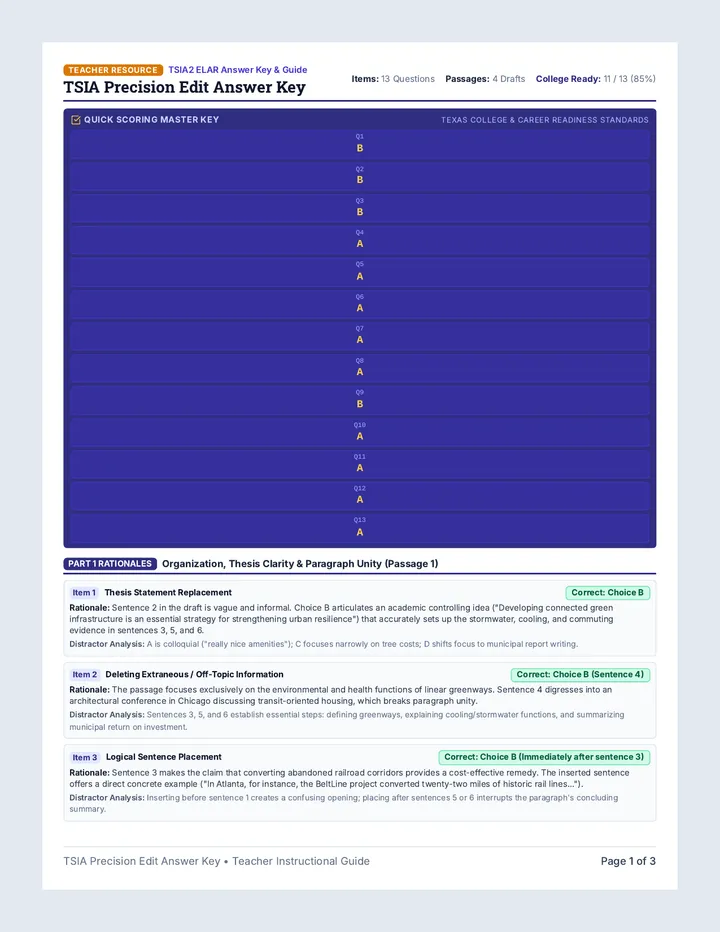
TSIA Precision Edit Answer Key
Teacher Resource TSIA2 ELAR Answer Key & Guide
TSIA Precision Edit Answer Key
Items: 13 Questions Passages: 4 Drafts College Ready: 11 / 13 (85%)
Quick Scoring Master Key Texas College & Career Readiness Standards
Q1
B
Q2
B
Q3
B
Q4
A
Q5
A
Q6
A
Q7
A
Q8
A
Q9
B
Q10
A
Q11
A
Q12
A
Q13
A
PART 1 RATIONALES Organization, Thesis Clarity & Paragraph Unity (Passage 1)
Item 1 Thesis Statement Replacement Correct: Choice B
Rationale: Sentence 2 in the draft is vague and informal. Choice B articulates an academic controlling idea ("Developing connected green infrastructure is an essential strategy for strengthening urban resilience") that accurately sets up the stormwater, cooling, and commuting evidence in sentences 3, 5, and 6.
Distractor Analysis: A is colloquial ("really nice amenities"); C focuses narrowly on tree costs; D shifts focus to municipal report writing.
Item 2 Deleting Extraneous / Off-Topic Information Correct: Choice B (Sentence 4)
Rationale: The passage focuses exclusively on the environmental and health functions of linear greenways. Sentence 4 digresses into an architectural conference in Chicago discussing transit-oriented housing, which breaks paragraph unity.
Distractor Analysis: Sentences 3, 5, and 6 establish essential steps: defining greenways, explaining cooling/stormwater functions, and summarizing municipal return on investment.
Item 3 Logical Sentence Placement Correct: Choice B (Immediately after sentence 3)
Rationale: Sentence 3 makes the claim that converting abandoned railroad corridors provides a cost-effective remedy. The inserted sentence offers a direct concrete example ("In Atlanta, for instance, the BeltLine project converted twenty-two miles of historic rail lines...").
Distractor Analysis: Inserting before sentence 1 creates a confusing opening; placing after sentences 5 or 6 interrupts the paragraph's concluding summary.
TSIA Precision Edit Answer Key • Teacher Instructional Guide Page 1 of 3
TSIA2 ELAR Prep
Parts 2 & 3: Sentence Boundaries & Grammar Precision
Passages 2 & 3 • Questions 4–9
PART 2 RATIONALES Sentence Boundaries & Transitions (Passage 2)
Item 4 Comma Splice Revision Correct: Choice A
Rationale: Sentence 1 fuses two independent clauses with merely a comma. Choice A repairs the boundary by employing a semicolon followed by the conjunctive adverb "however," accurately articulating the contrast between historical misconception and modern neuroimaging.
Distractor Breakdown: B uses ", and" which fails to show contrast; C eliminates punctuation, creating a run-on; D creates a fragment ("Because sleep was once viewed..., yet...").
Item 5 Sentence Combination & Subordination Correct: Choice A
Rationale: Choice A converts sentence 3 into an appositive modifier ("a specialized pathway that flushes out neurotoxic proteins...") placed immediately after the noun phrase it modifies ("glymphatic system"), creating fluid, mature syntactic coordination.
Distractor Breakdown: B introduces a dangling modifier; C produces repetitive compound sentences with multiple "and" coordinators; D distorts meaning ("accumulated by waking up").
Item 6 Transition Insertion Correct: Choice A (As a result,)
Rationale: Sentence 5 identifies the cause (chronic sleep deprivation preventing neural transmission), and sentence 6 outlines the direct consequence (struggles with memory consolidation). "As a result," accurately signals this cause-and-effect relationship.
Distractor Breakdown: "In contrast," and "Nevertheless," incorrectly signal opposition; "Similarly," incorrectly implies parallel comparison rather than consequence.
PART 3 RATIONALES Grammar & Usage Precision (Passage 3)
Item 7 Subject-Verb Agreement Correct: Choice A (has revealed)
Rationale: The subject is the singular noun phrase "A diverse array." The plural nouns "submersibles" and "sensors" are objects of intervening prepositional and participial phrases and do not determine verb agreement. Therefore, "have revealed" must become singular "has revealed."
Distractor Breakdown: B creates an ungrammatical participle; C alters sentence 1's correct singular verb; D awkwardly substitutes a noun for a participle.
Item 8 Vague Pronoun Reference ("which") Correct: Choice A
Rationale: The relative pronoun "which" in draft sentence 5 refers vaguely to the whole preceding action. Choice A replaces "which" with an explicit appositive noun phrase ("an investigation that has generated significant enthusiasm"), resolving all ambiguity.
Distractor Breakdown: B retains vague pronoun usage ("and this situation is exciting"); C introduces a misplaced modifier; D features confusing demonstrative phrasing.
Item 9 Conjunctive Adverb Punctuation Correct: Choice B (No change)
Rationale: Joining two independent clauses with a conjunctive adverb ("furthermore," "however," "therefore") requires a semicolon before the adverb and a comma immediately after: ; furthermore,. The draft is correctly punctuated.
Distractor Breakdown: A creates a comma splice; C omits the required trailing comma; D incorrectly transposes the semicolon and comma.
TSIA Precision Edit Answer Key • Teacher Instructional Guide Page 2 of 3
TSIA2 ELAR Prep
Part 4: Mixed Simulation & Score Diagnostic Matrix
Passage 4 • Items 10–13 & Action Plan
PART 4 RATIONALES Cumulative Revision & Editing Synthesis (Passage 4)
Item 10 Run-on Repair & Rhetorical Contrast Correct: Choice A
Rationale: Sentence 2 in the draft is a comma splice. Choice A resolves the boundary by coordinating the independent clauses with ", and", and introduces the sentence with "Yet" to effectively signal the counter-trend to sentence 1's predicted demise of print books.
Item 11 Subject-Verb Agreement Correct: Choice A (Change provide to provides)
Rationale: The subject is "The tactile sensation" (singular); "of turning pages" is an intervening prepositional modifier with a plural object ("pages"). The verb must agree in the singular: "provides distinct spatial markers."
Item 12 Conciseness & Academic Word Choice Correct: Choice A
Rationale: Choice A ("rather than engage deeply with demanding texts") provides an active, precise verb phrase that eliminates redundant verbiage while strengthening academic register. Choices B, C, and D are colloquial and wordy.
Item 13 Concluding Sentence Optimization Correct: Choice A
Rationale: Sentence 6 in the draft is simplistic and circular ("will probably remain around... because people buy them"). Choice A elevates the conclusion into an academic synthesis of the passage's evidence, linking the persistence of print to fundamental cognitive needs for focus and tactile engagement.
TSIA2 Score Benchmark & Remediation Matrix Diagnostic intervention guidelines based on student raw score
11 – 13 Points College Ready
Action: Mastered TSIA2 grammar, boundary logic, and revision. Advance to timed full-length exams and diagnostic essay composition.
8 – 10 Points Approaching
Action: Review intervening prepositional phrase subject-verb traps (Q7, Q11) and semicolon conventions (Q4, Q9).
0 – 7 Points Targeted Support
Action: Re-teach fundamental sentence boundaries (FANBOYS vs. semicolons), thesis clarity, and pronoun-antecedent agreement.
High-Frequency TSIA2 Question Stems & Quick Elimination Rules
"Which is the most effective way to combine...": Eliminate choices with dangling modifiers, passive voice shifts, or run-on coordinating conjunctions. Correct answers consistently employ concise appositives or dependent clauses.
"Which choice corrects the error in sentence...": Identify the grammatical subject by crossing out prepositional phrases. Check for singular/plural subject-verb mismatches before reading answer options.
"Which sentence should be removed...": Test each sentence against the paragraph's topic sentence. Delete sentences that share keywords but introduce off-topic anecdotes or irrelevant sub-topics.
"Which transition best connects...": Name the logical link (Contrast, Result, Illustration, Addition) before looking at the choices to avoid second-guessing on near-synonyms.
TSIA2 Computer-Adaptive Testing Note: Students cannot flag questions or return to prior items on the real TSIA2. Train students to actively eliminate options with grammatical errors first, then evaluate remaining choices for conciseness and rhetorical precision.
TSIA Precision Edit Answer Key • Teacher Instructional Guide Page 3 of 3