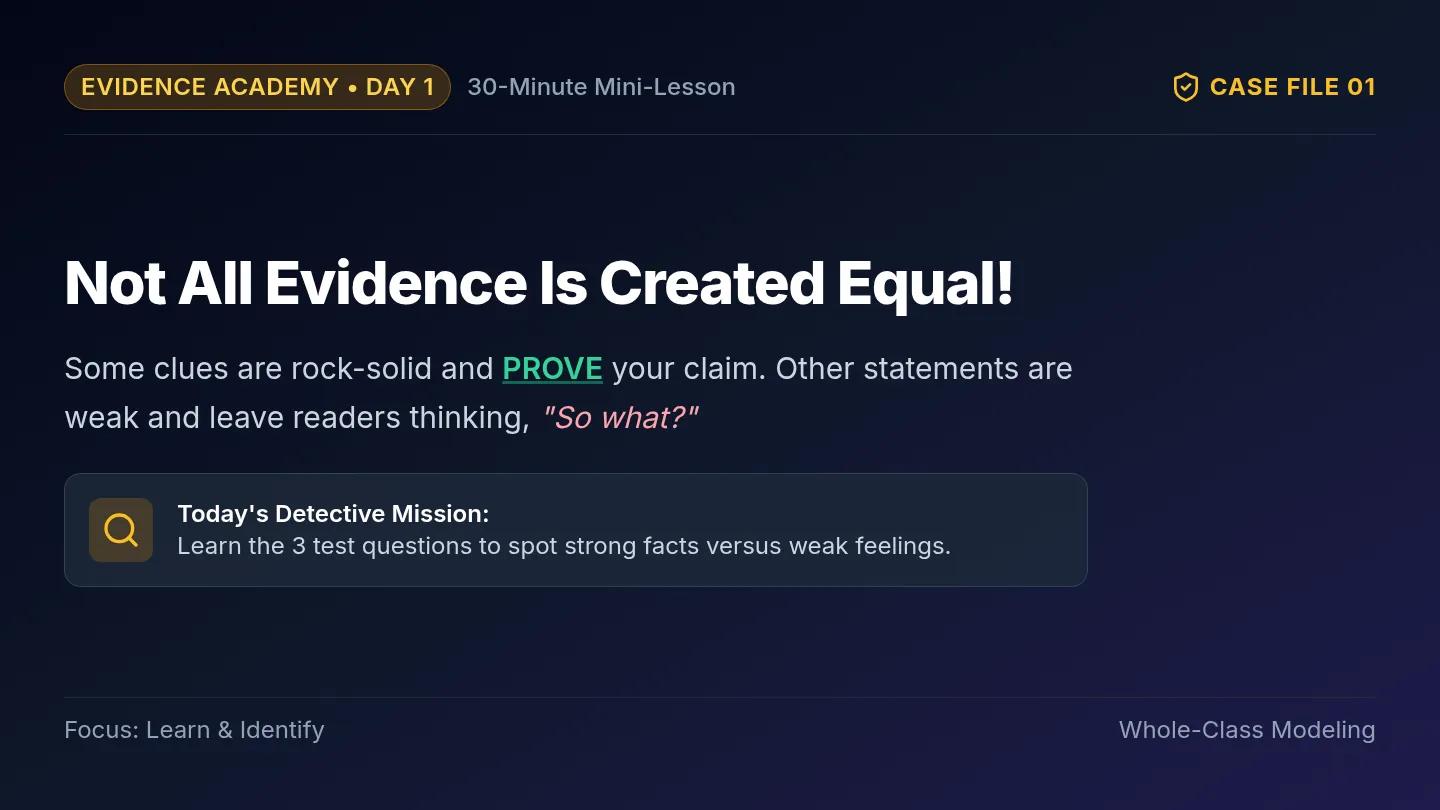
Claim Craft Slides 20-Minute Writing Sprint
Persuasive Writing Skills
CLAIM CRAFT
How to build an unshakeable thesis statement using real-world issues in three simple steps.
Goal: Turn everyday observations into powerful arguments
Mini-Lesson • Part 1
The Master Blueprint
The 3-Part Thesis Equation
Step 1
Topic
The real-life issue or subject you are tackling.
"Daily homework"
Step 2
Debatable Claim
Your firm stance (someone could disagree with you).
"should be capped at 30 minutes"
Step 3
The "Because"
Your big reason that you will prove with facts.
"because kids need time for family, sports, and sleep"
The Complete Sentence: "Teachers should cap daily homework at 30 minutes because students need time for family, sports, and sleep."
Quality Check
The Tests for Effective Thesis
1. Debatable?
Can a reasonable person take the other side?
FAIL: "School starts in the morning." (Just a fact!)
2. Specific?
Does it avoid fuzzy words like "cool," "bad," or "nice"?
FAIL: "Video games are bad." (Too vague!)
3. Gives a Reason?
Does it explain why without announcing the paper?
FAIL: "I am going to write about pets." (An announcement!)
Test rule: If someone can only answer "Yeah, obviously," it is not a thesis yet!
Real-Life Makeover
Turning Facts into Arguments
Example 1: School Cafeteria Weak Fact vs. Strong Claim
Weak Fact: "Vending machines sell soda and energy drinks in many schools."
Strong Thesis: "Schools should remove energy drinks from vending machines because high sugar levels trigger energy crashes that disrupt afternoon learning."
Example 2: Pet Adoption Vague Opinion vs. Strong Claim
Vague Opinion: "Adopting dogs is way better than buying dogs."
Strong Thesis: "Families should adopt pets from local rescue shelters because shelter adoption saves animal lives and reduces shelter overcrowding."
Clear Stance (What should happen)
Real-Life Reason (Why it matters)
Practice Phase
Your 7-Minute Challenge
01
Spot It
Read 3 everyday statements and identify: Fact, Vague Opinion, or Strong Thesis.
02
Fix It
Upgrade a boring statement of fact into a debatable claim with a clear reason.
03
Build It
Pick a real-life prompt (4-day week or phone rules) and write your own thesis.
Timer will run for 7 minutes • Work independently on your practice sheet
Ready, Set, Craft!
Thesis Builder Worksheet CC
Claim Craft Mini-Sprint
Constructing Debatable, Evidence-Driven Thesis Statements
Name
Date
Period
The Equation:
Real-Life Topic + Debatable Stance + The "Because" Reason
1 Part 1: The Diagnostic Test (3 Minutes)
Check one label for each real-life statement:
A. "Most students carry backpacks between classrooms during the school day."
Fact Only Vague Opinion Strong Thesis
B. "Cafeteria food is completely disgusting and terrible."
Fact Only Vague Opinion Strong Thesis
C. "Schools should allow students to listen to music during independent study because instrumental beats block noisy hallways and increase focus."
Fact Only Vague Opinion Strong Thesis
2 Part 2: The Fixer-Upper (2 Minutes)
Turn this weak statement into a strong thesis.
Weak Draft: "Many kids play video games after getting home from school." Problem: It is just an everyday fact. It does not take a stand or explain why.
Your Upgraded Thesis (Give a clear rule/stance + your big "because" reason):
3 Part 3: The Independent Forge (5 Minutes)
Core Practice
Choose one real-life issue below (circle your choice), plan your two pieces, and assemble your final thesis statement.
Option A: Four-Day School Week Should schools switch to 4 days with 3-day weekends?
Option B: Phone Pouches in Class Should students store phones in hanging pouches during lessons?
Debatable Claim (Your exact stance):
The "Because" (Your strongest reason):
Final Polished Thesis Statement: Combine your stance + because into one clear sentence
Self-Audit Checklist: Not just a fact Has a clear "because" A smart friend could disagree
Claim Craft Facilitator Guide TG
Claim Craft Facilitator Guide & Key
20-Minute Mini-Lesson Plan • Persuasive Writing Foundations
20 Min Total Slides + 1-Page Sheet
Core Objective
Turn everyday observations into debatable claims backed by a clear "because" reason.
Core Formula
Topic + Debatable Stance + The "Because" Reason = Strong Thesis.
Student Deliverable
Completed Thesis Builder Worksheet with 1 polished real-world thesis.
Minute-by-Minute Instructional Protocol
00:00–04:00
Slide 1–2: Direct Instruction & The Thesis Equation
Project Slide 2. State: "A thesis is never just a boring fact everyone agrees on. It takes a stand on a real-life issue and gives a clear 'because' reason that you have to prove."
04:00–08:00
Slide 3–4: Real-Life Makeover Showcase
Review the Cafeteria Vending Machine and Animal Shelter examples. Show how transforming an undisputed fact into an actionable rule creates an instant debate.
08:00–16:00
Slide 5: 8-Minute Student Practice Sprint
Distribute worksheet. Students spend 2m on Part 1 (Diagnostic), 2m on Part 2 (Makeover), and 4m on Part 3 (Independent Forge). Circulate actively.
16:00–20:00
Whip-Around Debrief & Exit Check
Have 2 students read their Part 3 thesis aloud. Class checks: "Could a friend argue against it? Did they include a clear 'because'?" Collect sheets.
Instant Verbal Redirects (During Circulation)
Trap 1: Stating an Everyday Fact
"Kids play video games after school."
Say: "That is true, but nobody can argue against it! What rule should parents set, and why?"
Trap 2: Just Saying Something is "Bad"
"Homework is really bad and stressful."
Say: "Replace 'really bad' with a specific solution: what exact limit should teachers set?"
Worksheet Answer Key & Exemplar Responses Master Key
Part 1: Diagnostic Solutions
Item A (Backpacks): Fact Only
Everyday observation; has no debate or stance.
Item B (Cafeteria food): Vague Opinion
Emotional reaction; lacks specific reason or solution.
Item C (Music study): Strong Thesis
Clear school policy stance with a sound "because" reason.
Part 2: Acceptable Remodel Exemplars (Video Games)
Exemplar 1 (Pro-Limit): "Parents should limit weekday video gaming to one hour because long screen sessions cut into sleep time and unfinished homework."
Exemplar 2 (Pro-Gaming): "Kids should be allowed up to an hour of video games after school because multiplayer games help students unwind and build teamwork skills."
Part 3: Independent Forge Target Exemplars
Option A (4-Day Week)
"Schools should switch to a four-day schedule because three-day weekends give students more time to recharge and show up ready to learn on Monday."
Option B (Phone Pouches)
"Teachers should require students to place phones in classroom pouches because removing notification buzzes keeps students focused on daily lessons."