A hands-on environmental science lesson where high school students investigate schoolyard microclimates using temperature mapping and weather data, analyzing the local urban heat island effect and proposing canopy-based mitigation.
An engaging lesson on animal adaptations featuring a visual nonfiction reading passage and text feature hunt. Students learn about the Thorny Devil and Polar Bear, analyze geographic maps, look up key terms in a glossary, and answer deep comprehension questions.
An introductory lesson exploring the greenhouse effect, carbon footprints, and deforestation. Includes an engaging visual slideshow and printable guided skeleton notes to keep students active and focused during instruction.
Travaux dirigés (TD) et corrigé sur le bilan humique en Bac Pro CGEA. Permet de maîtriser les concepts clés de minéralisation (K2), d'humification (K1) et d'évolution de la matière organique à travers l'étude de cas réelle d'une exploitation agricole de polyculture-élevage.
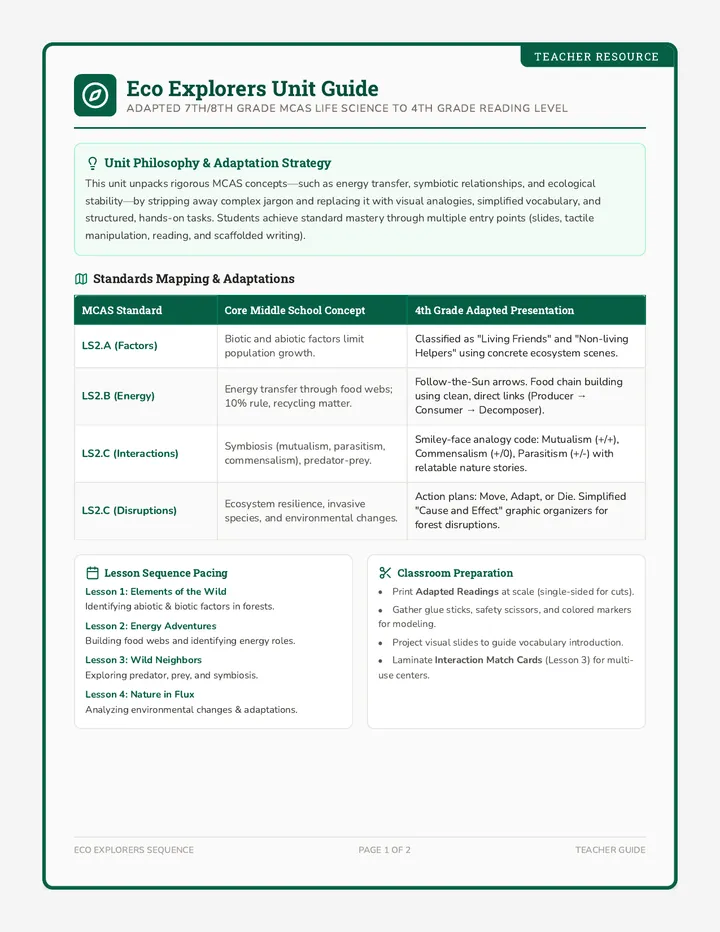
An extension lesson focusing on environmental pressures and natural selection using the classic peppered moth case study. Designed with scaffolding, visual aids, and clear graphic organizers for 9-10th grade special education students.
A hands-on STEM lesson where students design, build, and launch water bottle rockets. They apply Newton's Laws of Motion to optimize force, mass, and aerodynamics for maximum flight distance.
A comprehensive science lesson introducing epigenetics and gene expression. Students investigate how environmental triggers like stress, nutrition, and exercise can turn genetic switches on and off in identical twins.
A comprehensive hands-on engineering lesson where students design and test gravity-fed filtration systems to explore water scarcity and water quality testing.
An introductory lesson on web design principles, covering the website design process, anatomy of a webpage, and paper wireframe sketching. Includes interactive slides, an anatomy and vocabulary worksheet, a paper-based wireframing project guide, and a comprehensive teacher guide.
A comprehensive end-of-year capstone project where students select an environmental science topic, conduct in-depth synthesis, and design a professional presentation. This packet contains a detailed teacher guide, student planning pages, checklist, and a grading rubric.
Students investigate how identical twins with identical DNA can develop different physical traits due to epigenetics. Through color-coded data sorting and sentence-by-sentence graphic organizers, students draft a complete three-paragraph scientific explanation.
A hands-on, highly scaffolded science lesson exploring how recessive alleles express their phenotypes. Students use visual icon coding, cut-and-paste labels, a simplified vocabulary bank, and guided paragraph frames to explain genetic expression step-by-step.
Craft a persuasive business pitch and deliver/review startup presentations to simulate a real-world investor round.
Deconstruct business model basics and complete a streamlined Lean Canvas for a student-led venture concept.
Explore the entrepreneurial mindset, identify real-world problems, and brainstorm innovative startup solutions.
A project-based lesson where students research a chosen ecosystem, analyze its energy flow and biodiversity, focus on a specific species' population, and design a 'travel pitch' slide presentation with an actionable conservation plan.
A complete guide for teenagers to responsibly use AI for everyday learning tasks, mastering critical safety habits, privacy boundaries, and advanced prompting techniques.
Students analyze the causes and consequences of deforestation, mapping habitat fragmentation and designing collaborative, science-based conservation solutions.
Students investigate the rainforest as a massive climate-control engine, analyzing how evapotranspiration regulates weather and how trees act as vital global carbon sinks.
Students explore the structural layers of the rainforest (forest floor, understory, canopy, emergent layer) and model biodiversity and physical conditions across these strata.
An investigative project-based lesson for 7th-grade students exploring Massachusetts marine ecosystems. Students choose a local coastal ecosystem, research resident species, analyze competitive and symbiotic interactions, and demonstrate understanding of resource availability.
An AP Chemistry lesson exploring solubility rules, net ionic equations, particulate representations, and the mathematical link to Ksp and equilibrium shifts. Students engage with interactive station-based task cards simulating real laboratory precipitates.
A comprehensive sales and educational package designed to pitch advanced molecular UTI testing services to long-term care and nursing home administrators, highlighting clinical and operational benefits.
A dynamic lesson introducing the five core forms of energy: kinetic, potential, thermal, chemical, and electrical. This lesson utilizes highly engaging visual slides and structured templates to help students compare, contrast, and identify energy transformations.
A Station Rotation Lab lesson focusing on natural selection and survival of the fittest using the real-world Rock Pocket Mouse scenario, designed to be high school special education friendly.
A comprehensive graphing skills lesson in biology. Students will learn how to parse, select, and construct five key graph types (pie, line, bar, double line, and logarithmic graphs) using authentic biological datasets.
A comprehensive MCAS Chemistry preparation module containing a visual-heavy study guide, a high-structure test-taking checklist/reference sheet, and a detailed teacher answer guide.
An in-depth investigation into the ecological, cellular, and evolutionary mechanics of trees. Students analyze carbon sequestration, vascular transport, angiosperm vs. gymnosperm taxonomy, and design conservation strategies.