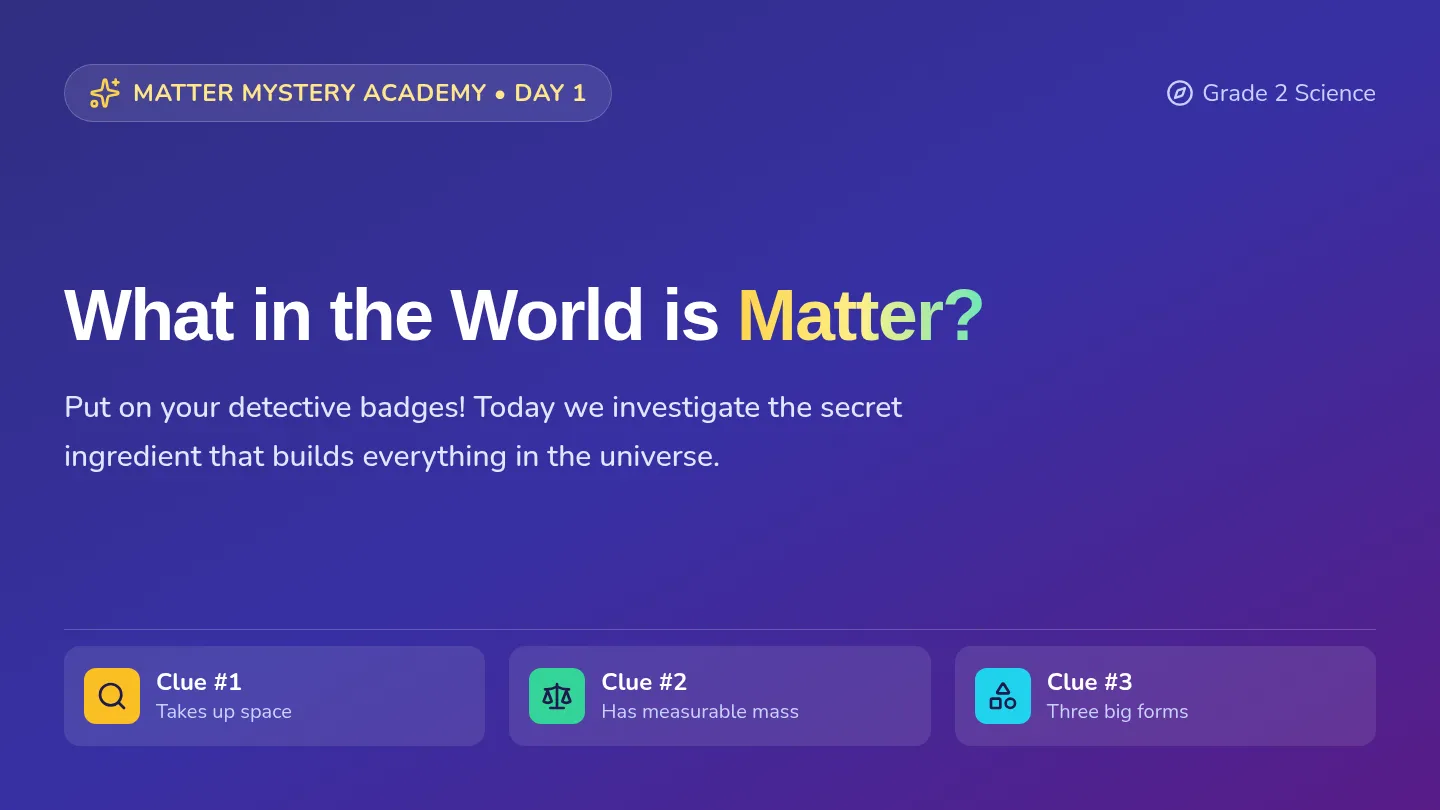
Matter Explorers Slides 2ND GRADE SCIENCE NGSS 2-PS1-1
States of Matter Challenge
Our Big Question
How do solids, liquids, and gases act differently?
🧊 Solid
💧 Liquid
🎈 Gas
Science Mystery
What Is Happening Here?
🧊
Ice Cube
Hard, cold, and keeps its square shape.
Gets Warmer →
← Gets Colder
💧
Water Puddle
Wet, runny, and spreads out flat!
Think & Share: Can water change back and forth? How?
Community Circle
Describe What You Notice!
Look closely and feel the object. Which words fit best?
Hard
Soft
Wet
Runny
Smooth
Bumpy
Bendy
Clear
Heavy
Light
Cold
Warm
Sentence Starter: "I notice it feels ________ and looks ________."
State of Matter #1
Solid
🧊
Keeps its own shape!
A solid does not spill or spread out when you put it on a table.
How particles act: Packed tight and wiggle in place!
Examples
🧊 Ice Cube
🪨 Rock
🧱 Wooden Block
State of Matter #2
Liquid
💧
Flows and changes shape!
A liquid pours and takes the shape of whatever cup or bowl holds it.
How particles act: Close together, sliding past each other!
Examples
💧 Water
🥛 Milk
🍯 Honey
State of Matter #3
Gas
🎈
Spreads out everywhere!
A gas has no set shape. It floats and fills up all the room it has.
How particles act: Far apart and zooming fast!
Examples
🎈 Helium in a Balloon
♨️ Steam in a Shower
💨 Air We Breathe
Science Talk
Connect to Your World
1
Where have you seen water, ice, or steam outside of school?
2
Have you ever left a popsicle out? What happens after 20 minutes?
3
What happens when you blow more air into a balloon?
Partner Challenge
Act Out States of Matter!
Work with a partner. Pick a card and use your body to show how matter moves!
🥶
Get Colder!
Freeze together like an ice cube.
🫠
Melt Down!
Flow slowly into a puddle on the floor.
🎈
Float & Zoom!
Spread out like helium or steam.
Safety Rule: Keep your hands to yourself and watch your space!
Share Your Thinking
What Did We Discover?
4
When you melted into a puddle, did you keep one shape?
5
How was acting like a gas different from acting like a liquid?
6
Show us with your body: Can you act out a solid, liquid, or gas?
Matter Acting Cards Community Circle Cards • Cut Along Dashed Lines
Pass & Describe: Picture Cards
NGSS 2-PS1-1
Circle Card 1 What am I?
🧊
Ice Cube
How does it feel? Does it keep its shape?
Words: cold • hard • smooth • square
Circle Card 2 What am I?
🪨
River Rock
Is it heavy or light? Can you bend it?
Words: hard • bumpy • heavy • solid
Circle Card 3 What am I?
💧
Water Puddle
Can you hold it in your hand? Does it flow?
Words: wet • runny • clear • flat
Circle Card 4 What am I?
🥛
Milk in a Cup
What shape is it inside the cup? If it spills?
Words: wet • smooth • white • pours
Circle Card 5 What am I?
🎈
Helium Balloon
What is inside? Why does it float up?
Words: light • airy • invisible • floats
Circle Card 6 What am I?
♨️
Shower Steam
Where does it go? Can you grab it?
Words: warm • misty • spreads • rises
Teacher Tip: Pass real objects (ice cube in a cup, rock, sealed water bottle) alongside these picture cards in the community circle!
Partner Movement Cards • Cut Along Dashed Lines
Act It Out! States of Matter Cards
Work in Pairs
Acting Card A 🥶
Get Colder & Freeze!
Pretend you are water getting colder and colder until you turn into a solid block of ice.
Clue: Stand close and lock your shape!
Acting Card B 🫠
Melt Into a Puddle!
Start frozen like an ice cube, then warm up in the sun and melt slowly into a puddle.
Clue: Do you keep one shape?
Acting Card C 🎈
Helium in a Balloon!
Pretend you are gas particles inside a balloon. More air is blown in—spread out and bounce gently!
Clue: Fill up all the space!
Acting Card D ♨️
Steam in the Shower!
Pretend you are hot water turning into steam. Rise up high and drift apart into the air!
Clue: Move freely and spread out!
Acting Card E 🥣
Pour Into a Bowl!
Act like liquid water being poured from a pitcher into a round bowl. Slide past your partner!
Clue: Stay close, but keep flowing!
Acting Card F 🍦
Popsicle in the Sun!
Start as a frozen popsicle. Wait 20 minutes in the warm sun—what happens to your body?
Clue: Solid → Liquid!
Challenge: After acting out your card, tell the circle whether you were a solid, a liquid, or a gas—and how you know!
Circle Discussion Teacher Guide Teacher Facilitation Guide • Grade 2
States of Matter Challenge
NYS / NGSS 2-PS1-1
DCI: PS1.A Structure & Properties of Matter
Phenomenon & Driving Question
An ice cube melting into a puddle of water; a puddle of water freezes into a solid.
"How do solids, liquids, and gases act differently?"
3D Learning Goal
Students will use models (their own bodies in pairs) in order to act out states of matter patterns under different conditions in the natural world (heating, cooling, container shape).
Community Circle Artifacts & Prep
• 1 Solid Object: wooden block, rock, or ice cube in a cup
• 1 Liquid Sample: sealed clear bottle of water or jar of honey
• 1 Picture of a Gas: helium balloon or shower steam card
• Printed Cards: Matter Acting Cards (circle & pair acting)
Lesson Flow & Facilitation Steps
1. Launch & Pass Around (Slides 1–3)
10 min
Gather in a community circle. Pass around your real solid, liquid, and gas picture (or Circle Picture Cards). Prompt students to describe each using the Slide 3 word bank (hard, soft, wet, runny, smooth, bumpy, bendy, clear ).
2. Definitions & Lived Experiences (Slides 4–7)
10 min
Display the kid-friendly definitions and images for Solid, Liquid, and Gas. Use Science Talk Questions 1–3 to connect the phenomenon to popsicles, balloons, and water at home.
3. Partner Acting Challenge (Slide 8)
10 min
Pair students up and hand each pair an Acting Card (e.g., "Get Colder & Freeze!" or "Melt Into a Puddle!"). Have pairs practice modeling particle movement with their bodies, then perform for the circle.
4. Sensemaking Science Talk (Slide 9)
10 min
Debrief the movement models using Questions 4–6 and Talk Moves. Ask students to compare how liquid movement felt different from gas movement and classify an everyday item from home.
Standard Note: Focus on observable properties (color, texture, hardness, flexibility) and temperature-driven changes.
Science Talk Script • Page 2
Ordered Questions & Talk Moves
Community Circle Guide
Ordered Science Talk Questions
1. Where have you seen water, ice, or steam outside of school?
Follow-up: What movements do you notice? A lot, or a little?
2. Have you ever left an ice cube or popsicle out of the freezer? What do you think happens to it after 20 minutes?
Follow-up: How does the frozen object appear at first?
3. Have you ever blown up a balloon? What happens when you blow more air into the balloon?
Look for: Air takes up space and pushes outward in all directions.
4. How did you act if the card asked you to melt into a puddle? Did you keep one shape?
Look for: Liquids spread out and change shape rather than staying rigid.
5. What might you look like if you were a gas particle, such as helium in a balloon or steam in the shower?
Follow-up: What differences did you notice from the liquid state to the gas state? What was similar or different?
6. Can you show me what you are thinking? Can your body show how a solid, liquid, or gas behaves?
Look for: Tight/still posture for solids, flowing/sliding for liquids, spreading/zooming for gases.
Talk Moves to Elicit Student Reasoning
Model It
"Can you show me what you are thinking?"
Ask for Evidence
"What makes you think that? What is your evidence?"
Home Connection
"What is something at home you are thinking about? Can you classify it as a solid, liquid, or gas?"
Differentiation Tip: Pair emerging speakers with a partner for the movement cards first so they can demonstrate understanding physically before sharing aloud.