Iodine Diffusion Lab Worksheet Iodine Diffusion Lab
Membrane Permeability
Name:
Date:
Lab Objective
Model diffusion through a semi-permeable membrane using iodine and cornstarch.
Safety First
Wear goggles at all times. Iodine stains skin and clothes. Do not taste lab materials.
1. Hypothesis & Variables
What do you predict will happen to the color inside the bag and in the beaker?
Independent Variable
Dependent Variable
Materials
Plastic bag
100 mL water
1 tsp cornstarch
250 mL beaker
150 mL water
10–15 drops iodine
Timer
2. Lab Procedure
Mix 100 mL water and 1 tsp cornstarch in the bag. Seal tightly until cloudy white.
Add 10–15 drops of iodine to 150 mL water in the beaker (amber-brown).
Record 0 min observations on Page 2 before placing the bag in the beaker.
Gently place the sealed bag into the beaker and start your timer.
Record color changes at 5, 10, and 15 min without opening the bag.
Part 2: Observations & Particle Model
Iodine Diffusion Lab
3. Timed Observations
Time
Bag Color
Beaker Color
Visible Changes
0 min
5 min
10 min
15 min
4. Draw & Label Particle Movement
Draw the beaker, plastic bag, iodine (I) , and starch (S) before and after 15 minutes. Use arrows to show movement.
Before (0 min)
After (15 min)
Part 3: Analysis & CER Explanation
Iodine Diffusion Lab
5. Analysis Questions
a. Which substance diffused across the bag? What evidence supports this?
Starter: "The substance that diffused was ________ because ________."
b. Did cornstarch move out into the beaker? Explain how you know.
Starter: "Cornstarch (did / did not) move out because ________."
c. How does the bag model a semi-permeable cell membrane?
Starter: "The bag is semi-permeable because it lets ________ pass while ________."
6. Claim – Evidence – Reasoning (CER)
Explain why the color changed inside the bag but not in the beaker.
Claim: "Inside the bag, ________, while in the beaker, ________."
Evidence: "At 0 minutes, ________. By 15 minutes, ________."
Reasoning: "Iodine particles are ________, whereas starch is ________."
Iodine Diffusion Slides Biology & Chemistry Lab
Starch Bag Mystery
Investigating diffusion and semi-permeable membranes using iodine and cornstarch.
Observe Diffusion
•
Test Permeability
•
Explain with Evidence
Today's Mission
Learning Targets
Observe Diffusion
Track iodine movement and describe visible color changes over time.
Membrane Permeability
Explore how iodine crosses the plastic bag while starch remains inside.
Use Lab Skills
Practice following steps accurately, making observations, and recording data.
Explain Evidence
Connect your color observations to particle movement using CER reasoning.
Before You Start
Materials & Safety Rules
Lab Station Kit
1 plastic sandwich bag
100 mL water + 1 tsp cornstarch
250 mL beaker with 150 mL water
10–15 drops of iodine solution
Timer or classroom clock
Safety Expectations
Wear safety goggles at all times.
Iodine stains skin, clothing, and notebooks.
Seal the plastic bag tightly before submerging.
Never taste or ingest any lab materials.
Follow Carefully
Lab Procedure
1
Mix 100 mL water + 1 tsp cornstarch in the plastic bag. Seal tightly.
2
Add 10–15 drops of iodine to 150 mL water in the beaker (amber-brown).
3
Write your Hypothesis and record 0 min colors on your worksheet.
4
Gently place the sealed bag into the beaker and start your timer.
5
Observe and record changes at 5, 10, and 15 minutes without opening the bag.
Data Collection
What Should You Look For?
0 min
Record the starting colors of both the bag and the beaker.
5 min
Look closely at the edges and bottom of the cornstarch bag.
10 min
Compare the intensity of colors inside vs. outside the bag.
15 min
Record final colors and begin your particle movement model.
Tip: Avoid shaking or squeezing the bag—let diffusion happen naturally!
Post-Lab Science
Semi-Permeable Membranes
Iodine Particles
Tiny molecules that easily pass through microscopic pores in the plastic bag from high to low concentration.
Starch Molecules
Large, complex molecules that are too big to fit through the pores, so they stay trapped inside.
The Color Clue
When iodine meets starch inside the bag, it reacts to turn deep blue-black .
Synthesis
Claim – Evidence – Reasoning
Claim
State clearly which substance diffused across the plastic bag and which did not.
Evidence
Cite your timed color observations from inside the bag and inside the beaker.
Reasoning
Explain how particle size, concentration gradient, and semi-permeability caused your results.
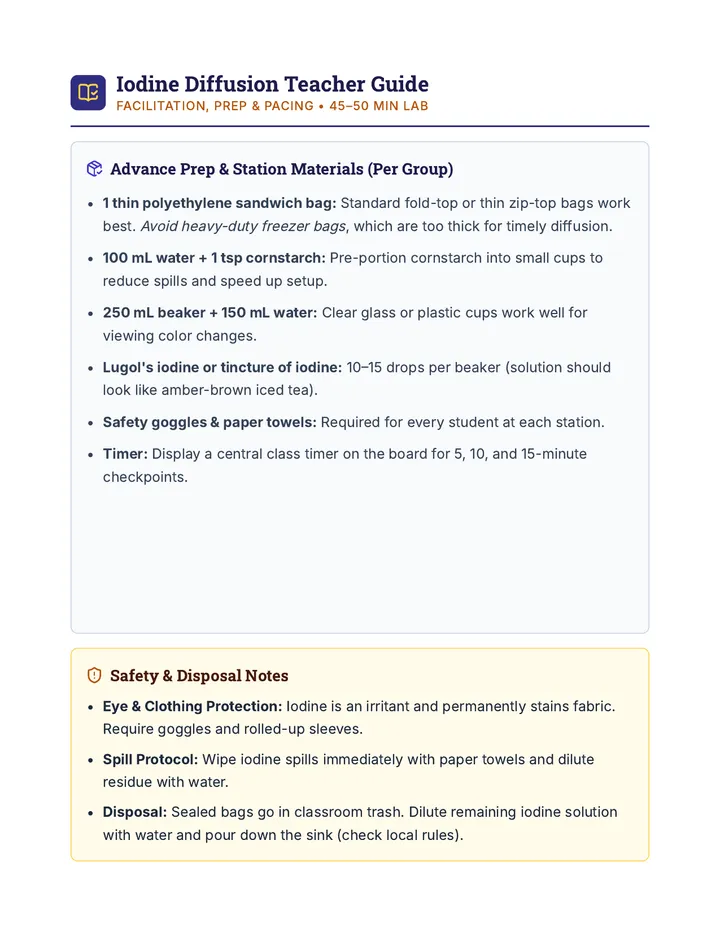
Iodine Diffusion Teacher Guide Iodine Diffusion Teacher Guide
Facilitation, Prep & Pacing • 45–50 Min Lab
Advance Prep & Station Materials (Per Group)
1 thin polyethylene sandwich bag: Standard fold-top or thin zip-top bags work best. Avoid heavy-duty freezer bags , which are too thick for timely diffusion.100 mL water + 1 tsp cornstarch: Pre-portion cornstarch into small cups to reduce spills and speed up setup.250 mL beaker + 150 mL water: Clear glass or plastic cups work well for viewing color changes.Lugol's iodine or tincture of iodine: 10–15 drops per beaker (solution should look like amber-brown iced tea).Safety goggles & paper towels: Required for every student at each station.Timer: Display a central class timer on the board for 5, 10, and 15-minute checkpoints.
Safety & Disposal Notes
Eye & Clothing Protection: Iodine is an irritant and permanently stains fabric. Require goggles and rolled-up sleeves.Spill Protocol: Wipe iodine spills immediately with paper towels and dilute residue with water.Disposal: Sealed bags go in classroom trash. Dilute remaining iodine solution with water and pour down the sink (check local rules).
45-Minute Pacing Guide
Teacher Guide
Time
Phase
Teacher & Student Actions
0–7 min
Hook & Safety
Introduce the Starch Bag Mystery using Slides 1–3. Review safety expectations and model how to seal the bag tightly.
7–15 min
Setup & Variables
Students mix cornstarch water, prepare the iodine beaker, write their hypothesis, identify variables, and record 0 min baseline colors.
15–30 min
Timed Observations
Start the 15-minute timer. Students record observations at 5, 10, and 15 min. Circulate to ask probing questions and preview key terms.
30–40 min
Model & CER
Reveal the particle-size explanation (Slide 6). Students draw their particle models and complete the Analysis and CER sections.
40–45 min
Cleanup & Debrief
Dispose of bags and rinse beakers. Have 2–3 students share their CER claims aloud to close the lesson.
Facilitation, Troubleshooting & Differentiation
Teacher Guide
Key Discussion Prompts
At 5 min: "Where inside the bag does the color change start? Why?"At 10 min: "Why hasn't the beaker liquid turned blue-black?"Post-Lab: "What kinds of nutrients could enter a cell like this?"
Troubleshooting & Misconceptions
Slow color change after 10 minutes
Bag may be freezer-grade or iodine too weak. Add 5–10 drops of iodine and gently swirl the beaker.
Blue-black color appears in the beaker
Bag leaked or starch dripped outside. Rinse the sealed bag before placing it in the beaker.
Scaffolds & ELL
Post a word bank: diffuse, semi-permeable, starch, iodine .
Use the built-in sentence starters on Page 3.
Pre-draw beaker/bag outlines for models.
Extensions
Temperature: Test warm vs. ice water baths.Concentration: Double iodine drops and time the change.Real-World: Research kidney dialysis tubing. Iodine Diffusion Answer Key Iodine Diffusion Answer Key
Sample Responses & Grading Criteria
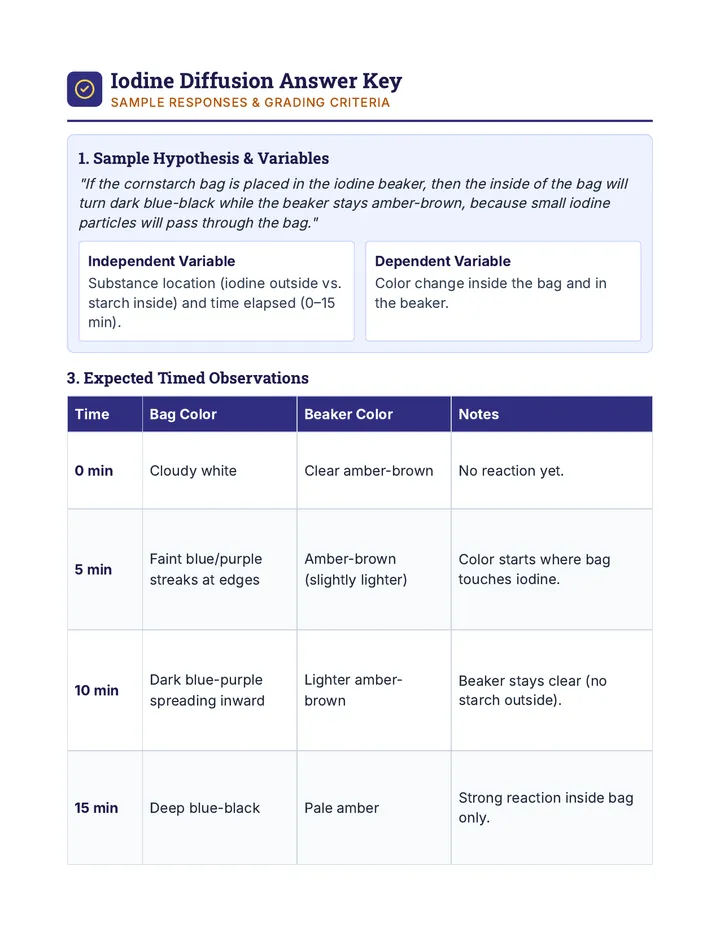
1. Sample Hypothesis & Variables
"If the cornstarch bag is placed in the iodine beaker, then the inside of the bag will turn dark blue-black while the beaker stays amber-brown, because small iodine particles will pass through the bag."
Independent Variable
Substance location (iodine outside vs. starch inside) and time elapsed (0–15 min).
Dependent Variable
Color change inside the bag and in the beaker.
3. Expected Timed Observations
Time
Bag Color
Beaker Color
Notes
0 min
Cloudy white
Clear amber-brown
No reaction yet.
5 min
Faint blue/purple streaks at edges
Amber-brown (slightly lighter)
Color starts where bag touches iodine.
10 min
Dark blue-purple spreading inward
Lighter amber-brown
Beaker stays clear (no starch outside).
15 min
Deep blue-black
Pale amber
Strong reaction inside bag only.
Part 2: Particle Model & Analysis Key
Answer Key
4. Particle Model Key (What to Look For)
Before (0 min)
Inside bag: Large starch (S) only.In beaker: Small iodine (I) only.
After (15 min)
Inside bag: Starch (S) + iodine (I).Arrows: Iodine (I) moving into bag.
5. Analysis Questions
a. Which substance diffused across the bag? What evidence supports this?
Answer: Iodine diffused into the bag. The cloudy white cornstarch inside turned deep blue-black, and the amber iodine in the beaker became lighter.
b. Did cornstarch move out into the beaker? Explain how you know.
Answer: No, cornstarch did not move out of the bag. If starch had diffused into the beaker, the iodine solution outside would have turned blue-black.
c. How does the bag model a semi-permeable cell membrane?
Answer: Like a cell membrane, the plastic bag is semi-permeable —it lets small iodine particles pass through tiny pores while blocking large starch molecules.
Part 3: CER Exemplar & Rubric
Answer Key
6. Exemplar Claim – Evidence – Reasoning (CER)
Claim: Iodine diffused from the beaker into the cornstarch bag, while cornstarch stayed trapped inside.
Evidence: At 0 minutes, the bag was cloudy white and the beaker was amber-brown. By 15 minutes, the bag turned deep blue-black while the beaker stayed clear and became lighter amber.
Reasoning: The plastic bag is semi-permeable. Small iodine particles diffused from high concentration in the beaker into the bag and reacted with starch. Large starch molecules could not fit through the pores.
Quick Lab Rubric (12 Points Total)
Criteria
Points
Expectation
Hypothesis, Variables & Data
4 pts
Testable prediction, correct IV/DV, and accurate 0–15 min observations.
Particle Model & Analysis
4 pts
Accurate particle sizes and arrows; correct use of semi-permeable .
CER Explanation
4 pts
Clear claim supported by lab color evidence and diffusion reasoning.