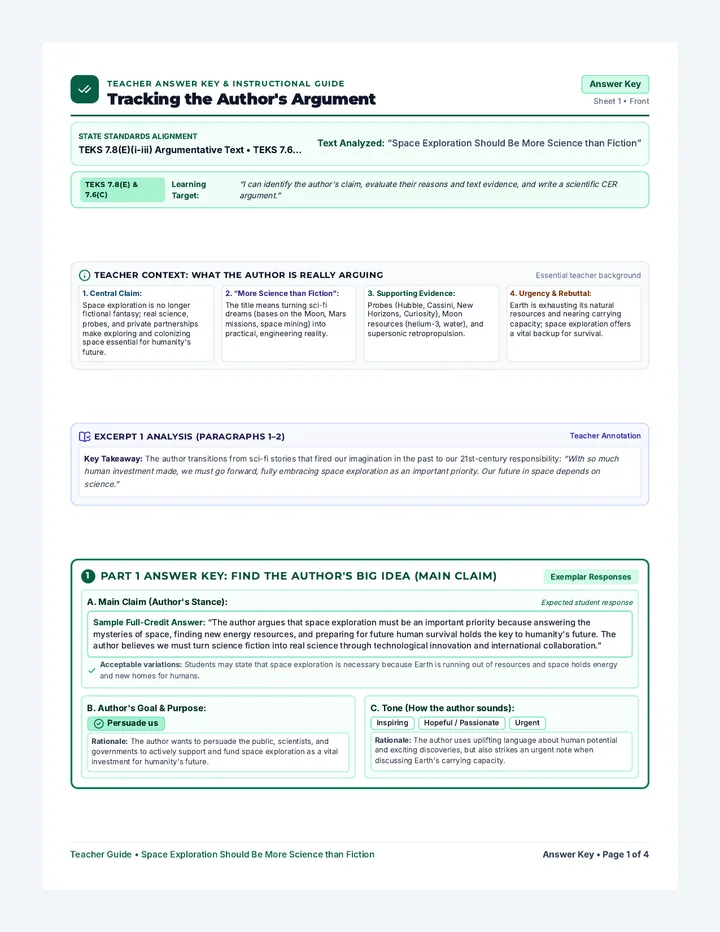
C. Tone (How the author sounds):
Inspiring Hopeful / Passionate Urgent
Rationale: The author uses uplifting language about human potential and exciting discoveries, but also strikes an urgent note when discussing Earth's carrying capacity.
Teacher Guide • Space Exploration Should Be More Science than Fiction Answer Key • Page 1 of 4
Checking Evidence Citation & Content Accuracy
Sheet 1 • Back
Page 2 of 4
Teacher Insight: The Role of Robotic Probes vs. Human Missions Text Nuance
In the text, the author sees robotic probes (Hubble, Cassini, New Horizons, Curiosity) not as an alternative to human exploration, but as the essential scouts and foundation that make future human bases on the Moon and Mars possible.
Scoring Guide
Reason A: Global Teamwork & Private “New Space” Companies (Paras 2–4) 4 Points Possible
Author's Point (Expected):
The author explains that 21st-century space exploration is powered by international cooperation and private commercial companies that make ambitious human goals achievable.
Text Evidence / Proof (Expected):
In paragraph 2 & 4, the text cites the International Space Station combining 16 nations, and dozens of “New Space” private companies working on moon tourist trips and Mars colonization.
Reason B: Probes & Telescopes Open Windows to New Worlds (Paras 5–6, 9) 4 Points Possible
Author's Point (Expected):
Robotic spacecraft and rovers conduct NASA's most productive missions, gathering vital data and searching for signs of past or present life on other planets.
Text Evidence / Proof (Expected):
The Hubble Telescope made 1.3 million observations over 4 billion miles; Cassini explored Saturn/Titan; Juno orbited Jupiter; New Horizons reached Pluto; Curiosity searches for organic building blocks of life on Mars.
Reason C: Space Mining & Resources Benefit Human Survival (Paras 6–8) 4 Points Possible
Author's Point (Expected):
Exploring space offers valuable natural resources needed for clean energy on Earth and can sustain long-term lunar and planetary bases.
Text Evidence / Proof (Expected):
In paragraph 6 & 7, the text notes the Moon has helium-3 for nuclear fusion and rare-earth metals for solar panels; asteroid ice provides hydrogen/oxygen to manufacture cheap rocket fuel.
Teacher Guide • Space Exploration Should Be More Science than Fiction Answer Key • Page 2 of 4
Documented Dangers vs. Guided Evaluation Solutions
Sheet 2 • Front
Page 3 of 4
Both Halves Required
Counterclaim (Documented Dangers & Obstacles):
Exemplar Answer: “The author acknowledges that space travel has serious documented dangers and tragic losses, such as the fatal explosions of the Challenger in 1986 and Columbia in 2003. Furthermore, landing heavy human spacecraft on Mars is far more problematic than landing rovers, because air bags and sky cranes will not work for human ships.”
Look for: shuttle explosions (Challenger/Columbia) or Mars landing weight problems.
Author's Rebuttal (Why We Must Still Go):
Exemplar Answer: “The author responds that Earth is close to surpassing its carrying capacity and exhausting natural resources, making space exploration essential for humanity's survival. Additionally, new engineering breakthroughs like supersonic retropropulsion make landing heavy ships possible, comparing the risk to climbing Mount Everest—risky, but achievable.”
Look for: Earth's carrying capacity, resource depletion, or Mount Everest comparison.
Scoring & Model Answers
1. Real Science in Action: Which real spacecraft/mission impressed you? What facts/discoveries were shared? Full Credit Sample
Sample Student Answer: “One real mission that impressed me was the Hubble Space Telescope because the author explains that it has made more than 1.3 million observations and traveled over 4 billion miles, sending back stunning photos of faraway stars and galaxies.”
Credit also given for: Curiosity rover finding chemical building blocks of life on Mars, Cassini carrying the Huygens probe to Titan, or New Horizons flying by Pluto.
2. Facing the Dangers (Fairness Check): Full Credit Sample
Sample Student Answer: “The author showed honesty about the dangers by discussing the tragic explosions of the Challenger in 1986 and Columbia in 2003, which shut down the shuttle program, and by explaining that landing heavy spacecraft carrying humans on Mars is a major unsolved engineering challenge.”
3. The Earth Connection (Relevance & Reason Check): Full Credit Sample
Sample Student Answer: “Exploring space helps Earth because mining resources like helium-3 on the Moon can provide clean nuclear fusion energy for humans, and mining rare-earth metals can help construct solar panels, especially since Earth is nearing its carrying capacity and running out of resources.”
Teacher Guide • Space Exploration Should Be More Science than Fiction Answer Key • Page 3 of 4
Exemplar Student Response with Exact Highlighter Coding
Sheet 2 • Back
Page 4 of 4
Teacher Verification Key for Student Highlighting: Students should highlight exactly as shown below
Pink: Words used from prompt in claim
Yellow: Answer to prompt (in claim)
Green: Text evidence (fact/quote)
Blue: Reasoning (why proof matters)
Exemplar Model Response A (Focus: Human Missions & Colonization) Exemplary Full-Credit Model
Space exploration should focus on investing in human missions to colonize Mars and the Moon because humanity's long-term survival is at stake. In paragraph 12 it states, “We are close to surpassing our planet’s carrying capacity and exhausting our natural resources,” while private New Space companies are developing supersonic retropropulsion to make landing heavy human ships on Mars achievable. This proof shows that my claim is correct because Earth cannot support our growing population forever without running out of energy and resources. By creating human settlements and conducting space mining on the Moon for clean energy elements like helium-3, we can protect life on Earth and build a safe backup home for future generations. While human spaceflight is risky like climbing Mount Everest, technological innovation makes it a necessary challenge we must pursue.
Word Bank Words Included:
New Space colonization carrying capacity space mining
Exemplar Model Response B (Focus: Robotic Missions First) Meets Standard
Space exploration should focus on practical robotic spacecraft right now before risking human lives. In paragraph 5 it states, “Robotic spacecraft have conducted some of NASA’s most exciting and productive missions,” including the Hubble Telescope making over 1.3 million observations. This evidence proves my claim because robotic probes can safely scout the solar system and locate water and minerals at far less cost and danger, laying the essential scientific foundation before sending astronauts.
Grading Quick Check: ✓ Claim has Pink & Yellow ✓ Quote has Green ✓ Reasoning has Blue ✓ Used 2+ Vocab Terms ✓ Complete Sentences
Teacher Guide • Space Exploration Should Be More Science than Fiction Answer Key • Page 4 of 4
Sheet 1 • Back (Part 2)
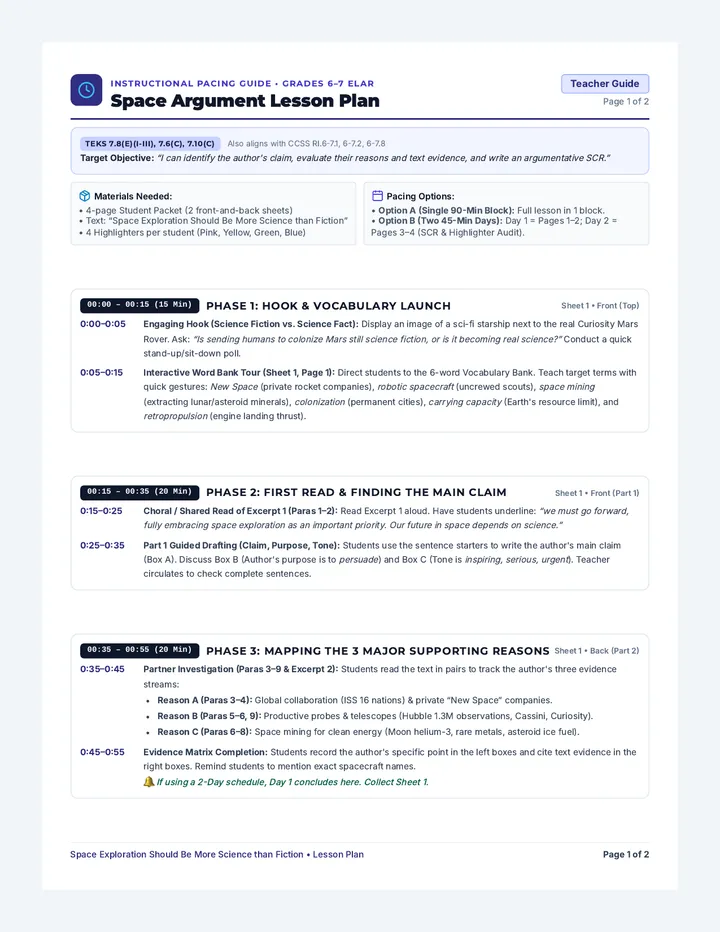
0:35–0:45
Partner Investigation (Paras 3–9 & Excerpt 2): Students read the text in pairs to track the author's three evidence streams:
0:45–0:55
Evidence Matrix Completion: Students record the author's specific point in the left boxes and cite text evidence in the right boxes. Remind students to mention exact spacecraft names. 🔔 If using a 2-Day schedule, Day 1 concludes here. Collect Sheet 1.
Space Exploration Should Be More Science than Fiction • Lesson Plan Page 1 of 2
Sheet 2 Execution (Pages 3 & 4 of Student Packet)
Sheet 2 Guide
Page 2 of 2
00:55 – 01:10 (15 Min)
Sheet 2 • Front (Page 3)
0:55–1:02
Close Read of Excerpt 3 (Paras 10–13): Read about the documented dangers (Challenger/Columbia explosions, landing heavy spacecraft on Mars). Contrast with the author's rebuttal: Earth is close to surpassing carrying capacity and the risk is like climbing Mount Everest.
1:02–1:10
Part 3 & 4 Guided Completion: Students fill in the Counterclaim (dangers/landing issues) and Rebuttal (carrying capacity/Mount Everest). Then students answer the 3 guided questions in Part 4 using the provided text hints and sentence starters.
01:10 – 01:22 (12 Min)
Sheet 2 • Back (Page 4)
The Prompt Breakdown:
“Should space exploration programs focus on practical robotic missions, or should they spend money trying to send humans to live on Mars?”
[C] Claim: Restate the prompt and give a direct answer in 1 sentence. Use starter: “Space exploration should focus on...”
[E] Evidence: Cite at least 1 fact from the text excerpts. Use starter: “In paragraph ___ it states...”
[R] Reasoning: Explain why this fact proves the claim. Use starter: “This proof shows that my claim is correct because...”
Writing Sprint (Silent Writing): Students draft their SCR paragraph on the 14 ruled lines on Page 4. Challenge them to include at least two Word Bank terms (e.g., carrying capacity, space mining, New Space).
01:22 – 01:30 (8 Min)
Self-Audit Protocol
Students swap highlighters and code their paragraph using the four colors before turning it in:
1. Pink: Words used from prompt in claim
2. Yellow: Answer to the prompt (in claim)
3. Green: Text evidence (fact/quote)
4. Blue: Reasoning (explaining why proof matters)
Quick Peer Check: If a color is missing, the student knows which part to add before submitting! Packet Complete!
Differentiation & Accommodations:
Struggling Writers (Tier 2/3): Provide sentence starters pre-written; have students dictate reasoning orally before writing; allow partnering for Part 2.
Emergent Bilinguals (ELPS): Pre-teach Spanish cognates (exploración, prioridad, ciencia, recursos); point to visual icons for each prompt component.
Advanced / GT Learners: Require students to evaluate both the pro-robotic and pro-human arguments and include a rebuttal sentence in their SCR paragraph.
Space Exploration Should Be More Science than Fiction • Lesson Plan Page 2 of 2