Sight Word Sleuths Slides Mission File: 3-AZ-RF
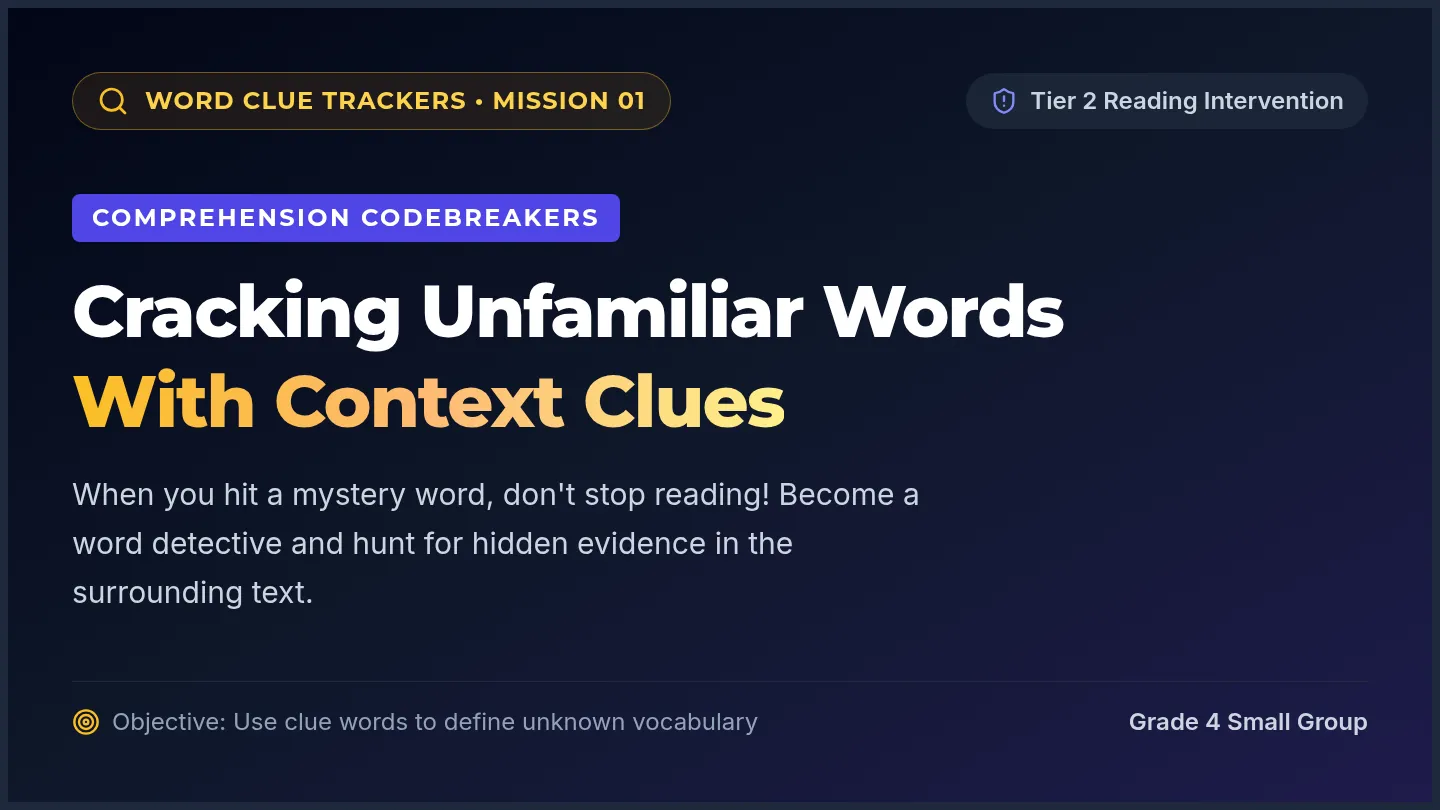
30-Minute Tier 2 Intervention
Case of the Tricky Words
Sight Word Sleuths
Uncover the secret patterns, trap the tricky letters, and read irregularly spelled third-grade words with instant speed!
Target: Top 8 Misread & Misspelled Words Grade 3 Foundational Literacy
The Sleuth Strategy
Cracking "Heart Words"
✓
The Sound Parts
Most letters follow the rules we already know! Sound them out using your phonics tools.
Say the sounds: /b/ ... /k/ ... /s/
The Heart Parts
A few letters break the rules. We memorize this special tricky spot by heart !
Lock the tricky letters in your memory!
Today's Mission: Detect the Heart Part before the word tricks you!
Case File 01 & 02
Tricky Vowel Pairs
Look for the Heart!
Target Word Sound: /f/ /r/ /e/ /n/ /d/
fr ie nd
Trap: Writing "frend" or "freind".
💡 Clue: Remember "i " comes first in my best friend !
Target Word Sound: /b/ /ē/ /k/ /u/ /z/
be au se
Trap: Writing "becuz" or "becuse".
💡 Clue: B ig E lephants C an A lways U nderstand S mall E lephants!
Choral Practice: Read aloud on 3... 2... 1: "FRIEND" and "BECAUSE"
Case File 03 & 04
The Silent "L" Family
Rhyming Triplet Clue
COULD
c ould
"Could you run to the bus?"
WOULD
w ould
"Would you sit with me?"
SHOULD
sh ould
"We should help the cat."
The Secret Code for -OULD:
O h U L ucky D uck! (The 'L' is completely silent!)
🦆
Case File 05 & 06
Sneaky Letter Disguises
Unusual Spellings
PEOPLE Sound: /p/ /ē/ /p/ /l/
p eo ple
Trap: Writing "peopel" or "peple".
💡 Clue: The sneaky "o " hides between the two p 's!
LAUGH Sound: /l/ /æ/ /f/
l augh
Trap: Writing "laf" or "laph".
💡 Clue: "gh " pretends to make the /f/ sound!
Tap on your arm: P - E - O - P - L - E and L - A - U - G - H
Case File 07 & 08
The Twin Traps: Their vs. There
Sound The Same, Mean Differently
THEIR Belongs to them
their
The letter "i" is shaped like a person!
"The kids took their red bags."
THERE A Place or Location
there
It has the word "here" right inside it!
"Sit over there by the red tent."
Quick Test: "The kids took their / there bags over their / there." Which is which?
Speed Challenge
Trap Busters: Spot the True Word!
Thumbs Up = Correct
1. Which is real?
frend friend
2. Which is real?
because becuse
3. Which is real?
cud could
4. Which is real?
people peple
Rapid Flash Choral:
friend • because • could • people • laugh • their
Clues Decoded
Next Step: Field Investigation
Time for Your Detective Field Report!
Grab your pencil and your detective worksheet. You will hunt down the misspelled words, crack secret sentences, and write like a master sleuth!
Step 1
Spot & circle the correctly spelled heart words.
Step 2
Choose their or there for the clues.
Step 3
Rewrite mystery sentences with zero spelling traps!
Independent Practice: 12-15 Minutes Good luck, Detective!
Sight Word Sleuths Worksheet Confidential Field Report • Arizona 3.RF.3.d
Sight Word Sleuths: Field Report
Name:
Date:
Target Clue Box (Heart Words) 8 Key Suspects
friend
because
could
would
people
laugh
their
there
Part 1: Trap Spotter Circle the ONE correctly spelled word in each row
frend friend freind
because becuz becuse
cud coold could
peopel people peple
laugh laff laph
Part 2: The Twin Trap (Their vs. There) Write the correct word on each blank line
their = belongs to them ("i" for person)
there = a place (has "here" inside)
The boys lost blue hats on the bus.
Look over ! A fat cat is on the red rug.
The kids picked up snack bags.
Is a wet pup in the tent?
Turn page for Case File Fix-Up & Final Code Page 1 of 2
Independent Practice • Continued
Case File Fix-Up & Decoder
Detective Evidence Sheet
Part 3: Detective Sentence Fix-Up Find the misspelled word, then write the sentence on the lines
Case Sentence 1: 1 Spelling Trap Inside
"My best frend sat with me on the bus."
Rewrite correctly on the lines:
Case Sentence 2: 1 Spelling Trap Inside
"We can not run in the mud becuz it is wet."
Rewrite correctly on the lines:
Case Sentence 3: 2 Spelling Traps Inside
"Ten peple did laff at the wet cat."
Rewrite correctly on the lines:
Part 4: Secret Clue Cracker Write the missing heart letters in the roomy boxes
1. c
d
rhymes with would
2. p
ple
a big crowd
3. l
sounds like /laf/
4. fr
nd
a good pal
Sleuth Badge Self-Check Check the box that fits your skills today:
Master Sleuth ⭐
Read & spell all 8 words fast
Field Detective 🔍
Know most words; 1-2 tricky
Cadet Sleuth 🛡️
Sight Word Sleuths Teacher Guide Tier 2 Reading Intervention • Pacing & Instructional Protocol
Sight Word Sleuths: Teacher Guide
30-Minute Tier 2
Arizona Standard: 3.RF.3.d
Group Size
3–6 Students
Target Skill
Irregular Sight Words
Method
Heart-Word Mapping
Core Words
8 High-Trap Words
30-Minute Lesson Timeline
00–05 min
Hook & Strategy Primer (Slides 1–2)
Introduce the "Sight Word Sleuth" mission. Explain the Heart-Word concept: most letters make regular sounds, but "heart parts" break the rules and must be memorized by heart.
05–16 min
Direct Modeling & Orthographic Mapping (Slides 3–6)
Examine target pairs: friend (ie=/e/), because (au=/aw/), could/would (silent L), people (eo=/e/), laugh (augh=/af/), and their/there (homophones). Guide students through multi-sensory arm tapping.
16–19 min
Interactive Choral Check & Trap Busters (Slide 7)
Conduct thumbs up / thumbs down rapid recognition on Slide 7. Do a rapid-fire flash read where every student reads words in unison within 1 second.
19–27 min
Independent Detective Practice (Worksheet Pages 1–2)
Distribute the 2-page field report with decodable context sentences. Circulate to provide targeted phoneme-grapheme scaffolding. Prompt struggling students with the mnemonic rhymes.
27–30 min
Debrief, Self-Evaluation & Exit Check
Review Part 2 answers as a group. Have students fill out their Sleuth Badge self-check. Congratulate cadets on solving the case!
Multi-Sensory Intervention Routines
Arm Tapping Routine:
Left arm out straight. Tap left shoulder for letter 1, inside elbow for middle letters, wrist for final letters. Then sweep from shoulder to wrist while saying the whole word.
Heart Spot Highlighting:
When writing tricky words, have students draw a tiny heart directly above the irregular vowel pair (e.g. above ie in friend or eo in people ).
Sight Word Sleuths • Tier 2 Facilitation Guide Page 1 of 2
Teacher Resource • Key & Scaffolds
Answer Key & Decodable Sentences
Complete Solutions
Worksheet Answer Key
Part 1: Trap Spotter (Correctly Spelled Choices) Common Phonetic Decoys