Slope Splash Lesson Plan Grades 4–5 Earth Science • Teacher Guide
Slope Splash Lesson Plan
Driving Question: Does slope change how water moves and shapes the land?
Pacing
50 Minutes
NGSS Alignment
4-ESS2-1: Make observations and/or measurements to provide evidence of the effects of weathering or the rate of erosion by water, ice, wind, or vegetation.
SEP: Planning & Carrying Out Investigations; Analyzing & Interpreting Data.
Learning Objectives
Model how changing a hill's slope affects water speed (runoff).
Measure and compare soil movement (erosion) across three slope angles.
Use collected data to explain why steeper slopes erode faster.
Key Vocabulary
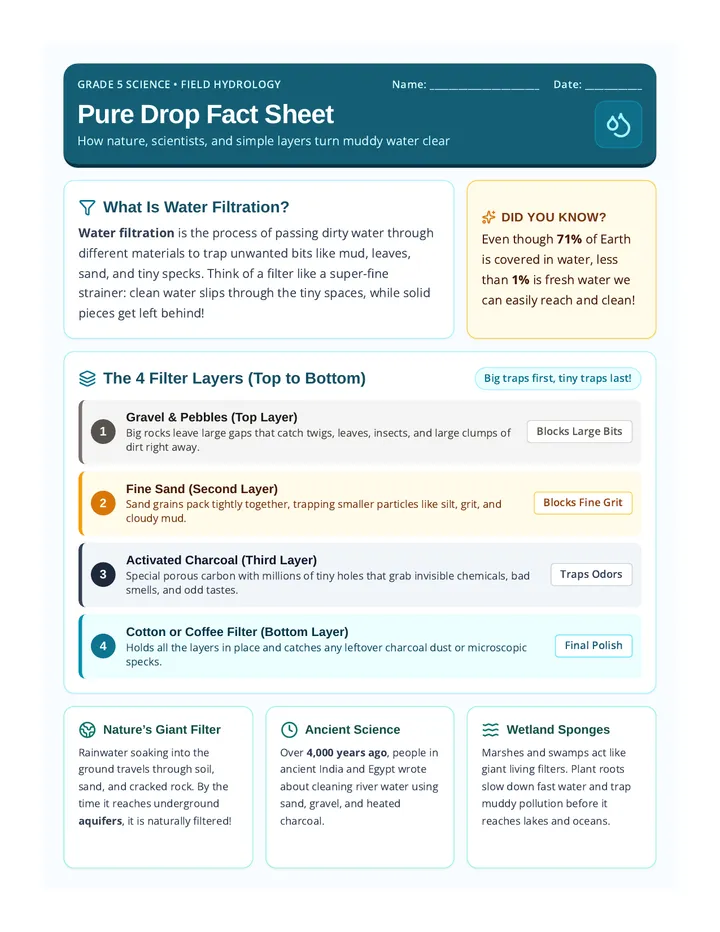
Slope: How steep or flat a landform is.
Runoff: Water that flows over the land instead of soaking in.
Erosion: The movement of soil, sand, or rock by water, wind, or ice.
Deposition: Dropping or settling of eroded sediment in a new place.
Materials Needed (Per Group of 3–4 Students)
1 aluminum baking pan or stream table tray (with a small drainage notch or catch tray at the bottom)
3–4 cups of damp sand or sandy soil (packed evenly at the top two-thirds of the tray)
4 identical hardcover books or wooden blocks (to raise the slope: 0, 2, and 4 books)
1 plastic cup with 3–4 small holes poked in the bottom (rainmaker cup)
1 measuring cup with 250 mL of water per trial (750 mL total)
1 stopwatch or timer, 1 metric ruler (cm), and paper towels
1 copy of Stream Table Activity per student
Fair Test Tip & Classroom Setup
Before starting, pre-pack or model how to gently smooth the sand back into a flat "hillside" between trials so every slope starts with the same soil shape. Emphasize controlled variables : groups must pour the exact same amount of water (250 mL) from the same height at the top of the tray for each trial.
Instructional Sequence & Teaching Notes
Slope Splash Lesson Plan
Phase & Time
Teacher & Student Actions
1. Engage
8 mins
Show two contrasting scenarios: rainwater hitting a flat sidewalk vs. a steep muddy hillside. Ask: "Where does water move faster, and what happens to the dirt?" Introduce the driving question and have students write a prediction on their Stream Table Activity sheet.
2. Explore
22 mins
Assign roles: Pourer, Timer, Measurer, Recorder . Groups test three slopes: Flat (0 books) , Gentle (2 books) , and Steep (4 books) . For each trial, students pour 250 mL of water through the rainmaker cup, time how many seconds it takes runoff to reach the bottom edge, and measure the widest/deepest eroded channel (gully) in centimeters.
3. Explain
10 mins
Groups graph their runoff time and gully width, then share patterns. Guide students to connect gravity to water speed: steeper slopes pull water downward faster, giving runoff more energy to pick up and carry soil (erosion) and carve deeper channels.
4. Evaluate
10 mins
Students complete the Runoff Erosion Assessment independently to demonstrate they can interpret slope/runoff data and apply erosion concepts to new scenarios.
Guiding Discussion Prompts
"What happened to the runoff time as we added more books? Why?"
"Compare the water at the bottom of the tray—which slope carried the muddiest water?"
"Where did the washed-away sand end up? (Deposition)"
"How could engineers slow down erosion on a steep highway hill?"
Common Misconceptions
More water = more erosion only: Students may forget that the same amount of water causes more erosion when it moves faster down a steeper slope.Disappearing soil: Clarify that eroded sand doesn't vanish—it is transported and deposited at the base of the slope.
Differentiation & Extensions
Support (ELL / Struggling Learners): Provide sentence frames ("As the slope became steeper, the water moved _____ and eroded _____." ) and pre-label the graph axes.
Extension (Early Finishers): Have students test how adding "vegetation" (toothpicks, moss, or felt strips) on the steep 4-book slope changes runoff speed and erosion.
Stream Table Activity Earth Science Lab • Grades 4–5
Name: ________________________ Date: ____________
Stream Table Activity
Investigation Question: Does the steepness of a slope change how water moves and erodes soil?
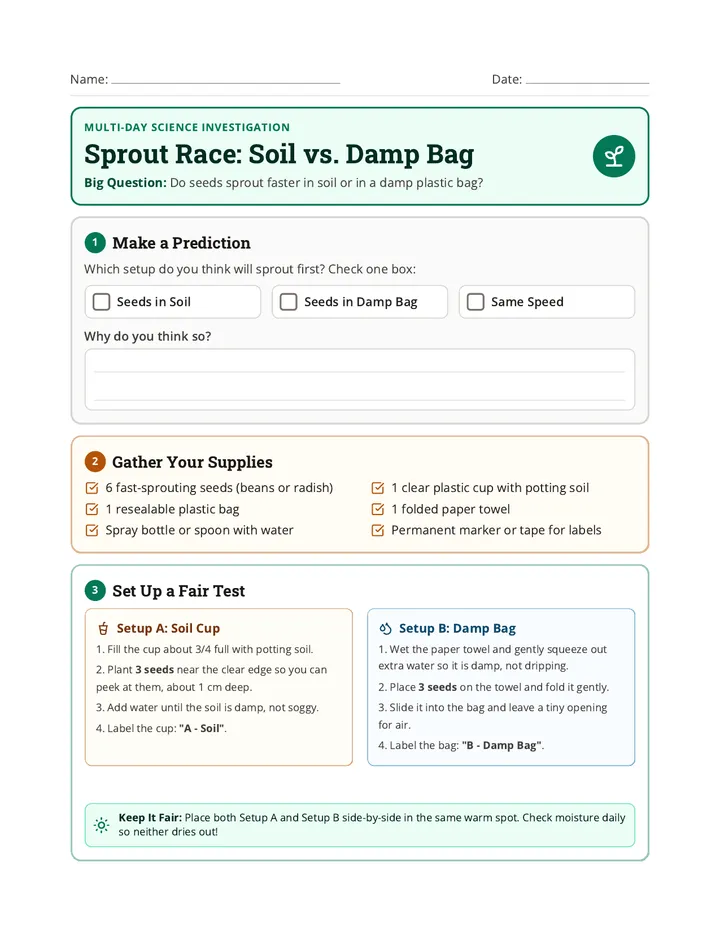
1. Make a Prediction
If you pour the same amount of water onto a flat tray, a gentle slope, and a steep slope, which slope will have the fastest runoff and the most soil erosion? Explain why.
2. Investigation Steps
Pack damp sand evenly into the top two-thirds of your stream tray. Leave the bottom third empty to catch runoff.
Trial 1 (Flat): Keep the tray flat (0 books). Hold the rainmaker cup at the top edge and pour 250 mL of water.Start the timer as soon as water hits the sand. Stop when runoff first reaches the bottom edge of the tray. Record the time.
Use a ruler to measure the widest eroded channel (gully) in centimeters. Record your observations.
Smooth the sand flat again. Repeat Steps 2–4 for Trial 2 (2 books) and Trial 3 (4 books) .
3. Stream Table Data
| Slope Trial | Runoff Time
Data Analysis & Conclusions
Name: ____________________
4. Graph Your Erosion Data
Create a bar graph showing the Gully Width (cm) for each slope trial. Label the numbers along the side axis.
Gully Width (cm)
Flat (0 books)
Gentle (2 books)
Steep (4 books)
5. Analyze Your Results
A. How did changing the slope affect the speed of the runoff ? Use your time data as evidence.
B. Which slope caused the most erosion ? How could you tell from the sand and the runoff water?
C. Why was it important to pour the exact same amount of water (250 mL) in every trial?
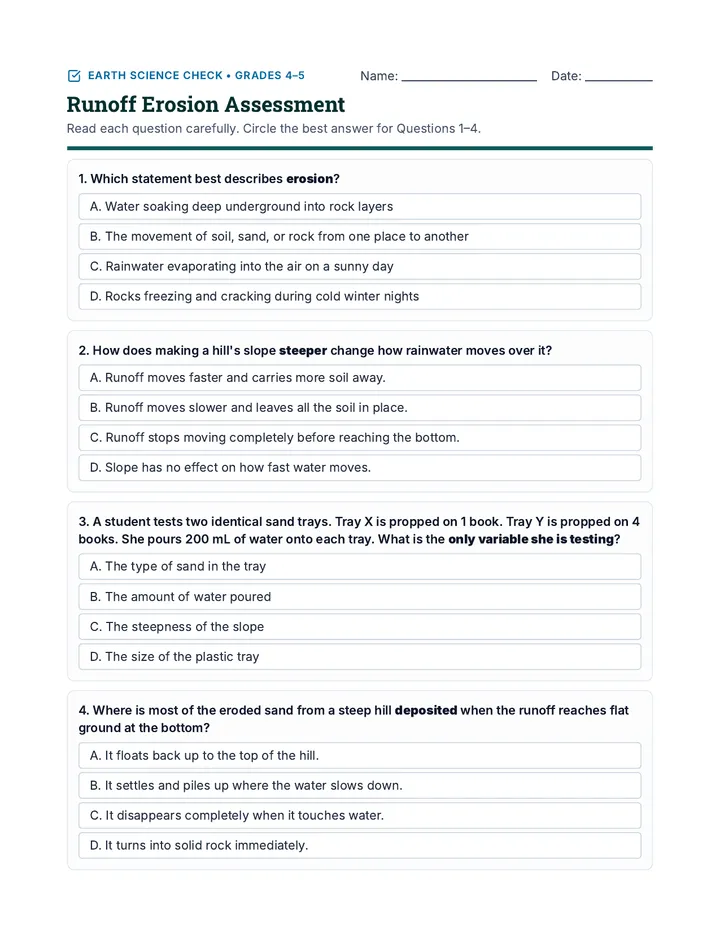
Runoff Erosion Assessment Earth Science Check • Grades 4–5
Name: ________________________ Date: ____________
Runoff Erosion Assessment
Read each question carefully. Circle the best answer for Questions 1–4.
1. Which statement best describes erosion ?
A. Water soaking deep underground into rock layers
B. The movement of soil, sand, or rock from one place to another
C. Rainwater evaporating into the air on a sunny day
D. Rocks freezing and cracking during cold winter nights
2. How does making a hill's slope steeper change how rainwater moves over it?
A. Runoff moves faster and carries more soil away.
B. Runoff moves slower and leaves all the soil in place.
C. Runoff stops moving completely before reaching the bottom.
D. Slope has no effect on how fast water moves.
3. A student tests two identical sand trays. Tray X is propped on 1 book. Tray Y is propped on 4 books. She pours 200 mL of water onto each tray. What is the only variable she is testing ?
A. The type of sand in the tray
B. The amount of water poured
C. The steepness of the slope
D. The size of the plastic tray
4. Where is most of the eroded sand from a steep hill deposited when the runoff reaches flat ground at the bottom?
A. It floats back up to the top of the hill.
B. It settles and piles up where the water slows down.
C. It disappears completely when it touches water.
D. It turns into solid rock immediately.
Data Analysis & Real-World Application
Name: ____________________
Part 2: Analyze Stream-Table Data
A 4th-grade science group poured 300 mL of water down three different slopes and measured how fast the runoff reached the bottom and how much soil washed into the catch pan.
Slope Height
Runoff Time (seconds)
Eroded Soil Collected (grams)
Low (1 block)
14 seconds
12 grams
Medium (3 blocks)
8 seconds
34 grams
High (5 blocks)
4 seconds
68 grams
5. How many more grams of soil eroded on the High slope compared to the Low slope ? Show your math and include units.
6. Describe the pattern you see in the table between Runoff Time and Eroded Soil Collected .
Part 3: Real-World Problem
7. A town wants to build a park at the bottom of a steep, bare dirt hill. Explain what might happen to the hill and the park during a heavy rainstorm, and suggest one way engineers could slow down erosion on the slope.
Slope Splash Answer Key Teacher Resource • Grades 4–5
Slope Splash Answer Key
Activity & Assessment Key
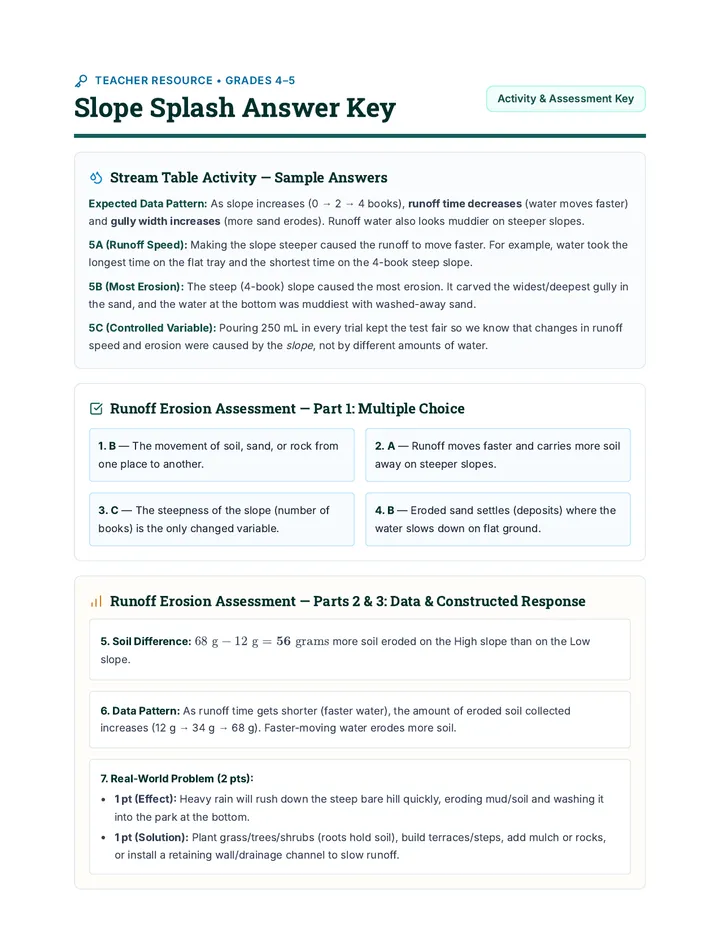
Stream Table Activity — Sample Answers
Expected Data Pattern: As slope increases (0 → 2 → 4 books), runoff time decreases (water moves faster) and gully width increases (more sand erodes). Runoff water also looks muddier on steeper slopes.
5A (Runoff Speed): Making the slope steeper caused the runoff to move faster. For example, water took the longest time on the flat tray and the shortest time on the 4-book steep slope.
5B (Most Erosion): The steep (4-book) slope caused the most erosion. It carved the widest/deepest gully in the sand, and the water at the bottom was muddiest with washed-away sand.
5C (Controlled Variable): Pouring 250 mL in every trial kept the test fair so we know that changes in runoff speed and erosion were caused by the slope , not by different amounts of water.
Runoff Erosion Assessment — Part 1: Multiple Choice
1. B — The movement of soil, sand, or rock from one place to another.
2. A — Runoff moves faster and carries more soil away on steeper slopes.
3. C — The steepness of the slope (number of books) is the only changed variable.
4. B — Eroded sand settles (deposits) where the water slows down on flat ground.
Runoff Erosion Assessment — Parts 2 & 3: Data & Constructed Response
5. Soil Difference: \(68\text{ g} - 12\text{ g} = \mathbf{56\text{ grams}}\) more soil eroded on the High slope than on the Low slope.
6. Data Pattern: As runoff time gets shorter (faster water), the amount of eroded soil collected increases (12 g → 34 g → 68 g). Faster-moving water erodes more soil.
7. Real-World Problem (2 pts):
1 pt (Effect): Heavy rain will rush down the steep bare hill quickly, eroding mud/soil and washing it into the park at the bottom.1 pt (Solution): Plant grass/trees/shrubs (roots hold soil), build terraces/steps, add mulch or rocks, or install a retaining wall/drainage channel to slow runoff.