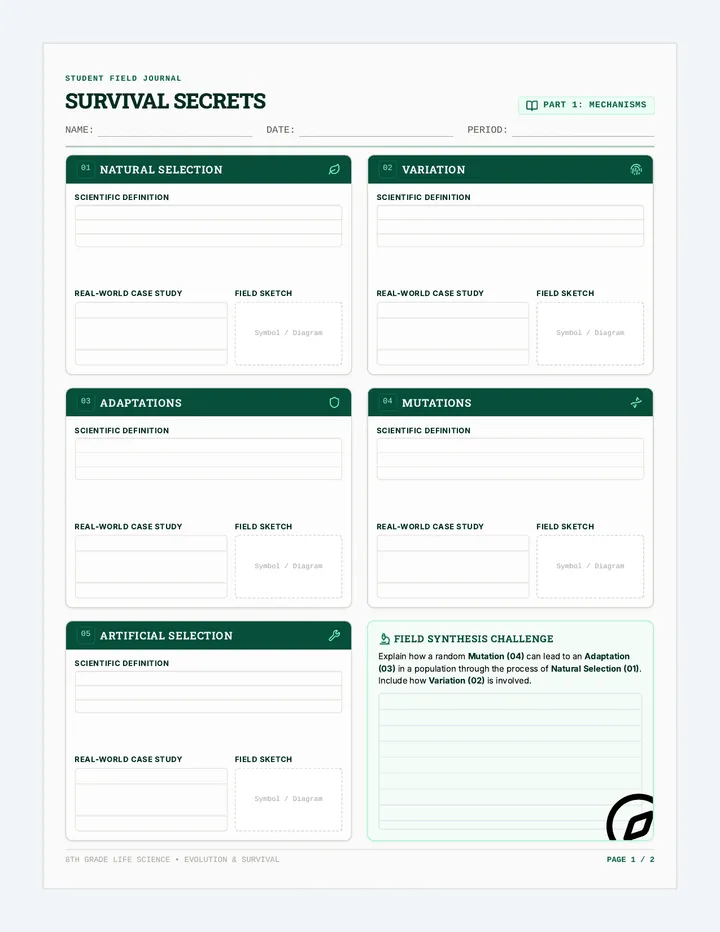
An inquiry-based exploration of the four forces of flight—lift, weight, thrust, and drag—through the lens of aerospace engineering. Students design, test, and iterate on paper gliders to observe aerodynamic principles in action.
An exploration of the nervous system's building blocks, focusing on neuron structure, the synaptic gap, and the chemical messengers that drive human behavior and sensation.
A lesson focused on identifying the roles of producers, consumers, and decomposers within an ecosystem through visual aids and hands-on sorting, designed for MCAS Alt portfolio evidence.
Master the fundamental concepts of elements, their properties, and the forces that bind them together.
A foundational lesson on cybersecurity for elementary students, focusing on identifying personal information and learning the 'Ask First' rule for online sharing.
A comprehensive exploration of Earth's biogeochemical cycles, covering the water, carbon, nitrogen, and phosphorus cycles. Students will learn how matter moves through ecosystems and why these processes are vital for life on Earth.
A comprehensive lesson exploring the unique stages of mammal life cycles, focusing on humans and dogs, with differentiated activities for 4th-grade students.
A final assessment to evaluate student understanding of thermal energy transfer, insulators, and conductors.
Applying thermal energy knowledge to complex real-world scenarios through a reading passage and interactive task cards.
A hands-on laboratory experiment where students test various materials to determine their effectiveness as insulators.
Reviewing the three types of heat transfer through interactive slides and a graphic organizer to connect concepts to everyday life.
A comprehensive lesson on the water cycle, covering evaporation, condensation, precipitation, runoff, and absorption through visual aids and tiered practice.
A comprehensive lesson exploring atomic structure, Periodic Table trends, and the fundamental differences between ionic and covalent bonding using elements from the first three periods.
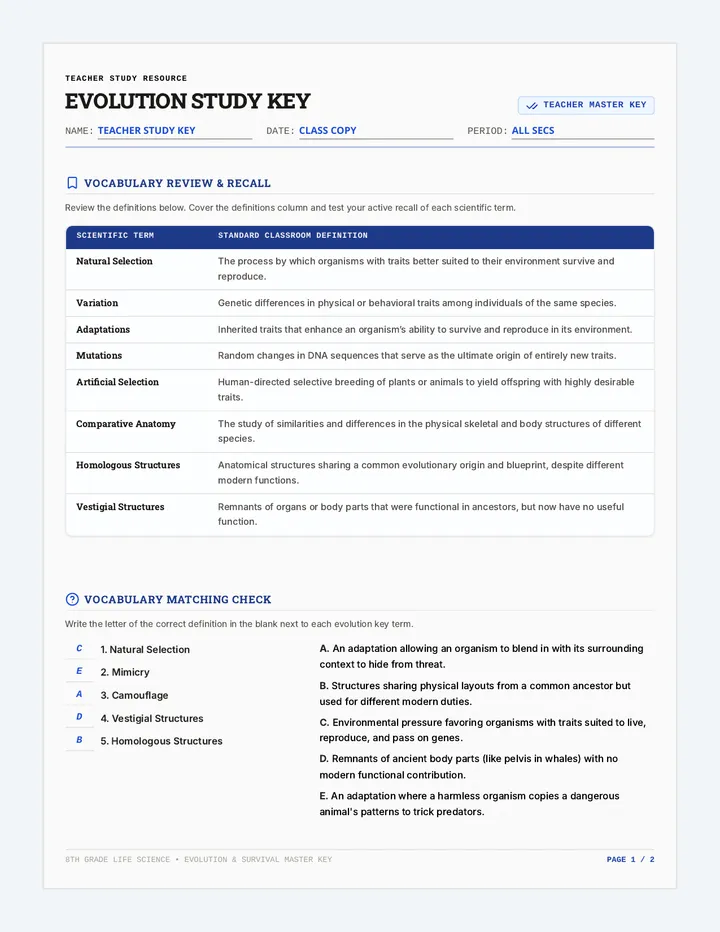
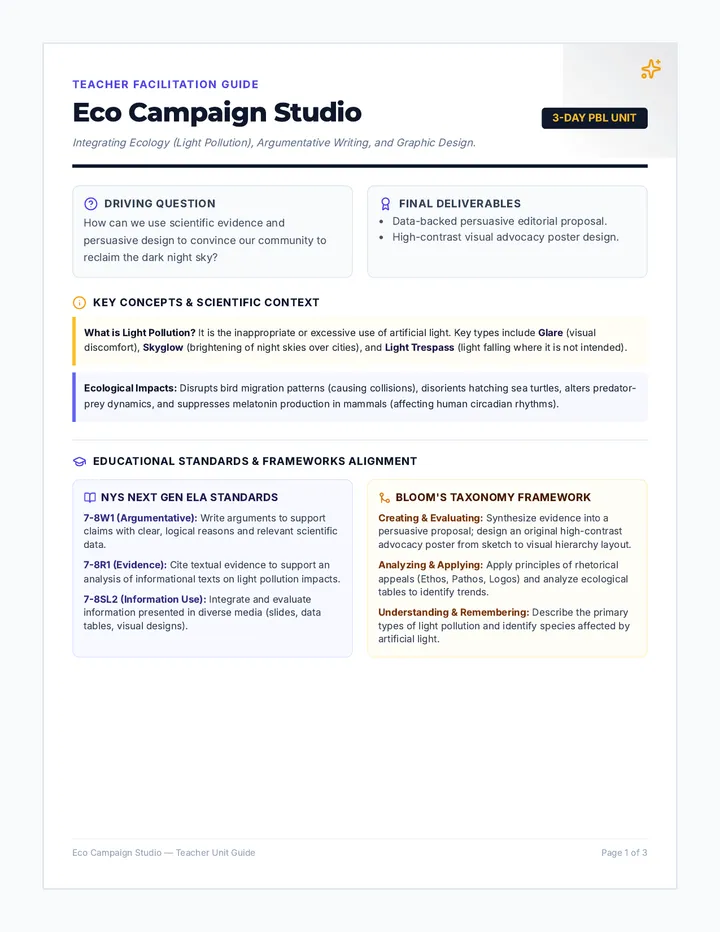
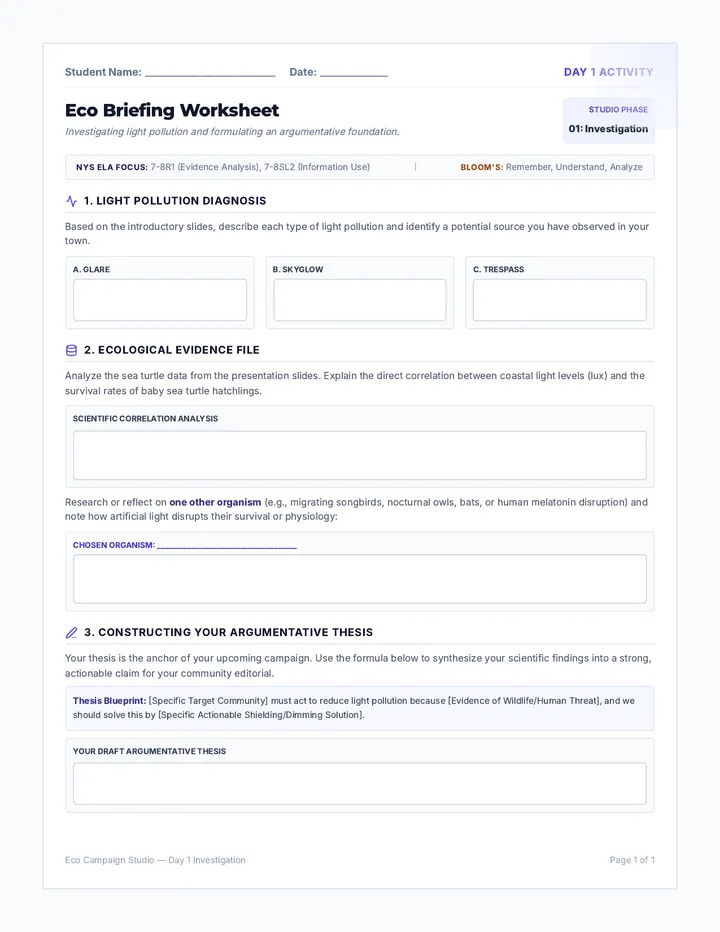
A comprehensive introduction to biomimicry where students explore how nature's best designs solve human challenges, culminating in a creative engineering project.
A high-energy workshop introducing 9th graders to design thinking. Students apply human-centered design to solve school-based challenges like hallway congestion or cafeteria waste.
Students explore the Input-Process-Output (IPO) model by deconstructing everyday smart devices and designing their own tech solutions to classroom challenges. This lesson bridges the gap between physical hardware and programmatic logic through hands-on analysis and creative problem-solving.
A comprehensive lesson exploring why Australia receives high levels of UV radiation, focusing on ozone depletion and the interaction between light and matter. Students analyze data, practice constructing scientific explanations, and explore the biological impact of UV light.
A comprehensive review of high school biology topics including viruses, DNA structure and replication, the cell cycle and its disruptions, and basic genetics focusing on monohybrid crosses and pedigrees. This lesson is designed to prepare students for standardized assessments with rigorous STAAR-aligned questions and practice.
A creative coding lesson where students use p5.js to manipulate image data, exploring the intersection of computer science and glitch art aesthetics.
A remedial lesson focused on rebuilding foundational skills in atomic notation and subatomic particle calculations for students who struggled with the initial unit.
A comprehensive review lesson covering the essential biology TEKS for Biomolecules, Cell Structure, and Cellular Energy (Photosynthesis and Respiration) to prepare students for the STAAR exam.
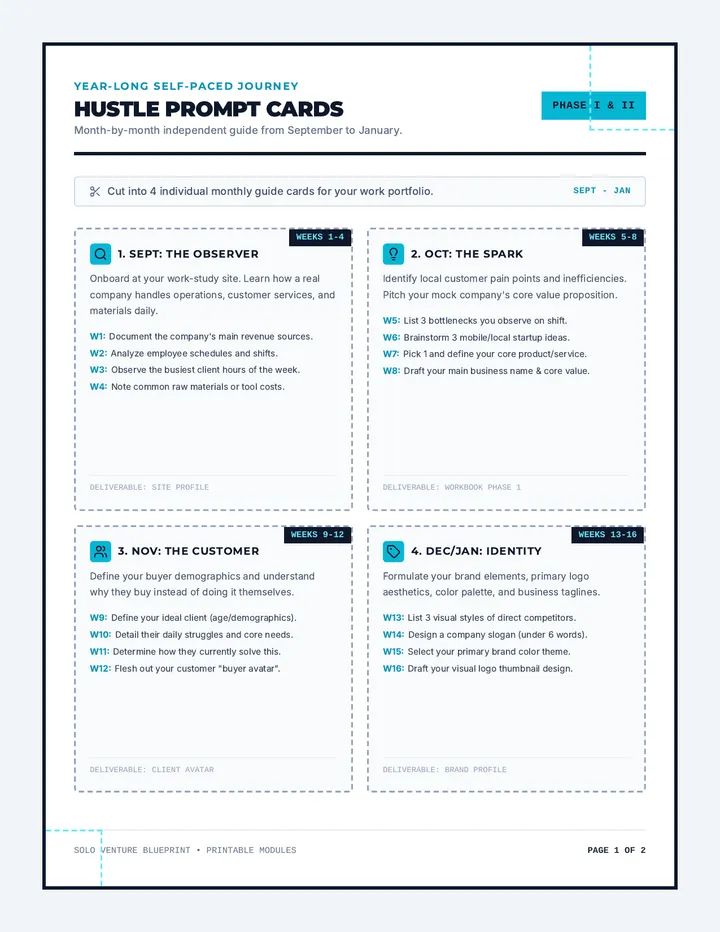
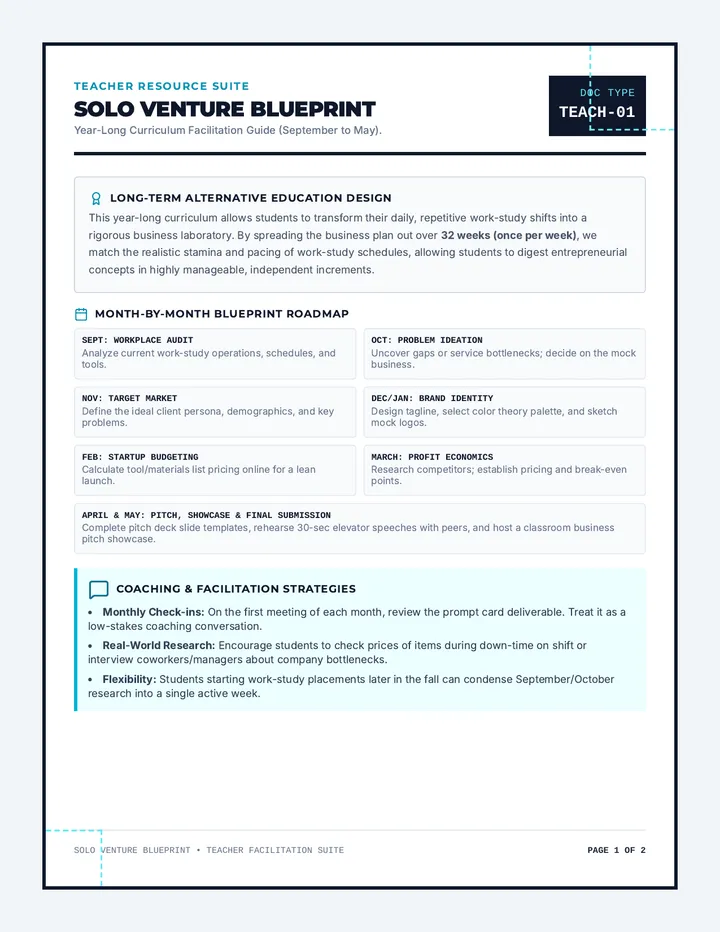
An introductory lesson exploring the world of entrepreneurship, focusing on the mindset, risks, and rewards of starting a business.
An interactive lesson for 7th graders to distinguish between habitat and niche, explore specific roles within ecosystems, and predict outcomes of ecological disruptions.
Students explore the diverse ecosystems of the California Central Coast, investigating how native plants and animals adapt to their specific environments before creating their own miniature biome models.
A high-energy, collaborative escape room experience where 7th graders decode the chemical secrets of photosynthesis and cellular respiration to 'unlock' a simulated lab. students will model reactions and track energy flow through a series of hands-on puzzles.
An introductory 6th-grade science lesson covering biotic and abiotic factors, levels of organization, competition, symbiosis, and adaptations, closely aligned with curriculum assessments.
A physics-focused lesson exploring the concept of centrifugal force through real-world applications like amusement park rides, car turns, and washing machines. Students will distinguish between centripetal and centrifugal force while analyzing how spinning motion affects objects.
A comprehensive 50-minute review session focused on energy transfer, ecological roles, and ecosystem stability, modeled after the Unit 5 Assessment. Includes a warm-up, main review worksheet, and exit ticket.
A journey into the intersection of Ancient Greek geometry and astronomy. Students explore how the Greeks used 'perfect' shapes to accurately calculate Earth's size and shape, while also examining how that same quest for perfection delayed our understanding of planetary orbits.