Sensory Explorers Lesson Plan
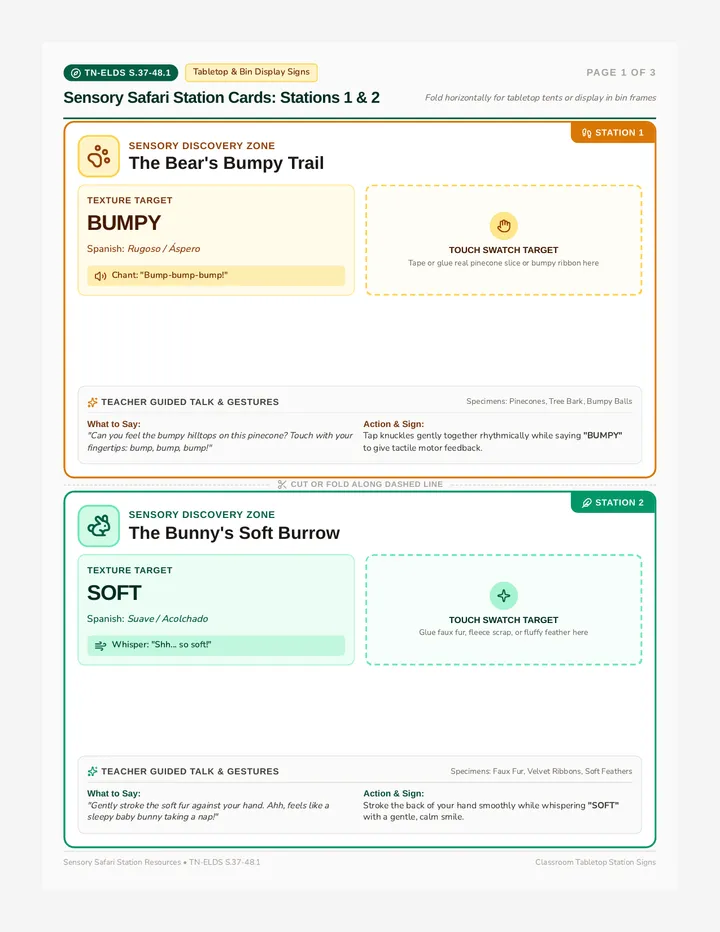
TN-ELDS S.37-48.1 Preschool (37–48 Months) 30 Minutes
Teacher Resource • Page 1 of 2
Sensory Explorers Lesson Plan
Authentic Tactile Discovery: Exploring, Describing & Comparing Physical Characteristics
Standard Alignment & Observable Goal
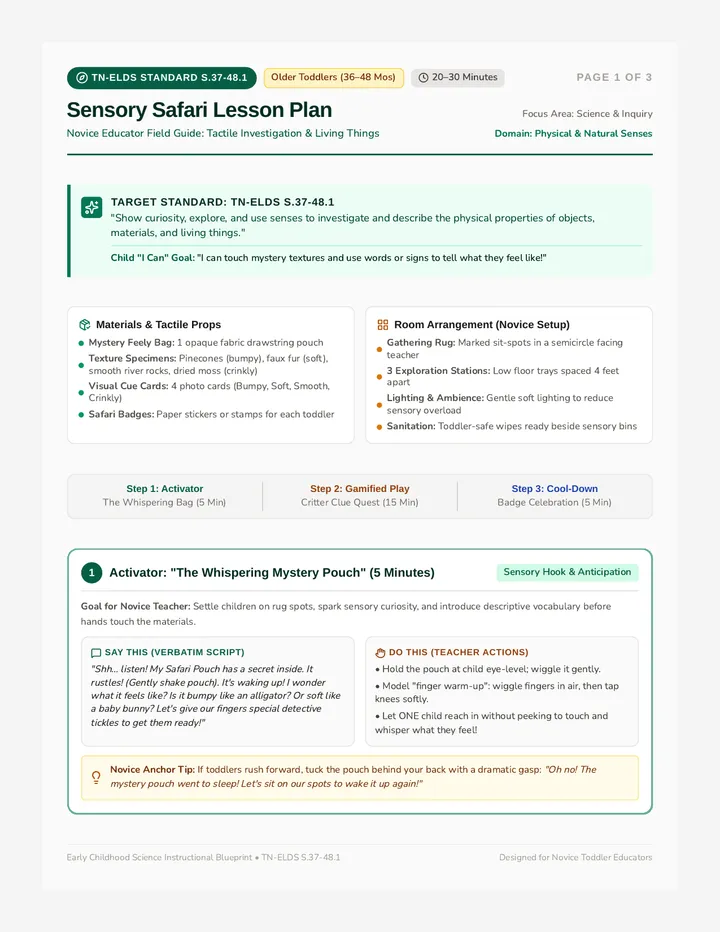
TN-ELDS S.37-48.1: Show curiosity about objects and materials by exploring, manipulating, and observing their physical characteristics (texture, shape, weight, temperature).
Child "I Can" Target: "I can use my fingers and hands to feel objects and tell how they feel (rough, smooth, heavy, light, soft, hard)."
Authentic Real-World Items
- Nature textures: river stones, pinecones, tree bark, fresh moss/leaves
- Household weights: wooden block, soft wool, metal spoon, cotton boll
- Activator: 1 opaque fabric "Wonder Pouch"
- Low sensory trays (bamboo or wood)
Novice Teacher Coaching Tips: 3-Year-Old Developmental Reality
Read Before Teaching
1. Narrate, Don't Quiz: Instead of asking "What is this?", describe: "Ooh, your fingers are rubbing that bumpy ridge!" Quizzing shuts down language; parallel talk builds it.
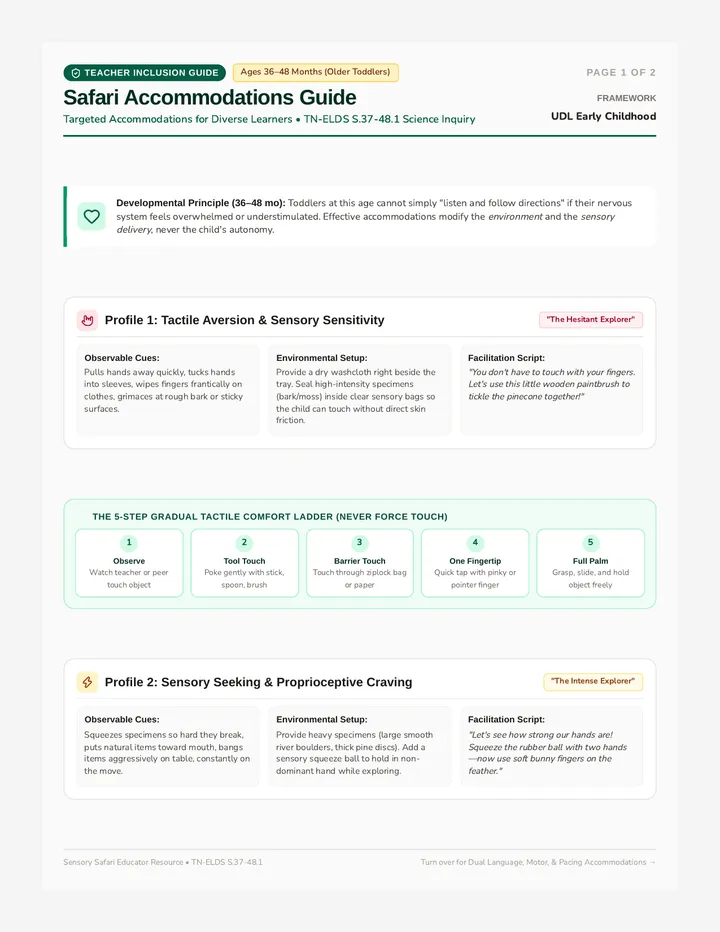
2. Respect Sensory Hesitation: Never force a child to touch a texture. Offer a two-finger touch, touch it yourself first, or let them observe a friend exploring.
3. Physical Boundaries: Keep objects inside shallow rimmed trays. 3-year-olds manage materials best when clear physical zones exist on the rug or table.
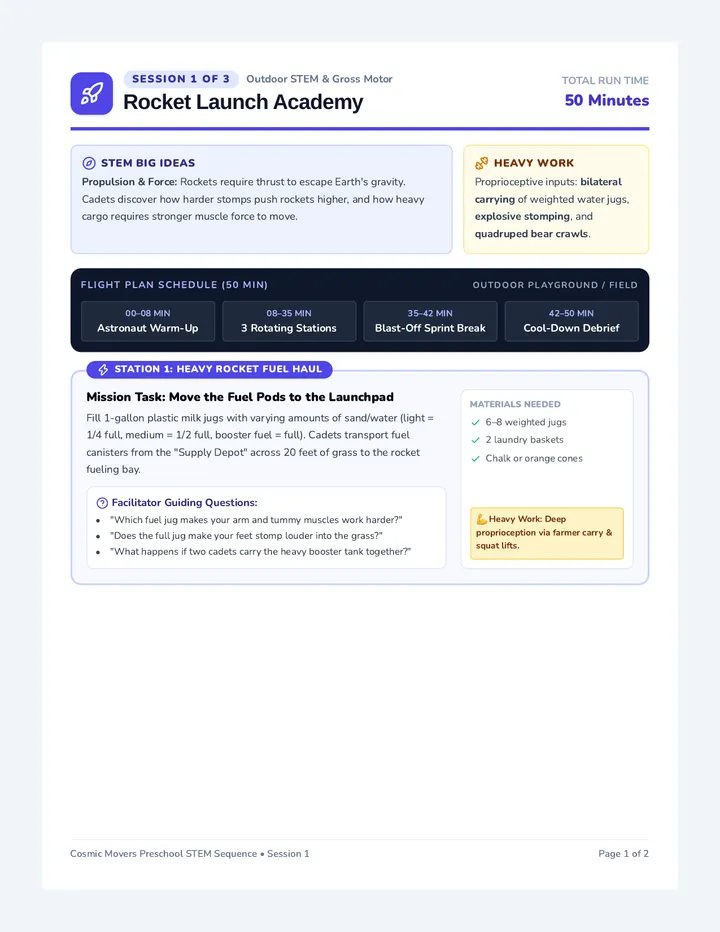
30-Min Flow:
Min 0–7: Activator Hook ➜ Min 7–22: Guided Exploration ➜ Min 22–30: Reflection & Transfer
Phase 1
The Activator: "The Mystery Wonder Pouch" (7 Minutes)
Rhythmic Hook & Sensory Cue
Step 1: The Gathering Chant (Min 0–2):
Gather children in a cozy circle on the rug. Hold up the opaque cloth "Wonder Pouch" and tap it to a gentle rhythm.
🎵 Sing to "Twinkle, Twinkle Little Star":
"Curious fingers, curious eyes, / What inside is a surprise? / Let's not look, but let's go feel, / Is it rough or smooth as teal? / Wonder pouch upon my lap, / Give two taps and take a clap! (Tap, tap, clap!)"
Step 2: Word-for-Word Teacher Demonstration (Min 2–5):
Reach into the pouch without looking. Exaggerate your sensory reactions using your face and body.
Teacher Script: "My eyes are closed, but my fingertips are working! (Make gentle rubbing motion). Oh! This feels cool... like ice on a window. And it feels so slippery and flat. My finger slides right across it without bumping! What word tells how this feels? It feels smooth!"
Reveal & Pass: Pull out a polished river stone. "Look! It's a river stone! Touch it with one gentle finger as I walk it around our circle. Does it feel smooth to you?"
Step 3: Contrast & Transition Trigger (Min 5–7):
Reach in again and pull out a spiky/bumpy pinecone. Let children react to the difference: "Whoa! Does this feel smooth like the stone? No! My fingers go bump, bump, bump! It is rough and prickly!"
Transition Call: "Our sensory scientist hands are awake! Let's walk like quiet field mice to our discovery trays!"
Early Childhood Science Instructional Blueprint • TN-ELDS S.37-48.1 Continued on Page 2 ➜
Phase 2 & 3
Guided Exploration, Debrief & Assessment
Teacher Resource • Page 2 of 2
Phase 2: Three Authentic Sensory Discovery Stations (15 Minutes)
Small Groups of 3–4 Children
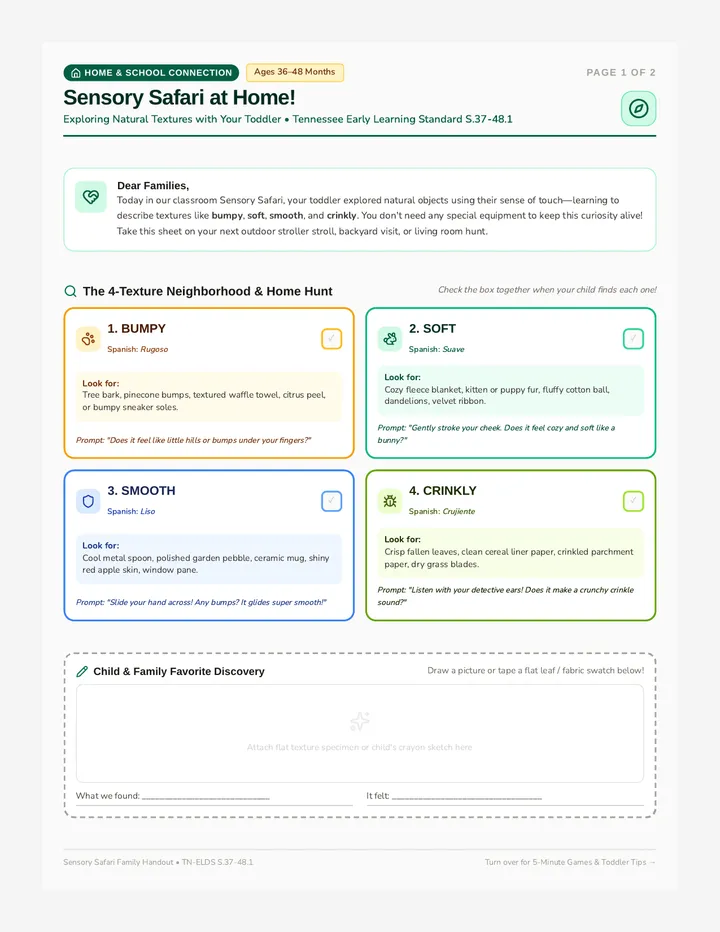
Station 1: Texture Match Rough vs Smooth
Materials: River stones, chunky bark, velvet felt, fresh green moss.
Authentic Task: Children touch pairs of items and put "smooth friends" on the green cloth and "bumpy friends" on the brown cloth.
💬 Prompt: "Which one makes your finger slide fast? Which makes tiny bumps?"
Station 2: Weight Scale Heavy vs Light
Materials: Solid wooden block, fluffy goose feather, metal spoon, cotton boll.
Authentic Task: "Two Hand Balance"—child puts one item on their left palm and one on their right palm. Which hand sinks down?
💬 Prompt: "Whoa, that big block is pressing down! Can you blow the feather?"
Station 3: Shape & Flex Hard vs Squishy
Materials: Real sea sponges, stiff wooden peg, pliable beeswax, smooth marble.
Authentic Task: Children squeeze and press items between fingers. Does it stay still, or does it change shape and bounce back?
💬 Prompt: "Look how your thumb squishes that sponge like bread dough!"
🎯 Active Facilitation Scripts (Circulate & Crouch):
- "Tell my ears what your fingers are discovering right now..."
- "If you close your eyes, can you still find the bumpiest one?"
- "Feel this stone against your cheek—is it warm or cool?"
⚠️ Novice Stumbling Block Alert:
If a child dumps the whole tray: Do not reprimand. Say calmly: "Our tray is the cozy bed for our stones. Let's pick two to test in your hands." Limit items to 3 per child at any time.
Phase 3
Reflection & Real-World Connection (8 Minutes)
Circle Time Debrief
1. The "Sensory Treasure Pass" Routine (Min 22–26):
Each child brings one favorite object back to the rug. In partners, child A holds their item behind child B's back or lets them touch it with closed eyes:
"Before you peek, tell your partner: Does it feel rough or smooth? Heavy or light?"
2. Authentic Transfer to Daily Life (Min 26–30):
Connect directly to children's immediate physical world:
- "Touch your sweater sleeves. Does that feel soft or prickly?"
- "When we go to the playground today, let's find one rough tree and one smooth slide!"
Differentiation & Adaptive Strategies (Ages 37–48 Months)
Tactile Sensitive: Allow use of a magnifying glass or wooden spoon to explore before direct fingertip touch. Never force sticky or spiky items.
Dual Language Learners: Pair physical gestures with words (rub arms for smooth, bounce hands for bumpy). Celebrate home language words for textures.
Active Movers: Assign a "heavy carrier" job (moving the wooden basket) to channel gross-motor energy into sensory weight exploration.
Novice Teacher Observational Assessment Matrix (TN-ELDS S.37-48.1) Evaluate during Station Play & Circle Share
| Indicator | Emerging (Level 1) | Target / Developing (Level 2) | Exceeding / Extended (Level 3) |
|---|
| Curiosity & Manipulation | Touches items passively or briefly drops them; requires adult hand-over-hand modeling. | Sustains touch for 20+ seconds, squeezes, taps, or turns items over independently. | Spontaneously compares two items together (e.g., rubs stone against wood block). |
| Describing Physical Traits | Reacts with facial expression or sounds ("ew", "ooh") but does not name quality. | Names at least 1–2 physical traits with teacher prompts (e.g., "bumpy", "heavy", "soft"). | Accurately uses contrasting pairs without prompting (e.g., "This one is light, but that is heavy!"). |
TN-ELDS Standard S.37-48.1 • Authentic Sensory Science Curriculum Classroom Ready • Printable Facilitation Guide
Texture Detective Checklist
TN-ELDS S.37-48.1 Ages 37–48 Months • Science Explorer
Texture Detective Checklist
Touch & Discover
My Explorer Name:
Date:
Use your curious fingers! Feel each real-world item at the discovery stations, then stamp, sticker, or color the circle when you find it!
Slick
Texture 1 Smooth Like a cool river stone
I felt:
Stamp
Ridges
Texture 2 Bumpy & Rough Like tree bark or a pinecone
I felt:
Stamp
Fuzzy
Texture 3 Soft & Fuzzy Like cozy wool or cotton
I felt:
Stamp
Pushes Down
Weight 1 Heavy Like a solid wooden block
I felt:
Stamp
Blow Away
Weight 2 Feather Light Like a goose feather or silk
I felt:
Stamp
Squeeze
Flexibility Squishy Like a real bath sponge
I felt:
Stamp
My Favorite Thing to Touch Today: Texture Rubbing or Picture
Put a flat item under this box and rub with a crayon!
Teacher Observation: Child demonstrated TN-ELDS S.37-48.1 milestones:
Explored with Hands Named 1+ Trait Compared 2 Objects
TN-ELDS Standard S.37-48.1 • Sensory Explorers Preschool Science Student Discovery Tool