Lenny.com
Explore
Create
ActivitiesNewMathEnglish Language ArtsScience & EngineeringSocial StudiesGlobal LanguagesHealth & Physical EducationSpecial EducationCounseling & Life SkillsArts & CreativityESL
Lenny.com
Lenny.com
Explore
Create
ActivitiesNewMathEnglish Language ArtsScience & EngineeringSocial StudiesGlobal LanguagesHealth & Physical EducationSpecial EducationCounseling & Life SkillsArts & CreativityESL
Lenny.com
Lenny.com

Solutions

Lenny for EducatorsLenny for SchoolsLenny for Districts

Product

ExploreSign inCreateSupportAbout

Resources

Getting startedMTSS Acceleration Program

Newsletters

School Funding Newsletter

© 2026 Lenny Learning Inc.

TermsPrivacyAccessibility
LinkedInInstagramX
Lenny
English Language ArtsPhonics & Reading FoundationsLetter IdentificationLearn Letters A-ZLowercase and Uppercase LettersConsonants and VowelsLetter-Sound AssociationsLetter-Sound Associations: LowercaseLetter-Sound Associations: UppercaseBeginning and Ending SoundsRhymingBlending And SegmentingShort VowelsShort Vowel SoundsConsonant BlendsConsonant DigraphsBlends, Digraphs, and TrigraphsDigraphs, Blends, and Silent LettersLong Vowel SoundsLong Vowel PatternsShort and Long VowelsShort and Long Vowel PatternsSilent EVowel SoundsVowel TeamsR-Controlled VowelsDiphthongs: Oi, Oy, Ou, OwVariant VowelsVariant, Diphthong, And R Vowel PatternsSoft G And CSight WordsIrregular WordsWord RecognitionSyllablesSyllable TypesTwo-Syllable WordsMultisyllabic WordsPhoneme ManipulationDecodable TextsVocabularyAction WordsQuestion WordsNouns and AdjectivesClassify WordsCompound WordsSynonyms and AntonymsHomophonesHomophones and HomonymsShades of MeaningContext CluesPrefixes and SuffixesGreek and Latin RootsAnalogiesIdioms and AdagesForeign Words and ExpressionsWord Choice and UsageReference SkillsReading ComprehensionRead-Along Literary TextsRead-Along Informational TextsReality vs. FictionStory ElementsCharacterSequenceMain IdeaCause And EffectCompare And ContrastReading StrategiesText StructureAuthor's PurposeAuthor's Purpose And ToneAuthor's PerspectivePoint Of ViewThemeInference And ThemeInference And AnalysisPoetry ElementsLiterary DevicesAnalyzing LiteratureAnalyzing Informational TextsComparing TextsAudience, Purpose, And ToneBusiness DocumentsNovel StudyNonfiction Book StudyGrammar & MechanicsSentencesNounsVerbsAdjectivesPronounsCapitalizationPunctuationContractionsConjunctionsPrepositionsArticlesAdjectives And AdverbsVerb TypesVerb TensePronouns And AntecedentsPronoun TypesSubject-Verb AgreementDirect And Indirect ObjectsSentences, Fragments, And Run-OnsPhrases And ClausesCommasSemicolons, Colons, And CommasDashes, Hyphens, And EllipsesSpellingAbbreviationsFormattingVerb Tense And MoodMisplaced ModifiersWritingDescriptive DetailsCreative WritingOpinion WritingTopic SentencesOrganizing WritingLinking WordsSentence VarietyIntroductions And ConclusionsPersuasive And Opinion WritingExpository WritingPersuasive StrategiesDeveloping And Supporting ArgumentsTopic Sentences And Thesis StatementsSummarizingResearch SkillsEditing And RevisingActive And Passive Voice=Writing Clearly And ConciselyDebate & Public SpeakingPublic Speaking BasicsPersuasive TechniquesClaims and EvidenceTypes of ArgumentsReasoning TypesLogical FallaciesTopic ResearchOrganizing EvidenceDebate Speech OrganizationAttacking and Defending ArgumentsClash and EngagementImpact CalculusQuestioning and Cross-ExaminationCritical ThinkingInformal LogicFormal LogicInductive Reasoning

Poetic Lens

A targeted 40-minute 9th-grade ELA lesson dissecting extended metaphor, diction, and imagery in Emily Dickinson's classic poem Hope is the thing with feathers. Students annotate poetic devices, engage in collaborative analysis, and synthesize thematic meaning on an exit ticket.

MJMr. J. Pfluke

Author's Insight:
It endures unconditionally

Final Universal Theme Statement:

RL.9-10.1 (Evidence), RL.9-10.2 (Theme), RL.9-10.4 (Figurative Meaning) Page 2 of 2

Theme vs. Subject: Students frequently offer "hope" or "staying strong" as the theme. Remind them a theme is a complete claim about human nature.

Verse Craft Facilitator Guide Page 1 of 2 • Pacing & Protocol

Answer Key, Exemplars & Differentiation

Teacher Reference Only

Worksheet Part 3: Text-Dependent Questions Key

Q1 (Stanza 1 - Vehicle):

Target Response: By using "thing with feathers," Dickinson emphasizes the ethereal, intangible, and instinctive nature of hope rather than limiting it to a physical biological species. "Without the words" signifies that hope operates on an intuitive, subconscious emotional level—it does not need verbal justification, logic, or persuasion to endure; it sings ceaselessly in the human soul.

Q2 (Stanza 2 - Conflict):

Target Response: The "Gale" and "sore storm" represent severe emotional turmoil, grief, or personal trauma. The word abash (to silence or shame) underscores that only an overwhelmingly devastating catastrophe could even threaten to quiet this inner bird. The song is heard "sweetest" in the storm because hope’s true value and emotional comfort are most profoundly recognized during adversity.

Q3 (Stanza 3 - Extremity & Crumb):

Target Response: The "chillest land" and "strangest Sea" symbolize extreme isolation, unfamiliar terrain, and emotional coldness. The "crumb" metaphor highlights the bird's absolute selflessness: even in the speaker's darkest moments ("Extremity"), hope freely sustains the individual without demanding compensation, sacrifice, or effort in return.

Part 4 (Theme Statement Exemplar):

"Hope is an innate, enduring force within the human spirit that provides unconditional comfort during life’s most severe trials without demanding anything in return."

Exit Ticket Key & Exemplar (10 Points)

Q1 Key Correct Answer: B (“And sweetest - in the Gale - is heard -”) (3 Points)

Q2 Constructed Response 10/10 Exemplar (7 Points):

“Dickinson uses a small, fragile songbird as her extended metaphor to demonstrate that hope is gentle yet remarkably invincible. Although a bird appears delicate, Dickinson writes that it ‘never stops - at all -’ and perseveres even through a ‘Gale.’ By contrasting the bird's diminutive size with its ability to keep ‘so many warm’ through harsh storms without ever asking for a ‘crumb,’ Dickinson proves that true hope is an unconditional internal resilience that outlasts even the fiercest personal hardships.”

Targeted Differentiation Strategies

Support / Striving Readers

  • Provide sentence stem: "Dickinson compares hope to a bird because..."
  • Pre-gloss vocabulary: gale (strong wind), abash (embarrass/silence), extremity (danger).
  • Allow choral reading before independent annotation.

Extension / Advanced Learners

  • Analyze Dickinson's use of common meter (ballad meter) and how the em-dashes disrupt rhythm.
  • Ask students to write an original 4-line stanza continuing the extended metaphor into modern society.
Verse Craft Facilitator Guide Page 2 of 2 • Evaluation & Extension

You might also like

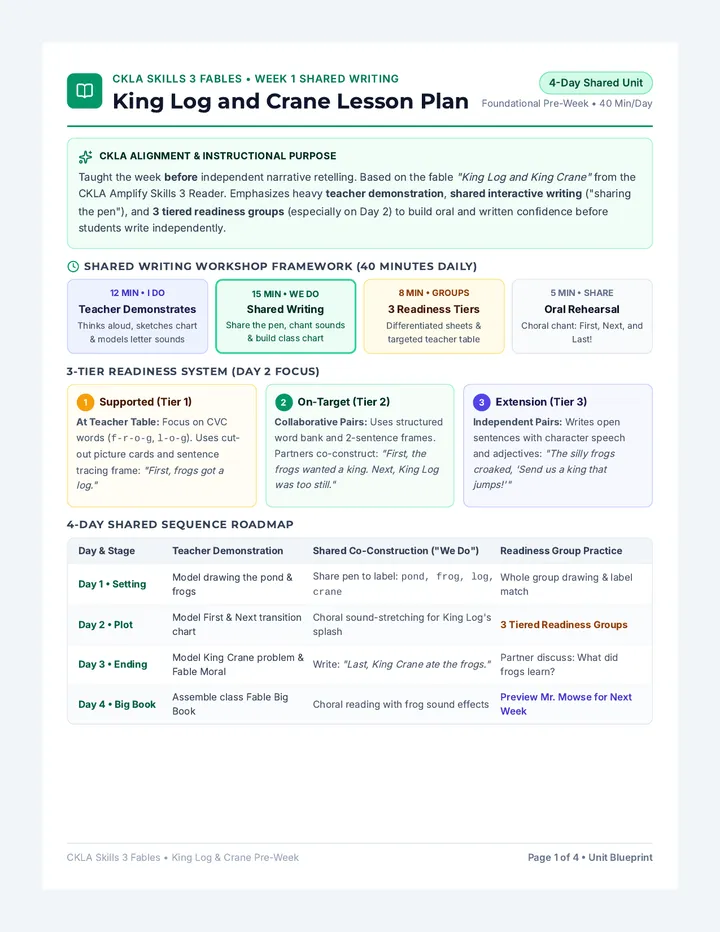
King Log Lesson Plan

Fable Writers

A two-part foundational early first-grade CKLA narrative writing sequence. Week 1 introduces shared and interactive fable retelling with King Log and King Crane and tiered readiness groups. Week 2 progresses to student-led retelling and opinion book reports with Mr. Mowse.

K

Katherine.Land

6
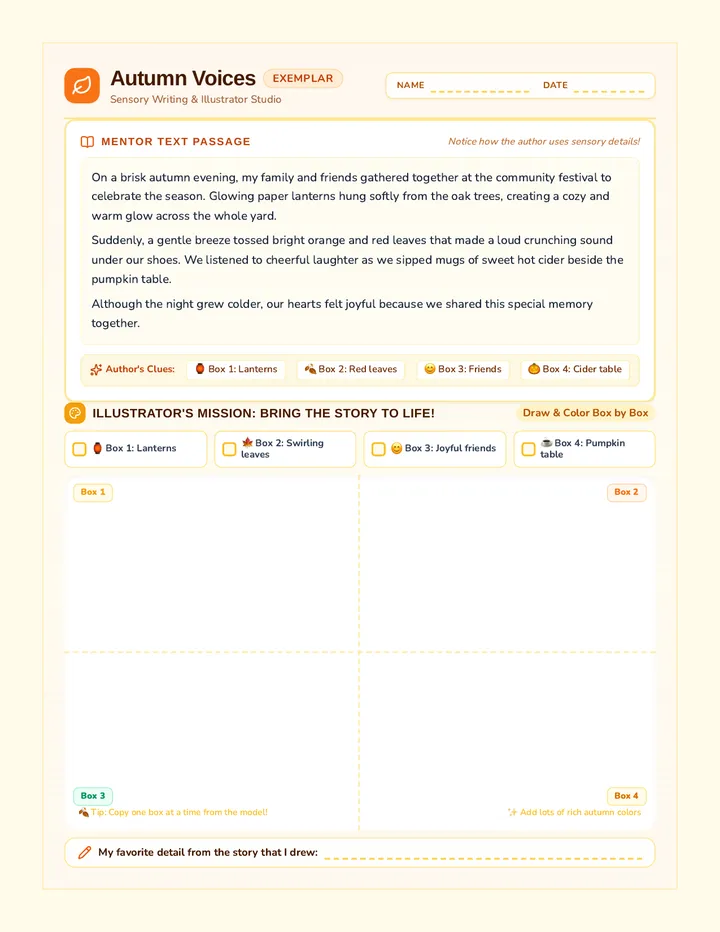
Autumn Voices Exemplar Worksheet

Autumn Voices

An elementary sensory writing and illustration lesson where students analyze descriptive details in a mentor text and translate seasonal imagery into expressive artwork.

SM

Shalini Mitchell

2
Essay Blueprint Exit Ticket Key

Essay Blueprint Exit Ticket Key

A one-page teacher answer key and diagnostic scoring guide for the Essay Blueprint Exit Ticket, providing correct answers, architectural rationales, and distractor flaw analyses for each manuscript blank.

T

timothy.nixon

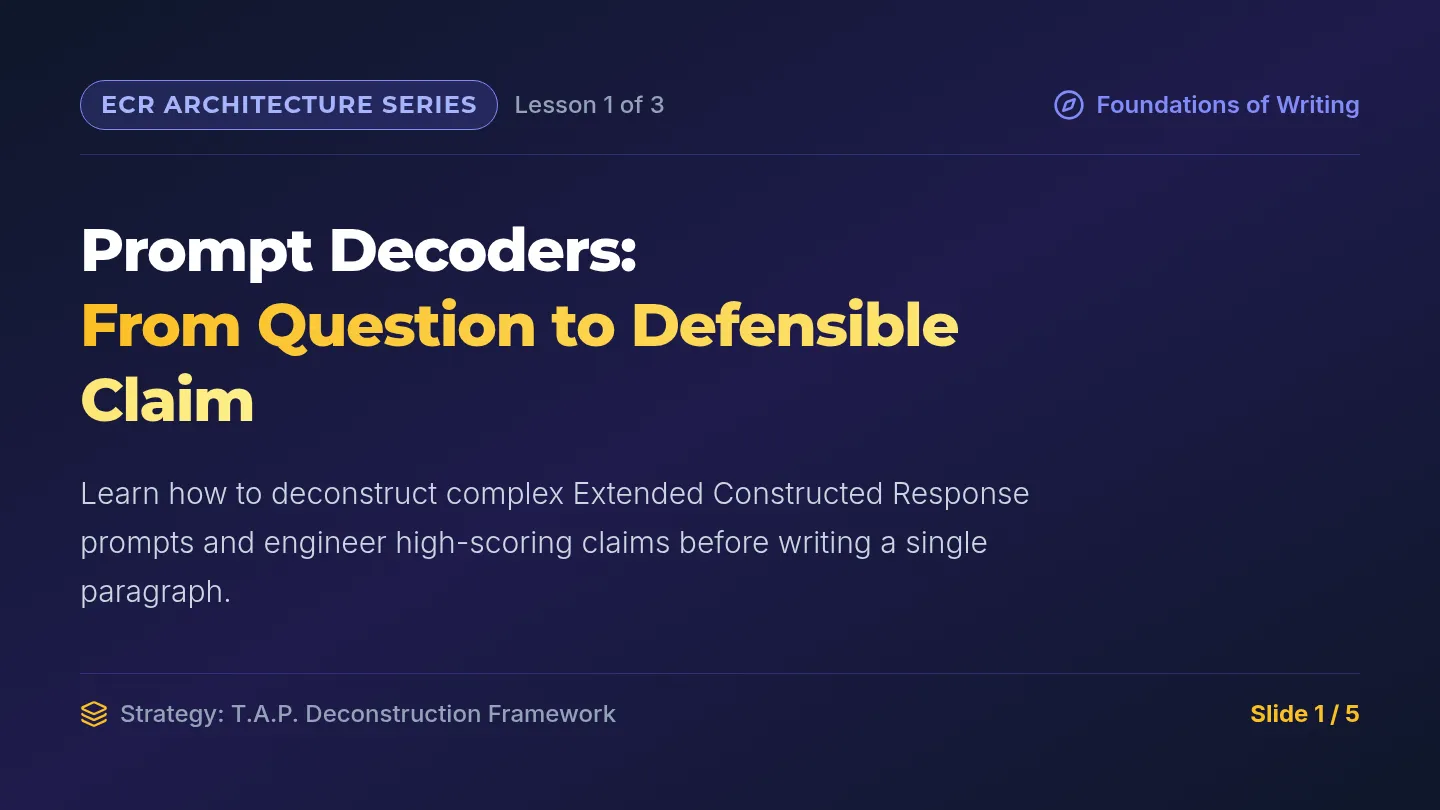
Prompt Decoder Slides

Argument Architecture

A comprehensive middle school writing sequence guiding students through the Extended Constructed Response process, from prompt deconstruction and claim generation to evidence integration and multi-paragraph synthesis.

Lenny Avatar
Lenny
6
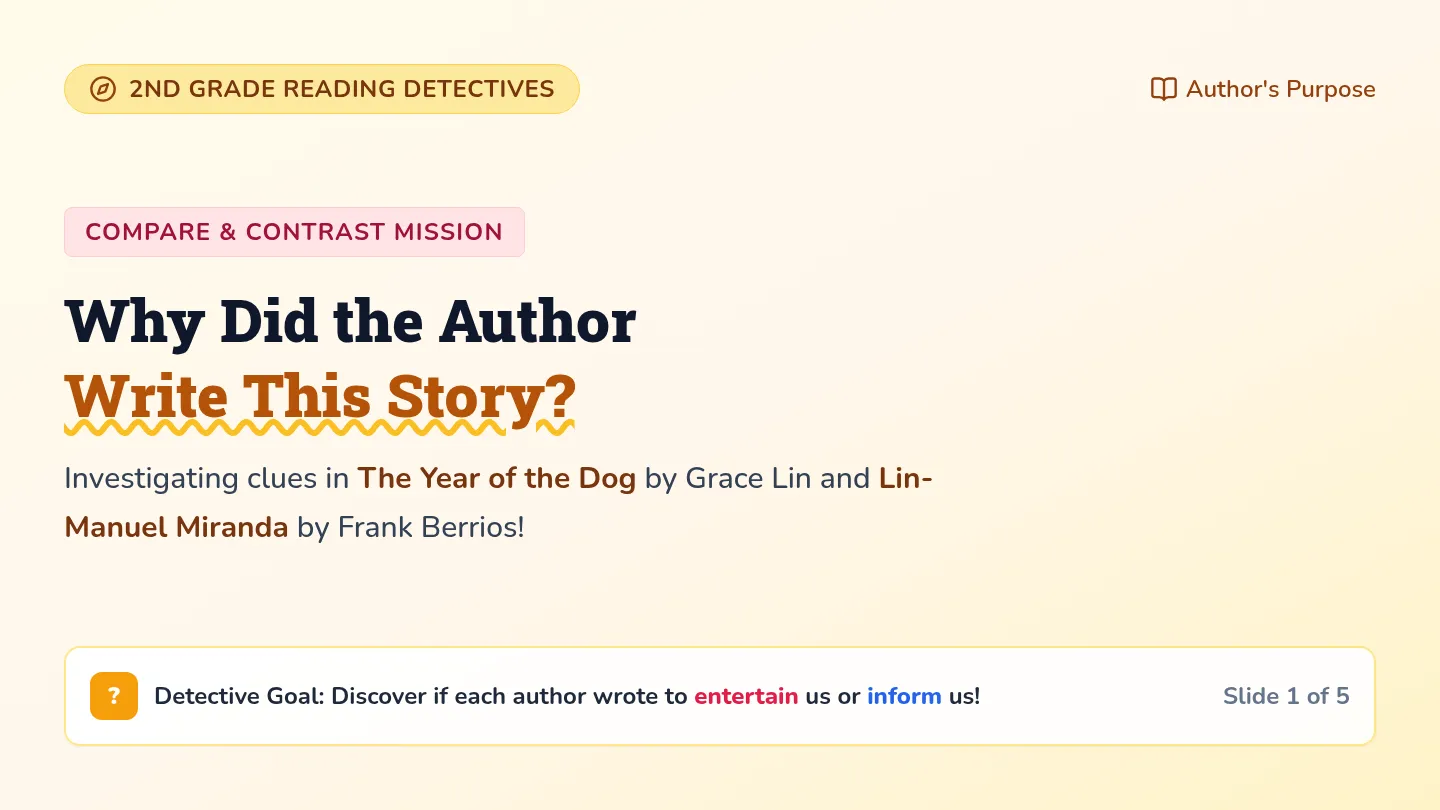
Story Purpose Slides

Story Purpose Detectives

A 2nd-grade comparative reading lesson exploring author's purpose through excerpts from Grace Lin's The Year of the Dog and Frank Berrios's Lin-Manuel Miranda. Students analyze why authors write to entertain or inform, make text-based inferences, and compare fictionalized memoir with biographical nonfiction.

A

awarner1

4
Essay Blueprint Exit Ticket

Essay Blueprint Exit Ticket

A five-question multiple-choice formative exit ticket where students inspect an essay manuscript draft and select the optimal architectural choices to fill in blanks for indentation, thesis formulation, body topic sentences, and reverse-funnel conclusions.

T

timothy.nixon

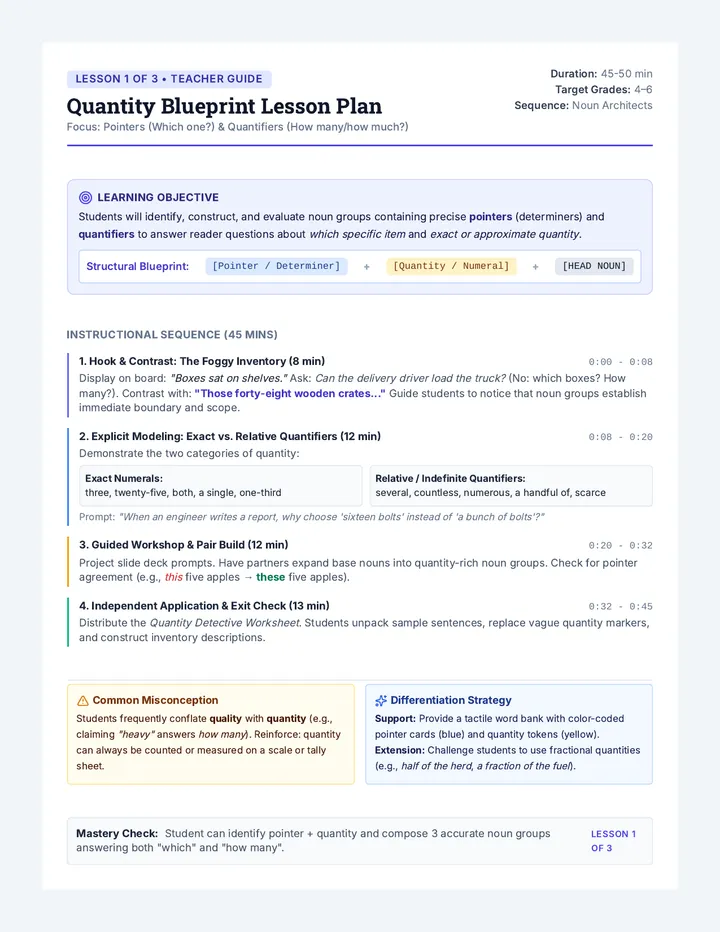
Quantity Blueprint Lesson Plan

Noun Group Architects

A three-part grammar and writing unit where students investigate, assemble, and refine precise noun groups. Learners progress from tracking quantity and pointer determiners to layering vivid qualities and specific classifiers for rich descriptive writing.

A

arlavoie-ridings

9
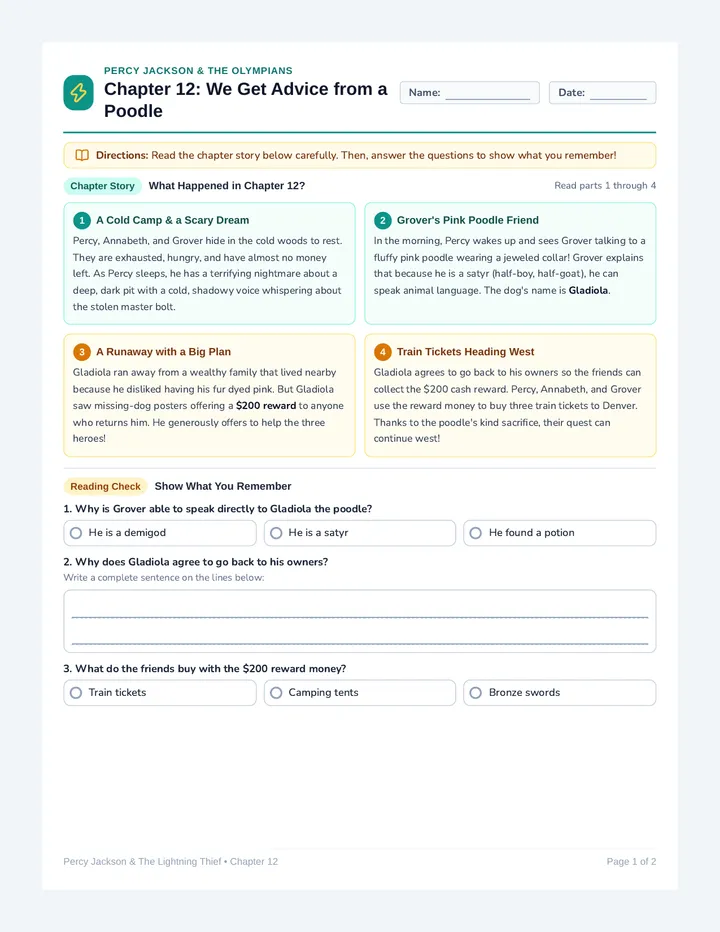
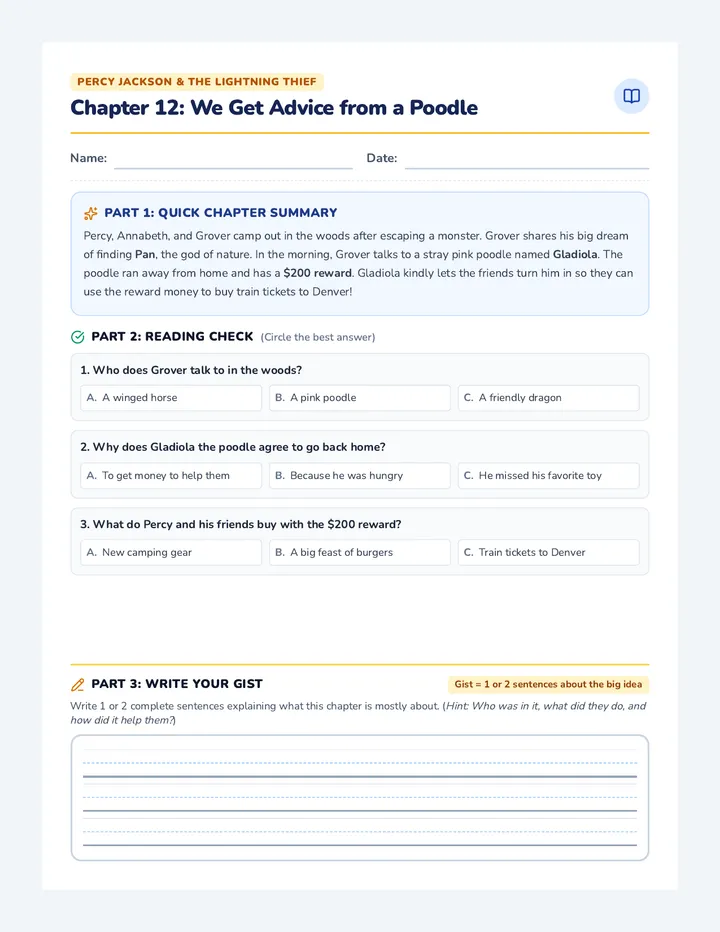
Poodle Advice Gist Worksheet

Poodle Advice Quest

A grade 2 lesson focused on Chapter 12 of Percy Jackson & The Olympians: The Lightning Thief, featuring an accessible chapter summary, comprehension quick-check, guided gist-writing scaffold, and a comprehensive teacher guide with modeling scripts.

C

cedaniels

2
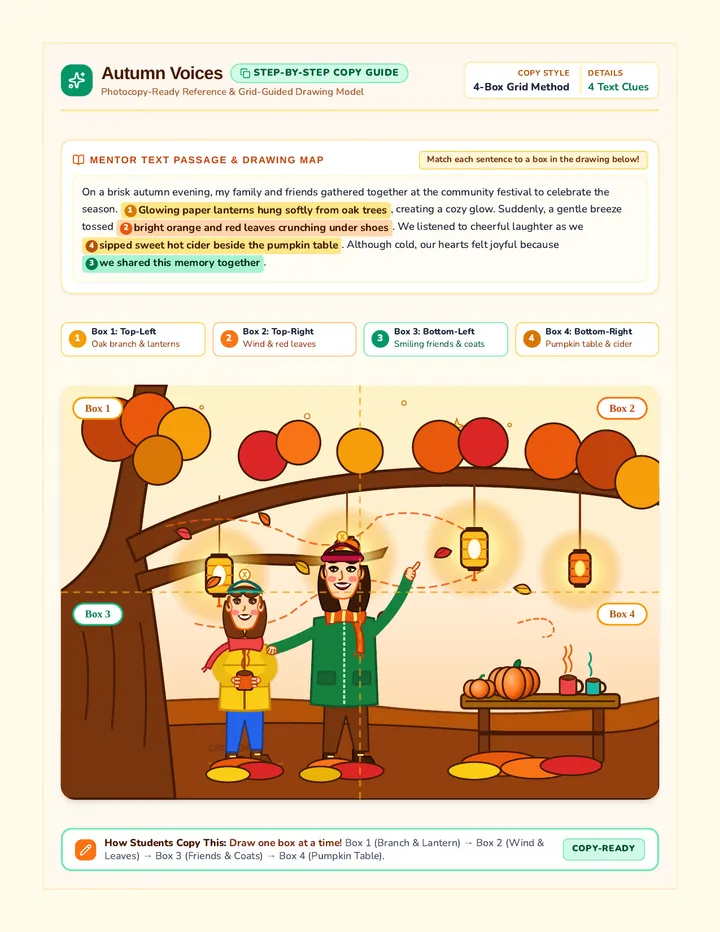
Autumn Voices Drawing Model

Autumn Voices Drawing Model

A clear, photocopier-friendly and kid-reproducible drawing model featuring bright, high-contrast line art, numbered quadrant copy guides, and fully detailed characters designed for students to easily replicate.

SM

Shalini Mitchell

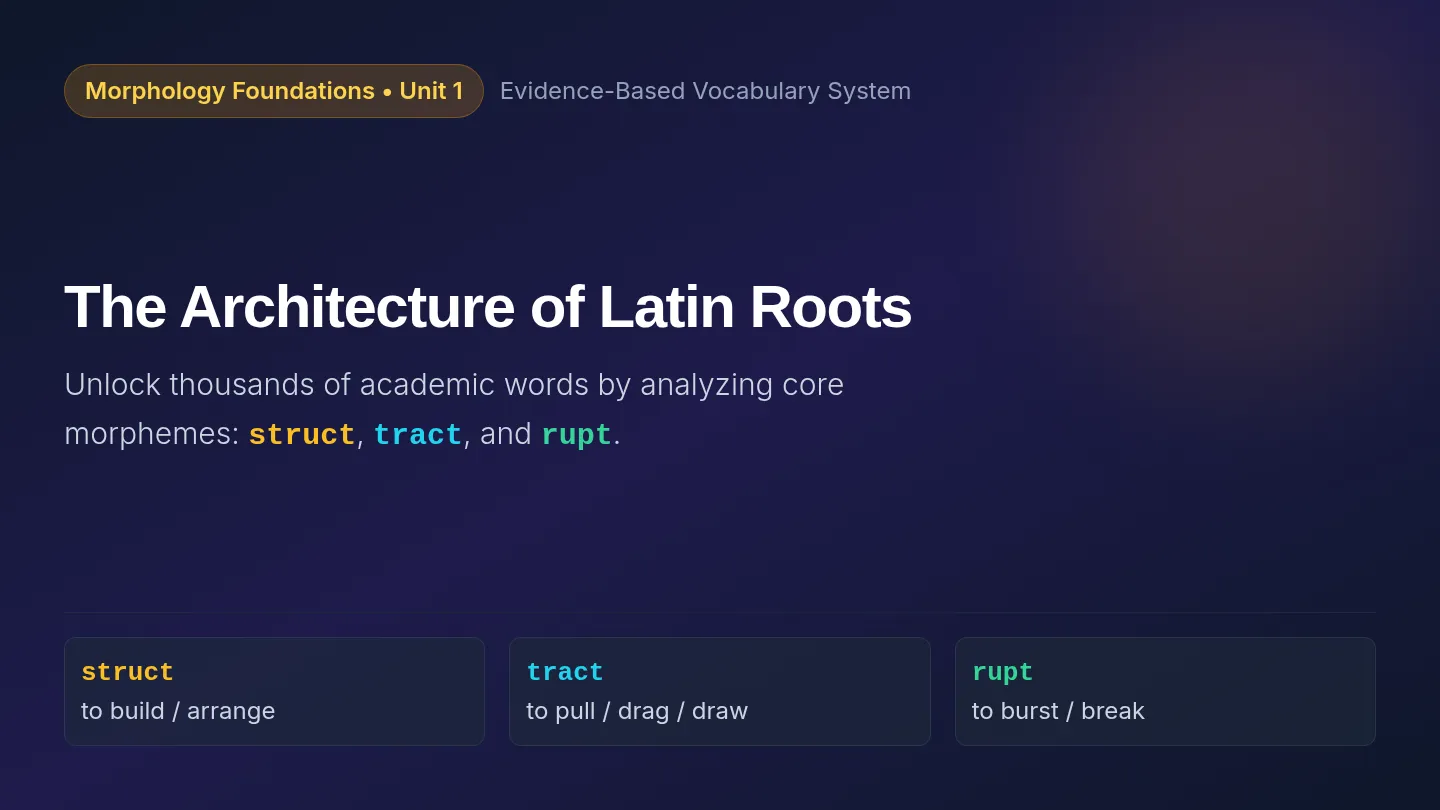
Latin Roots Slide Deck

Rooted Words Curriculum

A comprehensive, evidence-based morphology curriculum systematically teaching Latin roots, Greek combining forms, and prefix assimilation through word matrices, morpheme sums, and contextual decoding.

M

melissa.white

6
Poodle Advice Reading Worksheet

Poodle Advice Gist

A Grade 2 reading comprehension and writing lesson on Chapter 12 of The Lightning Thief, featuring an accessible story summary, reading check questions, dedicated gist writing spaces, and a comprehensive teacher guide with model responses.

Lenny Avatar
Lenny
3
Autumn Voices Exemplar Worksheet

Autumn Voices Exemplar Worksheet

An engaging elementary worksheet featuring the Autumn Voices descriptive exemplar passage, sensory checklist, and a 4-quadrant guided drawing canvas matching the model guide.

SM

Shalini Mitchell