Lenny.com
Explore
Create
ActivitiesNewMathEnglish Language ArtsScience & EngineeringSocial StudiesGlobal LanguagesHealth & Physical EducationSpecial EducationCounseling & Life SkillsArts & CreativityESL
Lenny.com
Lenny.com
Explore
Create
ActivitiesNewMathEnglish Language ArtsScience & EngineeringSocial StudiesGlobal LanguagesHealth & Physical EducationSpecial EducationCounseling & Life SkillsArts & CreativityESL
Lenny.com
Lenny.com

Solutions

Lenny for EducatorsLenny for SchoolsLenny for Districts

Product

ExploreSign inCreateSupportAbout

Resources

Getting startedMTSS Acceleration Program

Newsletters

School Funding Newsletter

© 2026 Lenny Learning Inc.

TermsPrivacyAccessibility
LinkedInInstagramX
Lenny
English Language ArtsPhonics & Reading FoundationsLetter IdentificationLearn Letters A-ZLowercase and Uppercase LettersConsonants and VowelsLetter-Sound AssociationsLetter-Sound Associations: LowercaseLetter-Sound Associations: UppercaseBeginning and Ending SoundsRhymingBlending And SegmentingShort VowelsShort Vowel SoundsConsonant BlendsConsonant DigraphsBlends, Digraphs, and TrigraphsDigraphs, Blends, and Silent LettersLong Vowel SoundsLong Vowel PatternsShort and Long VowelsShort and Long Vowel PatternsSilent EVowel SoundsVowel TeamsR-Controlled VowelsDiphthongs: Oi, Oy, Ou, OwVariant VowelsVariant, Diphthong, And R Vowel PatternsSoft G And CSight WordsIrregular WordsWord RecognitionSyllablesSyllable TypesTwo-Syllable WordsMultisyllabic WordsPhoneme ManipulationDecodable TextsVocabularyAction WordsQuestion WordsNouns and AdjectivesClassify WordsCompound WordsSynonyms and AntonymsHomophonesHomophones and HomonymsShades of MeaningContext CluesPrefixes and SuffixesGreek and Latin RootsAnalogiesIdioms and AdagesForeign Words and ExpressionsWord Choice and UsageReference SkillsReading ComprehensionRead-Along Literary TextsRead-Along Informational TextsReality vs. FictionStory ElementsCharacterSequenceMain IdeaCause And EffectCompare And ContrastReading StrategiesText StructureAuthor's PurposeAuthor's Purpose And ToneAuthor's PerspectivePoint Of ViewThemeInference And ThemeInference And AnalysisPoetry ElementsLiterary DevicesAnalyzing LiteratureAnalyzing Informational TextsComparing TextsAudience, Purpose, And ToneBusiness DocumentsNovel StudyNonfiction Book StudyGrammar & MechanicsSentencesNounsVerbsAdjectivesPronounsCapitalizationPunctuationContractionsConjunctionsPrepositionsArticlesAdjectives And AdverbsVerb TypesVerb TensePronouns And AntecedentsPronoun TypesSubject-Verb AgreementDirect And Indirect ObjectsSentences, Fragments, And Run-OnsPhrases And ClausesCommasSemicolons, Colons, And CommasDashes, Hyphens, And EllipsesSpellingAbbreviationsFormattingVerb Tense And MoodMisplaced ModifiersWritingDescriptive DetailsCreative WritingOpinion WritingTopic SentencesOrganizing WritingLinking WordsSentence VarietyIntroductions And ConclusionsPersuasive And Opinion WritingExpository WritingPersuasive StrategiesDeveloping And Supporting ArgumentsTopic Sentences And Thesis StatementsSummarizingResearch SkillsEditing And RevisingActive And Passive Voice=Writing Clearly And ConciselyDebate & Public SpeakingPublic Speaking BasicsPersuasive TechniquesClaims and EvidenceTypes of ArgumentsReasoning TypesLogical FallaciesTopic ResearchOrganizing EvidenceDebate Speech OrganizationAttacking and Defending ArgumentsClash and EngagementImpact CalculusQuestioning and Cross-ExaminationCritical ThinkingInformal LogicFormal LogicInductive Reasoning

Peach Rescue Evidence

Students analyze Chapters 17-20 of James and the Giant Peach as the peach faces a deadly shark attack and takes to the skies. Guided by NYS Next Generation Standard 7R1, learners practice citing textual evidence and explaining their reasoning with tiered scaffolds for all learners.

GLGrace Lisberg

I • Introduce:

In Chapter 17, the narrator reveals that

T • Text Evidence:

"...this small boy was the only one among them who had not lost his head" (p. 49).

E • Explain:

This proves his emotional self-control made him the natural leader.

Check Page 1: Complete your C.I.T.E. Guided Practice lines with your partner now!

Learning Objective: I can cite direct textual evidence with lead-in tags, quotation marks, and citations.

Standard 7R1


PRACTICE

C.I.T.E. the Seagull Escape (Ch. 19–20)

⏱ 15 Minutes

Key Focus Excerpt:

"We will get thousands of yards of strong silk string, make loops, and catch the seagulls by their necks! Then we tie the other ends to the peach stem!" ... With 502 seagulls attached, the giant peach rose right up out of the water!

Chapters 19 & 20

Your Mission (Page 2):

  • C: Claim: State James's scientific problem-solving skill.
  • I: Introduce: Add a lead-in tag with chapter/speaker.
  • T: Text: Quote exact words inside quotation marks (" ").
  • E: Explain: Show HOW this plan defeated the sharks.

Need help? Look at the C.I.T.E. Sentence Frames on Page 2! Done early? High-Flyer Challenge!

Learning Objective: I can cite direct textual evidence with lead-in tags, quotation marks, and citations.

Standard 7R1


CRITERIA

Self-Check: Did You Nail C.I.T.E.?

Peer & Self Review

C

Clear & Direct Claim

Does your claim answer the prompt directly in a full sentence?

I

Introduce the Source

Did you include a lead-in tag identifying who is speaking or the chapter?

T

Text Evidence Accurately Quoted

Are exact words inside quotation marks (" ") with page number citation?

E

Explain the Connection

Did you write 1–2 sentences explaining HOW this proves James's genius?

Switch worksheets with your shoulder partner for a 2-minute C.I.T.E. check!

Learning Objective: I can cite direct textual evidence with lead-in tags, quotation marks, and citations.

Standard 7R1


WRAP UP

Exit Ticket: C.I.T.E. in Action

⏱ 5 Minutes

Independent Exit Ticket Prompt:

In Chapter 20, how does James prove to the insect crew that his plan actually succeeded against the sharks?

Formula Check: Use the C.I.T.E. Formula (Claim, Introduce, Text evidence, and Explain).

Complete on your separate Exit Ticket half-sheet and turn in at the door!

Learning Objective: I can cite direct textual evidence with lead-in tags, quotation marks, and citations.

Standard 7R1

Silent, independent completion of differentiated C.I.T.E. Exit Ticket slips (Form A or Form B). Teacher collects at door for formative check on 7R1 mastery.

Teacher Think-Aloud Script (Guided Practice Phase)

"Scholars, remember the four letters of C.I.T.E.: First, state your C (Claim). Next, do not just drop the quote—use I (Introduce) to tell who is writing or speaking, like 'In Chapter 17, the narrator reveals that...' Then write your T (Text Evidence) in quotation marks. Finally, write E (Explain) to explain why not losing one's head made the creatures respect James."

James and the Giant Peach Facilitation Guide Page 1 of 2

Differentiation Matrix & Exemplar Keys

NYS 7R1 Mastery

Classroom Differentiation Framework

ENL / Multilingual Learners

  • Provide bilingual glossaries for tier-2 verbs (devoured, hoisted, despair).
  • Use Form B Exit Ticket with pre-framed C.I.T.E. sentence stems.
  • Allow oral rehearsal before writing to practice syntax.

Students with IEPs / 504 Plans

  • Provide pre-highlighted text excerpts on the worksheet.
  • Accept bulleted explanation lines instead of full paragraphs.
  • Check in at Step C (Claim) before student writes quote.

Striving / Low Readiness

  • Pull to small-group teacher table during independent practice (min 18).
  • Limit quote length to a single targeted phrase (under 10 words).
  • Co-write the explanation using the "Because... But... So..." frame.

High Readiness / Fast Finishers

  • Complete the Page 2 High-Flyer Challenge on character transformation.
  • Embed two distinct pieces of evidence in a single cohesive paragraph.
  • Analyze Dahl's humorous diction contrasting fear with silk mathematics.

Exemplar Answer Key (C.I.T.E. Aligned)

Do Now Exemplar:

"James remains calm because panic wastes energy and stops people from thinking of solutions. Shouting about sharks will not keep the peach from being bitten."

Guided Practice Exemplar (Chapter 17):

C (Claim): James earns the insect crew's trust by showing emotional control during a crisis.
I (Introduce): In Chapter 17, author Roald Dahl highlights that
T (Text Evidence): "...this small boy was the only one among them who had not lost his head" (p. 49).
E (Explain): This shows that while the older insects were screaming helplessly, James stayed focused. Because he did not panic, the insects recognized him as their natural decision-maker.

Independent Practice Exemplar (Chapters 19–20):

C (Claim): James demonstrates resourcefulness by using the unique biological skills of his passengers to engineer an escape.
I (Introduce): When planning how to escape the sharks, James announces to the group,
T (Text Evidence): "We have two creatures on board who can spin thread! Miss Spider and the Silkworm!" (p. 55).
E (Explain): This proves James is a brilliant problem-solver because instead of surrendering, he catalogs his available resources. By combining spider silk with seagull flight, he invents an aerial liftoff that saves them all.

Exit Ticket Exemplar (Chapter 20):

C: James proves his plan worked when the peach is lifted completely out of reach of the sharks.
I: In Chapter 20, Dahl writes that
T: "the giant peach rose right up out of the water, leaving the furious sharks snapping at the foam below" (p. 61).
E: This proves his calculations were accurate and that the 502 seagulls produced sufficient lift to guarantee their survival.

Common Misconceptions to Address:

• Skipping Step 'I' (Introduce): Students frequently jump from Claim straight to Quote. Stress that Step 'I' connects the speaker to the quote.
• Quote Repetition in 'E' (Explain): Students often just restate the quote. Coach them: "Explain what this quote proves about James's mind or character."

James and the Giant Peach Facilitation Guide Page 2 of 2
You might also like

RACES Strategy Slides

Abyss Writers

A five-part constructed response sequence for struggling 7th-grade writers using the RACES strategy. Students analyze an engaging informational text on deep-sea bioluminescence and systematically master restating, answering, citing, explaining, and summarizing into an evidence-based paragraph.

KW

Kristin Warner

8
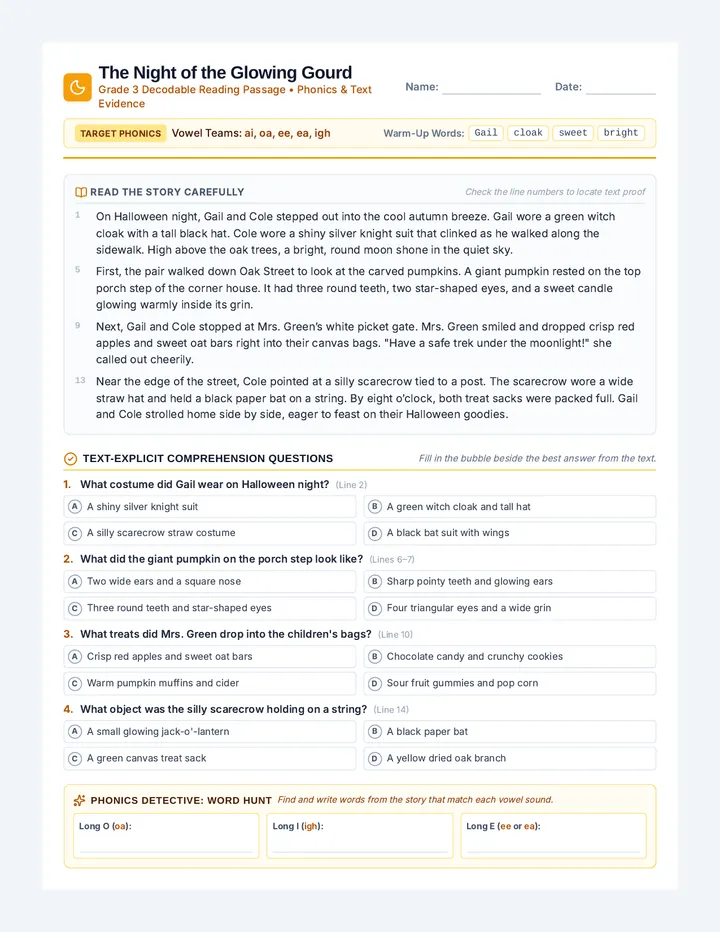
Pumpkin Trail Decodable Worksheet

Pumpkin Trail Phonics

A grade 3 decodable reading comprehension lesson centered on a Halloween narrative that builds vowel team phonics mastery and text-explicit evidence skills.

CW

Carrie Worland

2
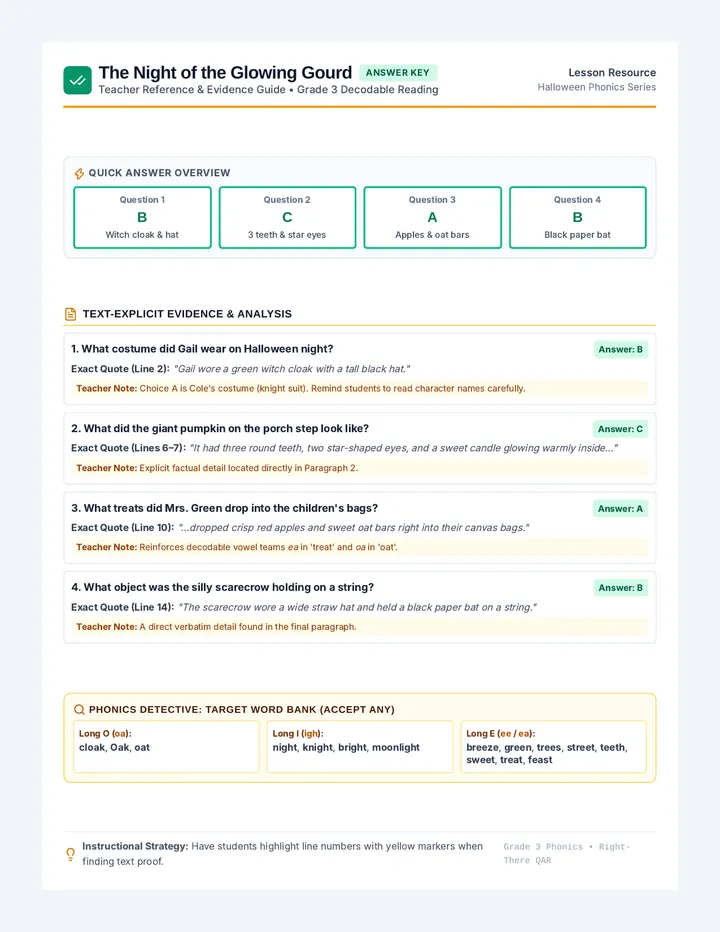
Pumpkin Trail Answer Key

Pumpkin Trail Answer Key

A teacher answer key and instructional guide for The Night of the Glowing Gourd, featuring correct multiple-choice answers, exact line citations, and a phonics word bank.

CW

Carrie Worland

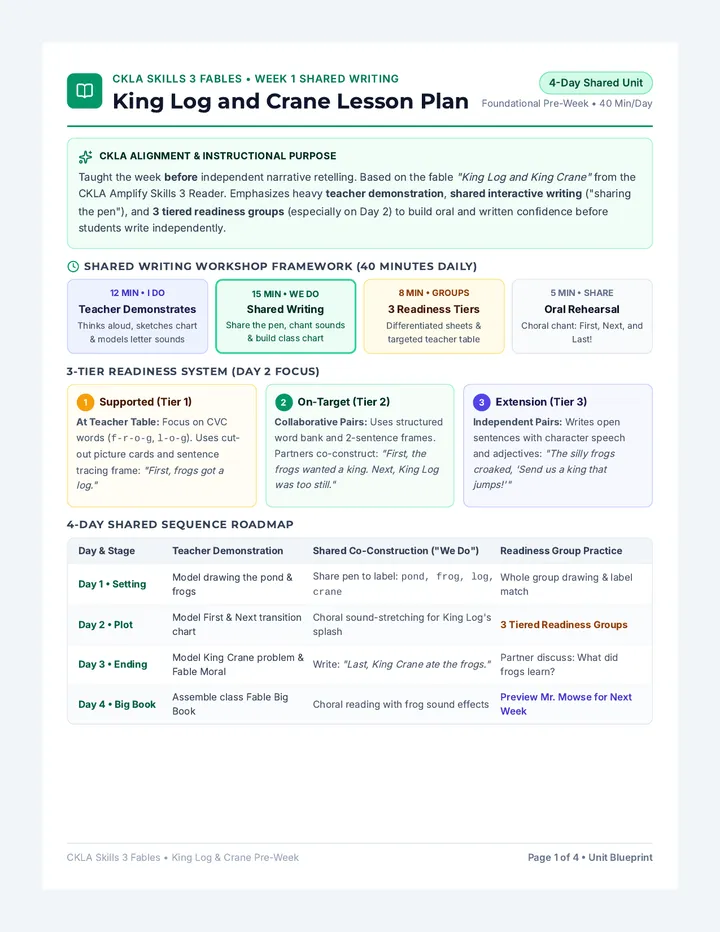
King Log Lesson Plan

Fable Writers

A two-part foundational early first-grade CKLA narrative writing sequence. Week 1 introduces shared and interactive fable retelling with King Log and King Crane and tiered readiness groups. Week 2 progresses to student-led retelling and opinion book reports with Mr. Mowse.

K

Katherine.Land

6
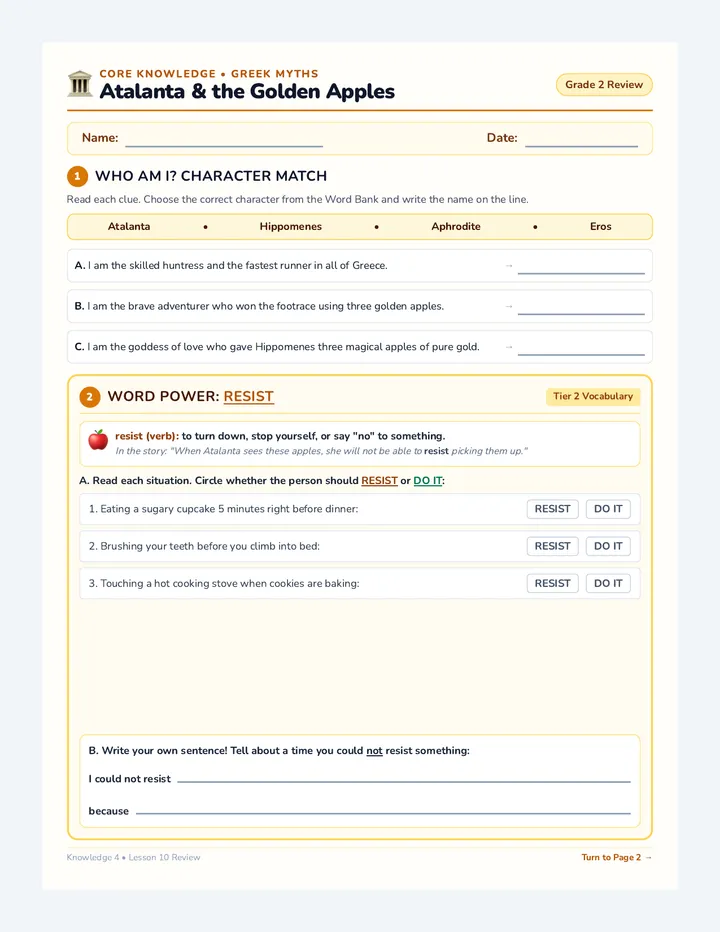
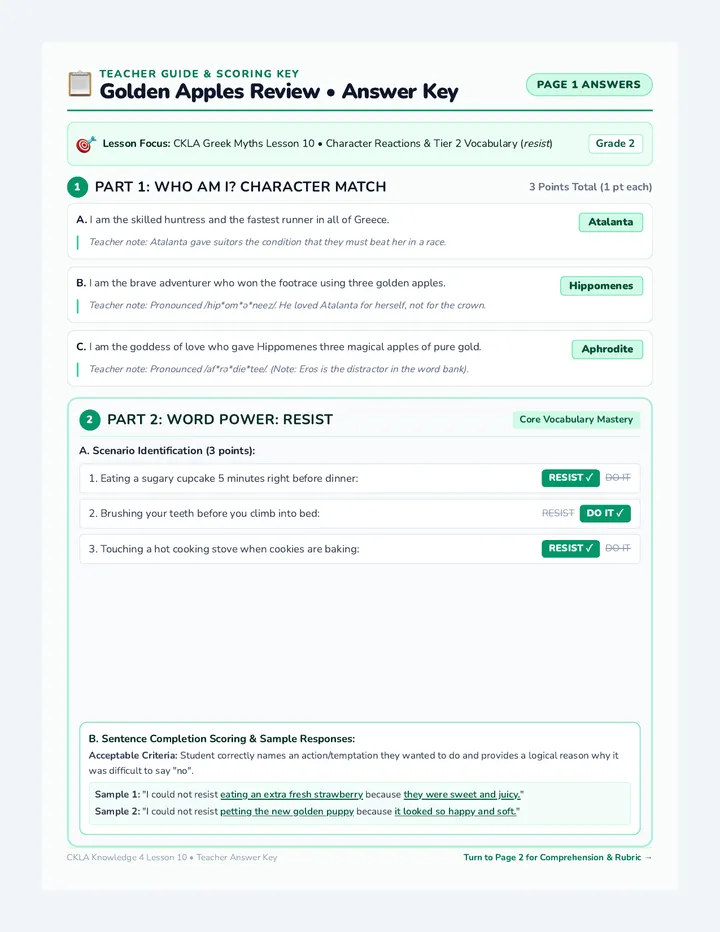
Golden Apples Review Worksheet

Golden Apple Dash

A 2nd grade lesson exploring the Greek myth of Atalanta and Hippomenes from CKLA Knowledge 4 Lesson 10. Students analyze character motivations and reactions to key events while exploring the Tier 2 vocabulary word resist.

FT

Faith Timberman

2
Golden Apples Answer Key

Golden Apples Answer Key

Complete teacher answer key and scoring guide for the Golden Apples Review Worksheet. Includes exact answers for character matching and reading comprehension, teacher guidance for the vocabulary word resist, and sample responses for the draw-and-describe exit pass.

FT

Faith Timberman

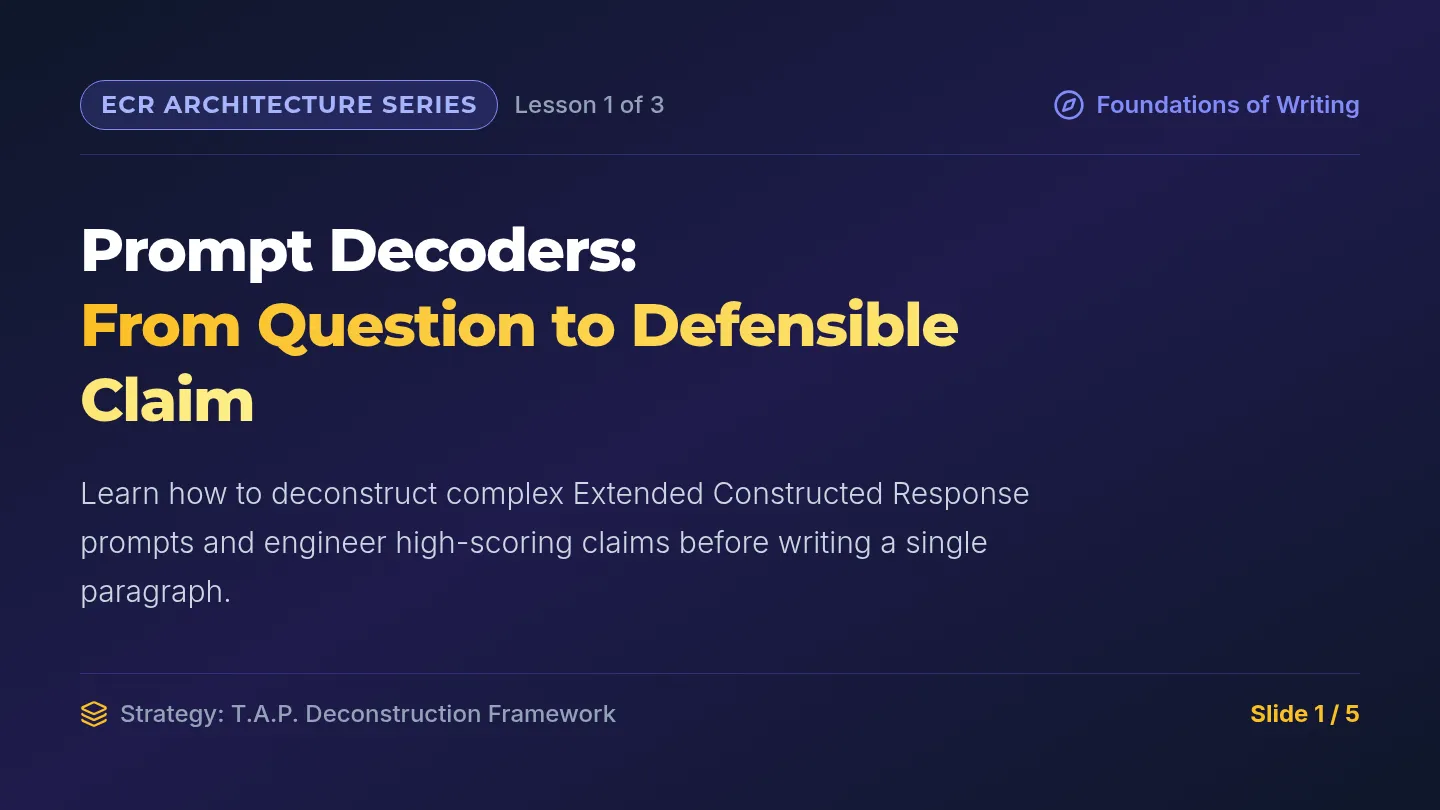
Prompt Decoder Slides

Argument Architecture

A comprehensive middle school writing sequence guiding students through the Extended Constructed Response process, from prompt deconstruction and claim generation to evidence integration and multi-paragraph synthesis.

Lenny Avatar
Lenny
6
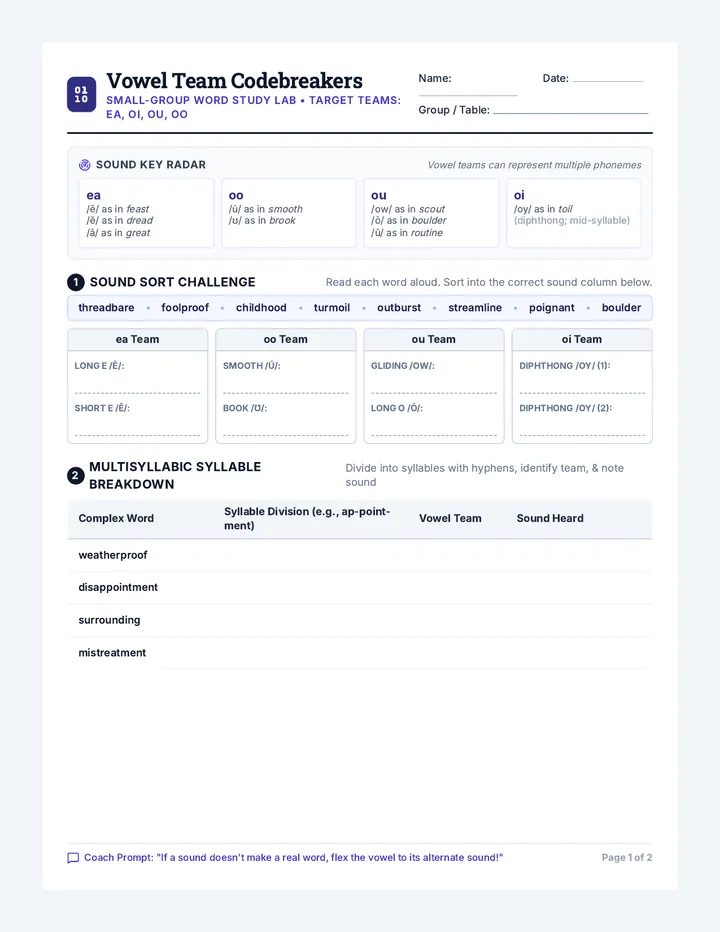
Vowel Team Codebreakers Activity Sheet

Vowel Team Codebreakers

A comprehensive small-group word study lesson focused on mastering variable and diphthong vowel teams (ea, oi, ou, and oo). Students analyze sound-spelling patterns, decode complex multisyllabic words, and strengthen orthographic mapping through scaffolded small-group routines.

LB

Lisa Ball

4
Pumpkin Trail Decodable Worksheet

Pumpkin Trail Decodable Worksheet

A third-grade decodable reading comprehension worksheet featuring a Halloween-themed passage with vowel teams, paired with four multiple-choice text-explicit evidence questions and a phonics detective word hunt.

CW

Carrie Worland

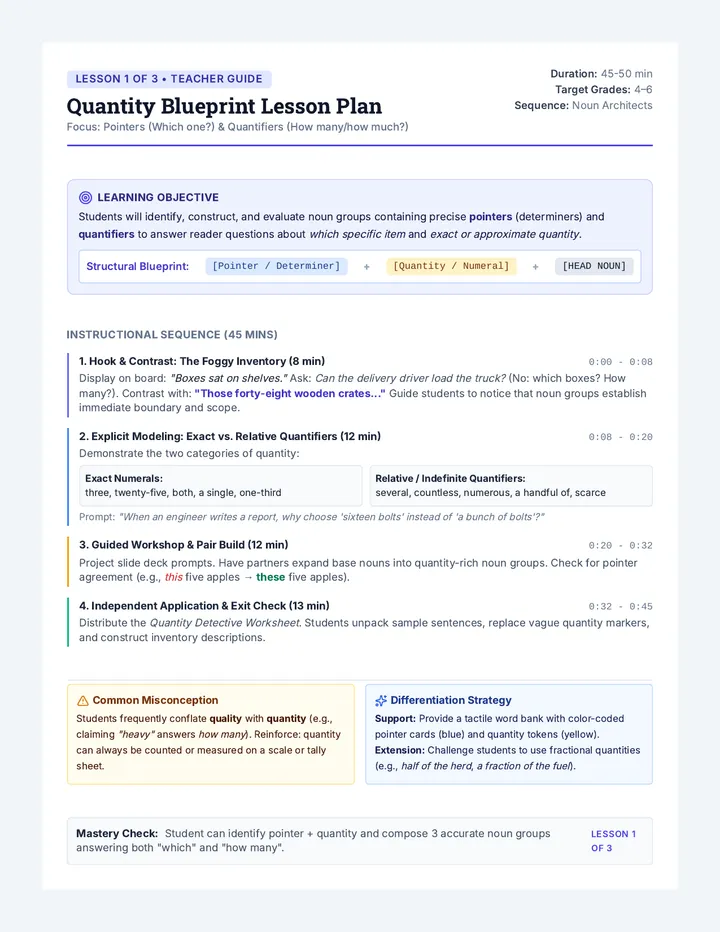
Quantity Blueprint Lesson Plan

Noun Group Architects

A three-part grammar and writing unit where students investigate, assemble, and refine precise noun groups. Learners progress from tracking quantity and pointer determiners to layering vivid qualities and specific classifiers for rich descriptive writing.

A

arlavoie-ridings

9
Abyss Final Writing Worksheet

Construct the Abyss

Students assemble their skills into a complete five-sentence RACES constructed response analyzing how bioluminescence enables deep-sea animals to survive, evaluated with a clear student rubric.

KW

Kristin Warner

2
Master Key and Tracker Teacher Guide

Master Key and Tracker Teacher Guide

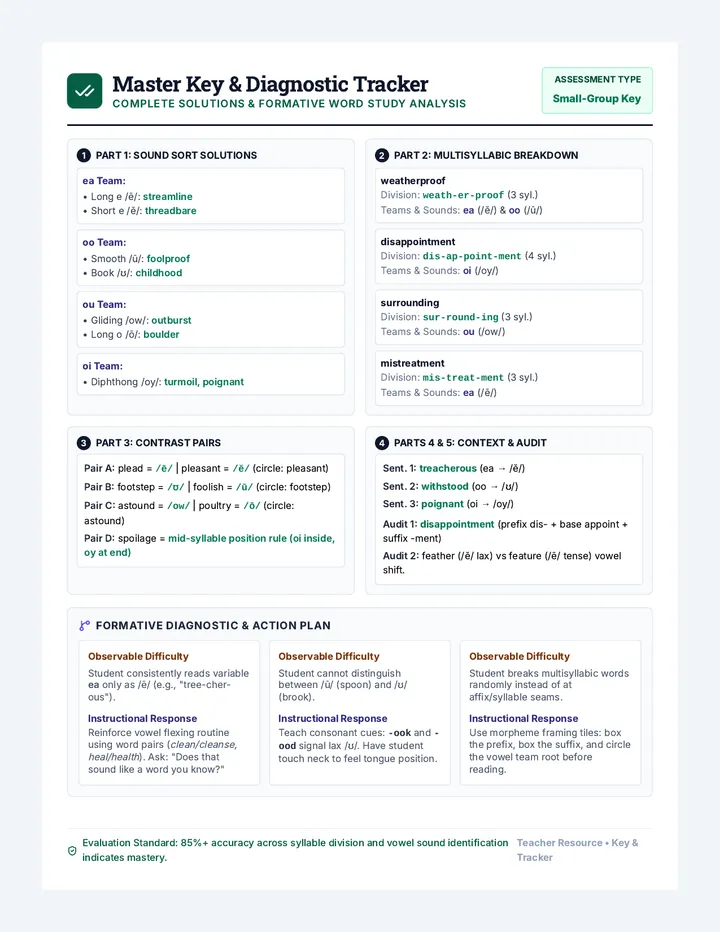
A comprehensive one-page answer key and formative diagnostic tracker for the Vowel Team Codebreakers student activities. Includes full solutions, phonetic breakdowns, error diagnostic guidance, and next-step recommendations without grade-level labels.

LB

Lisa Ball