A comprehensive introduction to sewing machine operation for middle schoolers, covering safety, machine anatomy, threading, and basic stitches. Students will learn how to prepare their machine and troubleshoot common issues like tension.
The finale of the course where students synthesize their proposal, budget data, and marketing assets into a high-impact digital presentation. Students learn presentation design, media integration, and public speaking skills to present their ideas to a panel of 'Sharks'.
Now that the data is solid and the business plan is formed, students must “market” their solution or product. This unit pushes word processing beyond just text into layout, graphic integration, and copyright-safe image sourcing.
The second unit of the computer skills course where students use spreadsheet software to prove their business ideas are viable. They learn about costs, profits, basic formulas (SUM, AVERAGE), and data visualization through charts and graphs.
The first unit of a 6th-grade computer skills course focusing on brainstorming business ideas, keyboarding foundations, and word processing basics. Students form teams and learn to create professional documents while practicing digital safety and file management.
A comprehensive introduction to radiometric dating, explaining how scientists use radioactive isotopes to determine the absolute age of rocks and fossils, and comparing it to relative dating methods.
A comprehensive lesson exploring the three primary states of matter (solid, liquid, gas) and their physical properties, designed for 6th-grade students. Includes visual aids, guided note-taking, and teacher-led instruction.
A foundational lesson on photosynthesis for middle schoolers, framing plants as 'Solar Kitchens' that convert light energy into chemical energy. The lesson covers reactants, products, the role of chloroplasts, and the importance of the process for life on Earth.
Weeks 1 focus on the scale of the solar system, the Sun, and the terrestrial planets, emphasizing executive functioning through organizational 'Mission Logs' and perspective-taking via planetary viewpoints.
Explore the fundamentals of atoms, the periodic table, and chemical bonding through the story of Carmela's science class. This lesson covers atomic structure, valence electrons, and types of bonding in a bilingual format.
A comprehensive Grade 6 Science review lesson covering cells, body systems, energy, Earth's history, and weather patterns, specifically designed for Arkansas ATLAS test preparation.
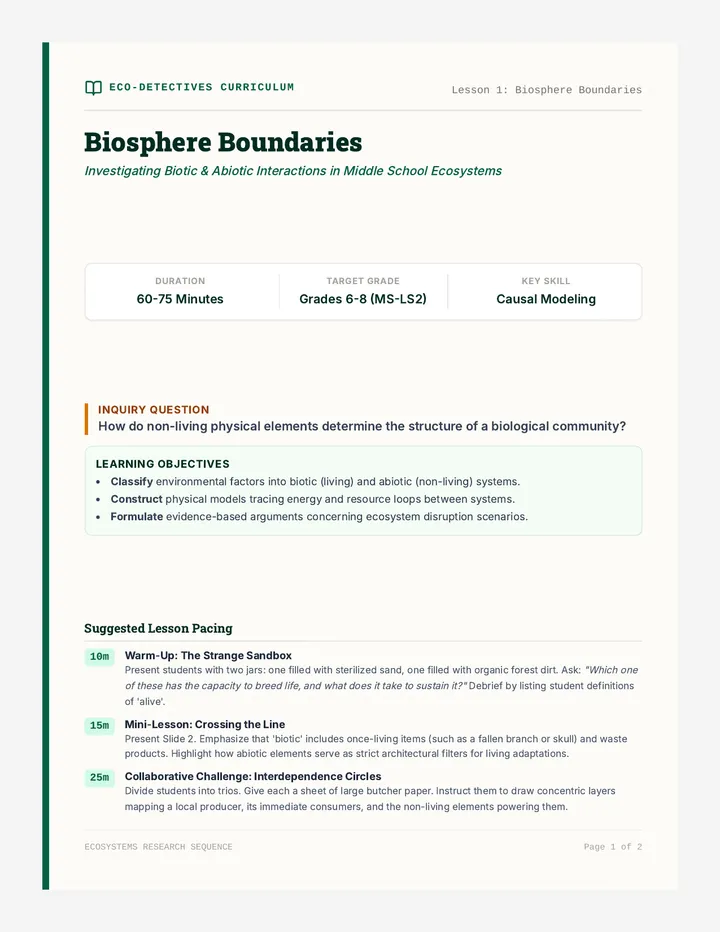
A lesson exploring how energy flows through an ecosystem using food webs. Students learn key vocabulary and identify roles of different organisms within their environment.
A comprehensive introduction to the microscopic world of animal and plant cells, exploring key organelles and their functions through visual diagrams and hands-on labeling.
An interdisciplinary lesson exploring ecological footprints through the unique environmental context of the Jemez Valley. Students analyze local resource consumption and research regional conservation to develop a sense of environmental stewardship.
A lesson exploring the mountain ecosystem of giant pandas, focusing on their specialized diet and the importance of conservation.
A comprehensive lesson exploring the scientific causes, effects, and prevention of brain freeze (ice cream headaches). Students read an informational text, analyze evidence, and understand the biological protection mechanisms of the brain.
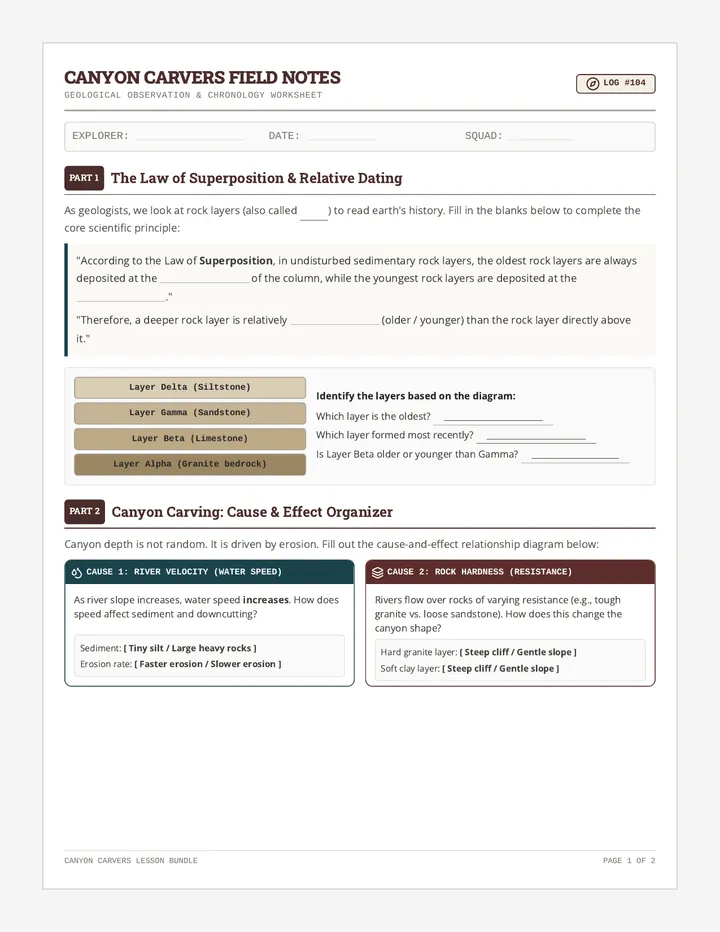
An interactive exploration of Earth's shifting plates, boundary types, and the evidence for continental drift. Students will analyze how the lithosphere moves and the landforms created by these massive geological forces.
A beginner-friendly introduction to Blender 4.0, focusing on navigation, object transformations, and essential edit mode tools for 3D modeling.
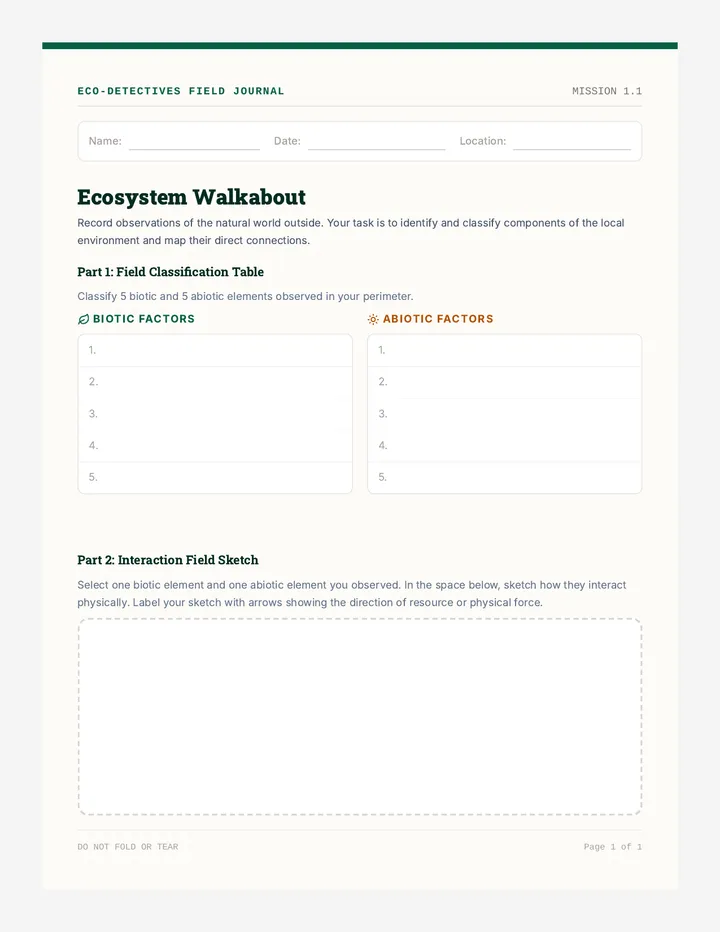
A field-based science lesson where students investigate urban ecosystems, identifying and documenting plant and animal life in developed environments to understand biodiversity and environmental stewardship.
A hands-on laboratory investigation where students explore how varying wire coils, voltage, and core materials affect the strength of an electromagnet.
A comprehensive lesson to inspire and equip students to organize their own neighborhood or park cleanup for Earth Day. Includes background on Earth Day, the impact of waste, and a practical planning framework for student-led action.
A lesson teaching students how to manage and conserve Earth's vital resources (air, water, soil, energy) and the difference between point and nonpoint source pollution.
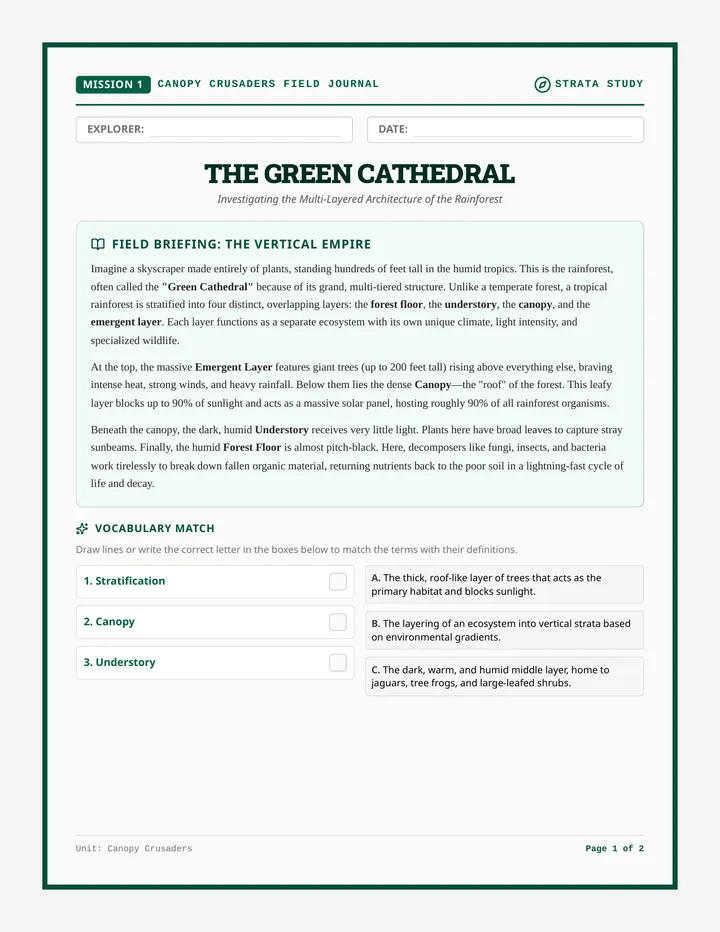
A comprehensive lesson exploring ecosystems as complex systems, focusing on food webs and subsystems across four major biomes: North American Forests, Oceans/Coral Reefs, Deserts, and Tropical Rainforests.
Students demonstrate their mastery of plant adaptations through a creative project and a summative assessment.
Students examine structural adaptations for defense and the role of stomata in gas exchange, understanding how plants protect themselves and breathe.
Students investigate plant behaviors and tropisms, exploring how plants respond to light, gravity, touch, and temperature to optimize growth and survival.
这是一套关于动物细胞结构的教学资源,包括课堂演示文稿、标注练习和功能匹配活动,重点讲解细胞核、核糖体、高尔基体和溶酶体。
Students act as the final editorial team for their digital magazine, performing rigorous quality control checks on layout, links, and media to ensure the publication is ready for its public launch. This lesson concludes the magazine project with a focus on professional standards and technical accuracy.
Students learn the fundamentals of digital site architecture by planning and building the framework for their digital publication, focusing on navigation, page hierarchy, and cohesive theme selection.
A hands-on investigation into the global journey of microplastics through ocean currents, where students simulate marine gyres and design localized reduction strategies.
An introductory lesson on evolution covering natural selection, adaptations, fossils, and genetic mutations using visual and accessible formats.
Students culminate their AI literacy journey by designing an AI solution for a real-world problem. They focus on responsible design, identifying potential biases, and ensuring societal benefit.
Students analyze the ethical implications of AI on privacy and identity. They explore deepfakes, facial recognition, and the balance between security and personal freedom.
Middle school students dive into the mechanics of Large Language Models (LLMs). They learn about tokenization, probability, and how AI "predicts" the next word in a sequence.
Students explore the "ingredients" of AI: datasets. They learn how biased or incomplete data can lead to unfair or inaccurate AI systems and practice creating a balanced dataset.
Students learn to critically evaluate AI outputs by identifying "hallucinations" and factual errors. They explore why AI sometimes makes mistakes and how to verify information.