Demystifying the Internet Lesson Plan Demystifying the Internet
Lesson Plan • 8th Grade Digital Literacy
Duration
35 Minutes
Tier
Tier 1 Instruction
Audience
8th Grade Class
Prep Time
10 Minutes
Learning Objective
Students will understand and differentiate between the Internet and the World Wide Web, dispelling common misconceptions through interactive activities and discussions.
Why This Matters
Clarifying these concepts is essential for digital literacy, ensuring students grasp the fundamentals of online systems and avoid common misunderstandings that impact their technical fluency.
Preparation Checklist
Review the lesson plan for background content.
Familiarize yourself with the Slide Deck and technical setup.
Prepare discussion prompts for the Myths and Facts activity.
Confirm technical tools for displaying slides are ready.
Required Materials
Demystifying the Internet Lesson Plan Internet vs. World Wide Web Slide Deck Myths and Facts Discussion Guide
Instructional Sequence
1
Introduction
5 Minutes
Briefly introduce the day's topic and state learning objectives.
Ask students what they already know about the Internet and the Web to gauge prior knowledge.
2
Slide Deck Presentation
15 Minutes
Present the Internet vs. World Wide Web (Slide Deck) to outline key differences.
Highlight the infrastructure of the Internet (hardware) vs. the content-based nature of the Web (software/service).
Teacher Note: Use the "Roads vs. Destinations" analogy provided in the slides.
3
Myths and Facts Discussion
10 Minutes
Engage students using the Myths and Facts Discussion Guide to debunk common misconceptions.
Facilitate a short class discussion, encouraging sharing and questioning.
Summarize key points ensuring clarity and retention.
4
Recap & Wrap-up
5 Minutes
Recap the main differences between the Internet and the World Wide Web.
Review any student questions or uncertainties.
Provide a takeaway message about the importance of digital literacy.
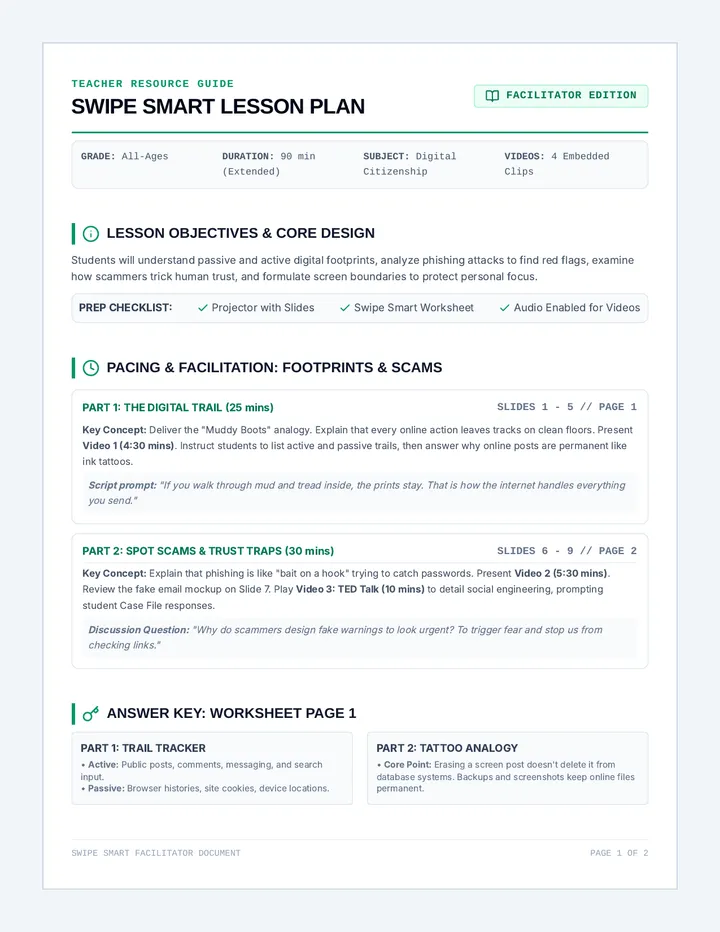
Lesson Plan: Demystifying the Internet
Tier 1 Instructional Resource
Digital Connectivity Slides Digital Connectivity
Internet vs.
World Wide Web
Understanding the Basics of Digital Connectivity and Dispelling Common Myths
8th Grade Digital Literacy
What is the Internet?
1
A global network of interconnected computers and devices.
2
Made up of hardware : servers, routers, satellites, and undersea cables.
3
Provides the infrastructure for many services (Email, Gaming, Streaming, Web).
The Physical Infrastructure
Web Pages
Multimedia
Hyperlinks
HTTP/HTTPS
The Digital Service
What is the WWW?
1
A service that runs on top of the Internet infrastructure.
2
Uses HTTP/HTTPS protocols to access formatted documents (web pages).
3
Consists of content : websites, apps, images, and videos.
Comparing the Two
The Internet
Physical Hardware
Connects Devices Globally
The "Roads"
VS
The Web
Digital Content & Services
Accessible via Internet
The "Destinations"
Recap & Key Takeaways
Main Distinction
The Internet is the hardware network. The World Wide Web is a service that utilizes this network for digital content.
Interdependence
Both are crucial for digital communication. You need the Internet (Roads) to reach the World Wide Web (Destinations).
"One is the infrastructure, the other is the information."
Myth Busters Discussion Guide Myth Busters
Internet vs. World Wide Web Discussion Guide
NAME:
DATE:
Think critically about common misunderstandings related to the Internet and the World Wide Web. Work in groups or as a class to share ideas and debunk common myths. Use this guide to structure your thoughts and record key insights.
Discussion Guidelines
Listen Actively: Let everyone share without interruptions.
Reference Facts: Support your ideas with facts from the lesson.
Stay Respectful: Respect all questions and differing opinions.
Collaborate: Work together to reach common understanding.
Key Refresher
The Internet is the network (the roads).
The WWW is the content we access via that network (the destinations).
1. Common Misconceptions
IDENTIFY
What are some things you've heard about the Internet or the Web that might not be entirely true? Why do you think these exist?
2. Differentiating the Two
EXPLAIN
In your own words, explain the difference between the physical network and the content-based service. How does knowing this help you?
3. Real-World Implications
APPLY
How might confusing these two lead to technical or security problems? Give a specific scenario where correct knowledge helps.
4. Myth Busting Activity
ACTION
Choose one specific myth and debunk it using evidence from today's lesson.
Conclusion & Group Consensus
After discussing these prompts, summarize the key points as a group. Ensure everyone agrees on the correct distinctions before finishing.