A comprehensive high-school equivalency preparation module focusing on Wisconsin HSED Life Science standards. This modular quiz series integrates key Reading Language Arts (RLA) skills, including text feature analysis, drawing conclusions, and interpreting scientific data, alongside life science concepts.
Q3. ANALYZING EVOLUTIONARY TREES (RLA: Compare & Contrast) [2 points]
Based on the cladogram above, which species is evolutionary closer to the Gray Wolf: the Coyote or the Bobcat? Support your answer using node locations.
Q4. NATURAL SELECTION TEXT COMPREHENSION (RLA: Context Clues) [2 points]
A native Wisconsin snowshoe hare population shows variation in fur color. Winter hares with white fur blend into snow, escaping owls. Brown fur hares are easily spotted and eaten. Due to climate warming, snow cover in northern Wisconsin arrives 3 weeks later than normal.
Predict how this environmental shift acts as a selective pressure on the hare population over generations.
Q5. SCIENTIFIC INFERENCE (RLA Integration: Making Inferences) [2 points]
In a separate forest, all snowshoe hares possess identical DNA with zero genetic variation. If a sudden, deadly parasite invades this forest, what is the most likely evolutionary outcome?
A. The population will adapt instantly by growing defensive armor plates.
B. Without genetic diversity to provide resistance, the entire population risks localized extinction.
C. Hares will split into two new species immediately to evade the disease.
D. The parasite will act as a mutual partner, doubling the hares' lifespan.
WISCONSIN HSED SYSTEM • LIFE SCIENCE MODULE 2 • PAGE 2
STEP 1 Phosphorus Runoff
STEP 2 Rapid Algae Bloom
STEP 3 Algae Dies & Decomposes
STEP 4 Oxygen Depleted
Q3. CAUSE AND EFFECT CHAIN (RLA Integration: Cause & Effect) [2 points]
Based on the text and the sequence diagram above, explain how the presence of decomposing bacteria directly causes the deaths of multicellular fish.
Q4. REVISING AN EXPERIMENTAL DESIGN (Scientific Practices) [2 points]
Suppose you want to design a new experiment to test the hypothesis: "Algae blooms grow at a faster rate when water temperatures are high." Explain how you would change your experimental design (treatment tanks, independent variable, etc.) to test this hypothesis.
Q5. VOCABULARY IN CONTEXT (RLA Integration: Context Clues) [1 point]
In paragraph 2 of the passage, the word hypoxic is used. Based on contextual evidence, which of the following is the most accurate synonym?
A. Nutrient-rich
B. Freezing cold
C. Oxygen-deficient
D. Hyperactive
WISCONSIN HSED SYSTEM • LIFE SCIENCE MODULE 3 • PAGE 2
WISCONSIN HSED SYSTEM • EVALUATION ADMIN STRATEGIES • PAGE 1
Wisconsin HSED Science Admin
Scoring Guide & Key
Modular Quizzes 1, 2, and 3 Alignment & Solutions
PAGE 2 RESOURCE
Module 2 Quiz Answer Explanations
Q1 (Choice B) Zebra mussels consume primary producers (Phytoplankton). This cuts off food for Zooplankton, creating a cascade that collapses the yellow perch populations who depend on secondary food sources.
Q2 (10% Energy Loss) 3 points: 1 point for explaining that 90% of energy is lost as heat/metabolism at each tier transition. 1 point for referring to the quantitative chart showing dramatic scale differences. 1 point for noting that top-tier predators require enormous prey ranges to find enough energy.
Q3 (Cladogram Analysis) 2 points: 1 point for stating Coyote is closer. 1 point for explanation: They share a more recent branching point (node) with Gray Wolves than Bobcat.
Q4 (Selective Pressure) 2 points: 1 point for identifying that white-furred hares will be visible on brown, snow-free ground. 1 point for concluding that brown-coat traits will survive better, shifting the population genetics over generations towards delayed coat color changes.
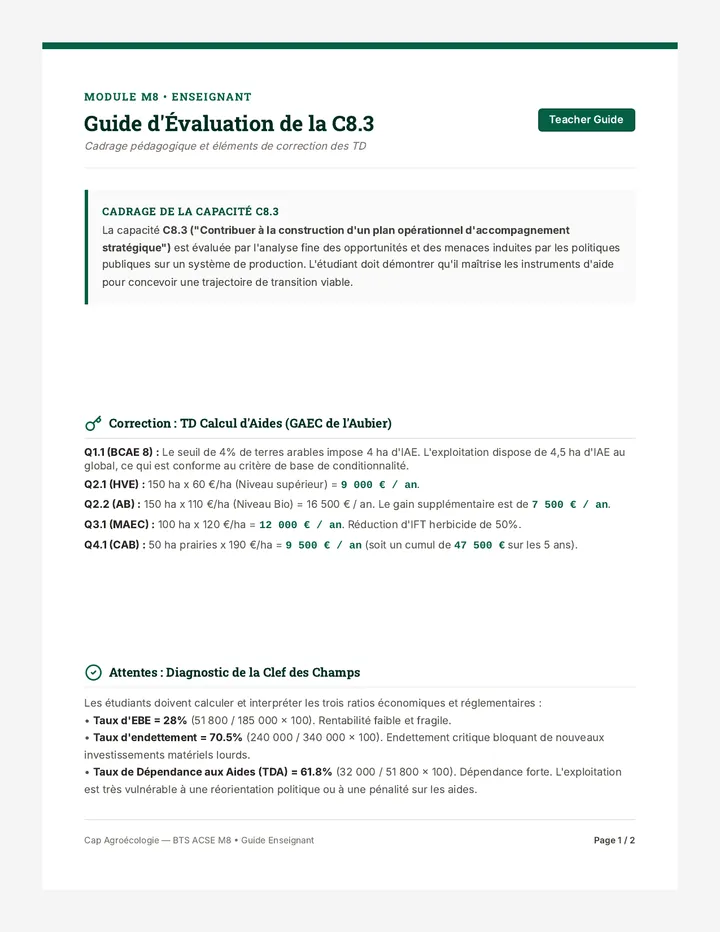
Q5 (Choice B) Lack of genetic variation means there are no resistant alleles. A deadly parasite can easily kill all organisms in the clone-like pool, leading to local extinction.
Q2 (Population Crash) 2 points: Over-population (reaching carrying capacity) consumes all available phosphorus, causing nutrients to deplete, leading to a sudden algae die-off.
Q3 (Hypoxia Pathway) 2 points: Decomposing aerobic bacteria consume dissolved oxygen as they feed on dead algae. The resulting low-oxygen water (hypoxia) suffocates multicellular gill-breathing fish.
Q4 (Experimental Redesign) 2 points: 1 point for changing the independent variable to water temperature. 1 point for controlling phosphorus concentration (keeping it identical across all tanks).
Q5 (Choice C) "Hypoxic" means oxygen-deficient based on the surrounding context explaining oxygen exhaustion.