A high-energy lesson for 8th graders on the mechanics, strategies, and rhythm-based physics of Geometry Dash. Students will learn about game modes, timing mastery, and the importance of practice mode.
A detective-themed lesson on Earth's resources for 6th-grade students. The lesson focuses on resource management, conservation strategies, and identifying types of pollution, directly aligned with the curriculum test on Managing Earth's Resources.
A fun, hands-on vocabulary activity for 7th-grade students to master taxonomy terms through puzzles and creative drawing. The lesson culminates in a 'Beast Blueprint' activity where students build a creature based on their vocabulary knowledge.
A culinary and mathematical exploration of Mexico's most famous sauce, focusing on the cultural significance of the kilogram in large-scale traditional cooking.
A problem-based learning (PBL) investigation where students act as forensic chemists to save a deteriorating bronze statue. They will analyze reaction types, signs of chemical change, and conservation of mass to solve the mystery.
An exploration of how atoms become charged particles. Students learn about valence electrons, the octet rule, cation and anion formation, and the energy required to remove electrons.
A journey through the organization of matter. Students explore atomic structure, periodic trends, and the unique properties of chemical families.
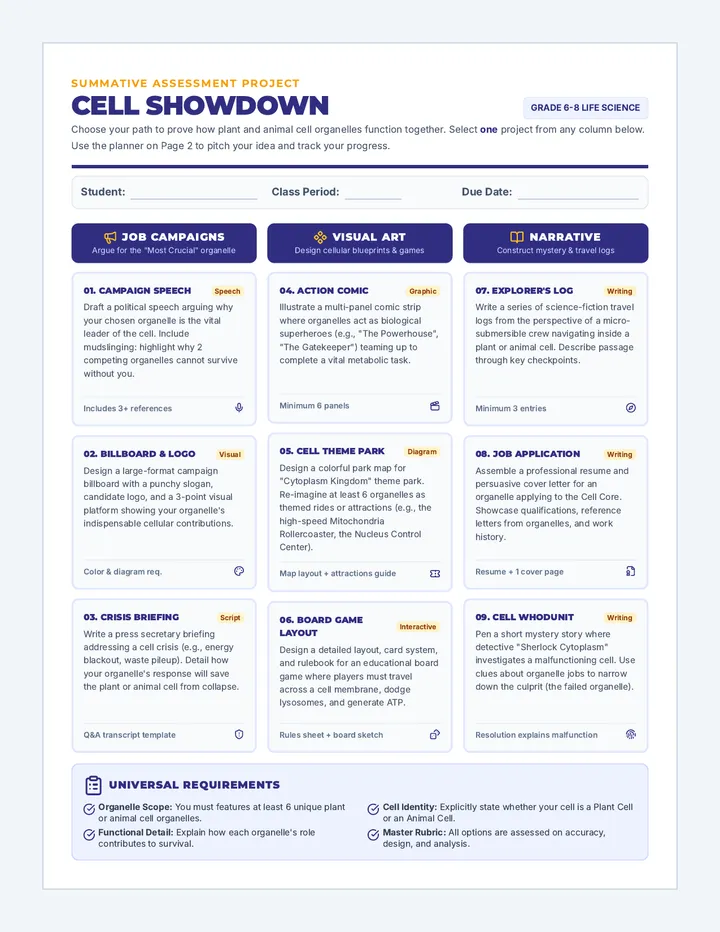
An investigation into the building blocks of life. Students compare plant and animal cells, identify organelle functions, and understand how cells maintain homeostasis.
A deep dive into Newton's three laws of motion. Students calculate force, mass, and acceleration while observing physics in everyday life through hands-on experiments.
Unlocking the secrets of DNA and inheritance. Students learn how traits are passed from parents to offspring using Punnett squares and pedigree analysis.
An exploration of the greenhouse effect, global warming, and the measurable impact of human activity on Earth's ecosystems. Students analyze data and design solutions for a more sustainable future.
Students explore the structure of plant cells within a leaf to understand how specific organelles contribute to the process of photosynthesis. This lesson aligns with NGSS MS-LS1-2, focusing on cell parts and their functions.
A low-stress introduction to circuit components and configurations through a creative coloring activity. Students identify symbols and differentiate between series and parallel circuits to unlock a color-coded blueprint.
A targeted one-day review session covering key NYS Science standards: Space Systems, Ecosystems, Earth's Systems, and Matter. Includes morning work and homework to reinforce essential concepts through practice questions.
An in-depth look at horse anatomy, vital signs, and health maintenance for aspiring equestrians and young veterinarians.
Explores the diverse movement patterns of every vehicle and icon type in the game, from the classic Cube to the advanced Swing mode.
Focuses on the fundamental physics of the game, technical hardware considerations, and professional practice techniques to improve player performance.
Moving beyond mere survival, this lesson covers weapons, combat strategies against various enemies, and the intricacies of building a secure base. Perfect for players ready to dominate the wasteland.
The foundation of any Forsaken player's journey, focusing on UI navigation, essential survival stats, and the first day of gameplay. Students will learn how to scavenge for resources and keep their character alive.
Students analyze DNA evidence from a crime scene using gel electrophoresis data to identify a suspect and justify their findings using the CER (Claim-Evidence-Reasoning) framework.
A self-contained, high-engagement "Secret Agent" themed review mission for Day 4 (the day before the STAAR exam), designed for independent work.
A quick review lesson exploring the mechanics of runoff and groundwater, specifically focusing on how human activities lead to water pollution and environmental impact.
Concludes the review with heredity problems and a comprehensive vocabulary blitz to ensure students are ready for the STAAR exam.
Dives into the complexities of mutation scenarios and the mechanics of meiosis, helping students navigate tricky genetic questions.
Focuses on mastering cell transport mechanisms and the logic of experimental design and data analysis with a focus on STAAR elimination tactics.
A deep dive into the mechanics, physics, and design principles of Geometry Dash, focusing on how 'tech' drives gameplay and level creation.
An interactive guided notes packet exploring the movement of water through Earth's systems, featuring a detailed diagram and critical thinking questions.
A comprehensive lab manual covering water filtration, energy efficiency, genetics, and ecosystem dynamics through hands-on projects and real-world audits.