An engaging, collaborative high school anatomy project where students research and design educational communication posters tracking the monthly physical and physiological milestones of human fetal development across gestation.
An immersive gardening lesson introducing pruning principles. Students master key tools, safety protocols, and the mechanics of plant growth to make clean, professional, and healthy cuts.
A hands-on, engaging lesson on the science and art of pruning. Students learn the botanical reasons for pruning (apical dominance), the "3 Ds" of identifying what to cut, and proper pruning cuts to keep plants healthy.
A digital design lesson focusing on social media brand personas, digital footprint, and visual design aesthetics using Adobe and Canva. Students compare contrasting brand voices, from Wendy's playful roasts to polished professional corporate presences.
Express new expertise through a multi-page layered flipbook template and structured cooperative writing prompts.
Sing and chant about ocean adaptations, fill out a collaborative Process Grid of focus animals, and use differentiated sentence frames for group writing.
Build vocabulary and deep comprehension using a interactive Cognitive Content Dictionary (CCD) and the story of Ollie the Octopus's Deep Sea Adventure.
Spark curiosity with high-interest Observation Charts, positive-behavior Literacy Awards, and a large-scale visual blueprint for the multi-zone ocean chart.
Students synthesize their understanding of radioactive decay, fission, fusion, and nuclear energy. They analyze historical case studies and participate in a structured debate on global nuclear energy and policy futures.
A tense, role-play nuclear control room simulation. Students act as engineers, reactor operators, and safety officers trying to manage a surging core under crisis while learning about nuclear energy systems and safety protocols.
An active, station-based inquiry into fission, fusion, and mass-energy equivalence. Students rotate through tactile and analytical stations to untangle the powerful physics that bind and break atomic nuclei.
Students investigate alpha, beta, and gamma radioactive decay by building interactive paper models. They track nuclear equations and explore how unstable elements shed mass and energy to reach stability.
An introductory lesson on biotechnology, focusing on key tools like CRISPR, recombinant DNA, and gel electrophoresis. Students complete interactive guided notes and a formative assessment to demonstrate understanding of genetic engineering.
A self-paced study lesson designed for students catching up on Evolution and Classification. It chunk-packs Darwinian theory, speciation, lines of evolutionary evidence, Linnaean taxonomy, and cladograms into accessible, digestible visual summaries and active workbook exercises.
A highly differentiated 30-minute lesson where students act as 'Placement Officers' for the Pup Placement Agency. They analyze physical and behavioral traits of dog candidates and match them with appropriate service dog jobs, aligning with the OpenSciEd Grade 3 Trait Variation unit.
A comprehensive review lesson where students synthesize paleoclimate concepts, isotope calculations, and feedback loops. Students participate in interactive review challenges and complete a structured synthesis worksheet to demonstrate mastery.
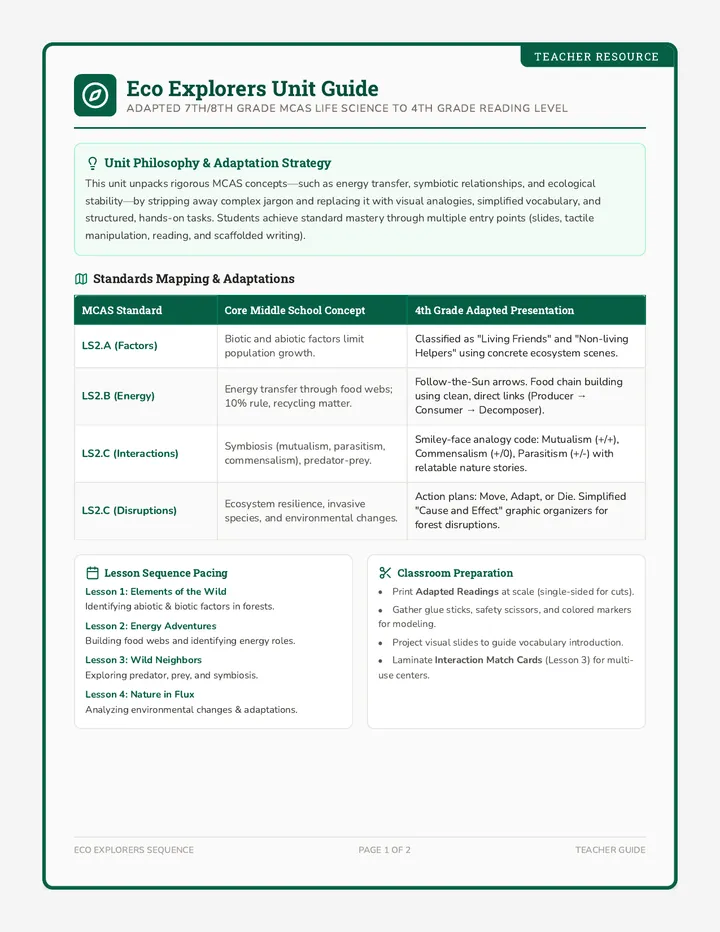
An introductory science lesson exploring ecological levels of organization, biotic versus abiotic factors, and population growth limits.