Catalase Chaos Lab Sheet
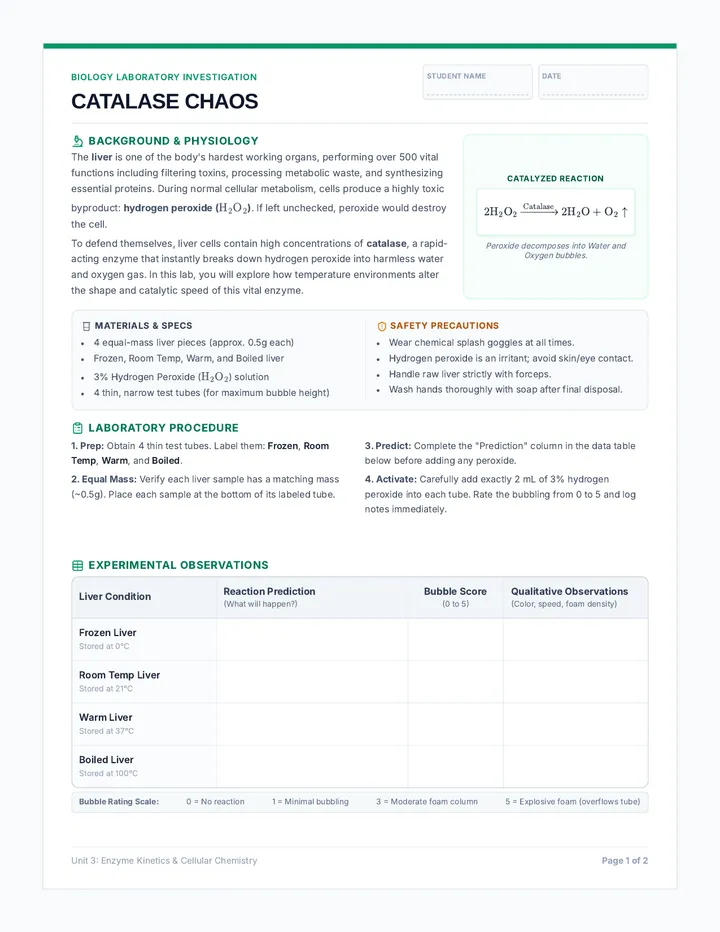
Biology Laboratory Investigation
CATALASE CHAOS
Student Name
Date
Background & Physiology
The liver is one of the body's hardest working organs, performing over 500 vital functions including filtering toxins, processing metabolic waste, and synthesizing essential proteins. During normal cellular metabolism, cells produce a highly toxic byproduct: hydrogen peroxide (\(\text{H}_2\text{O}_2\)). If left unchecked, peroxide would destroy the cell.
To defend themselves, liver cells contain high concentrations of catalase, a rapid-acting enzyme that instantly breaks down hydrogen peroxide into harmless water and oxygen gas. In this lab, you will explore how temperature environments alter the shape and catalytic speed of this vital enzyme.
Catalyzed Reaction
\[ 2\text{H}_2\text{O}_2 \xrightarrow{\text{Catalase}} 2\text{H}_2\text{O} + \text{O}_2 \uparrow \]
Peroxide decomposes into Water and Oxygen bubbles.
Materials & Specs
- 4 equal-mass liver pieces (approx. 0.5g each)
- Frozen, Room Temp, Warm, and Boiled liver
- 3% Hydrogen Peroxide (\(\text{H}_2\text{O}_2\)) solution
- 4 thin, narrow test tubes (for maximum bubble height)
Safety Precautions
- Wear chemical splash goggles at all times.
- Hydrogen peroxide is an irritant; avoid skin/eye contact.
- Handle raw liver strictly with forceps.
- Wash hands thoroughly with soap after final disposal.
Laboratory Procedure
1. Prep: Obtain 4 thin test tubes. Label them: Frozen, Room Temp, Warm, and Boiled.
2. Equal Mass: Verify each liver sample has a matching mass (~0.5g). Place each sample at the bottom of its labeled tube.
3. Predict: Complete the "Prediction" column in the data table below before adding any peroxide.
4. Activate: Carefully add exactly 2 mL of 3% hydrogen peroxide into each tube. Rate the bubbling from 0 to 5 and log notes immediately.
Experimental Observations
| Liver Condition | Reaction Prediction (What will happen?) | Bubble Score (0 to 5) | Qualitative Observations (Color, speed, foam density) |
|---|
| Frozen Liver Stored at 0°C | | | |
| Room Temp Liver Stored at 21°C | | | |
| Warm Liver Stored at 37°C | | | |
| Boiled Liver Stored at 100°C | | | |
Bubble Rating Scale: 0 = No reaction 1 = Minimal bubbling 3 = Moderate foam column 5 = Explosive foam (overflows tube)
Unit 3: Enzyme Kinetics & Cellular Chemistry Page 1 of 2
Visual Lab Notebook
Draw the physical liver slice at the bottom of each tube. Then, shade the resulting foam column indicating exactly how high the bubbles rose.
- Max - High - Mid - Low - 0cm
FROZEN (0°C)
- Max - High - Mid - Low - 0cm
ROOM TEMP (21°C)
- Max - High - Mid - Low - 0cm
WARM (37°C)
- Max - High - Mid - Low - 0cm
BOILED (100°C)
Analysis & Post-Lab Questions
1. Which liver temperature condition exhibited the absolute highest rate of reaction (highest bubble score)? Why do you think this specific temperature was optimal for the catalase enzyme in liver tissue?
2. Which liver temperature condition(s) showed completely denatured enzymes? Explain what happened physically to the molecular structure of the enzyme in those samples to cause this lack of reaction.
Enzyme-Substrate Structural Analysis
State A: Active Catalase Enzyme (Working)
1. Binding (Before) CATALASE H₂O₂ SUBSTRATE
2. Reaction (After) CATALASE H₂O O₂ PRODUCTS
Before: Active site fits substrate. After: Substrate cleaved into safe products.
State B: Denatured Catalase Enzyme (Boiled)
1. Blocked (Before) CATALASE H₂O₂ SUBSTRATE
2. No Reaction (After) CATALASE H₂O₂ UNREACTED
ACTIVE SITE SHAPE DESTROYED / COLLAPSED BY HEAT
3a. Based on State B above, why can't a denatured enzyme perform its biological function? Explain using the term "active site".
3b. Predict what happens to the amount of toxic hydrogen peroxide inside a cell if the cell's environment permanently transitions to State B.
Unit 3: Enzyme Kinetics & Cellular Chemistry Page 2 of 2
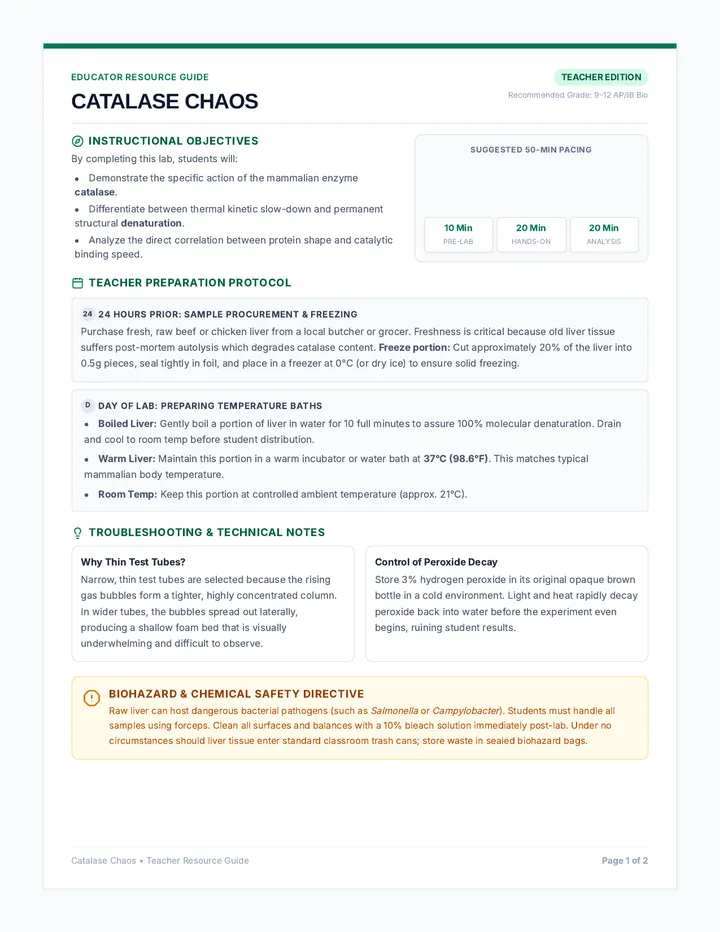
Catalase Chaos Teacher Guide
Educator Resource Guide
CATALASE CHAOS
Teacher Edition Recommended Grade: 9–12 AP/IB Bio
Instructional Objectives
By completing this lab, students will:
- Demonstrate the specific action of the mammalian enzyme catalase.
- Differentiate between thermal kinetic slow-down and permanent structural denaturation.
- Analyze the direct correlation between protein shape and catalytic binding speed.
Suggested 50-Min Pacing
10 Min Pre-Lab
20 Min Hands-On
20 Min Analysis
Teacher Preparation Protocol
24 24 Hours Prior: Sample Procurement & Freezing
Purchase fresh, raw beef or chicken liver from a local butcher or grocer. Freshness is critical because old liver tissue suffers post-mortem autolysis which degrades catalase content. Freeze portion: Cut approximately 20% of the liver into 0.5g pieces, seal tightly in foil, and place in a freezer at 0°C (or dry ice) to ensure solid freezing.
D Day of Lab: Preparing Temperature Baths
- Boiled Liver: Gently boil a portion of liver in water for 10 full minutes to assure 100% molecular denaturation. Drain and cool to room temp before student distribution.
- Warm Liver: Maintain this portion in a warm incubator or water bath at 37°C (98.6°F). This matches typical mammalian body temperature.
- Room Temp: Keep this portion at controlled ambient temperature (approx. 21°C).
Troubleshooting & Technical Notes
Why Thin Test Tubes? Narrow, thin test tubes are selected because the rising gas bubbles form a tighter, highly concentrated column. In wider tubes, the bubbles spread out laterally, producing a shallow foam bed that is visually underwhelming and difficult to observe.
Control of Peroxide Decay Store 3% hydrogen peroxide in its original opaque brown bottle in a cold environment. Light and heat rapidly decay peroxide back into water before the experiment even begins, ruining student results.
Biohazard & Chemical Safety Directive
Raw liver can host dangerous bacterial pathogens (such as Salmonella or Campylobacter). Students must handle all samples using forceps. Clean all surfaces and balances with a 10% bleach solution immediately post-lab. Under no circumstances should liver tissue enter standard classroom trash cans; store waste in sealed biohazard bags.
Catalase Chaos • Teacher Resource Guide Page 1 of 2
Master Lab Answer Key