Lenny.com
Explore
Create
ActivitiesNewMathEnglish Language ArtsScience & EngineeringSocial StudiesGlobal LanguagesHealth & Physical EducationSpecial EducationCounseling & Life SkillsArts & CreativityESL
Lenny.com
Lenny.com
Explore
Create
ActivitiesNewMathEnglish Language ArtsScience & EngineeringSocial StudiesGlobal LanguagesHealth & Physical EducationSpecial EducationCounseling & Life SkillsArts & CreativityESL
Lenny.com
Science & EngineeringLife ScienceLiving ThingsAnimalsPlantsBody SystemsTraitsAdaptationsCellsEcosystemsHeredityGenes to TraitsCell DivisionPhysicsComparing MaterialsShapes and PropertiesMagnetsMagnetismLightSoundLight and SoundMatterStates of MatterChanges of StateMixturesPhysical and Chemical ChangeHeating and CoolingHeat and Thermal EnergyEnergyForce and MotionElectrical CircuitsAtoms and MoleculesPeriodic TableMotion in One DimensionMotion in Two DimensionsScalars and VectorsForces and Laws of MotionCircular Motion and GravityMomentum and ImpulseWork, Energy, and PowerWavesElectromagnetic WavesGeometric OpticsElectricity and MagnetismSimple Harmonic MotionThermodynamicsNuclear PhysicsEarth Science & AstronomyWeatherWater CycleRocks and MineralsFossilsEarth's FeaturesEarth's ResourcesEarth's StructureWeather and ClimateEarth EventsFossils and Geologic TimePlate TectonicsHuman ImpactsAstronomyChemistryUnits and MeasurementAtomic StructurePeriodic TrendsChemical BondingNomenclatureMolecular StructureIntermolecular ForcesThe MoleStoichiometryProperties of GasesSolutionsChemical ReactionsBalancing EquationsEnergy ChangesRates of ReactionsEquilibriumAcids and BasesQuantum ModelBiologyClassificationCell StructureThe Chemistry of LifeBiomoleculesCellular TransportCell EnergyCell Growth and DivisionDNAProtein SynthesisMeiosis and Sexual ReproductionPatterns of InheritanceMulticellular OrganismsEvolutionEcologyBiodiversityComputer ScienceAlgorithms and Computational ThinkingProgramming LanguagesComputing SystemsNetworks and InternetData AnalysisCybersecurityAI and Machine LearningSoftware Design and DevelopmentBlockchainEngineering & AIDesigning ExperimentsEngineering PracticesDesign ThinkingEngineering Design ProcessMechanical EngineeringElectrical EngineeringMaterials and StructuresCAD and 3D DesignRoboticsArtificial Intelligence BasicsVibe CodingMachine LearningAI Ethics and SocietySystems ThinkingEntrepreneurship & InnovationEntrepreneurial MindsetBusiness Idea DevelopmentBusiness Plan BasicsMarketing & Customer DiscoveryFinancial Management for Startups

Circular Motion and Gravity

Centripetal acceleration, angular velocity, and uniform circular motion principles. Analyzes Newton’s law of universal gravitation and Kepler’s laws to describe planetary orbits and satellite motion.

Lenny.com

Solutions

Lenny for EducatorsLenny for SchoolsLenny for Districts

Product

ExploreSign inCreateSupportAbout

Resources

Getting startedMTSS Acceleration Program

© 2026 Lenny Learning Inc.

TermsPrivacyAccessibility
LinkedInInstagramX
Lenny

Videos

Calculating the Force of Gravity with Newton's Law

Calculating the Force of Gravity with Newton's Law

This educational video provides a comprehensive introduction to Newton's Law of Universal Gravitation, bridging conceptual understanding with mathematical application. It begins by contextualizing the universality of physical laws, explaining how the same force that causes an apple to fall also governs the motion of planets. The narrator breaks down the gravitational formula step-by-step, identifying each variable and explaining the significance of the gravitational constant (G) determined by Henry Cavendish.

Miacademy & MiaPrep Learning ChannelMiacademy & MiaPrep Learning Channel

11mins 37s

Resolving the Gravity Paradox: Why Heavy Objects Don't Fall Faster

Resolving the Gravity Paradox: Why Heavy Objects Don't Fall Faster

This physics video addresses a common student paradox regarding gravity: if the force of gravity depends on an object's mass, why do all objects fall with the same acceleration regardless of their weight? The video begins by defining a paradox and setting up the conflict between the observation that acceleration is constant (9.8 m/s²) and the Law of Universal Gravitation which includes mass as a variable. The content moves from a conceptual discussion to a mathematical proof using Newton's Second Law and the Law of Universal Gravitation. Through step-by-step algebraic derivation, the narrator demonstrates how the mass of the falling object cancels out of the equation, leaving acceleration dependent only on the mass and radius of the planet. The video also applies this logic to calculate the gravitational acceleration on the Moon. This resource is highly valuable for high school physics classrooms as it bridges the gap between conceptual understanding and mathematical application. It directly addresses a specific cognitive conflict that many students face when learning Newton's laws. Teachers can use this video to model problem-solving strategies, reinforce algebraic substitution in physics, and visually demonstrate why "heavy" objects do not fall faster than "light" ones in a vacuum.

Miacademy & MiaPrep Learning ChannelMiacademy & MiaPrep Learning Channel

8mins 40s

How Objects Accelerate by Slowing Down and Turning

How Objects Accelerate by Slowing Down and Turning

This physics video provides an in-depth exploration of acceleration, challenging the common misconception that it only refers to speeding up. The instructor explains that in physics, acceleration is a vector quantity defined as any rate of change in velocity. Through clear visual examples and animations, the video demonstrates the three distinct ways an object can accelerate: speeding up, slowing down (negative acceleration), and changing direction (turning). Special attention is given to the direction of acceleration vectors relative to velocity vectors in each scenario. The content moves from conceptual understanding to mathematical application. It guides students through a step-by-step problem-solving process to calculate negative acceleration using the formula for rate of change in velocity. The video uses a race car deploying a parachute as a practical example, showing how to determine variables, select the correct equation, and solve for the answer with appropriate units and significant figures. This resource is highly valuable for physical science and physics classrooms as it bridges the gap between intuitive understandings of motion and formal physics definitions. It specifically addresses the tricky concept of "slowing down" as acceleration in the negative direction and the often-overlooked fact that turning at a constant speed is also acceleration. The included practice scenarios at the end provide immediate formative assessment opportunities for teachers to check student comprehension.

Miacademy & MiaPrep Learning ChannelMiacademy & MiaPrep Learning Channel

11mins 39s

Understanding Kepler's First Law and Elliptical Orbits

Understanding Kepler's First Law and Elliptical Orbits

This educational video explores Kepler's First Law of Planetary Motion, explaining that planets orbit the sun in elliptical paths rather than perfect circles. It begins by defining the etymology of the word "planet" and contrasting ancient observations of stars versus planets. The narrator creates a clear distinction between the circular orbits proposed by Copernicus and the elliptical reality discovered by Johannes Kepler, using visual aids to demonstrate the geometry of an ellipse, including its two foci.

Miacademy & MiaPrep Learning ChannelMiacademy & MiaPrep Learning Channel

12mins 30s

How the Earth Moves: Rotation, Revolution, and Seasons

How the Earth Moves: Rotation, Revolution, and Seasons

This installment of Crash Course Geography explores the fundamental movements of our planet—rotation and revolution—and how they shape life on Earth. Host Alizé Carrère begins with a personal anecdote about growing up in a treehouse to illustrate adapting to nature, before zooming out to the cosmic origins of our solar system. The video explains the physics behind Earth's formation from a solar nebula, detailing why the planet spins and orbits the way it does.

CrashCourseCrashCourse

10mins 33s

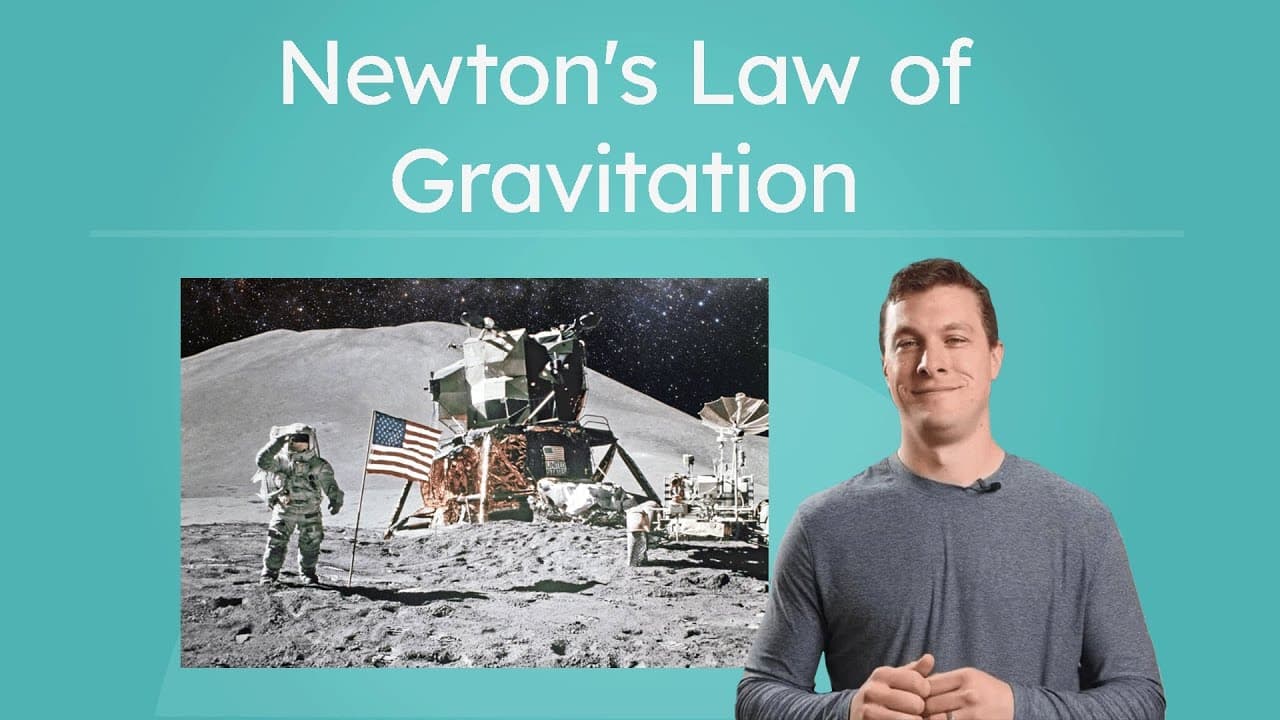
How Our View of the Solar System Evolved

How Our View of the Solar System Evolved

This educational video provides a comprehensive historical overview of how humanity's understanding of the solar system and gravity has evolved over time. It traces the journey from ancient geocentric models to modern gravitational theories, highlighting the key scientists who drove these paradigm shifts. The narrative explains why early civilizations believed the Earth was stationary and how observational evidence eventually led to the acceptance of a sun-centered solar system. The content focuses on the progression of scientific models, specifically examining Ptolemy's geocentric model with its complex epicycles, Copernicus's introduction of heliocentrism, Kepler's discovery of elliptical orbits, Newton's mathematical formulation of gravity, and finally Einstein's theory of general relativity. Major themes include the nature of scientific inquiry, how models are adjusted to fit data, and the resistance often faced by radical new scientific ideas. For educators, this video serves as an excellent introduction to units on astronomy, gravity, or the history of science. It effectively demonstrates the 'nature of science' by showing that scientific knowledge is tentative and evolves with new evidence. Teachers can use the specific arguments presented (like the lack of observable stellar parallax) to help students understand why reasonable people once held incorrect scientific views, fostering critical thinking about how we interpret evidence today.
Miacademy & MiaPrep Learning ChannelMiacademy & MiaPrep Learning Channel

8mins 49s

Materials

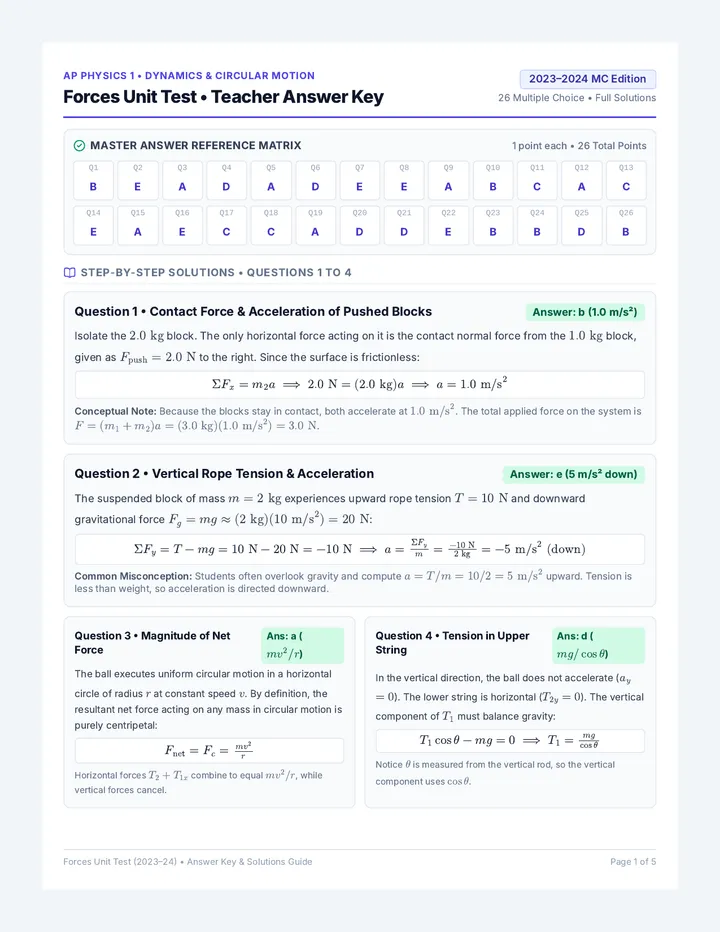
Forces Unit Test Answer Key

Forces Unit Test Answer Key

A five-page teacher answer key and complete solutions guide for the Forces Unit Test MC (2023–24). Includes a master quick-grading reference table, step-by-step physical derivations, free-body diagram analyses, common student pitfalls, and diagnostic remediation targets for all 26 questions.

CM

Chuguna Murugesan

Solar System Trivia Cards

Solar System Trivia Cards

A set of 20 printable question-and-answer trivia cards designed for astronomy classroom warm-ups, partner quizzes, and small-group review. Each card features an engaging astronomical question, a targeted clue, an official verification answer, and a fascinating cosmic fact across five structured planetary themes.

M

Megan.Tanner

Sequences

Spin Cycle Reading Guide Updated v4

Spin Cycle Unit

A comprehensive unit on rotational mechanics, mapping the transition from linear motion to angular dynamics through technical analysis and real-world applications.

CM

Chuguna Murugesan

34
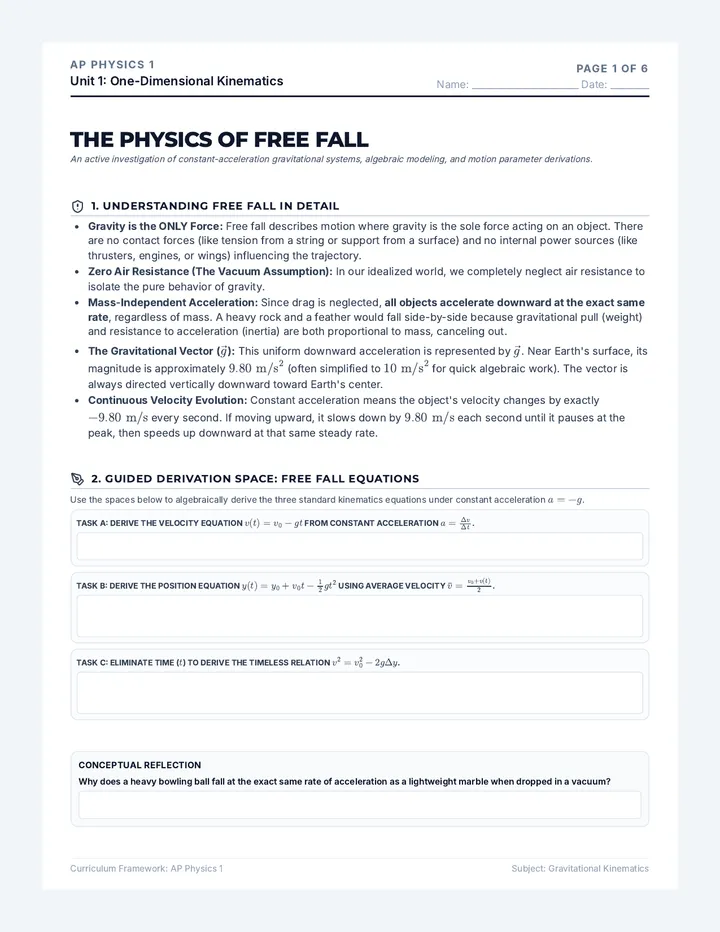
Gravitational Kinematics Reading Packet

AP Kinematics Unit

A comprehensive AP Physics 1 unit on one-dimensional and two-dimensional kinematics, covering free fall vertical motion, horizontal projectile pathways, experimental lab designs, and graphical signature analysis.

CM

Chuguna Murugesan

6
Motion Dual Reading Pack

Physics of Motion

A comprehensive unit exploring the principles of kinematics, focusing on the relationship between linear and angular motion through readings, analysis, and real-world applications.

CM

Chuguna Murugesan

8
Harmonic Cosmos Slides

Celestial Empires

An exploration of how humanity harnessed the stars and the physics of time to build global networks, mapping the Earth through celestial symmetry and precision engineering.

DB

Danielle Burham

18
Fluid Frontiers Teacher Guide

Planetary Fluids

A comprehensive exploration of fluid dynamics, from laboratory experiments on Earth to the geomorphology of rivers and lakes on other planets and moons in our solar system.

TS

Taryn Sigl

10
Gravity Games Slides

Newtonian Universe

A deep dive into the forces that shape our universe, focusing on Newtonian mechanics, gravity, and orbital dynamics through hands-on activities and visual simulations.

MD

Mara DeCesare

4

Lessons

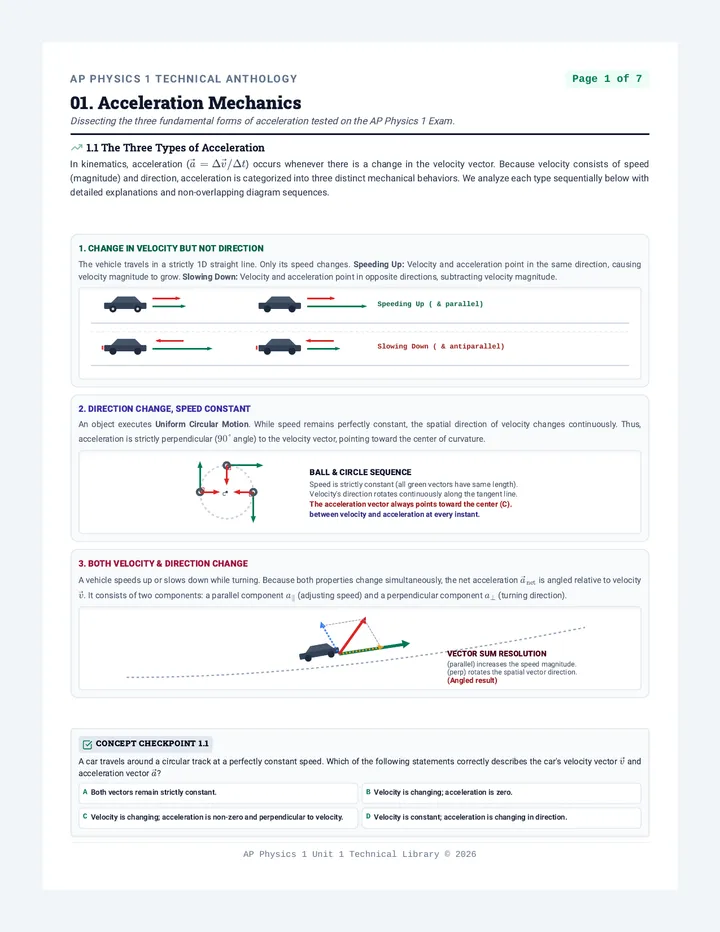
Motion Mechanics Anthology

Motion Mechanics

An AP Physics 1 lesson focusing on the advanced graphical, algebraic, and vector representations of velocity and acceleration. Includes a comprehensive 12-page reading anthology and a matching 12-page student analysis packet.

CM

Chuguna Murugesan

14
Electric Tug Master Lab Sheet

Electric Tug

An inquiry-based lab where students use the PhET Coulomb's Law simulation to discover the relationships between charge, distance, and electrostatic force.

CM

Chuguna Murugesan

29
Spin City Slides

Spin City

This lesson introduces students to the concepts of centripetal and centrifugal forces through visual aids, comparative analysis, and real-world application. Students will learn the physical reality of center-seeking forces versus the apparent sensation of outward force caused by inertia.

TL

Tricia Lucie

6
Spectrometer Secret Lab Notes Article

Magnetic Motion and Torque

A deep dive into the behavior of charged particles in magnetic fields, focusing on the mechanics of mass spectrometry and the rotational dynamics of current-carrying loops. Students will derive key equations for particle paths and analyze the torque that drives electric motors.

CM

Chuguna Murugesan

6
Magnetism Blueprint Article

Currents and Fields

An in-depth exploration of electromagnetism focusing on the relationship between electric currents and magnetic fields, featuring the Biot-Savart Law, Ampere's Law, and the Lorentz Force.

CM

Chuguna Murugesan

20
Galaxy Hunters Worksheet

Cosmic Islands

An astronomy lesson exploring the shapes, compositions, and lifecycles of galaxies. Students classify galactic morphologies using the Hubble system, analyze the architectural structure of the Milky Way, and investigate our Local Group neighborhood.

S

Shelby.Toll

4