Lenny.com
Explore
Create
ActivitiesNewMathEnglish Language ArtsScience & EngineeringSocial StudiesGlobal LanguagesHealth & Physical EducationSpecial EducationCounseling & Life SkillsArts & CreativityESL
Lenny.com
Lenny.com
Explore
Create
ActivitiesNewMathEnglish Language ArtsScience & EngineeringSocial StudiesGlobal LanguagesHealth & Physical EducationSpecial EducationCounseling & Life SkillsArts & CreativityESL
Lenny.com
Lenny.com

Solutions

Lenny for EducatorsLenny for SchoolsLenny for Districts

Product

ExploreSign inCreateSupportAbout

Resources

Getting startedMTSS Acceleration Program

© 2026 Lenny Learning Inc.

TermsPrivacyAccessibility
LinkedInInstagramX
Lenny

Networks and Internet

Data transmission protocols, network topologies, and the architectural components of the global internet. Examines routing, security layers, and the client-server model to explain how information moves across distributed systems.

Science & EngineeringLife ScienceLiving ThingsAnimalsPlantsBody SystemsTraitsAdaptationsCellsEcosystemsHeredityGenes to TraitsCell DivisionPhysicsComparing MaterialsShapes and PropertiesMagnetsMagnetismLightSoundLight and SoundMatterStates of MatterChanges of StateMixturesPhysical and Chemical ChangeHeating and CoolingHeat and Thermal EnergyEnergyForce and MotionElectrical CircuitsAtoms and MoleculesPeriodic TableMotion in One DimensionMotion in Two DimensionsScalars and VectorsForces and Laws of MotionCircular Motion and GravityMomentum and ImpulseWork, Energy, and PowerWavesElectromagnetic WavesGeometric OpticsElectricity and MagnetismSimple Harmonic MotionThermodynamicsNuclear PhysicsEarth Science & AstronomyWeatherWater CycleRocks and MineralsFossilsEarth's FeaturesEarth's ResourcesEarth's StructureWeather and ClimateEarth EventsFossils and Geologic TimePlate TectonicsHuman ImpactsAstronomyChemistryUnits and MeasurementAtomic StructurePeriodic TrendsChemical BondingNomenclatureMolecular StructureIntermolecular ForcesThe MoleStoichiometryProperties of GasesSolutionsChemical ReactionsBalancing EquationsEnergy ChangesRates of ReactionsEquilibriumAcids and BasesQuantum ModelBiologyClassificationCell StructureThe Chemistry of LifeBiomoleculesCellular TransportCell EnergyCell Growth and DivisionDNAProtein SynthesisMeiosis and Sexual ReproductionPatterns of InheritanceMulticellular OrganismsEvolutionEcologyBiodiversityComputer ScienceAlgorithms and Computational ThinkingProgramming LanguagesComputing SystemsNetworks and InternetData AnalysisCybersecurityAI and Machine LearningSoftware Design and DevelopmentBlockchainEngineering & AIDesigning ExperimentsEngineering PracticesDesign ThinkingEngineering Design ProcessMechanical EngineeringElectrical EngineeringMaterials and StructuresCAD and 3D DesignRoboticsArtificial Intelligence BasicsVibe CodingMachine LearningAI Ethics and SocietySystems ThinkingEntrepreneurship & InnovationEntrepreneurial MindsetBusiness Idea DevelopmentBusiness Plan BasicsMarketing & Customer DiscoveryFinancial Management for Startups

Videos

How GPS Works and Why We Need It

How GPS Works and Why We Need It

This educational video provides a clear and engaging explanation of the Global Positioning System (GPS), tracing its evolution from a military tool to an essential part of daily civilian life. The video begins by contrasting modern digital navigation with the traditional use of paper maps, highlighting the convenience technology has brought to travel. It then dives into the technical mechanics of GPS, explaining how a network of satellites orbiting Earth communicates with receivers in devices like smartphones to determine precise locations through signal timing.

Next Generation ScienceNext Generation Science

7mins 7s

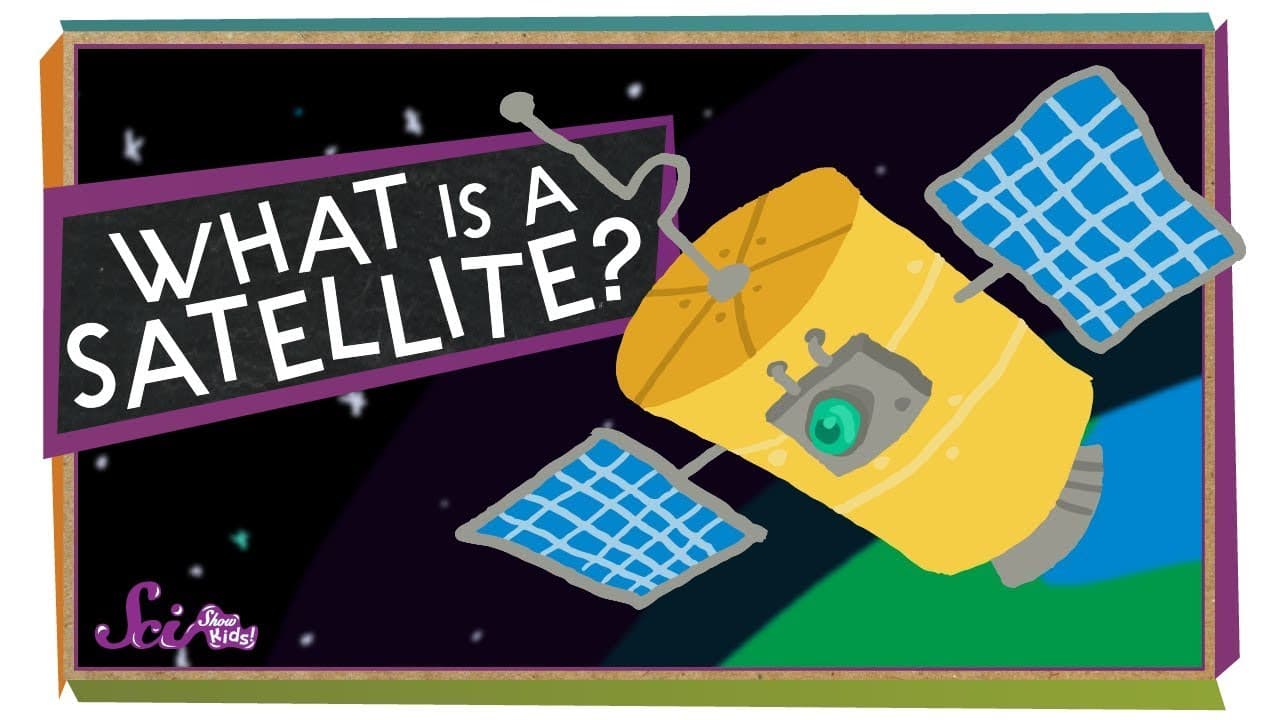
What Are Satellites and What Do They Do?

What Are Satellites and What Do They Do?

Join Jessi and Squeaks the Robot Rat in this engaging introduction to satellites and space exploration. The video begins with a mystery as the duo spots a steady, moving light in the night sky, leading to an investigation into what satellites are and how to identify them. It distinguishes between natural satellites, like the Moon, and the artificial ones launched by humans, explaining their basic construction including computers, solar panels, and scientific instruments. The content explores the history of space flight, introducing Sputnik as the first human-made satellite launched in 1957, and contrasts it with the thousands of satellites orbiting today. It breaks down the critical jobs these machines perform, from monitoring Earth's climate and tracking weather patterns to enabling GPS navigation and global communication. The video makes complex technology relatable by showing how students use satellite tech in their daily lives through phones and television. Finally, the video tours the largest artificial satellite in existence: the International Space Station (ISS). Students get a glimpse into astronaut life, learning that people live and conduct experiments in space for months at a time. This resource is excellent for elementary science units on space, technology, or Earth systems, helping students understand the connection between what they see in the sky and the technology they use on the ground.
SciShow KidsSciShow Kids

3mins 37s

Materials

Coding Pioneers Worksheet

Coding Pioneers Worksheet

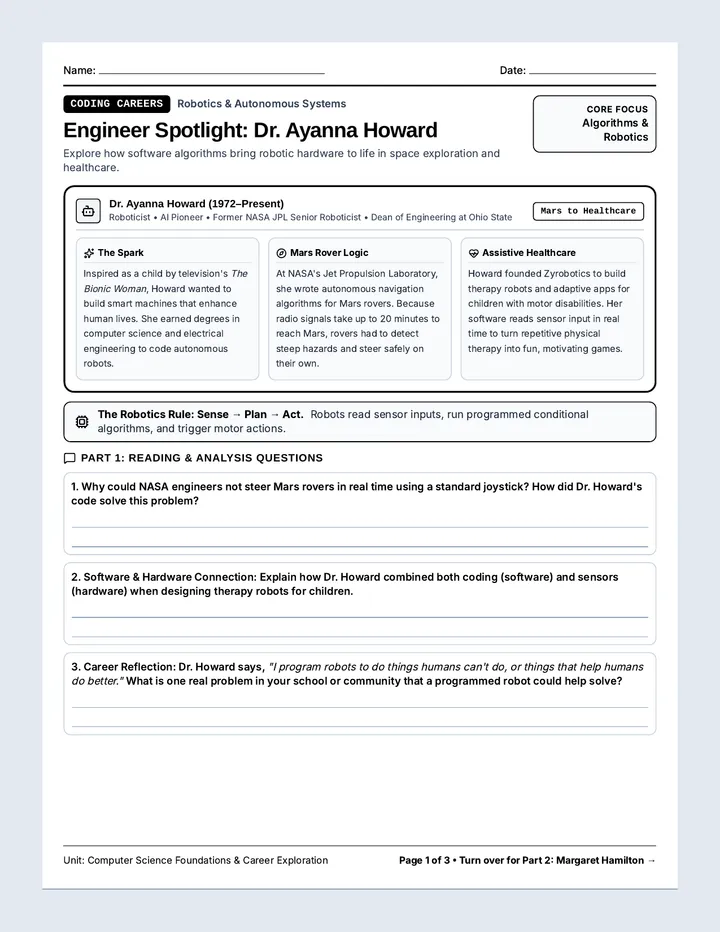
A printer-friendly black-and-white edition of the three-page computer science packet featuring Dr. Ayanna Howard (Page 1), Margaret Hamilton (Page 2), and an independent digital research lab (Page 3), optimized for crisp monochrome photocopying and minimal toner use.

M

Megan.Tanner

Cyber Frontiers Slides

Cyber Frontiers Slides

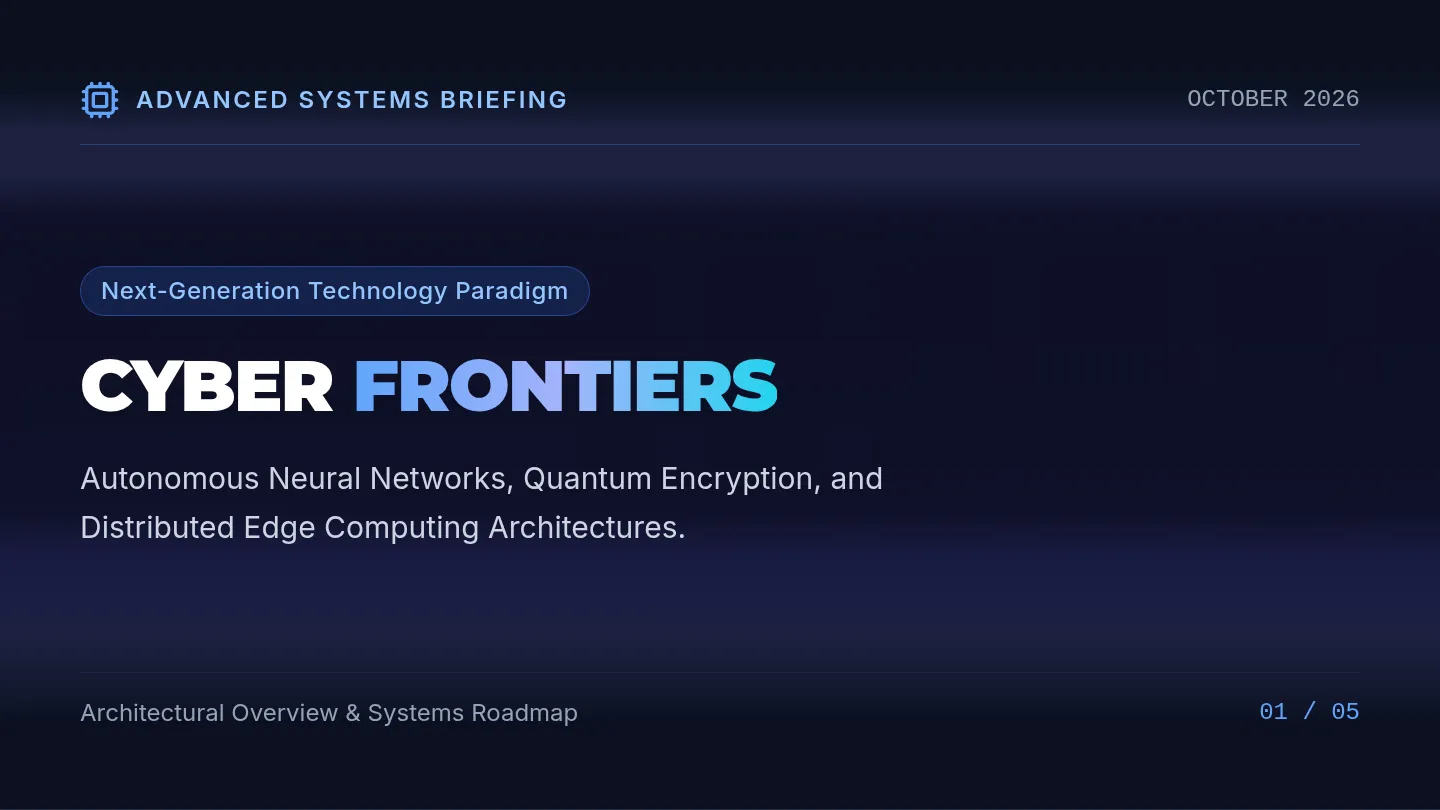
A sleek 5-slide dark presentation deck built around the blue light bar visual aesthetic, exploring modern cyber architecture, neural systems, and quantum data frontiers.

N

Nicole

Network Basics Form Guide

Network Basics Form Guide

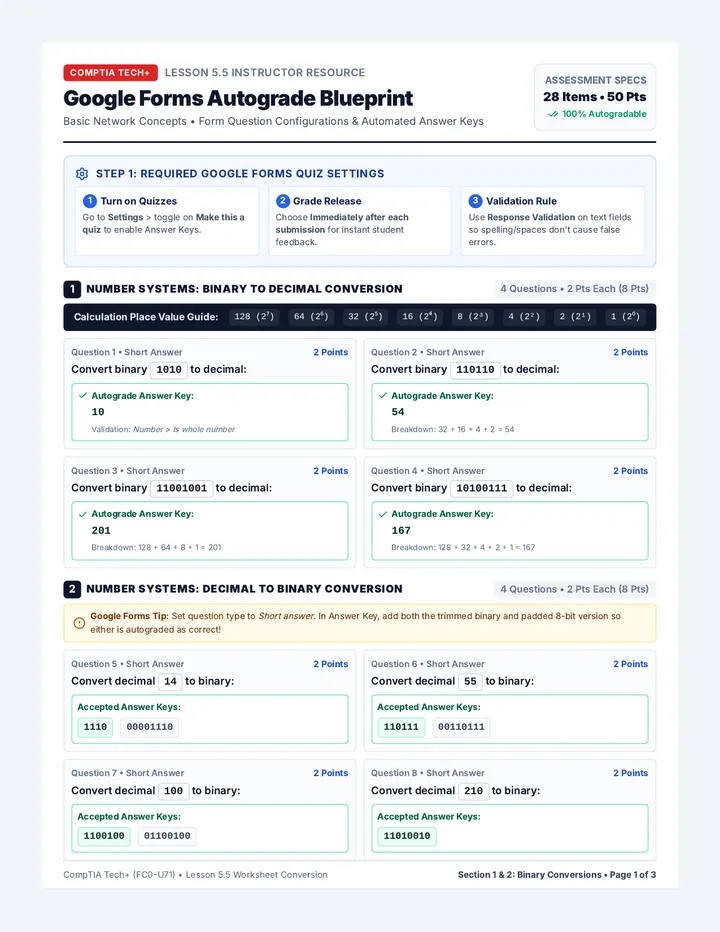
A comprehensive Google Forms conversion and autograding teacher guide for CompTIA Tech+ Lesson 5.5: Basic Network Concepts. Includes exact question configurations, validated answer keys, point distributions, and form optimization settings.

AG

Armand Gonzalez

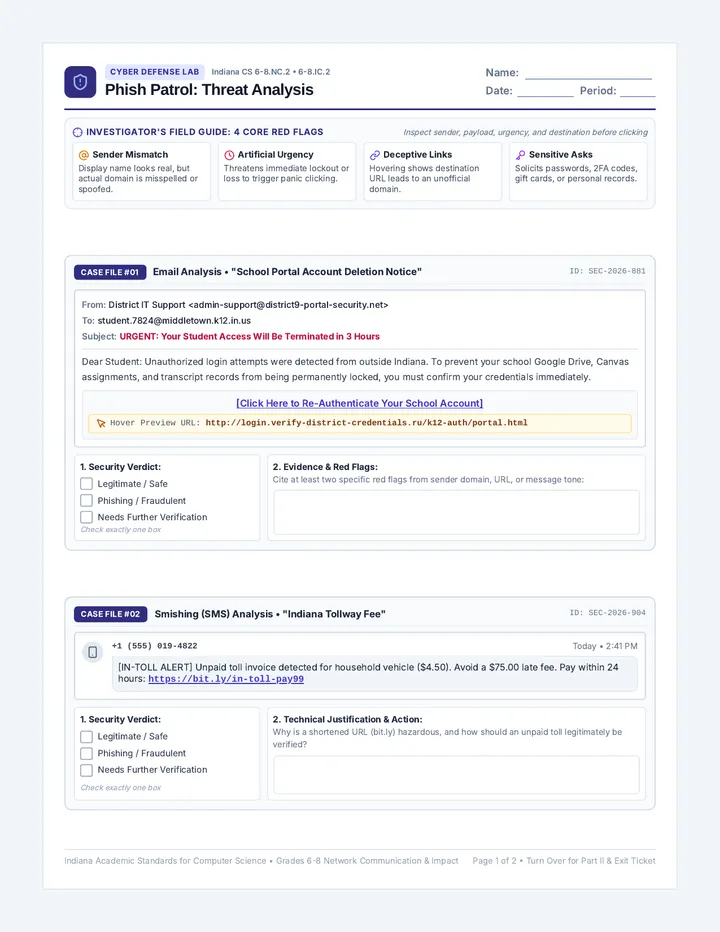
Phish Patrol Worksheet

Phish Patrol Worksheet

An 8th grade cybersecurity worksheet aligned with Indiana CS standards where students analyze realistic email, SMS, and direct message scenarios to detect phishing indicators and justify their security verdicts. Includes deep analysis questions and a debrief exit ticket.

NG

Nadine Gilkison

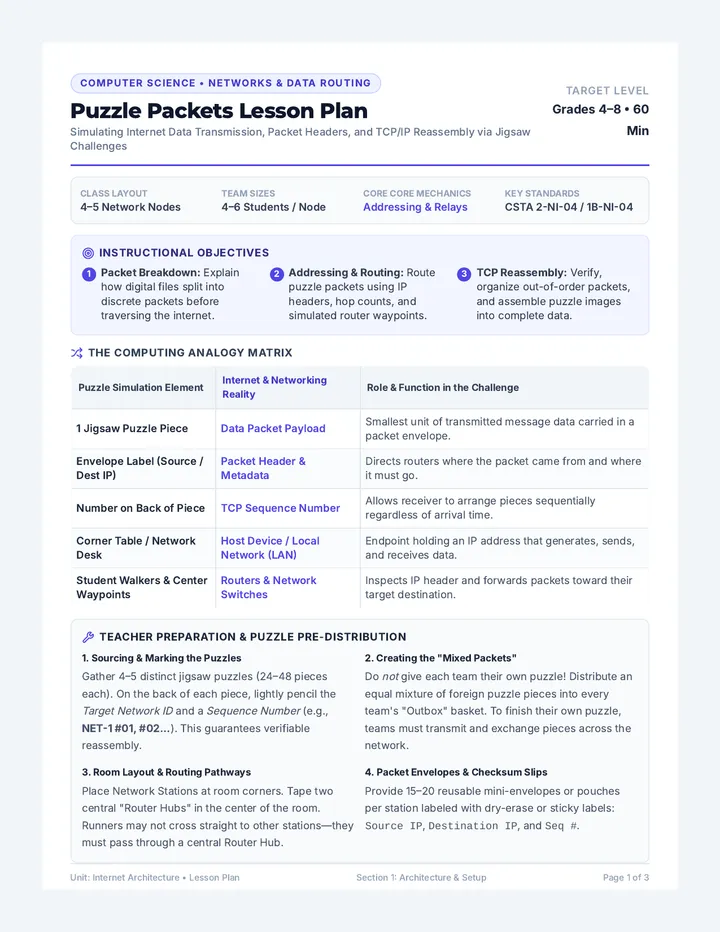
Puzzle Packets Lesson Plan

Puzzle Packets Lesson Plan

A comprehensive educator lesson plan adapting internet packet routing and reassembly into an active jigsaw puzzle relay simulation. Includes step-by-step room topology setup, packet header protocols, mixed-piece exchange mechanics, and timed network challenge rounds.

D

DANIELLE.RIGSBY

Sequences

Malware Mutiny Lesson Plan

Digital Defense Unit

A multi-part cybersecurity unit focusing on defensive strategies, from identifying malicious threats to mastering network access control and traffic filtering.

KW

Karen Wright

13
Pattern Power Slides

Binary Blitz

A week-long exploration of binary code, patterns, and digital communication designed for 4th-grade students. This sequence covers how patterns form codes for devices, the process of binary image transfer, and how engineers use code to solve problems like image brightness.

MG

Matthew Gaudin

13
Packet Path Slides

Packet Pathfinders

This sequence explores how data is formatted and transmitted across the internet using the TCP/IP model. Students will analyze the lifecycle of a packet, from encapsulation and routing to transport protocols and addressing, concluding with a hands-on packet analysis workshop.

15
Security Architecture Slides

Implementing Network Security and Cryptography

A comprehensive sequence for 12th-grade students exploring network security, cryptography, and the protocols that secure the modern internet. Students progress from foundational security principles to the technical details of public key infrastructure and the HTTPS handshake.

14
Router Relay Teacher Guide

Network Security Protocols and Architecture

This sequence explores how network protocols and architecture form the backbone of internet security, focusing on packet switching, port security, threat mitigation, and encrypted tunneling.

15
Safe Signals Intro Slides

Safe Signals

This sequence explores how data remains secure across public networks. Students move from basic vulnerabilities to complex encryption methods like SSL/TLS and firewall configurations to understand digital privacy and integrity.

15