A series of high school science lessons exploring the physics of waves and their biological impacts on human health, using real-world professional contexts.
Una secuencia didáctica sobre el desarrollo web interactivo, enfocada en la captura de eventos del teclado mediante JavaScript para crear experiencias de usuario dinámicas y juegos sencillos.
A series of high-level assessments for Grade 11 Biology focusing on the body's homeostatic mechanisms and organ systems.
A two-day unit exploring the carbon cycle's movement through diverse ecosystems, focusing on how carbon storage and release impact global stability. Students examine oceans, rainforests, tundra, and local environments to understand ecological balance.
A two-week environmental science review sequence focusing on key takeaways: climate change, pollution, renewable energy, and biodiversity. Students compile a 'Field Dossier' review packet as a final course artifact.
A 5-day exploration of environmental science concepts including ecological succession, tolerance levels, the Canadian grasslands biome, and human demographic impacts. Designed for a small-contained 9th/10th grade setting with high levels of scaffolding and modified reading materials.
A high-intensity review sequence designed to move students from 'not met' to 'mastery' in Biology through vocabulary immersion and STAAR-style practice.
A high-impact Biology STAAR preparation series utilizing AVID WICOR strategies. This sequence focuses on core reporting categories to ensure students are prepared for the Texas state assessment through collaborative and inquiry-based learning.
A comprehensive technology applications sequence covering Internet Safety & Ethics, Computer Hardware, and Spreadsheet Data Management. Designed for middle or high school students to build foundational digital literacy and technical skills.
A five-day high school chemistry unit exploring thermochemistry, collision theory, enthalpy diagrams, and calorimetry through the lens of body heat and chemical reactions. Students investigate the anchoring phenomenon of exercise-induced heat while mastering TEKS C.13 standards.
A 5-day intensive exploration of magnetic forces and fields, focusing on atomic-level causes, field interactions, and mathematical modeling of forces on charged particles. Students progress from anchoring phenomena to complex mathematical applications and a comprehensive unit review.
A 4-lesson sequence designed to help high school chemistry students master Coulomb's Law through qualitative reasoning, mathematical practice, and application to atomic structure. The sequence aligns with Iowa High School Chemistry standards and OpenSciEd's inquiry-based approach.
A comprehensive unit on genetics and heredity, focusing on the mechanisms of trait inheritance, molecular genetics, and biotechnology applications.
In this project-based unit, students become lead geneticists in a top-secret laboratory. They will master alleles, inheritance patterns, and Punnett squares to design a unique monster and predict the genetic outcomes of its future offspring, culminating in a professional scientific presentation.
A comprehensive review of electrical circuits, covering Ohm's Law, Kirchhoff's Rules, and circuit analysis techniques through visual guides and structured problem-solving.
A comprehensive K-12 AI literacy sequence covering the fundamentals of how AI works, machine learning, ethics, social impact, and creative application through age-appropriate lessons.
A comprehensive set of materials exploring the historical development of atomic theory from ancient Greece to the modern quantum model, provided in a bilingual format to support English and Spanish speaking learners.
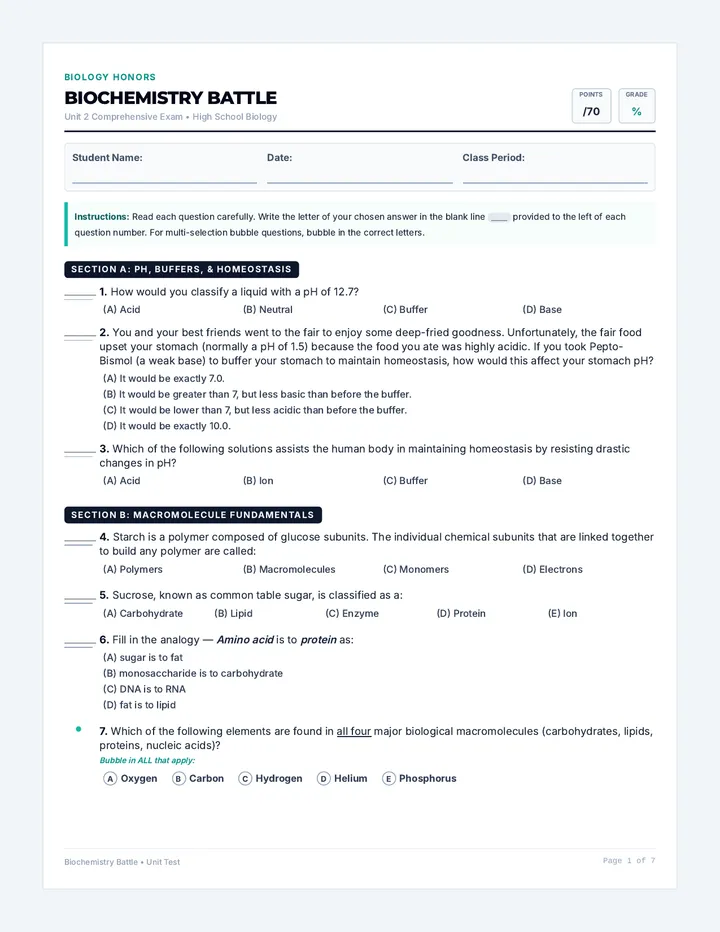
A biology unit covering the chemical foundations of life (macromolecules) and the physiological balance of complex organisms (homeostasis).
A deep dive into the evolutionary transition from aquatic life to terrestrial mammals, focusing on homologous structures and divergent evolution.
Une séquence pédagogique de 2 heures pour les élèves de 1ère Bac Pro sur le concept de couple de forces, illustrée par des applications concrètes sur un tracteur agricole (moteur, serrage de roues, relevage).
A comprehensive 12-period vocational sequence focused on the assembly and theory of Drain, Waste, and Vent (DWV) systems. Students transition from safety and material identification to a collaborative full-scale plumbing mockup using PVC and cast iron materials.