Plural Power Slides Lesson 1 • Grade 3 Grammar
Lesson 1 • Slide 1 of 6
Lesson 1
Plural Nouns with -s and -es
A plural noun names more than one person, place, or thing. Learn the rule to choose the right ending every time!
-s
Add -s to MOST nouns
cup → cups | coin → coins
-es
Add -es to -s, -sh, -ch, -x
bus → buses | box → boxes
Lesson 1 • I Do (Teacher Model)
Lesson 1 • Slide 2 of 6
Let's Fix the Singular Noun
Look for the clue word and check the base word ending.
Original Sentence:
“Evan stared at the three equation on the page.”
1. Clue Word
The number word “three” tells us we need a plural noun.
2. Check Ending
The base noun is equation . It ends in -n (not s, sh, ch, x).
3. Add -s
Just add -s :
Correct: “Evan stared at the three equations on the page.”
Lesson 1 • We Do (Together)
Lesson 1 • Slide 3 of 6
What Happens to Words Ending in -x?
Let's solve this math riddle sentence as a team!
Help Fix This Sentence:
“How many six are in thirty-six?”
Ask the Question:
What letter does the word six end with?
It ends with -x!
Remember the Rule:
When a noun ends in -s, -sh, -ch, or -x , we MUST add -es !
six + es = sixes
Complete Sentence: “How many sixes are in thirty-six?”
Lesson 1 • You Do (Turn & Talk)
Lesson 1 • Slide 4 of 6
Test Your Plural Power!
Look at the bold word. Will you add -s or -es ? Tell your partner why!
Challenge 1
“All of the school bus were lined up in the parking lot.”
Ends in -s → Add -es
→ school buses
Challenge 2
“He needed to make two extra buck by Sunday evening.”
Ends in -k → Add -s
→ extra bucks
Partner Check: Did you hear the extra syllable in buses ?
Great job! ★
Lesson 1 • More Examples
Lesson 1 • Slide 5 of 6
Explore the 4 “-es” Endings
Whenever you hear the hissing or buzzing sound, add -es !
-s
glass
glasses
“Fill four glasses with ice!”
-sh
dish
dishes
“Wash the sticky dishes.”
-ch
bench
benches
“The park benches were full.”
-x
box
boxes
“Stack two lemon boxes.”
Pronunciation Tip: The ending -es sounds like “ez” and gives the word an extra beat!
Lesson 1 • Quick Review
Lesson 1 • Slide 6 of 6
Before You Begin Independent Practice
Keep this checklist in your mind as you work on your worksheet.
+s
Most Nouns
dollar → dollars
lemon → lemons
sign → signs
+es
Ends in -s, -sh, -ch, -x
bus → buses (-s)
dish → dishes (-sh)
bench → benches (-ch) | six → sixes (-x)
Grab your pencil! Time for the Lesson 1 Worksheet!
Let's Go! →
Plural Power Practice Worksheet Name:
Date:
Score: / 10
Lesson 1
Lesson 1: Plural Nouns with -s and -es
Forming plural nouns that mean more than one
Lesson 1 • Grade 3
+s
Add -s to most nouns:
lemon → lemons | coin → coins
+es
Add -es if the word ends in:
-s, -sh, -ch, or -x
1 Part 1: Make It Plural
Add -s or -es to write each plural word.
1. cup (-p)
→
2. bus (-s)
→
3. dish (-sh)
→
4. buck (-k)
→
5. bench (-ch)
→
6. box (-x)
→
2 Part 2: Circle the Correct Plural Noun
Read each Lemonade War sentence carefully.
Evan solved all four math [ equations ] [ equationes ] before lunch.
How many [ sixs ] [ sixes ] are in thirty-six?
The park [ benches ] [ benchs ] were filled with thirsty customers.
3 Part 3: Daily Write & Circle
Write 2 sentences and circle the plural noun in each.
Sentence A: Write a sentence with a plural noun ending in -s (e.g., cups, books, dollars)
Sentence B: Write a sentence with a plural noun ending in -es (e.g., buses, dishes, boxes)
Self-Check: Did you circle your plural nouns in Part 3?
Yes! Need help
Action All-Stars Slides Lesson 2 • Grade 3 Grammar
Lesson 2 • Slide 1 of 6
Lesson 2
Action Verbs & Compound Predicates
Every complete sentence has two main parts: a subject (who/what) and a predicate (what they do or are).
Action Verb
The main word in the predicate showing what someone or something does.
Compound Predicate
Two or more actions joined together by “and” or “or”.
Lesson 2 • I Do (Teacher Model)
Lesson 2 • Slide 2 of 6
Finding the Action Verb
Watch how I split the sentence into subject and predicate.
Mentor Sentence:
“An idea popped into Evan’s head.”
Step 1: Find the Subject
Ask: Who or what is the sentence about?
The subject is “An idea”
Step 2: Find the Action
Ask: What did the idea DO?
Action verb: “popped”
The action verb “popped” is the engine of the predicate!
Lesson 2 • We Do (Double Action!)
Lesson 2 • Slide 3 of 6
Compound Predicate: Two Actions!
Sometimes one subject performs two or more actions joined by “and” .
Mentor Sentence:
“Evan surveyed the scene and picked his spot.”
Action #1
“surveyed the scene”
Verb: surveyed (he looked around carefully)
Action #2
“picked his spot”
Verb: picked (he chose his location)
Joined by “and” = A Compound Predicate!
Lesson 2 • You Do (Turn & Talk)
Lesson 2 • Slide 4 of 6
Be an Action Verb Detective!
Read this sentence with your partner and answer both questions.
Read Carefully:
“First, he wheeled his wagon off to the side.”
Question 1: Subject
Who did the action?
→ “he” (Evan)
Question 2: Action Verb
What did he do?
→ “wheeled”
Discuss: Can you act out the verb “wheeled” with your hands?
Action in motion! ★
Lesson 2 • More Examples
Lesson 2 • Slide 5 of 6
Single Action vs. Compound Predicate
How many action verbs can you find in each sentence?
Action All-Stars Practice Worksheet Name:
Date:
Score: / 10
Lesson 2
Lesson 2: Action Verbs & Predicates
Finding the action in sentences from The Lemonade War
Lesson 2 • Grade 3
Action Verb:
Tells what the subject does (e.g., ran, popped, looked).
Compound Predicate:
Two actions joined by “and” (e.g., surveyed and picked).
1 Part 1: Action Verb Hunt
Read each sentence. Circle the one action verb.
1. An idea popped into Evan’s head.
Action:
2. First, he wheeled his wagon off to the side.
Action:
3. He looked at the tubs of ice cream.
Action:
4. Jessie stirred the pitcher of cold lemonade.
Action:
2 Part 2: Double Action Detective
Find and write the TWO action verbs joined by “and”.
5. Evan surveyed the scene and picked his spot.
First Action: + and + Second Action:
6. Then he crossed the street and walked into the Big Dipper.
First Action: + and + Second Action:
3 Part 3: Daily Write Challenge
Write 1 complete sentence. Circle the verb & underline the subject!
Directions: Write a sentence about Evan or Jessie selling lemonade.
Example: Evan shouted to the crowd.
Did you underline the subject? Did you circle the action verb?
Grammar Star Check: I can identify action verbs and compound predicates!
Mastered Practicing
Verb Detectives Slides Lesson 3 • Grade 3 Grammar
Lesson 3 • Slide 1 of 6
Lesson 3
Action Verbs & Being Verbs
Not every verb shows movement! Some verbs tell what the subject does, while others tell what the subject is or was.
Action Verb
Shows what someone or something does (e.g., looked, poured, ran).
Being Verb
Shows what someone or something is or was: am, is, are, was, were.
Lesson 3 • I Do (Teacher Model)
Lesson 3 • Slide 2 of 6
Spotting a Being Verb
Watch how I identify what tells what the subject is or was.
Mentor Sentence:
“The five-dollar bill was enough to buy a bag of candy.”
1. Identify the Subject
Who or what is this sentence about?
Subject: “The five-dollar bill”
2. Action or State of Being?
Does the five-dollar bill do an action? No!
Being Verb: “was” (it tells what it was!)
The word “was” does not show action—it links the subject to a description!
Lesson 3 • We Do (Together)
Lesson 3 • Slide 3 of 6
Action Verb or Being Verb?
Let's analyze Officer Ken's sentence together as a team.
Mentor Sentence:
“Officer Ken looked right at Evan for ten very stern seconds.”
Check the Action
Can someone “look”?
Yes! Looking is something someone can physically do with their eyes.
The Verdict
Action Verb!
“looked” tells what Officer Ken did.
Because Officer Ken performed an action, “looked” is an action verb!
Lesson 3 • You Do (Turn & Talk)
Lesson 3 • Slide 4 of 6
Your Turn to Decide!
Read the sentence below with your partner. Is the bold word action or being?
Partner Challenge:
“Jessie and Megan were sure that everyone would buy a cup of lemonade.”
Question: Can you “were”?
Can you act out “were”? No! It shows a state of being.
Answer:
“were” is a BEING VERB!
Partner Check: How did you know “were” is on the Being Verb team?
Awesome! ★
Lesson 3 • More Examples
Lesson 3 • Slide 5 of 6
Comparing Mentor Sentences
Verb Detectives Practice Worksheet Name:
Date:
Score: / 10
Lesson 3
Lesson 3: Action Verbs & Being Verbs
Deciding what the subject does vs. what the subject is or was
Lesson 3 • Grade 3
Action Verb:
Shows what someone does (e.g., looked, shrugged, sold).
Being Verb (am, is, are, was, were):
Tells what someone is or was (no physical movement).
1 Part 1: Quick Verb Sort
Circle whether each verb is Action or Being.
1. was
[ Action ] [ Being ]
2. shrugged
[ Action ] [ Being ]
3. were
[ Action ] [ Being ]
4. looked
[ Action ] [ Being ]
2 Part 2: Sentence Detective
Read each Lemonade War sentence. Label the bold verb!
5. The five-dollar bill was enough to buy a bag of candy.
Type:
6. Officer Ken looked right at Evan for ten stern seconds.
Type:
7. Jessie and Megan were sure everyone would buy lemonade.
Type:
8. It is impossible to sell that much lemonade in one day.
Type:
3 Part 3: Daily Write Challenge
Write 1 sentence with a being verb and circle it!
Directions: Use one being verb: am, is, are, was, were.
Example: The lemonade was ice cold.
Does your sentence describe the subject without showing movement? Did you circle your being verb?
Grammar Star Check: I can tell the difference between action verbs and being verbs!
Mastered Practicing
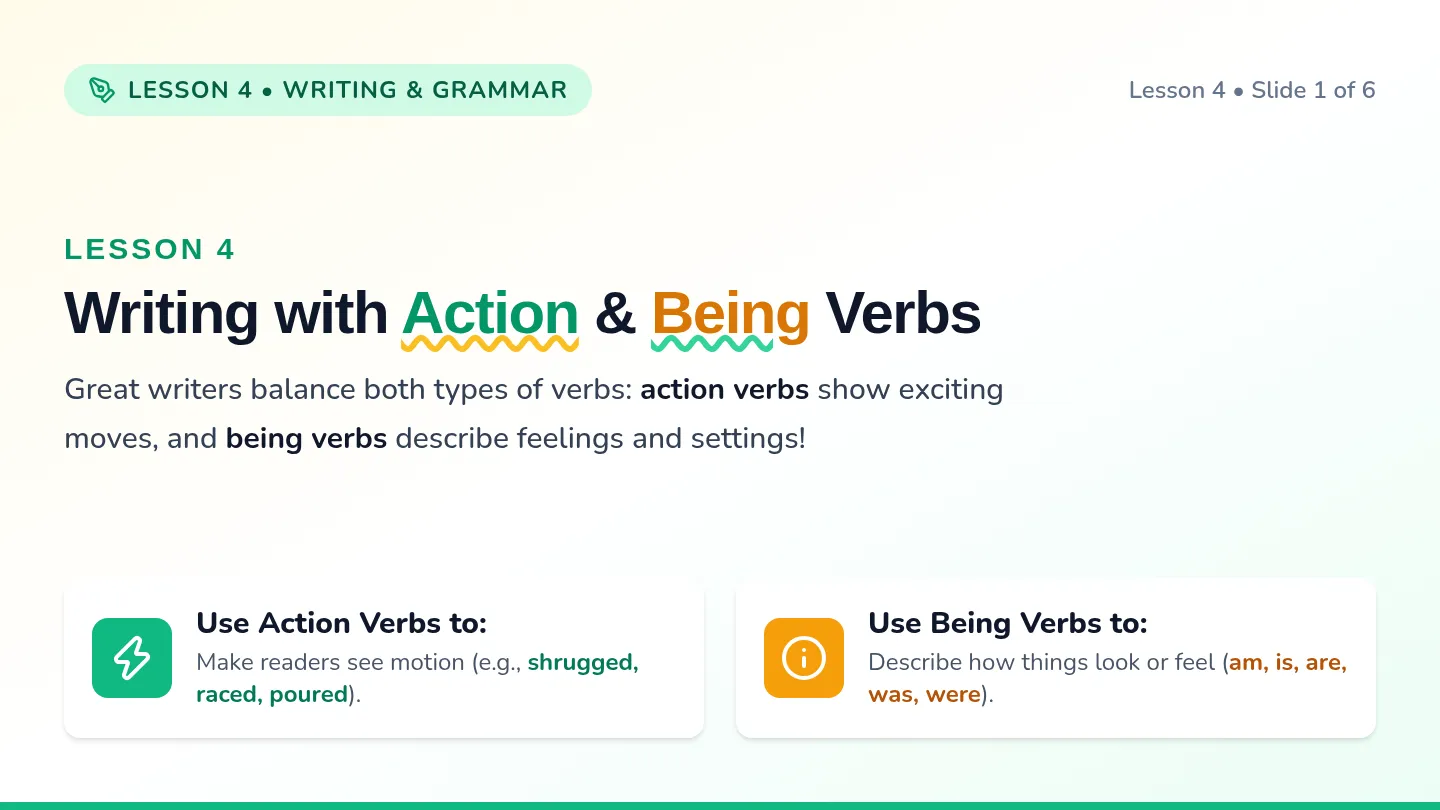
Verb Writers Slides Lesson 4 • Writing & Grammar
Lesson 4 • Slide 1 of 6
Lesson 4
Writing with Action & Being Verbs
Great writers balance both types of verbs: action verbs show exciting moves, and being verbs describe feelings and settings!
Use Action Verbs to:
Make readers see motion (e.g., shrugged, raced, poured).
Use Being Verbs to:
Describe how things look or feel (am, is, are, was, were).
Lesson 4 • I Do (Teacher Model)
Lesson 4 • Slide 2 of 6
Analyzing Author Choices
Notice how the author uses a being verb to establish the value of money.
Mentor Sentence:
“The five-dollar bill was enough to buy a bag of candy.”
Why use “was”?
The bill cannot jump or run! It needs a being verb to describe that the amount was sufficient.
Next Action Step:
In the very next sentence, a character can do an action :“Evan grabbed the bag!”
Authors combine being verbs (facts/feelings) with action verbs (events) to tell strong stories!
Lesson 4 • We Do (Together)
Lesson 4 • Slide 3 of 6
Pairing Action with Feeling
Let's look at how two sentences work together in The Lemonade War.
Action Sentence
“Officer Ken looked right at Evan for ten stern seconds.”
→ Shows the suspenseful action!
Being Sentence
“Evan was nervous about his lemonade stand.”
→ Explains Evan's state of mind!
Notice how the story needs both kinds of verbs to feel real!
Lesson 4 • You Do (Turn & Talk)
Lesson 4 • Slide 4 of 6
Which Verb Fits Best?
Help Jessie write her sentence! Choose an action verb or being verb.
Choice 1: Description
“Jessie and Megan [ were / danced ] sure of their plan.”
→ Being Verb: “were”
Describes their confidence!
Choice 2: Movement
“Evan [ was / shrugged ] his shoulders in defeat.”
→ Action Verb: “shrugged”
Shows his physical motion!
Partner Check: Can you shrug your shoulders right now?
Action in motion! ★
Lesson 4 • Writer's Revision
Lesson 4 • Slide 5 of 6
Editing for Verb Power
Check each verb to make sure it matches what the author means.
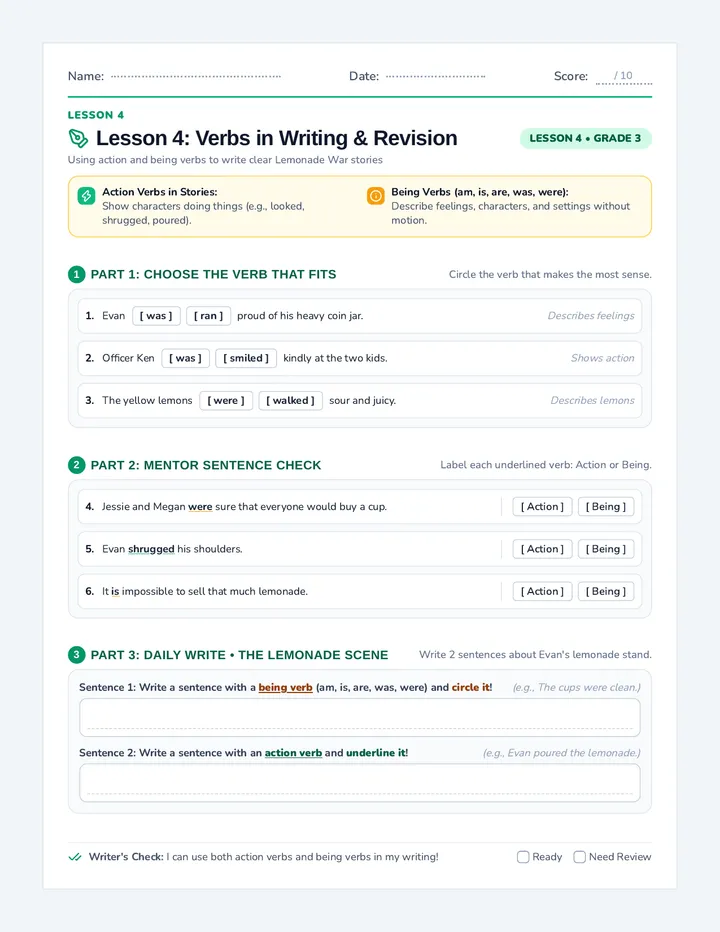
Verb Writers Practice Worksheet Name:
Date:
Score: / 10
Lesson 4
Lesson 4: Verbs in Writing & Revision
Using action and being verbs to write clear Lemonade War stories
Lesson 4 • Grade 3
Action Verbs in Stories:
Show characters doing things (e.g., looked, shrugged, poured).
Being Verbs (am, is, are, was, were):
Describe feelings, characters, and settings without motion.
1 Part 1: Choose the Verb That Fits
Circle the verb that makes the most sense.
1. Evan [ was ] [ ran ] proud of his heavy coin jar.
Describes feelings
2. Officer Ken [ was ] [ smiled ] kindly at the two kids.
Shows action
3. The yellow lemons [ were ] [ walked ] sour and juicy.
Describes lemons
2 Part 2: Mentor Sentence Check
Label each underlined verb: Action or Being.
4. Jessie and Megan were sure that everyone would buy a cup.
[ Action ] [ Being ]
5. Evan shrugged his shoulders.
[ Action ] [ Being ]
6. It is impossible to sell that much lemonade.
[ Action ] [ Being ]
3 Part 3: Daily Write • The Lemonade Scene
Write 2 sentences about Evan's lemonade stand.
Sentence 1: Write a sentence with a being verb (am, is, are, was, were) and circle it! (e.g., The cups were clean.)
Sentence 2: Write a sentence with an action verb and underline it! (e.g., Evan poured the lemonade.)
Writer's Check: I can use both action verbs and being verbs in my writing!
Ready Need Review
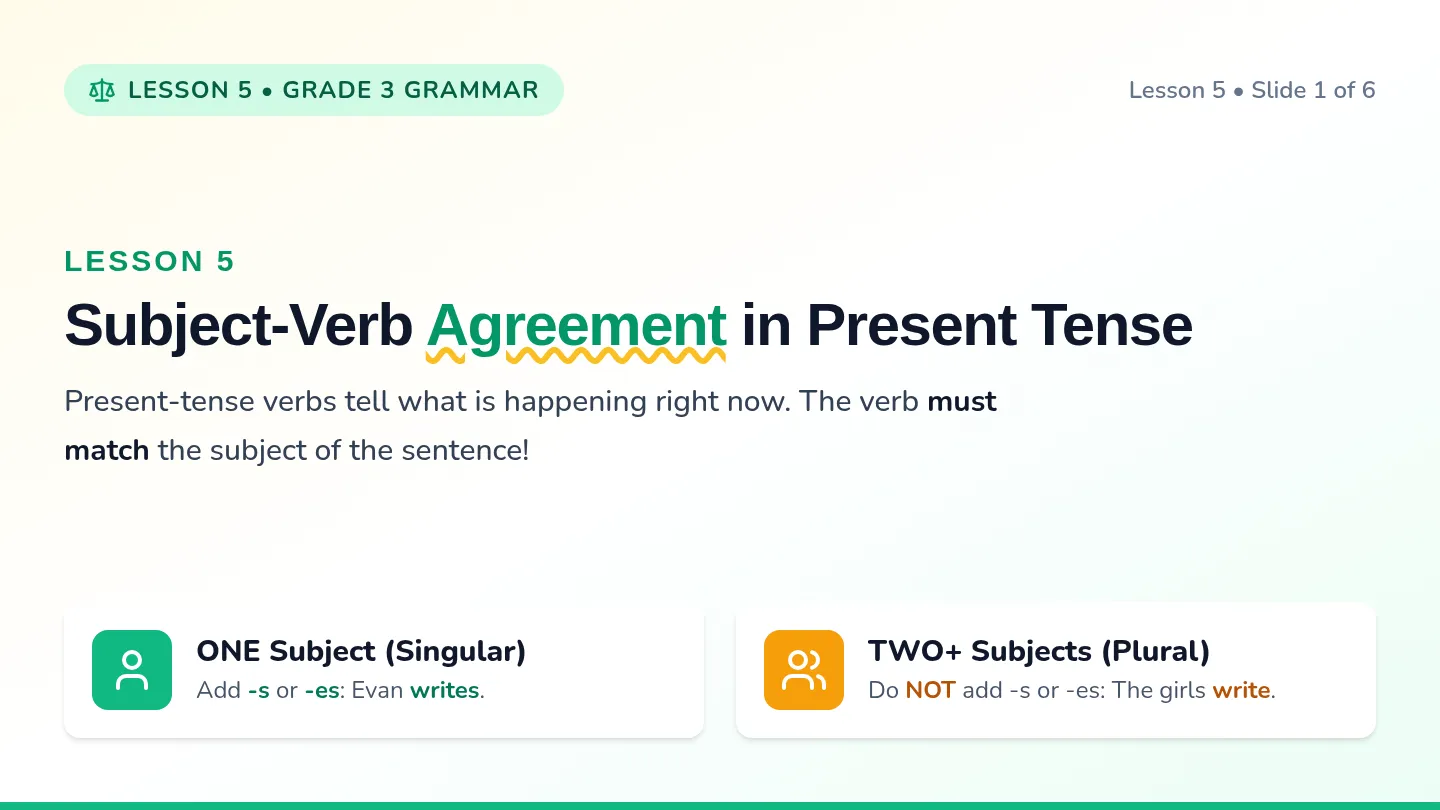
Agreement Champions Slides Lesson 5 • Grade 3 Grammar
Lesson 5 • Slide 1 of 6
Lesson 5
Subject-Verb Agreement in Present Tense
Present-tense verbs tell what is happening right now. The verb must match the subject of the sentence!
ONE Subject (Singular)
Add -s or -es : Evan writes.
TWO+ Subjects (Plural)
Do NOT add -s or -es: The girls write.
Lesson 5 • I Do (Teacher Model)
Lesson 5 • Slide 2 of 6
Singular Subject + Special Y Rule
Watch how I match the verb to one person and apply the spelling rule.
Mentor Sentence:
“Evan [ worry / worries ] that he will lose the competition.”
1. Check Subject
“Evan” is one person (singular).
2. Needs -s / -es
Because the subject is singular, the verb needs an ending.
3. Y to IES Rule
worry ends in consonant + y → change y to i and add -es: worries
Correct: “Evan worries that he will lose the competition.”
Lesson 5 • We Do (Together)
Lesson 5 • Slide 3 of 6
What Happens with Plural Subjects?
Let's solve this Lemonade War sentence together as a team.
Mentor Sentence:
“The girls [ watch / watches ] the customers line up.”
Step 1: The Subject
“The girls”
This is PLURAL (more than one person!).
Step 2: The Agreement Rule
NO -s on the verb!
When the subject is plural, the verb stays in its simple base form: watch .
Complete: “The girls watch the customers line up.”
Lesson 5 • You Do (Turn & Talk)
Lesson 5 • Slide 4 of 6
Make the Subject and Verb Match!
Read the sentence below with your partner. Which verb forms agreement?
Partner Challenge:
“Jessie [ show / shows ] Megan her page of calculations.”
Question 1: Subject
How many people is Jessie? One (Singular)
Question 2: Verb Choice
Add -s → shows!
Partner Check: If the subject changed to “Jessie and Evan”, what would the verb be?
They show! ★
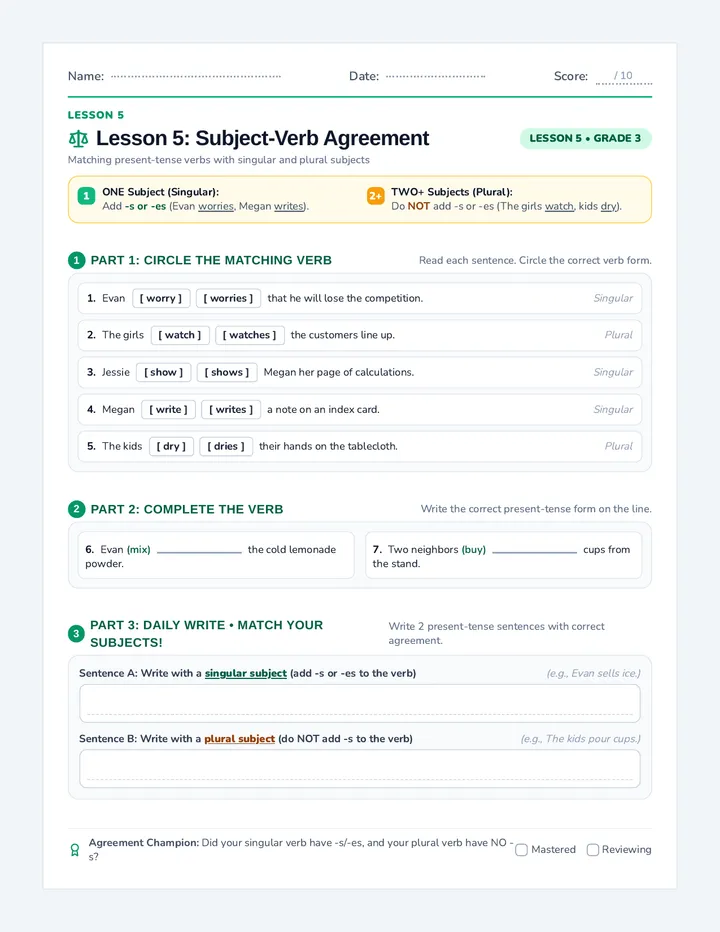
Agreement Champions Practice Worksheet Name:
Date:
Score: / 10
Lesson 5
Lesson 5: Subject-Verb Agreement
Matching present-tense verbs with singular and plural subjects
Lesson 5 • Grade 3
1
ONE Subject (Singular):
Add -s or -es (Evan worries, Megan writes).
2+
TWO+ Subjects (Plural):
Do NOT add -s or -es (The girls watch, kids dry).
1 Part 1: Circle the Matching Verb
Read each sentence. Circle the correct verb form.
1. Evan [ worry ] [ worries ] that he will lose the competition.
Singular
2. The girls [ watch ] [ watches ] the customers line up.
Plural
3. Jessie [ show ] [ shows ] Megan her page of calculations.
Singular
4. Megan [ write ] [ writes ] a note on an index card.
Singular
5. The kids [ dry ] [ dries ] their hands on the tablecloth.
Plural
2 Part 2: Complete the Verb
Write the correct present-tense form on the line.
6. Evan (mix) the cold lemonade powder.
7. Two neighbors (buy) cups from the stand.
3 Part 3: Daily Write • Match Your Subjects!
Write 2 present-tense sentences with correct agreement.
Sentence A: Write with a singular subject (add -s or -es to the verb) (e.g., Evan sells ice.)
Sentence B: Write with a plural subject (do NOT add -s to the verb) (e.g., The kids pour cups.)
Agreement Champion: Did your singular verb have -s/-es, and your plural verb have NO -s?
Mastered Reviewing