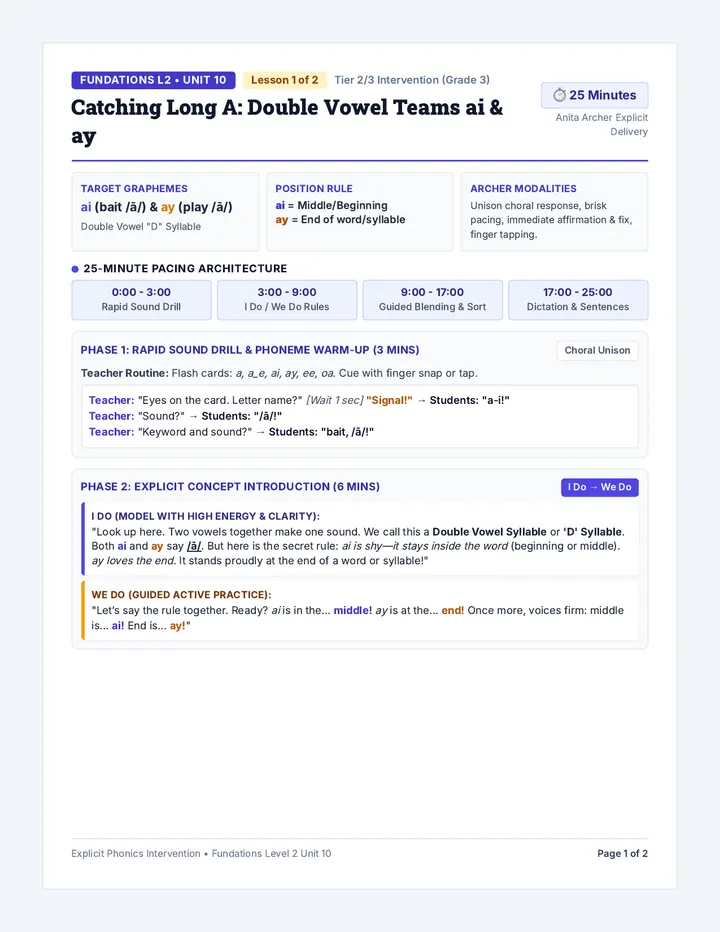
A comprehensive 5-day Grade 6 ELA unit on standard 6.RI.2 covering Component 1 (determining central idea), Component 2 (how ideas are conveyed through particular details), and Component 3 (providing an objective summary without personal opinion or judgment). Features mentor texts on animal teamwork, biomimicry, and search-and-rescue canines.
• Collaborative Paired Text ("We Do") (16 Mins): Read "Nature's Blueprint." Partners analyze kingfisher beak and termite mound details, connecting them to human technology.
• Independent Application ("You Do") (12 Mins): Complete Part 2 and Part 3 of the Conveying Details Analysis Worksheet. Exit debrief on comparative author craft.
Grade 6 ELA • Unit 2 | Central Idea & Conveying Details Teacher Guide Page 1 of 2
Answer Keys & Diagnostic Rationales
Standard 6.RI.2 (Comp 1 & 2)
Teacher Assessment Key & Rubric Reference
Classroom Resource
Check for Understanding (CFU) Worksheet Key (Day 1)
Q1: Correct = B. Animals working together are more successful at surviving. Trap: D is too narrow (hunting only).
Q2: Correct = B. Teamwork allows animals to hunt, stay safe, and care for young. Trap: C is contradicted by paragraph 4 (ants).
Q3: Correct = B and D. (Umbrella statements covering whole text). Traps: A, C, E are single-animal facts.
Q4: Highlight: "Cooperation is not just helpful—it is often the key to survival." (or sentence 1).
Q5 Short Answer Rubric (2 pts): 2 pts = Complete sentence stating animals cooperate in groups to survive/protect/hunt. 1 pt = Topic only without survival purpose. (Exemplar: "Animals rely on teamwork to find food, defend against danger, and survive in the wild.")
Conveying Details Analysis Worksheet Key (Day 2)
Part 1 Organizer (Elephants): Adult circle defends vulnerable young from predators; matriarch's memory locates water during severe drought, keeping the herd alive.
Part 1 Organizer (Ants): Division into workers and soldiers protects colony; scent trails ensure rapid gathering of food resources so entire colony survives.
Q2: Correct = B. Observing animal adaptations provides blueprints to solve modern problems.
Q3: Correct = A. Explaining how Eastgate Centre mimics termite ventilation to cut 90% energy.
Q4 Comparative Synthesis Rubric (2 pts): Both authors use multiple animal species (wolves, elephants, ants; kingfishers, termites, ants/wolves) across paragraphs to prove their claim is widespread rather than a single fluke.
Differentiation & Extension Moves
Support / Multilingual Learners: Use the "Detail vs. Umbrella" sorting frame: "Can this sentence cover an elephant AND an ant? If no, it's a detail." Provide sentence frames for writing responses.
Extension / Challenge: Have students identify an additional animal adaptation (e.g., gecko feet, shark skin) and write a short paragraph modeling how an author would convey a central idea about human technology.
Grade 6 ELA • Unit 2 | Central Idea & Conveying Details Teacher Guide Page 2 of 2
Par. 1 (Introduction):
Central claim about biomimicry:
Par. 2 (Kingfisher Beak):
Human problem this solved:
Par. 3 (Termite Mounds):
How termite architecture cools:
Par. 4 (Ants & Wolves):
How animal cooperation guides tech:
Par. 5 (Conclusion):
How author restates the big idea:
Curriculum Resource • Paired Informational Text: Animal Observations in Human Innovation Grade 6 ELA | 6.RI.2 (Comp 1 & 2)
5. In one sentence, state the central idea of the text in your own words.
Model Student Exemplar:
"Animals of all sizes work together in groups to find food, defend each other, and survive in the wild."
Full Credit (2 pts): Complete sentence containing both the topic (animal teamwork) AND the purpose (survival/defense/hunting across the text).
Partial Credit (1 pt): Mentions animal teamwork without the survival function, or focuses only on a single species. (0 pts if non-responsive)
Teacher Answer Key • Dysart Schools Grade 6 ELA | Unit 2 Standard 6.RI.2 (Component 1)
Teacher Answer Key • Standard 6.RI.2 (Component 2: Conveying Details) Day 2 Practice Evaluation
Key canine personality qualities:
Grade 6 ELA | Unit 2 | Search-and-Rescue Dogs at Work | 6.RI.2 Page 1 of 2
Grade 6 ELA • Unit 2 (Continued)
Search-and-Rescue Dogs at Work
[7]
The handler must train, too. Handlers learn how to read their dogs’ behavior. A change in the dog’s movement, posture, or barking can signal that the dog has found something important. The handler must also know when the dog needs rest, water, or medical attention.
[8]
Search-and-rescue dogs have helped at many disaster sites, including the attacks of September 11, 2001. After those attacks, researchers studied the health of dogs that worked at the World Trade Center, the Pentagon, and other related search sites. A University of Pennsylvania study followed search-and-rescue dogs over many years and found little difference in life span or cause of death between dogs deployed after 9/11 and a comparison group of search-and-rescue dogs that were not deployed there.
[9]
Researchers did not take this result to mean that disaster work is easy or risk-free. Search-and-rescue dogs can face fatigue, dehydration, cuts/abrasions, respiratory problems, and heat exhaustion. FEMA standards also recognize that a dog's working time must be adjusted for the environment, terrain, and other conditions. Their safety depends on careful handlers, medical support, rest breaks, and continued research into how working dogs respond to difficult conditions.
[10]
Search-and-rescue dogs are valuable because they can do work that machines and people cannot do in exactly the same way. Their noses, training, courage, and partnership with handlers allow them to search dangerous places with speed and focus.
[11]
Still, a search dog is not just a tool. It is a living animal that depends on people for care. When communities rely on these dogs during emergencies, they also have a responsibility to protect them. Keeping search-and-rescue dogs healthy helps them continue doing the work they are trained to do: finding people when every minute matters.
Annotations & Notes
Handler Role (Par. 7):
How handlers read behavior & monitor health:
Health & Risks (Pars. 8–9):
What did researchers and FEMA learn about canine safety?
Ending (Pars. 10–11):
Why dogs are irreplaceable and our responsibility to protect them:
Source Note: This passage was written as an original classroom text using information from FEMA’s public information about urban search-and-rescue canine teams and University of Pennsylvania reporting on long-term research about 9/11 search-and-rescue dogs.
Grade 6 ELA | Unit 2 | Search-and-Rescue Dogs at Work | 6.RI.2 Page 2 of 2
✗
Opinion / Judgment (Cut)
"It was terrible that the dogs had to breathe in dirty dust, and I felt so sad reading about it."
Watch for "Signal Words": Words like heroic, sad, wonderful, unfair, best, and terrible are judgments, not facts!
Formula for Success
Topic Sentence: Name It + Verb It + Central Idea
Step 1
Name It
State the exact title and text format or author.
"In the informational article 'Search-and-Rescue Dogs at Work'..."
Step 2
Verb It
Pick a powerful, objective academic action verb.
...explains / explores / describes / examines...
Step 3
Central Idea
State the author's primary focus across the whole text.
"...how trained canine teams partner with handlers to locate victims."
Combined Exemplar Topic Sentence:
"In the article 'Search-and-Rescue Dogs at Work,' the author explains how specialized canine search teams use extensive training and keen senses to find disaster victims while depending on humans for protection."
Structuring the Body
Tracking Evidence Across the Text
Beginning (Pars. 1–2)
The Problem & Team
Disasters leave victims trapped in dangerous rubble. Dogs and human handlers work in coordinated teams to search large areas with speed.
Transition:
"To begin with..."
Middle (Pars. 3–7)
Rigorous Training
Canines need curiosity and energy. They train through play rewards to navigate rubble, ignore loud noises, and signal their handlers when scent is found.
Transition:
"Furthermore..."
End (Pars. 8–11)
Health & Protection
Disaster deployment carries risks of injury and fatigue. FEMA standards and human care ensure these working animals receive rest and medical support.
Transition:
"Finally..."
Rule of Thumb: A balanced summary captures 1 key paraphrased point from each major section.
Teacher Model • "I Do"
Examining a Complete Objective Summary
Topic Sentence: In the article "Search-and-Rescue Dogs at Work," the author describes how trained canines partner with human handlers to locate disaster victims quickly.
Paraphrased Evidence: To begin with, emergency responders rely on dogs' keen sense of smell and agility to search dangerous debris where humans cannot reach. In addition, successful search dogs undergo extensive reward-based training to ignore confusing disaster noise, while handlers learn to interpret their dogs' signals. Finally, while research shows working dogs can survive deployments safely, handlers and communities must protect them from fatigue, heat, and physical injuries.
Concluding Sentence: Ultimately, search-and-rescue dogs are invaluable partners whose lifesaving abilities depend on proper human care and support.
✓ No Opinions ✓ No Quotes ✓ Third Person ✓ All 3 Sections Covered 100% Objective!
Self & Peer Evaluation
The 9-Point Quality Checklist
Structure & Content
1 Name it + Verb it + Central Idea topic sentence
2 Paraphrased evidence (beginning, middle, end)
3 Strong concluding sentence to wrap it up
4 Transition words connect all sentences smoothly
Objectivity Rules
5 Zero quotes: 100% in your own words
6 Zero opinions or feelings: No bias or praise
7 Zero personal judgments: Stick to facts
8 Third person only: No "I", "me", "we", or "you"
Pro Tip: Audit your draft line by line with a highlighter before turning it in!
Unit Timeline
Our Objective Summary Roadmap
Day 3 (45 Mins)
Read & Annotate
Close read "Search-and-Rescue Dogs at Work." Identify the central idea and sort facts from opinions.
Deliverable:
Annotated 2-page text + fact identification
Day 4 (45 Mins)
Draft & Polish
Complete the Graphic Organizer. Apply Name It + Verb It, paraphrase evidence, draft the paragraph, and audit.
Deliverable:
Final Summary Paragraph + 9-Point Checklist
Standard: 6.RI.2 (Component 3) Goal: High-quality, objective summary without opinion or judgment.
"In the informational text 'Search-and-Rescue Dogs at Work,' the author explains..."
• Collaborative Outlining (12 Mins): In pairs, students complete Page 1 of the Graphic Organizer, tracking paraphrased evidence across Beginning (Pars 1–2), Middle (Pars 3–7), and End (Pars 8–11), and drafting a concluding sentence.
• Independent Drafting (13 Mins): Students draft their final objective summary paragraph on Page 2 of the organizer, using transitions to connect their ideas into a unified paragraph.
• Collaborative Peer Checklist Audit (10 Mins): Partners exchange drafts and complete the 9-point Objective Summary Checklist. Students highlight any accidental opinion words or first-person pronouns.
Grade 6 ELA • Unit 2 | Objective Summary Teacher Guide (Days 3–4) Page 1 of 2
Exemplar Model, Scoring Rubric & Differentiation
Standard 6.RI.2 (Component 3)
Teacher Assessment & Evaluation Guide
Classroom Resource
Mentor Exemplar Objective Summary Level 4 Standard Mastery
In the article "Search-and-Rescue Dogs at Work," the author explains how specialized canine search teams use extensive training and keen senses to locate disaster victims while depending on humans for protection. To begin with, emergency responders rely on dogs' strong sense of smell and agility to search dangerous rubble where human searchers cannot easily reach. Furthermore, successful search dogs undergo rigorous reward-based training to ignore chaotic disaster noises, while handlers learn to interpret their dogs' signals. Finally, although research shows deployed dogs can remain healthy over time, handlers and communities must protect them from fatigue, heat, and physical injuries. In conclusion, search-and-rescue dogs are invaluable partners whose lifesaving success relies on careful human cooperation and medical care.
✓ Name + Verb + Central Idea ✓ Paraphrased Beg / Mid / End ✓ 100% Objective & 3rd Person
4-Point Objective Summary Scoring Rubric
Score 4 (Exemplary): Accurate topic sentence (Name+Verb+Central Idea); balanced paraphrased evidence from all 3 sections; smooth transitions; zero quotes; zero opinions/judgments; strict third person.
Score 3 (Proficient): Accurate topic sentence; paraphrased evidence covers most of text; minor transition gaps; zero quotes; no opinions or judgments; written in third person. Meets standard.
Score 2 (Developing): Topic sentence missing one element; evidence overemphasizes one section; includes 1 minor direct quote or slight opinionated word ("heroic," "sad"); needs editing.
Score 1 (Beginning): Lacks central idea; mostly direct quotes or heavy personal opinion/judgment; written in first person ("I think"); does not reflect the whole text accurately.
Differentiation & Strategic Scaffolds
For Striving Writers & MLs: Provide the fill-in sentence frame for the topic sentence: "In the text 'Search-and-Rescue Dogs at Work,' the author [verb] that search dogs [central idea]." Allow oral rehearsal before writing.
Extension for Advanced Learners: Have students write a 2-sentence "Summary Critique" evaluating whether a sample summary contains subtle bias or personal value judgments, and suggest objective revisions.
Grade 6 ELA • Unit 2 | Objective Summary Teacher Guide (Days 3–4) Page 2 of 2
Validated 9-Point Checklist Audit
9 / 9 Criteria Met
☑ Name + Verb + Central Idea: Article named, 'explains' used, text-wide central idea stated.
☑ Paraphrased Evidence: Evidence drawn from Pars 1–2, Pars 3–7, and Pars 8–11.
☑ Concluding Sentence: Wraps up author's overall message on mutual responsibility.
☑ Zero Quotes: 100% in writer's own words; no quotation marks used.
☑ Zero Opinions: No subjective words (e.g., eliminated heroic, sweet, amazing).
☑ Zero Judgments: Stick strictly to FEMA/Penn research and factual text statements.
☑ Third-Person Point of View: No personal pronouns (no I, me, my, we, you).
☑ Facts Only: Every sentence reflects source evidence directly from the passage.
☑ Transitions Used: Incorporates To begin with, Furthermore, Finally, In conclusion for seamless cohesion.
Teacher Diagnostic Check: Common Student Errors
• Error 1: Student writes "These brave dogs are heroes." Guidance: Flag "brave" and "heroes" as value judgments. Prompt student to replace with objective fact: "Canines are trained to navigate dangerous rubble."
• Error 2: Student copies direct sentences from text. Guidance: Require oral paraphrasing before drafting.
Teacher Exemplar Key • Standard 6.RI.2 (Component 3) Page 2 of 2
Par. 1 (Introduction):
Central idea claim about cross-species teamwork:
Par. 2 (Dolphin Cue):
How dolphins guide murky water fishing:
Par. 3 (Cast Net Timing):
Why human success depends on the cue:
Par. 4 (Mutual Benefits):
How both sides gain food & pass on culture:
Par. 5 (Takeaway & Threat):
Author's final takeaway message:
Capstoning Standard 6.RI.2 • Animal-Human Cooperation in Laguna, Brazil Grade 6 ELA | Unit 2 Day 5
Central Idea: cooperative fishing alliance ensures survival
Final Objective Summary Paragraph:
[ Indent ]
Summary Quality Verification Checklist Verify before turning in
Name it + Verb it + Central Idea present Zero direct quotes (100% paraphrased) Evidence from beginning, middle, and end Zero personal feelings, opinions, or judgments Smooth transition words connect sentences Strict third-person point of view (no "I" or "you")
6.RI.2 Triad Assessment • Dolphin Allies of Laguna Page 2 of 2
Topic
Cross-species cooperative fishing in Brazil
Key Particular Details
Murky water signals • Circular cast nets • Cultural learning across generations
Summary Focus
Factual recap of the alliance without praise or bias
Today's Mission: Apply all three 6.RI.2 skills to this real-world animal-human alliance.
Collaborative Drill • "We Do"
Spot the Error: Audit These Sample Sentences
Sample A (Summary Sentence):
"I think Laguna’s wonderful dolphins are the smartest animals on the planet."
Opinion & 1st Person Trap!
Sample B (Central Idea Candidate):
"Fishermen throw circular nylon cast nets weighted with heavy lead."
Too Narrow (Single Detail)!
Sample C (Topic Sentence):
"In 'Dolphin Allies,' the author explains how wild dolphins and fishermen hunt together for mutual survival."
✓ 100% Accurate & Objective!
Takeaway: Keep your eyes peeled for hidden bias, narrow details, and missing formulas!
Independent Assessment • "You Do"
Your 3-Part Assessment Challenge
Part 1 (Comp 1)
Central Idea
Identify the overarching central idea statement and highlight the text's primary thesis sentence.
Points: 25
Part 2 (Comp 2)
Conveying Details
Complete the connection table explaining how head-slaps and net panics prove mutual survival.
Points: 35
Part 3 (Comp 3)
Objective Summary
Draft a 4–5 sentence objective paragraph using Name It/Verb It and paraphrased evidence.
Points: 40
Time Allotted: 15 Minutes Independent Work Check your work against the 6-point checklist before turning in!
Quality Audit
The 6-Point Summary Quality Audit
Required Elements
Topic Sentence: Title + Strong Verb + Central Idea
Evidence from beginning, middle, and end
Smooth transition words linking evidence
Disqualification Check
Zero direct quotes (100% in your own words)
Zero personal opinions, praise, or judgments
Strict third-person point of view (no "I" or "you")
Standard 6.RI.2 Mastery: Accurate central idea + explanatory details + objective summary!
Unit 2 Standard 6.RI.2 Complete!
CONGRATULATIONS
You Are Official 6.RI.2 Experts!
Across 5 days, you analyzed how nature, animals, and humans interact while mastering informational reading:
🐺
Animal Teamwork
Central Idea
🚅
Nature’s Blueprint
Conveying Details
🐕
Rescue Dogs
Objective Summary
🐬
Dolphin Allies
Full Triad Mastery
Standard 6.RI.2: Determine central idea, analyze conveying details, and summarize without bias!
Day 5 Assessment Key & Standards Rubric
Standard 6.RI.2 (All Components)
Teacher Answer Key & Standards Tracking Reference
Classroom Resource
Part 1 & Part 2 Assessment Key
Q1 (Central Idea): Correct = B. Wild dolphins and fishermen engage in a cooperative hunting partnership ensuring mutual survival and abundance for both species. Traps: A is a detail about water; C is narrow/inaccurate; D is about fishing equipment.
Q2 (Sentence Identification): "This rare cooperative partnership allows both species to catch far more food than either could alone, demonstrating how cross-species collaboration ensures mutual survival."
Q3 (Conveying Details Organizer):
• Panic Mullet: Conveys that dolphins receive a direct food reward (escaping fish dart into their mouths), proving it is a mutual survival alliance, not one-sided.
• Generational Culture: Conveys that the partnership is an essential, sustainable survival practice passed down through learned behavior over generations.
Part 3: Exemplar Objective Summary Exemplar (40/40 Pts)
In the article "Dolphin Allies: The Fishermen of Laguna," the author explains how wild bottlenose dolphins and shoreline fishermen work in a cooperative alliance to hunt mullet fish for mutual survival. To begin with, wild dolphins herd schools of fish toward the beach and signal human net-casters in murky water by rolling or slapping the surface. Furthermore, when fishermen cast their weighted nets, escaping mullet flee into the dolphins' open jaws, providing abundant food for both species. Finally, while this alliance has been passed down across generations, modern boat traffic and pollution pose potential threats to future cooperation. In conclusion, the Laguna fishery demonstrates how respectful collaboration between humans and wildlife allows both species to prosper.
✓ Name + Verb + Central Idea ✓ Beg, Mid, End Paraphrased ✓ 100% Objective & 3rd Person