Main Idea Student Packet 1
Week 1 • Skill Focus: Main Idea & Details
Clue Finders: The Bee Colony
Reading Level: Grade 3
Strategy: Tabletop Model
Name: ______________________
Date: ________________
Group: ________________
A
Read the Clue Passage
Honeybee Heroes
Honeybees are tiny insects that do huge jobs to keep our planet healthy. Inside a busy beehive, thousands of bees work together as one big team. Some bees clean out nursery cells so baby bees have a safe home. Other worker bees fly miles every day to gather sweet nectar and yellow pollen from blooming flowers. While bees collect food, they pollinate plants, which helps fruits and vegetables grow for animals and people to eat. Without hardworking honeybees, our dinner plates would lose delicious foods like apples, strawberries, and carrots!
Word Count: 104 words Target Lexile: 520L-600L
B
Tabletop Graphic Organizer
(The tabletop is the Main Idea; the 3 legs are Supporting Details)
Tabletop: Main Idea (What is the whole text mostly about?)
Write the central main idea here in your own words...
1 Supporting Leg 1
2 Supporting Leg 2
3 Supporting Leg 3
💡 Detective Tip: Ask yourself: "Does each detail leg hold up the big tabletop idea?" Page 1 of 2
W1
Comprehension Evidence Hunt
Week 1 • Independent & Paired Practice
1. What is the central main idea of "Honeybee Heroes"?
A. Worker bees fly miles every day to gather sweet nectar.
B. Honeybees work hard to keep our planet healthy and food growing.
C. Baby bees need safe, clean nursery cells in the hive.
D. Apples, strawberries, and carrots are sweet garden foods.
2. Which detail from the text directly supports the fact that bees help people?
A. Thousands of bees live inside a dark hive.
B. Bees pollinate plants, which helps fruits and vegetables grow.
C. Worker bees fly long distances in the morning.
D. Cleaners tidy up nursery cells for newly born bees.
3. Why is "Baby bees live in cells" NOT the main idea of the passage?
A. It is too small of a detail to explain the whole text.
B. It is an untrue statement not found in the story.
C. It explains why fruits and vegetables grow in gardens.
D. It describes what happens outside of the beehive.
C
Written Evidence Mission
R.A.C.E. Strategy
In 2-3 complete sentences, explain how worker bees help both their colony and human beings. Use one specific piece of evidence from the text.
Self-Check: Capital letter & period Used word "because" Quoted text proof
Page 2 of 2
Main Idea Teacher Guide T1
Teacher Intervention Protocol • Week 1
Main Idea & Details Small Group Guide
Tier 2 / Tier 3 Intervention
Duration: 20 Min / Day (5 Days)
5-Day Small Group Intervention Flow (20 Min Daily)
Day 1: Explicit Intro
Introduce "Tabletop & Legs" anchor. Model with 3-sentence picture prompt.
Day 2: Shared Read
Read "Honeybee Heroes" chorally. Teacher models topic vs. main idea think-aloud.
Day 3: Guided Mapping
Co-construct tabletop organizer. Highlight 3 detail legs in yellow highlighter.
Day 4: Evidence Hunt
Paired work on comprehension questions 1-3. Draft R.A.C.E. written answer.
Day 5: Progress Check
Administer 1-minute cold probe below. Calculate WCPM & comprehension score.
🗣️ Scripted Modeling ("I Do"):
"Watch me find the main idea. First, I ask: Who or what is mentioned in almost every sentence? (Honeybees). That's the topic. Next, I ask: What big point does the author want me to understand about bees? (They work hard to keep our world healthy). If I test the sentence about cleaning nursery cells, does it hold up that big point? Yes! It's one leg supporting the tabletop."
Teacher Prompt: "Topic is 1-2 words; Main Idea is a whole sentence!"
🎯 Targeted Intervention Scaffolds:
Tier 2 (Striving): Provide sentence stems: "The author's big idea is that bees ______ because they ______." Tier 3 (Intensive): Cut the text into individual strips. Have students sort strips into "Big Umbrella Idea" vs. "Tiny Proof Details."Multilingual Learners: Pre-teach tier 2 vocabulary (colony, nectar, pollinate ) with image flashcards before reading.
✓
Day 5 Progress Check Probe (Student Copy / Running Record)
62 Words • 1-Minute Cold Read
"Beavers are nature's clever builders. (5) They use their sharp orange teeth to chop down birch and willow trees. (17) Next, beavers drag the heavy logs and sticks into flowing streams. (28) They pack thick river mud over the branches to build strong dams. (40) These dams create quiet ponds where beavers build safe dome homes called lodges. (53) Their homes protect beaver families from hungry predators. (60)"
Quick Comprehension Question:
"What is the main idea of this beaver text?"
Mastery Target: Identifies that beavers build dams and homes to stay safe / survive (accepts equivalent wording).
Packet Answer Key (Page 2):
Character Clues Student Packet 2
Week 2 • Skill Focus: Character Traits & Motivations
Clue Finders: The Rainy Rescue
Reading Level: Grade 3
Strategy: F.A.S.T. Framework
Name: ______________________
Date: ________________
Group: ________________
A
Read the Narrative Passage
Leo and the Whimpering Bush
Rain poured from the gray autumn sky as Leo hurried home from soccer practice. His muddy sneakers squished with every step, and his stomach rumbled loudly for dinner. Suddenly, a soft whimper caught his ear near Mrs. Gable’s prickly rosebush. Leo stopped immediately. Instead of dashing into his dry, warm house, he dropped his heavy sports bag onto the wet sidewalk. He carefully parted the thorny green branches. Curled in the cold mud was a shivering golden puppy with no collar. "Don't be scared, little buddy," Leo whispered gently. He unzipped his warm dry jacket and wrapped it around the trembling pup.
Word Count: 110 words Target Lexile: 530L-610L
B
F.A.S.T. Character Clue Detective Board
(Collect clues about Leo to prove his character trait)
F Feelings (How does Leo feel inside?)
Note feelings or emotional clues...
A Actions (What does Leo DO?)
List key physical actions...
S Sayings (What does Leo SAY?)
Copy Leo's exact dialogue words...
T Trait Verdict (What character trait fits Leo?)
Leo is ________________ because...
💡 Detective Tip: Traits describe what a person is like on the inside all the time, not just for a second! Page 1 of 2
W2
Character Evidence Analysis
Week 2 • Evidence Investigation
1. Which word best describes Leo's character in this story?
A. Impatient and annoyed
B. Caring and selfless
C. Careless and forgetful
D. Fearful and nervous
2. What action proves that Leo put the puppy's comfort before his own?
A. His muddy sneakers squished in the cold rain puddles.
B. He unzipped his warm dry jacket to wrap up the puppy.
C. He hurried on his way home from soccer practice.
D. His stomach rumbled because he was hungry for dinner.
3. Why did Leo speak in a whisper to the puppy?
A. He wanted to comfort the frightened animal and keep it calm.
B. He did not want his soccer coach to hear him on the sidewalk.
C. He had lost his voice while shouting during the game.
Character Clues Teacher Guide T2
Teacher Intervention Protocol • Week 2
Character Traits & Motives Guide
Tier 2 / Tier 3 Intervention
Duration: 20 Min / Day (5 Days)
5-Day Small Group Intervention Flow (20 Min Daily)
Day 1: Anchor Concept
Differentiate temporary feelings (sad, mad) vs. lasting traits (kind, brave).
Day 2: Choral Reading
Read "Leo and the Whimpering Bush." Highlight Leo's action verbs in green.
Day 3: F.A.S.T. Detective
Complete F.A.S.T. board together. Model connecting actions to internal traits.
Day 4: Questions & Write
Answer text questions. Guide students in writing trait justification sentences.
Day 5: Progress Check
Administer 1-minute cold reading probe below. Score fluency and inference.
🗣️ Scripted Modeling ("I Do"):
"Watch how I find a character trait using F.A.S.T. The author does not directly say 'Leo is compassionate.' But look at what he DOES: he stops in the pouring rain, ignores his hungry stomach, and takes off his warm jacket to shield a shivering puppy. Actions speak louder than words! That proves he is selfless and caring."
Rule of Thumb: "Feelings change by lunchtime; traits stay true over time!"
🎯 Targeted Intervention Scaffolds:
Tier 2 (Striving): Provide a Character Trait Word Bank (e.g., protective, selfless, patient, dishonest ) so students choose rather than recall.Tier 3 (Intensive): Color-code the passage together: Yellow for what Leo SAYS, Pink for what Leo DOES.Visual Scaffold: Draw a stick figure with a heart (feelings), mouth (sayings), and hands/feet (actions).
✓
Day 5 Progress Check Probe (Student Copy / Running Record)
65 Words • 1-Minute Cold Read
"Maya stood at the school doorway holding her large red umbrella. (11) Rain fell in heavy sheets across the courtyard. (19) Suddenly, Maya noticed Sam staring sadly at the sidewalk. (28) His backpack was soaked, and he had no coat. (37) Maya walked over and held the umbrella over Sam's head. (47) 'Walk with me to the bus so you don't get wet,' she smiled. (60) Sam smiled back with relief. (65)"
Quick Comprehension Question:
"What character trait describes Maya, and what text clue proves it?"
Mastery Target: Identifies trait (kind, generous, caring) AND cites clue (shared umbrella / invited Sam to walk together).
Packet Answer Key (Page 2):
Q1:
Inference Detectives Student Packet 3
Week 3 • Skill Focus: Making Inferences
Clue Finders: The Secret in the Attic
Reading Level: Grade 3
Formula: Clues + Schema = Inference
Name: ______________________
Date: ________________
Group: ________________
A
Read the Mystery Passage
The Midnight Scratch
Liam woke up suddenly to a strange scratching sound directly above his bedroom ceiling. He clicked on his flashlight and checked the clock: 1:15 AM. Tap, scurry, tap! Liam crept into the hallway and looked up at the wooden attic door. Fine gray dust floated down through the crack, and a tiny acorn rolled off the frame and bounced on the carpet. Outside his window, a tall oak branch swayed heavily, brushing right against the attic vent where a loose wire screen hung crooked. Liam grinned and whispered, "I think our attic has a furry visitor getting ready for winter!"
Word Count: 108 words Target Lexile: 540L-620L
B
The Inference Equation Board
(Combine what the text says with what you already know!)
1 Text Clues (Author says)
List 2 clues from text (e.g. acorn, scratching, oak branch)...
My Schema (I know that...)
What do you already know about animals that collect acorns?
= My Inference (I conclude)
The furry visitor in the attic is a _______________ because...
💡 Detective Tip: An inference is NOT a wild guess! You must have proof from the text and your brain. Page 1 of 2
W3
Inference Evidence Investigation
Week 3 • Text Proof & Logic
1. What animal can you infer crawled into Liam's attic?
A. A noisy woodpecker bird
B. A squirrel looking for a winter nest
C. A stray neighborhood cat
D. A large brown bear searching for caves
2. How did the animal most likely get inside the attic?
A. It ran up Liam's bedroom stairs while he slept.
B. It leaped from the tree branch into the loose vent screen.
C. Liam opened the attic door and placed it inside.
D. It climbed through an open kitchen window downstairs.
3. How did Liam feel once he figured out what was in the attic?
A. Terrified that a monster was attacking
B. Relieved and amused because he grinned and whispered
C. Angry that his clock woke him up at 1:15 AM
D. Disappointed that his flashlight battery was dead
C
Inference Detectives Teacher Guide T3
Teacher Intervention Protocol • Week 3
Making Inferences Small Group Guide
Tier 2 / Tier 3 Intervention
Duration: 20 Min / Day (5 Days)
5-Day Small Group Intervention Flow (20 Min Daily)
Day 1: The Equation
Introduce: Text Clues + My Schema = Inference. Practice with visual mystery bags.
Day 2: Clue Read
Read "The Midnight Scratch." Highlight clues in orange; underline Liam's reactions.
Day 3: Schema Math
Chart clues on the Equation Board. Model explicitly connecting schema to evidence.
Day 4: Defend Answers
Complete questions 1-3. Write constructed response using "I can infer... because...".
Day 5: Progress Check
Administer 1-minute cold reading probe below. Calculate fluency and inference rubric.
🗣️ Scripted Modeling ("I Do"):
"Watch how I solve this reading mystery without guessing. The text doesn't name the animal. But clue 1 is 'acorn rolling down.' Clue 2 is 'scratching and scurrying.' Now I pull from my schema: what animal eats acorns and scurries through branches? Squirrels! When I add the tree branch touching the loose vent, I can infer a squirrel climbed inside to nest."
Formula Cue: "Never make a guess you cannot back up with a page clue!"
🎯 Targeted Intervention Scaffolds:
Tier 2 (Striving): Provide the schema first (e.g., "Remember what squirrels collect in autumn?" ) to guide text matching.Tier 3 (Intensive): Present 3 physical picture cards (bear, squirrel, fish) and test which one matches ALL the clues.Sentence Stem: "The author says ______, and I know ______, so I infer ______."
✓
Day 5 Progress Check Probe (Student Copy / Running Record)
63 Words • 1-Minute Cold Read
"Early Saturday morning, Caleb peeked outside through his frosted bedroom window. (10) The grass was covered under a deep blanket of powdery white. (21) Caleb zipped his thick heavy snow pants and pulled wool mittens over his cold hands. (36) He grabbed his wooden sled from the garage and ran toward the steep neighborhood hill. (51) Shouts of laughter echoed down the snowy slope. (58) Caleb cheered with excitement. (63)"
Quick Inference Question:
"What season is it, and what is Caleb going to do?"
Mastery Target: Infers Winter + Sledding down the hill using text clues (snow pants, sled, deep white powdery blanket).
Packet Answer Key (Page 2):
Cause Effect Student Packet 4
Week 4 • Skill Focus: Cause & Effect
Clue Finders: The Autumn Transformation
Reading Level: Grade 3
Strategy: Cause & Effect Flowchart
Name: ______________________
Date: ________________
Group: ________________
A
Read the Science Clue Passage
The Magic Behind Autumn Colors
During the sunny summer, tree leaves make food using green pigment called chlorophyll. But when autumn arrives, daylight hours become shorter and cooler temperatures set in. Because trees receive less sunlight, they stop making chlorophyll. As the green color gradually fades away, hidden yellow, orange, and fiery red pigments finally show through! Soon after, a tiny cork-like seal forms at the base of each leaf stem so the tree can save water for winter. Consequently, the dry leaves detach from the branches and drift down to the forest floor.
Word Count: 102 words Target Lexile: 550L-630L
B
Cause & Effect Chain Reaction Board
(Cause = Why it happened; Effect = What happened as a result)
CAUSE 1 (Why):
Days become shorter and trees receive less sunlight in autumn.
EFFECT 1 (What happens):
Write effect: Leaves stop making...
CAUSE 2 (Why):
Green chlorophyll fades away from the leaf cells.
EFFECT 2 (What happens):
Write effect: Hidden yellow and red...
💡 Detective Tip: Look for signal words: because, so, therefore, as a result, consequently ! Page 1 of 2
W4
Cause & Effect Clue Analysis
Week 4 • Causal Logic & Evidence
1. Why do trees stop producing green chlorophyll when autumn arrives?
A. Too much rain floods the tree roots in September.
B. Daylight hours become shorter and there is less sunlight.
C. Birds eat all the green pigments from the branches.
D. Forest animals scratch off the bark from the trunks.
2. What is the EFFECT of a cork-like seal forming at the base of the leaf stem?
A. The tree grows brand new flowers within a week.
B. The dry leaves detach and fall to the ground.
C. The leaves turn bright green again immediately.
D. Insects build large nests inside the tree branches.
3. Which word in paragraph 1 directly signals an effect to the reader?
A. "During"
B. "Consequently"
C. "Summer"
D. "Yellow"
C
Cause Effect Teacher Guide T4
Teacher Intervention Protocol • Week 4
Cause & Effect Small Group Guide
Tier 2 / Tier 3 Intervention
Duration: 20 Min / Day (5 Days)
5-Day Small Group Intervention Flow (20 Min Daily)
Day 1: Domino Effect
Use dominoes or toy car track to model Cause (the push) vs. Effect (the crash).
Day 2: Signal Word Hunt
Read "Autumn Colors." Circle signal words: because, so, consequently .
Day 3: Flowchart Chain
Fill in the 2-step chain reaction board. Connect less sun to color revelation.
Day 4: Questions & Write
Complete questions 1-3. Write short constructed response with signal words.
Day 5: Progress Check
Administer 1-minute cold reading probe below. Score fluency and causal analysis.
🗣️ Scripted Modeling ("I Do"):
"Watch how I untangle cause and effect. I look for the word 'Because.' The text says: 'Because trees receive less sunlight, they stop making chlorophyll.' To find the Cause, I ask: WHY did they stop making chlorophyll? Because daylight became shorter. To find the Effect, I ask: WHAT happened as a result? They stopped producing green pigment."
Teacher Prompt: "Cause = The Reason (Why). Effect = The Result (What)."
🎯 Targeted Intervention Scaffolds:
Tier 2 (Striving): Provide sentence frames: "The leaves change color because ______ happened first." Tier 3 (Intensive): Use physical arrow cards. Place "Why?" on the left and "What happened?" on the right.Signal Word Anchor: Post an anchor list: Because, Since, As a result, Therefore, So, Consequently .
✓
Day 5 Progress Check Probe (Student Copy / Running Record)
62 Words • 1-Minute Cold Read
"A heavy thunderstorm rolled over Green Valley Park yesterday afternoon. (10) Lightning flashed across the purple sky, followed by booming thunder. (20) Because giant puddles quickly filled the grassy pathways, children had to pack up their soccer balls and run to the shelter. (41) Soon after the rain stopped, earthworms crawled out onto the damp soil to breathe fresh air. (56) The park was quiet again. (62)"
Quick Causal Question:
"Why did the children run to the shelter?"
Mastery Target: Identifies that heavy rain/storm/giant puddles caused children to leave the grass.
Packet Answer Key (Page 2):
Q1: B Q2:
Text Features Student Packet 5
Week 5 • Skill Focus: Nonfiction Text Features
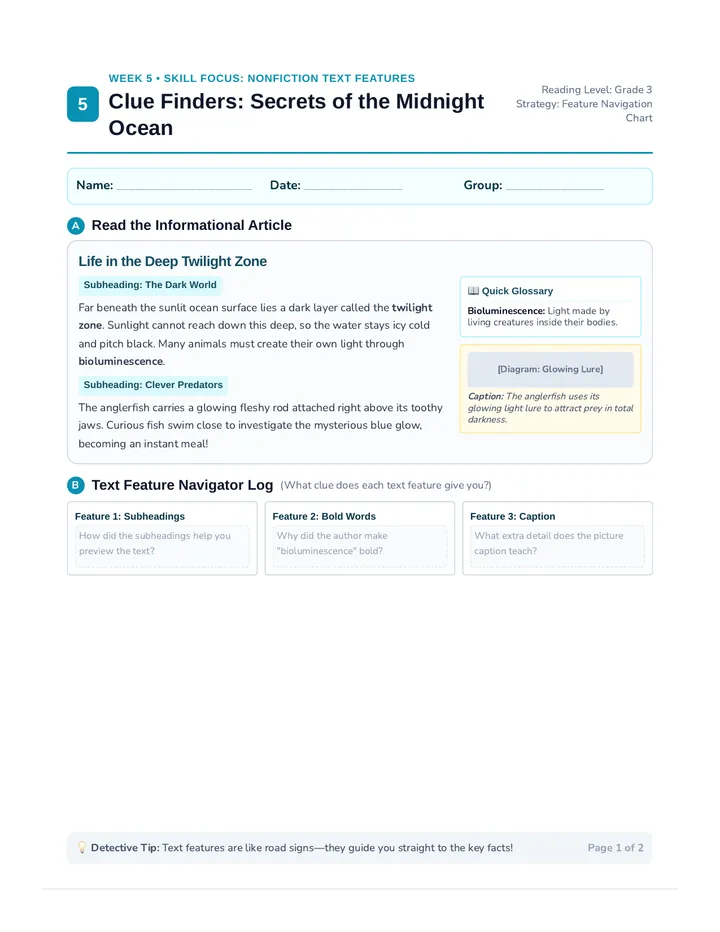
Clue Finders: Secrets of the Midnight Ocean
Reading Level: Grade 3
Strategy: Feature Navigation Chart
Name: ______________________
Date: ________________
Group: ________________
A
Read the Informational Article
Life in the Deep Twilight Zone
Subheading: The Dark World
Far beneath the sunlit ocean surface lies a dark layer called the twilight zone . Sunlight cannot reach down this deep, so the water stays icy cold and pitch black. Many animals must create their own light through bioluminescence .
Subheading: Clever Predators
The anglerfish carries a glowing fleshy rod attached right above its toothy jaws. Curious fish swim close to investigate the mysterious blue glow, becoming an instant meal!
📖 Quick Glossary
Bioluminescence: Light made by living creatures inside their bodies.
[Diagram: Glowing Lure]
Caption: The anglerfish uses its glowing light lure to attract prey in total darkness.
B
Text Feature Navigator Log
(What clue does each text feature give you?)
Feature 1: Subheadings
How did the subheadings help you preview the text?
Feature 2: Bold Words
Why did the author make "bioluminescence" bold?
Feature 3: Caption
What extra detail does the picture caption teach?
💡 Detective Tip: Text features are like road signs—they guide you straight to the key facts! Page 1 of 2
W5
Text Feature Evidence Hunt
Week 5 • Nonfiction Tools
1. Under which subheading would you find information about how the anglerfish hunts?
A. The Dark World
B. Clever Predators
C. Quick Glossary
D. Sunlit Ocean Surface
2. According to the Quick Glossary sidebar, what is "bioluminescence"?
A. The freezing cold temperature of deep ocean water
B. Light made by living creatures inside their bodies
C. Sharp teeth used to catch small swimming shrimp
D. Strong sunlight shining down on the top waves
3. How does the diagram caption help the reader understand the text better?
A. It explains where the glowing lure is located and why it works.
B. It lists how many eggs an anglerfish lays each year.
Text Features Teacher Guide T5
Teacher Intervention Protocol • Week 5
Nonfiction Text Features Small Group Guide
Tier 2 / Tier 3 Intervention
Duration: 20 Min / Day (5 Days)
5-Day Small Group Intervention Flow (20 Min Daily)
Day 1: Feature Walk
Preview page without reading body text. Point out headings, sidebars, and captions.
Day 2: Guided Read
Read "Midnight Ocean." Stop at bold words and immediately cross-reference the glossary.
Day 3: Navigator Log
Complete feature chart. Model how captions provide extra facts not in paragraphs.
Day 4: Questions & Write
Answer text feature questions 1-3. Write R.A.C.E. response citing specific features.
Day 5: Progress Check
Administer 1-minute cold reading probe below. Score fluency and text feature check.
🗣️ Scripted Modeling ("I Do"):
"Before I read a single sentence, I scan the page like a detective. I see the bold heading 'Clever Predators.' That tells my brain: get ready to learn how deep-sea creatures catch their food! When I encounter a bold word like 'bioluminescence,' I don't panic if it looks tricky—I look right over to the Quick Glossary sidebar for the exact definition."
Teacher Prompt: "Headings tell you where to look; glossaries tell you what it means!"
🎯 Targeted Intervention Scaffolds:
Tier 2 (Striving): Provide sticky note flags labeled "Heading," "Caption," "Bold Word" for students to place on the page.Tier 3 (Intensive): Mask the body text with paper so students ONLY look at the features and make predictions first.Visual Anchor: Create a classroom scavenger hunt icon checklist for informational text features.
✓
Day 5 Progress Check Probe (Student Copy / Running Record)
65 Words • 1-Minute Cold Read
"Rover on Mars
Quick Text Feature Question:
"What does the caption explain that the rover is doing?"
Mastery Target: Identifies that the caption explains drilling rock samples / gathering soil cores.
Mastery Quest Student Packet 6
Week 6 • Cumulative Mastery & Synthesis
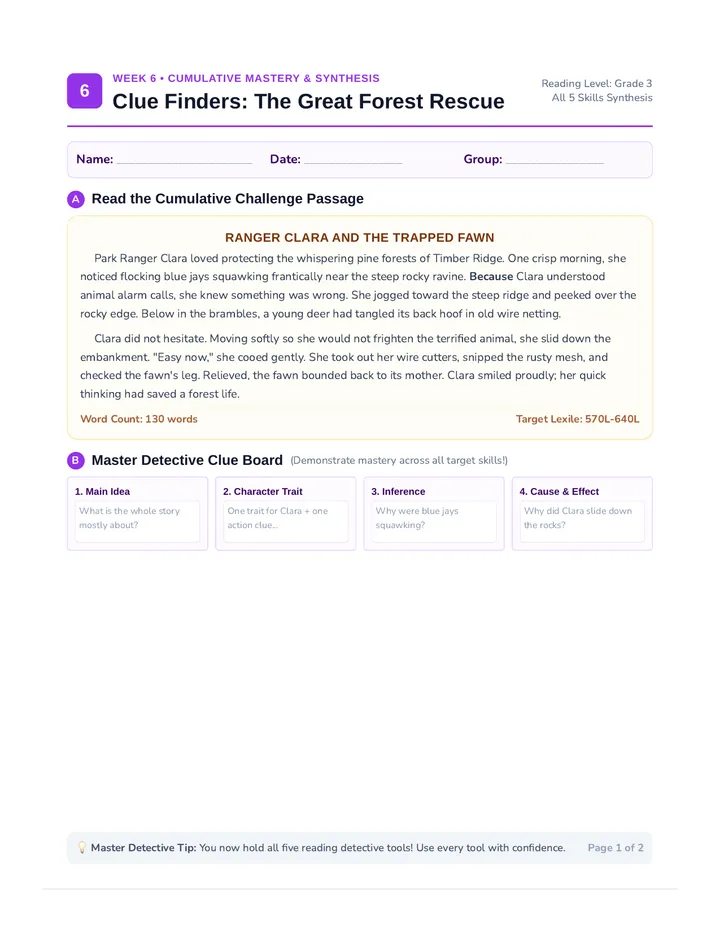
Clue Finders: The Great Forest Rescue
Reading Level: Grade 3
All 5 Skills Synthesis
Name: ______________________
Date: ________________
Group: ________________
A
Read the Cumulative Challenge Passage
Ranger Clara and the Trapped Fawn
Park Ranger Clara loved protecting the whispering pine forests of Timber Ridge. One crisp morning, she noticed flocking blue jays squawking frantically near the steep rocky ravine. Because Clara understood animal alarm calls, she knew something was wrong. She jogged toward the steep ridge and peeked over the rocky edge. Below in the brambles, a young deer had tangled its back hoof in old wire netting.
Clara did not hesitate. Moving softly so she would not frighten the terrified animal, she slid down the embankment. "Easy now," she cooed gently. She took out her wire cutters, snipped the rusty mesh, and checked the fawn's leg. Relieved, the fawn bounded back to its mother. Clara smiled proudly; her quick thinking had saved a forest life.
Word Count: 130 words Target Lexile: 570L-640L
B
Master Detective Clue Board
(Demonstrate mastery across all target skills!)
1. Main Idea
What is the whole story mostly about?
2. Character Trait
One trait for Clara + one action clue...
3. Inference
Why were blue jays squawking?
4. Cause & Effect
Why did Clara slide down the rocks?
💡 Master Detective Tip: You now hold all five reading detective tools! Use every tool with confidence. Page 1 of 2
W6
Summative Comprehension Assessment
Week 6 • Mastery Benchmark
1. [Main Idea] What is the central message or main idea of the passage?
A. Blue jays make loud squawking noises in pine trees.
B. Ranger Clara bravely and gently rescued an injured deer in need.
C. Rocky ravines are dangerous places to walk in the morning.
D. Wire cutters are important tools for fixing fences.
2. [Character Trait] Which trait best describes Ranger Clara's personality?
A. Impatient and careless
B. Brave, attentive, and compassionate
C. Hesitant and timid
D. Stern and frustrated
3. [Cause & Effect] What CAUSED Clara to run to the ravine in the first place?
A. Her supervisor called her on her radio.
B. She heard blue jays giving frantic animal alarm calls.
Mastery Quest Teacher Guide T6
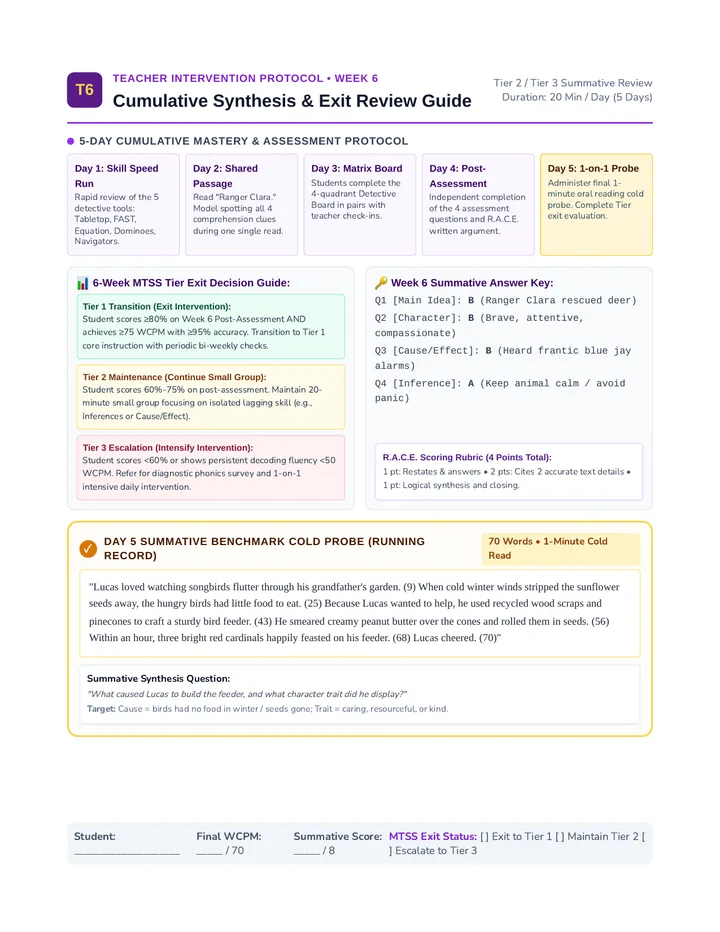
Teacher Intervention Protocol • Week 6
Cumulative Synthesis & Exit Review Guide
Tier 2 / Tier 3 Summative Review
Duration: 20 Min / Day (5 Days)
5-Day Cumulative Mastery & Assessment Protocol
Day 1: Skill Speed Run
Rapid review of the 5 detective tools: Tabletop, FAST, Equation, Dominoes, Navigators.
Day 2: Shared Passage
Read "Ranger Clara." Model spotting all 4 comprehension clues during one single read.
Day 3: Matrix Board
Students complete the 4-quadrant Detective Board in pairs with teacher check-ins.
Day 4: Post-Assessment
Independent completion of the 4 assessment questions and R.A.C.E. written argument.
Day 5: 1-on-1 Probe
Administer final 1-minute oral reading cold probe. Complete Tier exit evaluation.
📊 6-Week MTSS Tier Exit Decision Guide:
Tier 1 Transition (Exit Intervention): Student scores ≥80% on Week 6 Post-Assessment AND achieves ≥75 WCPM with ≥95% accuracy. Transition to Tier 1 core instruction with periodic bi-weekly checks.
Tier 2 Maintenance (Continue Small Group): Student scores 60%-75% on post-assessment. Maintain 20-minute small group focusing on isolated lagging skill (e.g., Inferences or Cause/Effect).
Tier 3 Escalation (Intensify Intervention): Student scores <60% or shows persistent decoding fluency <50 WCPM. Refer for diagnostic phonics survey and 1-on-1 intensive daily intervention.
🔑 Week 6 Summative Answer Key:
Q1 [Main Idea]: B (Ranger Clara rescued deer)
Q2 [Character]: B (Brave, attentive, compassionate)
Q3 [Cause/Effect]: B (Heard frantic blue jay alarms)
Q4 [Inference]: A (Keep animal calm / avoid panic)
R.A.C.E. Scoring Rubric (4 Points Total): 1 pt: Restates & answers • 2 pts: Cites 2 accurate text details • 1 pt: Logical synthesis and closing.
✓
Day 5 Summative Benchmark Cold Probe (Running Record)
70 Words • 1-Minute Cold Read
"Lucas loved watching songbirds flutter through his grandfather's garden. (9) When cold winter winds stripped the sunflower seeds away, the hungry birds had little food to eat. (25) Because Lucas wanted to help, he used recycled wood scraps and pinecones to craft a sturdy bird feeder. (43) He smeared creamy peanut butter over the cones and rolled them in seeds. (56) Within an hour, three bright red cardinals happily feasted on his feeder. (68) Lucas cheered. (70)"