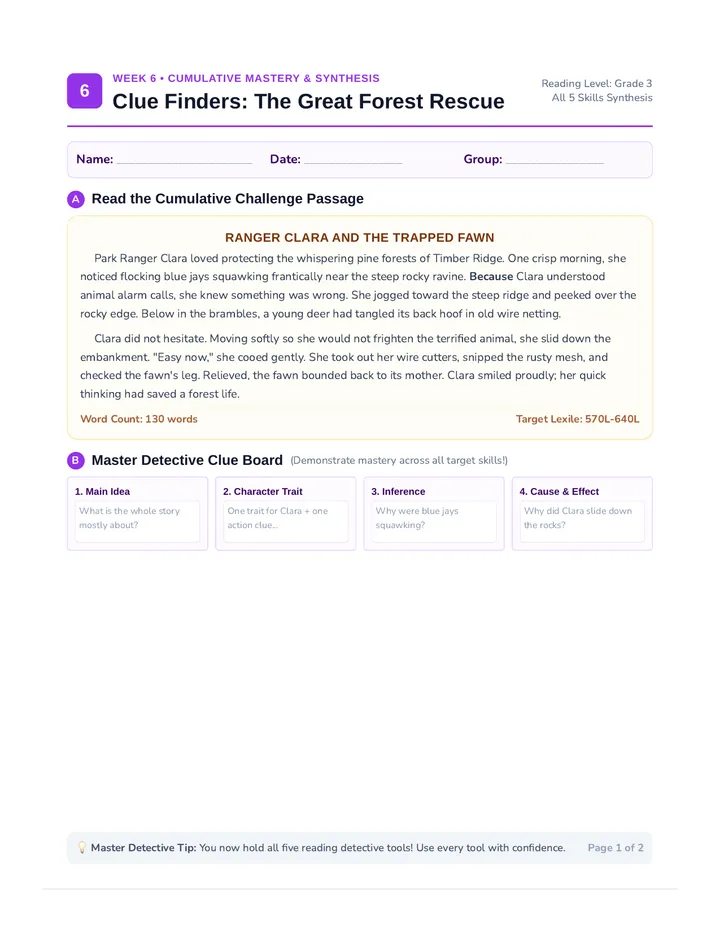
Syllable Sleuths Teacher Plan Small Group Tier 2 • Days 1-2
Syllable Sleuths Teacher Plan
Indiana Standards Alignment: 3.RF.1 (Phonics & Word Analysis) & 3.RC.1 (Text Evidence)
ILEARN Focus: EBSR & Multiselect
Target Time: 30-35 min/day
Day 1 Focus: Syllables & Details
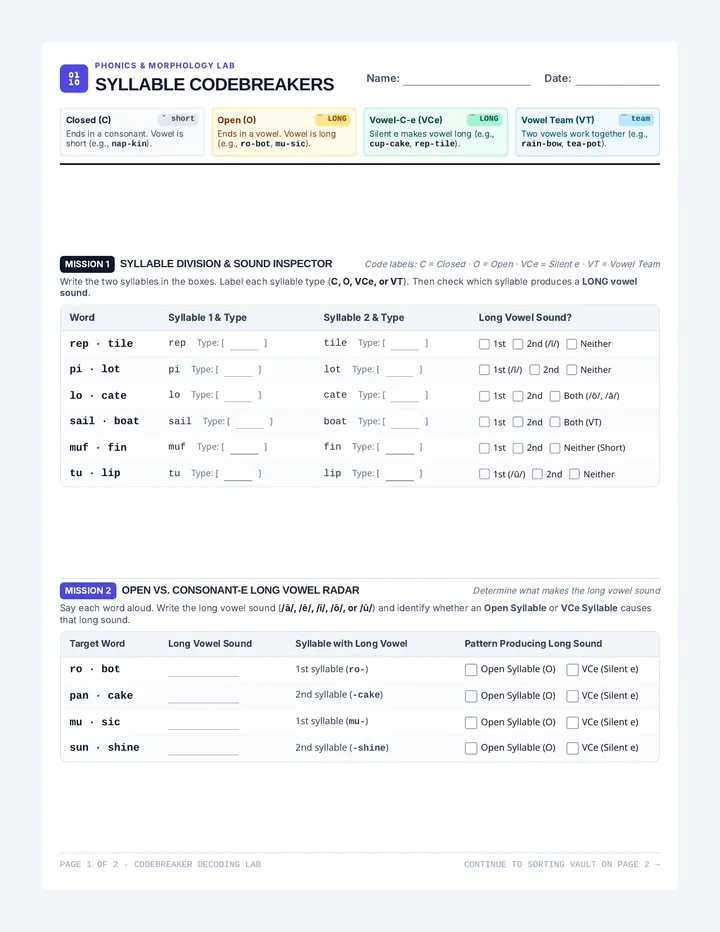
• 3.RF.1: Decode 2-syllable VCCV words (rab-bit, bas-ket) by splitting between twin/different consonants.
• 3.RC.1: Scan for exact word matches in paragraphs to answer direct factual questions.
Day 2 Focus: Two-Part Evidence
• 3.RF.1: Decode open/closed VCV words (fe-ver vs. lem-on).
• 3.RC.1: ILEARN Part A / Part B pairing: Part B must provide physical proof that justifies Part A.
4-Step Small Group Instructional Flow
1
Phonics Warm-Up (6 Mins) — Spot, Dot, & Split
Teacher Script: "Look at the word basket . Dot the vowels (a, e). Count the consonants between them (s, k). When there are two consonants in the middle, we split right down the middle: bas-ket !" Practice chorally with silver, dentist, traffic .
2
Active Text Reading & Paragraph Numbering (8 Mins)
Students whisper-read "The Lost Compass". Guide students to circle multisyllabic target words. Prompt: "Before we read questions, point to Paragraph 1. Put your finger on Paragraph 2. In ILEARN, items will tell you exactly which paragraph holds the evidence."
3
ILEARN Question Protocol: Part A / Part B Match (12 Mins)
Key Rule: "If Part B doesn't directly prove Part A, your Part A might be wrong!" Model highlighting the key question stem, checking each option against the text, and underlining the direct quote in the story.
4
Independent Application & Exit Check (6 Mins)
Students complete the multi-select item independently. Check that students selected exactly TWO options as instructed by the test prompt.
Common ILEARN Misconceptions
• Selecting Part B based on general story truth rather than proving the specific Part A claim.
• Selecting only 1 choice on multiselect questions ("Select TWO").
Tier 2 Small Group Accommodations
• Provide a tactile syllable chop card or highlighting ruler.
• Color code Part A (yellow underline) and Part B (green underline in text).
Syllable Sleuths Slide Deck Mission Days 1-2 Small Group Focus • Grade 3 ELA
Indiana 3.RF.1 & 3.RC.1
Syllable Sleuths &
Text Evidence Masters
Crack multisyllabic words with syllable cuts and lock down ILEARN text evidence with 100% proof!
Objective 1: Syllable Chop
Spot vowels and split consonants in 2-syllable words.
Objective 2: Part A & B Match
Prove every answer with exact words from the story.
Phonics Lab
The VCCV Syllable Cut Rule
Standard 3.RF.1
Step 1
Spot & Dot
Find and dot the vowels in your word.
b a s k e t
Step 2
Count Consonants
Look between the vowels. See two consonants?
s & k = 2 Consonants
Step 3
Chop Down Middle!
Split between the consonants to read each chunk.
bas / ket
Quick Try Together: rab / bit • den / tist • sil / ver Sound out each chunk!
Test Strategy
The ILEARN Two-Part Evidence Lock
Standard 3.RC.1
Part A The Answer
What is happening?
Choose the answer that tells what happened, how a character feels, or what caused an event.
Ask: "What does the passage say?"
Part B The Evidence Proof
Which sentence proves it?
Pick the exact quote from the story that acts as courtroom evidence for your Part A answer!
Rule: "If Part B doesn't match, recheck Part A!"
Never guess Part B: It must be the EXACT proof of Part A!
Syllable Sleuths Student Worksheet Indiana ELA Standards • 3.RF.1 & 3.RC.1
Syllable Sleuths Student Worksheet
Name:
Date:
Part 1: Syllable Split (3.RF.1)
Draw a slash (/) between the two consonants to divide each word.
Word 1 basket
__ / __
Word 2 silver
__ / __
Word 3 dentist
__ / __
Word 4 traffic
__ / __
Read the Passage: "The Lost Compass"
¶ 1 Leo clutched his backpack as the chilly afternoon wind swept through the tall pine forest. He reached inside his pocket to find his shiny brass compass, but his fingers met empty fabric. A hollow gasp escaped his throat. Without his trusty instrument, every twisting hiking path looked exactly the same.
¶ 2 Instead of panicking, Leo paused near a mossy boulder. He remembered his scout leader's advice: look for landmarks. High on the ridge, the wooden watchtower rose above the trees, and the rushing sound of Whispering Creek sounded faintly to his left. Leo took a deep breath, smiled, and began marching steadily toward the creek.
Question 1 (3.RC.1) Part A / Part B Item
Part A: What is Leo's main problem in paragraph 1?
A. He forgot his warm coat and backpack.
B. He lost the compass he uses to navigate.
C. The wooden watchtower fell over in the wind.
D. He injured his foot while hiking on the ridge.
Part B: Which sentence from paragraph 1 BEST supports the answer to Part A?
A. "Leo clutched his backpack as the chilly afternoon wind swept through the tall pine forest."
B. "He reached inside his pocket to find his shiny brass compass, but his fingers met empty fabric."
C. "A hollow gasp escaped his throat."
D. "Instead of panicking, Leo paused near a mossy boulder."
Question 2 (3.RC.1) Multi-Select: Choose TWO
Which TWO details from paragraph 2 show how Leo finds his way back?
[ ] He spots the wooden watchtower above the trees.
[ ] He finds his brass compass in his deep pocket.
[ ] He hears the rushing water of Whispering Creek.
[ ] He calls his scout leader on a radio phone.
Syllable Sleuths Answer Key Teacher Evaluation Key • Days 1-2
Syllable Sleuths Answer Key
Standards: Indiana 3.RF.1 (Phonics) & 3.RC.1 (Text Evidence)
Total Points: 5 pts
Part 1: Syllable Division Solutions (1 pt each, 4 total)
Word 1 bas / ket VCCV rule
Word 2 sil / ver VCCV rule
Word 3 den / tist VCCV rule
Word 4 traf / fic Twin consonant
Question 1: Part A & Part B Evidence Item
Standard 3.RC.1
Part A Correct Answer: B. He lost the compass he uses to navigate.
Teacher Rationale: Paragraph 1 explicitly states Leo searched for his shiny brass compass but his fingers met empty fabric. Options A, C, and D are fabricated details not present in the text.
Part B Correct Answer: B. "He reached inside his pocket to find his shiny brass compass, but his fingers met empty fabric."
Teacher Rationale: This sentence provides direct textual proof of the missing compass. Option A describes the setting/wind, Option C shows his reaction (gasp), and Option D is in paragraph 2.
Question 2: Multi-Select Item
Select TWO required
Correct Answers: Choices 1 and 3
Choice 1: "He spots the wooden watchtower above the trees." (Directly from ¶2: "the wooden watchtower rose above the trees")
Choice 3: "He hears the rushing water of Whispering Creek." (Directly from ¶2: "rushing sound of Whispering Creek sounded faintly")
Scoring Tip: On ILEARN, multi-select items require both correct answers for full credit (1 point). Give feedback to students who selected only one item.
Next Step Tier 2 Intervention Check:
If a student failed Part B, have them read Part A aloud, then read each Part B choice while asking: "Does this sentence prove Leo's compass is missing?" This reinforces the logical pairing required on Indiana assessments.
Affix Explorers Teacher Plan Small Group Tier 2 • Days 3-4
Affix Explorers Teacher Plan
Indiana Standards: 3.RF.1 (Prefixes & Suffixes) & 3.RC.1 (Character Traits & Actions)
ILEARN Focus: Table Match & EBSR
Target Time: 30-35 min/day
Day 3 Focus: Prefixes & Traits
• 3.RF.1: Prefixes un- (not), re- (again), dis- (opposite).
• 3.RC.1: Inferring internal character traits from external actions in the story.
Day 4 Focus: Suffixes & Table Match
• 3.RF.1: Suffixes -ful (full of), -less (without), -able (can be).
• 3.RC.1: ILEARN Table Match grids (matching character traits to supporting actions).
4-Step Small Group Instructional Flow
1
Affix Dissection Warm-Up (6 Mins) — Root Word Boxing
Teacher Script: "Words have building blocks! Look at rebuild . What is the base word? Build ! What does prefix re- mean? Again ! So rebuild means to build again." Model unselfish, careless, joyful .
2
Guided Text Reading & Character Tracking (8 Mins)
Read "Maya's Big Invention". Focus questions: "What action does Maya take when her tower collapses? What does that show about her personality trait?" Teach that feelings change quickly, but traits stay steady.
3
ILEARN Table Grid Strategy (12 Mins)
Table Strategy: Show students how ILEARN uses rows and columns. "Read each row across like a sentence: Does picking up the broken gears show that Maya is persistent or frustrated? Place only one checkmark per row!"
4
Independent EBSR Practice & Debrief (6 Mins)
Students complete the character feeling Part A/Part B question. Reinforce that Maya's feeling must match the evidence from that exact paragraph.
Common ILEARN Errors
• Confusing a temporary feeling (sad) with a long-term character trait (determined).
• Checking multiple boxes in a single table row where only one is permitted.
Tier 2 Differentiation
• Use affix flash strips (prefix + root + suffix) with color-coded index cards.
• Provide a trait word bank (creative, persistent, discouraged) with student-friendly definitions.
Affix Explorers Slide Deck Mission Days 3-4 Small Group Focus • Grade 3 ELA
Indiana 3.RF.1 & 3.RC.1
Affix Explorers &
Character Trait Trackers
Unlock new word meanings with prefixes and suffixes, and uncover how character actions drive the story!
Word Parts: 3.RF.1
Prefixes (un-, re-) and Suffixes (-ful, -less).
Character Proof: 3.RC.1
Match what characters DO to who they ARE.
Phonics Lab
The Affix Word Formula
Standard 3.RF.1
re- + build = rebuild
Prefix re- = again "To build something again"
care + -less = careless
Suffix -less = without "Without taking care"
Quick Detective Check: What does unselfish mean? (un = not) → "Not selfish!"
Test Strategy
ILEARN Character Traits & Actions
Standard 3.RC.1
Step 1: The Action
What does the character DO?
Actions are what you can see in the passage: picking up gears, trying a new design, sharing tools.
Look for strong verbs in the paragraph!
Step 2: The Trait
Who is the character INSIDE?
Traits describe their lasting personality: determined, creative, helpful, patient.
Action proves the trait on ILEARN match tables!
Remember: Feelings change quickly, but traits stay steady!
Affix Explorers Student Worksheet Indiana ELA Standards • 3.RF.1 & 3.RC.1
Affix Explorers Student Worksheet
Name:
Date:
Part 1: Affix Unpacker (3.RF.1)
Break each word into its base and affix parts.
rebuild
Prefix: _______
Base: _______
careless
Base: _______
Suffix: _______
unselfish
Prefix: _______
Base: _______
Read the Passage: "Maya's Big Invention"
¶ 1 For three long weeks, Maya collected discarded gears, rubber bands, and wooden craft sticks to build her solar-powered bookholder. She wanted to present it at the Willow Creek Young Inventors Fair. When she tested the turning lever, a loud snap echoed across the workshop, and two gears flew across the table.
¶ 2 Her younger brother Sam offered to bring her a cool glass of water. "Do you want to quit?" he asked gently. Maya wiped her dusty hands on her apron and shook her head firmly. "Real inventors never quit after one broken piece," she replied with a determined grin. "We just redesign."
¶ 3 Maya knelt down, retrieved the runaway parts from under the workbench, and carefully sketched a thicker wooden support arm in her notebook. She spent the rest of the evening reinforcing the frame until the pages turned smoothly.
Question 1 (3.RC.1) ILEARN Table Match
Which character trait does each action from the story demonstrate? Select ONE box per row.
Character Action Creative Persistent Collecting discarded gears and sticks to build a solar bookholder [ ] [ ] Refusing to quit when the lever snaps and redesigning the arm [ ] [ ]
Question 2 (3.RC.1) Part A / Part B Item
Part A: What motivates Maya to continue working after the lever snaps?
A. Her belief that inventors solve problems by redesigning.
B. Her fear that Sam will win first place at the fair.
C. Her teacher told her she would fail the assignment.
D. She wanted to sell her bookholder for money.
Part B: Which sentence from paragraph 2 proves the answer to Part A?
A. "Her younger brother Sam offered to bring her a cool glass of water."
B. "'Do you want to quit?' he asked gently."
C. "'Real inventors never quit after one broken piece,' she replied with a determined grin."
D. "Maya wiped her dusty hands on her apron and shook her head firmly."
Affix Explorers Answer Key Teacher Evaluation Key • Days 3-4
Affix Explorers Answer Key
Standards: Indiana 3.RF.1 (Affixes) & 3.RC.1 (Character Analysis)
Total Points: 5 pts
Part 1: Affix Unpacker Solutions (1 pt each, 3 total)
rebuild
Prefix: re- (again)
Base: build
careless
Base: care
Suffix: -less (without)
unselfish
Prefix: un- (not)
Base: selfish
Question 1: Table Match Solutions
1 Point Total
Action Creative Persistent Collecting discarded gears and sticks to build solar bookholder ✔ Correct — Refusing to quit when the lever snaps and redesigning the arm — ✔ Correct
Scoring Rule: Both rows must be matched correctly for 1 point. Collecting scraps shows imagination/originality (creative); continuing through setbacks shows determination (persistent).
Question 2: EBSR Motivation & Evidence
Standard 3.RC.1
Part A Correct Answer: A. Her belief that inventors solve problems by redesigning.
Teacher Rationale: Maya explicitly explains her motivation in paragraph 2 ("Real inventors never quit... We just redesign"). Options B, C, and D are external pressures not mentioned in the text.
Part B Correct Answer: C. "'Real inventors never quit after one broken piece,' she replied with a determined grin."
Teacher Rationale: This direct dialogue gives Maya's exact internal belief that motivates her continued effort. Choice B is Sam's question, and Choice D is physical action without motivation.
Teacher Coaching Quick-Tip:
When reviewing Part B choices, ask: "Does this sentence tell WHY Maya kept working, or just WHAT she did with her hands?" Remind students that motivation answers the question "Why?" .
Evidence Masters Teacher Plan Small Group Tier 2 • Day 5 ILEARN Sprint
Evidence Masters Teacher Plan
Indiana Standards: 3.RF.1 (Vocabulary in Context) & 3.RC.1 (Central Message & Constructed Response)
ILEARN Focus: 2-Point SCR & EBSR
Target Time: 35-40 min
Central Message Formula
Central Message = Topic (pride vs. flexibility) + Life Lesson (bending in storms prevents breaking). Teach students to avoid plot-only summaries.
Indiana 2-Point SCR Standard
Requires: 1) Direct response to prompt prompt, 2) Exactly TWO specific text details cited, and 3) Complete, coherent sentences.
Small Group Test Simulation Sequence
1
Affixes in Context Warm-Up (5 Mins)
Prompt: "Look at the word unbreakable . It has a prefix (un-), base word (break), and suffix (-able). What does it mean when the wind tests a tree?" Students decode before opening the passage.
2
Fable Reading & Central Message Unpacking (10 Mins)
Students read "The Oak and the Willow". Direct them to circle contrast words (while, however, instead ). Prompt: "What happened to the boastful oak? What happened to the willow? What is Aesop trying to teach human beings?"
3
Constructed Response Modeling & Sentence Stems (12 Mins)
Display the 2-point ILEARN response stem: "The willow survives the storm because it [action]. According to paragraph 2, '[detail 1]'. The text also states that '[detail 2]'." Have students underline their two proof details in the passage first.
4
Review & Self-Scoring against Indiana Rubric (8 Mins)
Guide students to use their finger to count: "Do I have my answer? (Finger 1). Do I have detail one? (Finger 2). Do I have detail two? (Finger 3)."
Official ILEARN 2-Point Short Response Rubric
Score 2 (Full Credit)
Accurate claim with TWO clear, relevant text details that explain how the willow survived.
Score 1 (Partial Credit)
Accurate claim with only ONE supporting text detail, or vague text reference.
Score 0 (No Credit)
Inaccurate statement, off-topic, or simply copies lines from text without answering prompt.
Evidence Masters Slide Deck Mission Day 5 ILEARN Challenge • Grade 3 ELA
Indiana 3.RF.1 & 3.RC.1
Evidence Masters:
The ILEARN Challenge
Put all your detective skills together! Crack vocabulary in context, uncover the central message, and score 2 out of 2 points!
Target 1: Central Message
Find the big life lesson the author wants us to learn.
Target 2: 2-Point Response
Write an answer using TWO exact details from the text.
Comprehension Lab
The Central Message Formula
Standard 3.RC.1
Part 1
The Big Topic
What is the story about in one or two words? (Pride, kindness, patience).
Pride & Flexibility
Part 2
Character Lesson
What does the character learn from their mistake or challenge?
Stubbornness hurts!
Part 3
Life Lesson for Us
What should the reader do in their own everyday life?
Flexibility brings safety!
ILEARN Warning: Central message applies to EVERYONE, not just characters in the story!
Written Response
How to Earn 2 out of 2 Points on ILEARN
Indiana SCR Rubric
Point Part 1
Direct Answer
Restate the question and state your main claim clearly in complete sentences.
"The willow survives because..."
Point Part 2
Detail One
Quote or cite your first piece of evidence directly from the text.
"First, the text states that..."
Point Part 3
Detail Two
Provide your second piece of proof from the text to secure full credit!
"In addition, paragraph 2 says..."
Formula: 1 Answer + 2 Text Details = 2 Full Points!
Evidence Masters Practice Test Indiana ELA Standards • 3.RF.1 & 3.RC.1
Evidence Masters Practice Test
Name:
Date:
Read the Fable: "The Oak and the Willow"
¶ 1 A towering oak tree stood proudly along the riverbank, boasting to a slender willow nearby. "Look at my thick trunk and mighty branches!" the oak scoffed. "I am completely unbreakable, while you tremble at the gentlest summer breeze." The willow quietly rustled its green leaves and replied, "It is better to bend than to break."
¶ 2 Soon, dark clouds rolled across the sky, bringing a fierce thunderstorm. Howling winds slammed into the trees. The rigid oak tree stiffened its thick limbs and fought against the violent gusts with all its strength. Near the bank, the flexible willow yielded to the gale, bowing its pliant branches low to the damp earth. When the storm finally cleared, the proud oak lay uprooted on the ground, while the humble willow stood unhurt, swaying peacefully in the sunshine.
Question 1 (3.RF.1) Vocabulary in Context
In paragraph 1, what does the word unbreakable mean?
A. Able to be moved easily
B. Not capable of being broken
C. Growing very slowly in soil
D. Full of green spring leaves
Question 2 (3.RC.1) Part A / Part B Item
Part A: What is the central message of the fable?
A. Trees should never grow near rivers.
B. Being flexible is wiser than being stubborn.
C. Storms are dangerous for small animals.
D. Having thick branches prevents all damage.
Part B: Which detail from the story BEST supports the central message?
A. "'I am completely unbreakable, while you tremble at the gentlest summer breeze.'"
B. "Soon, dark clouds rolled across the sky, bringing a fierce thunderstorm."
C. "...the proud oak lay uprooted on the ground, while the humble willow stood unhurt..."
D. "Near the bank, the flexible willow yielded to the gale..."
Question 3: Short Constructed Response (3.RC.1) 2-Point Item
Explain how the willow's actions helped it survive the storm. Use TWO details from the passage to support your response.
Evidence Masters Answer Key Teacher Evaluation Key & Rubric • Day 5
Evidence Masters Answer Key
Standards: Indiana 3.RF.1 (Vocabulary) & 3.RC.1 (Central Message & SCR)
Total Points: 4 pts
Question 1: Vocabulary with Affixes (3.RF.1) 1 Point
Correct Answer: B. Not capable of being broken
Affix Analysis: Prefix un- (not) + root break + suffix -able (capable of). The oak tree believes it is impossible for the wind to damage its limbs.
Question 2: Central Message EBSR (3.RC.1) 1 Point Total
Part A: B. Being flexible is wiser than being stubborn.
Part B: C. "...the proud oak lay uprooted on the ground, while the humble willow stood unhurt..."
Teacher Rationale: Choice B in Part A summarizes the universal lesson. Choice C in Part B directly shows the contrasting outcome of the stubborn oak versus the flexible willow.
Question 3: Short Constructed Response (2 Points) Indiana 3.RC.1 Benchmark
Score 2 (Full Credit Model Exemplar) Claim + 2 Text Details
"The willow tree survives the storm because it chooses to bend instead of fighting the wind. According to paragraph 2, the willow 'yielded to the gale' and 'bowed its pliant branches low to the damp earth.' Because it moved with the violent gusts, it remained unhurt while the stiff oak broke."
Score 1 (Partial Credit Model) Claim + 1 Text Detail
"The willow survived because it bowed down low to the damp earth during the wind so it didn't get blown over." (Notice: accurate claim with only one single supporting text detail).
Individual Conference Question:
Ask the student: "Point to the two different places in your sentences where you quoted or mentioned facts from the story." If they only have one, prompt: "What else did the willow do with its branches?"