Plot Blueprint Slides Indiana 3.W.3.1
Plot Crafters Narrative Academy • Lesson 1
Mission Launch
Build a Story Blueprint:
Characters, Setting & Hooks
Every great story begins with a master plan. Today, you become an architect of imagination!
Character & Setting
Who & Where
Story Mountain
Organized Sequence
Opening Hook
Grab the Reader
Goal 1
What Makes a Real Narrative?
Indiana Standard 3.W.3.1
A Memorable Character
Someone we care about!
Has clear outside traits (curly hair, mud boots) and inside feelings (brave, nervous, curious). They want something badly!
Example: Leo wants to win the school kite race, but his kite is ripped!
A Vivid Setting
Time + Place + Atmosphere
Don't just say "outside." Say "a windy October morning on the grassy hill behind Lincoln Elementary."
Sensory Check: What does the character see, hear, or feel in this place?
Remember: A story is not just a list of events—it is a journey with a problem to solve!
Goal 2
Climb the Story Mountain
Clear Sequence of Events
1. Hook & Setup
Introduce character, setting, and normal world.
The Ground
2. Rising Action
The problem appears! Obstacles get tougher.
Climbing Up
3. Climax Peak
Most exciting part! The big choice or showdown.
The Peak
4. Falling Action
Results of the climax unfold. Tension drops.
Stepping Down
5. Closure
Problem solved! Character reflects and changes.
The Finish Line
Writer Tip: Never jump straight to the peak! Build tension step by step.
Goal 3
Hook Your Reader Instantly!
Indiana Standard 3.W.3.1
1. Sound Effect (Onomatopoeia)
"CRACK! The old wooden branch snapped under Maya's sneaker."
2. Action in Motion
"Julian sprinted down the hallway, clutching the secret brass key."
3. Bold Dialogue
"'Whatever you do, do NOT open the blue locker,' whispered Sam."
4. Curiosity Question
"Have you ever seen a hamster ride a tiny motorized skateboard?"
Turn to your writing partner: Which hook strategy will fit your story best?
Action
Your Architect Task Today
Worksheet Time
1
Profile Character
Name, outer look, internal feelings, and their biggest goal.
2
Map the Mountain
Plot the starting hook, 2 rising obstacles, peak climax, and closure.
3
Partner Check
Read your hook aloud to your partner. Did it make them want to read more?
Open your Story Architect Worksheet and start drafting!
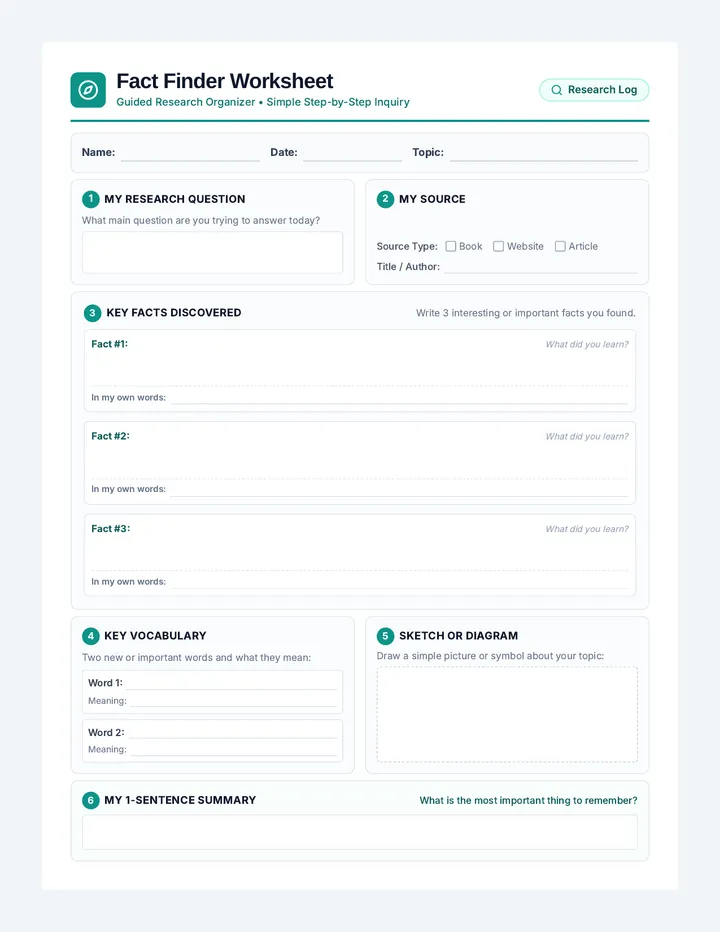
Story Architect Worksheet INDIANA 3.W.3.1 Narrative Writing Academy
Story Architect Blueprint
Part 1: Character, Setting, and the Central Problem
Name:
Date:
A
Character Builder (Who is living this story?)
Give your character personality and goals!
Character Name & Age:
What does your character WANT most?
Outside Traits (Appearance, clothes, habits):
Inside Traits (Feelings, personality, fears):
B
Setting Blueprint (Where and when does it happen?)
Use sensory clues!
Specific Place (e.g., attic, creek, gym):
Time & Weather (e.g., foggy sunrise, stormy noon):
👀 Sight:
👂 Sound:
✋ Touch/Air:
👃 Smell:
C
The Central Conflict (The Big Problem)
What stops the character?
What unexpected trouble happens? Why can't the character easily get what they want?
Plot Crafters • Lesson 1 Student Handout Page 1 of 2 (Turn over for Story Mountain)
INDIANA 3.W.3.1 Sequence Architecture
Story Mountain Organizer
Part 2: Map your story from the hook to the final closure.
Working Title:
PEAK 3
The Climax (The Most Intense Moment)
The big choice, brave test, or showdown
STEP 2
Rising Action: Trouble Grows
An obstacle appears or a plan fails:
STEP 4
Falling Action: Untangling
What happens right after the climax?
STEP 1
Inciting Incident
The moment things change for the character:
STEP 5
Resolution & Sense of Closure
How is life different? What did they learn?
LAUNCH HOOK
Draft Your Opening Sentence (Pick One Style)
[ ] Sound [ ] Action [ ] Dialogue [ ] Question
Architect Peer Check: Does the story sequence flow in order from Step 1 to Step 5?
Peer initials: ________
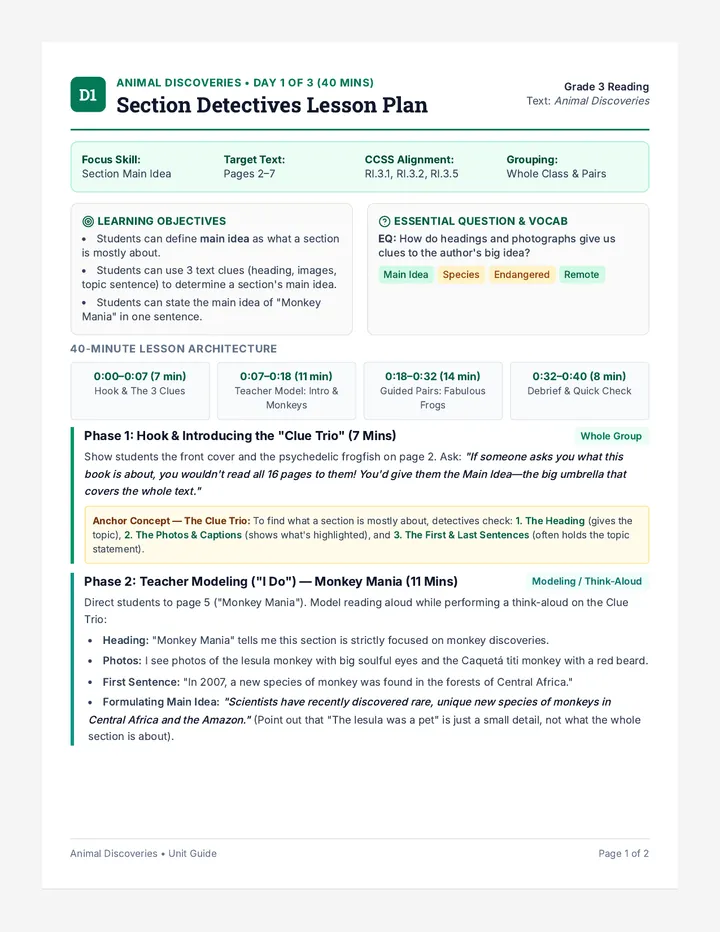
Plot Blueprint Teacher Guide TEACHER GUIDE Plot Crafters Sequence • Lesson 1
Suggested Time: 50–60 Min
Plot Blueprint Teacher Guide
Standards-Aligned Instructional Framework & Mentor Text Analysis
Indiana Academic Standards
IAS 3.W.3.1: Write narratives to develop real or imagined experiences or events using effective technique, descriptive details, and clear event sequences.
Establish a situation; introduce narrator and characters.
Organize an event sequence that unfolds naturally.
Student "I Can" Targets
I can invent a character with outside traits and internal goals.I can map a story mountain with a clear beginning, middle, and end.I can hook my reader with sound, action, dialogue, or wonder.
Lesson Flow & Suggested Pacing
10 Min • Hook & Intro
Present Slide Deck. Compare flat summary vs. dynamic narrative blueprint.
15 Min • Mini-Lesson
Examine mentor text below. Model filling Step 1-3 on class anchor chart.
25 Min • Guided Writing
Students complete Story Architect Worksheet. Teacher runs 1-on-1 desk conferences.
10 Min • Partner Share
Turn-and-talk hook test: Does the partner want to read the next sentence?
Mentor Text: "The Whispering Attic" (Use for Model Analysis)
Grade 3 Exemplar
HOOK & SETTING CREEEAK! The narrow oak floorboard shivered under Mateo’s bare toes. Outside his grandmother's Indiana farmhouse, autumn wind rattled the windowpanes like loose teeth. Mateo gripped his brass flashlight with sweaty palms.
CHARACTER & PROBLEM Nine-year-old Mateo wasn't supposed to be in the attic, but his grandfather’s pocket watch had disappeared after dinner. He had promised himself he would find it before morning.
RISING ACTION Suddenly, a dusty shadow darted behind a pile of quilt boxes. A soft tick-tick-tick echoed through the dark rafters. Mateo took a slow breath and stepped forward...
Plot Crafters • Instructional Guide Page 1 of 2
FACILITATION TOOLKIT Lesson 1 Support
Indiana 3.W.3.1 Delivery
Classroom Delivery & Differentiation
Common Misconceptions & How to Pivot
Misconception: "Bed-to-Bed" Recounts
Students list entire days ("I woke up, ate cereal, went outside, then went to bed") with no central conflict.
Teacher Pivot: Ask: "What was the ONE big problem or surprise that made this day unforgettable? Focus only on that hour."
Sensory Showdown Slides Indiana 3.W.3.1
Plot Crafters Narrative Academy • Lesson 2
Crafting Realism
Bring Stories to Life:
Show, Don't Tell & Dialogue Rules
Make your reader feel the goosebumps, hear the whispers, and experience every dramatic second!
Sensory Details
Show, Don't Tell
Dialogue Rules
Quotation Marks & Tags
Temporal Words
Transitions in Order
Skill 1
Show, Don't Just Tell!
Character Reactions
Telling (Boring & Flat)
"Maya was terrified."
Telling names the emotion like a robot. The reader feels nothing because there is no picture in their head.
Reader reaction: "So what?"
Showing (Vivid & Real)
"Maya pressed her back against the icy wall. Her knees wobbled, and cold sweat dripped into her eyes."
Shows physical actions, body clues, and sensory sensations. The reader feels the terror right along with Maya!
Reader reaction: "I can feel that!"
Formula: Physical Action + Body Clue + Sensation = Unforgettable Scene!
Skill 2
Turn on the Senses Radar
Indiana Standard 3.W.3.1
What You See
Shadows flickered, fluorescent lights buzzed overhead, neon streaks blurred.
What You Hear
Gravel crunching under tires, deafening whistle, faint whisper behind the locker.
What You Feel
Prickly goosebumps, sticky mud squeezing between fingers, icy wind stinging cheeks.
What You Smell
Burnt toast, damp pine needles after rain, sour cafeteria floor cleaner.
Pick at least TWO senses to activate on every single page of your story!
Skill 3
The 3 Dialogue Golden Rules
Indiana Standard 3.W.6.2
1
Quotation Hugs
Quotation marks (" ") wrap around ONLY the exact words coming out of the mouth.
"Duck your head!" yelled Sam.
2
Punctuation Inside
Commas, exclamation points, and question marks stay INSIDE the final quotation mark!
"Is that a footprint?" she whispered.
3
Vivid Speech Tags
Retire boring words like "said." Use speech tags that reveal character emotion!
Gasped, warned, cheered, stammered, pleaded.
Bonus Rule: New Speaker = New Line / New Paragraph!
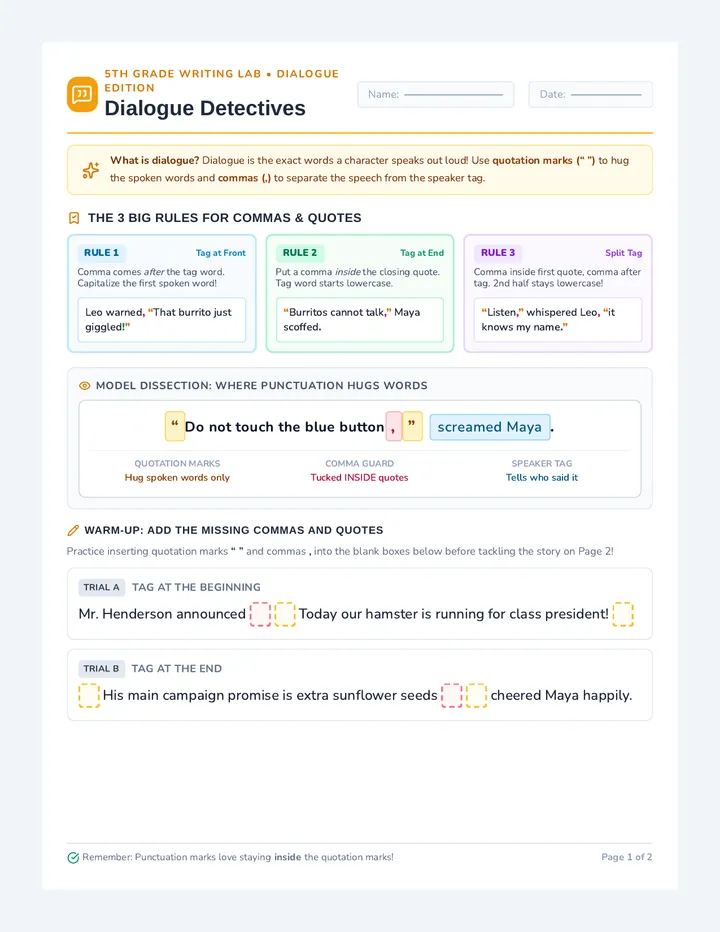
Dialogue Detective Worksheet INDIANA 3.W.3.1 Sensory Detail Studio
Dialogue Detective Worksheet
Part 1: Transforming Bland "Tell" Sentences into Rich "Show" Scenes
Name:
Date:
Detective Mentor Model:
Bland Tell:
"Lucas was boiling angry."
Vivid Show:
"Lucas clenched his fists until his knuckles turned chalk-white. His nostrils flared, and his teeth ground together."
Case #1: Nervous Jitters Body clues: shaking, sweating, quiet voice
Tell Sentence: Marcus was very nervous before presenting his science project.
Your Upgraded "Show" Scene (Write 1-2 sensory sentences):
Case #2: Creepy Setting Sensory clues: creaks, shadows, chilly air
Tell Sentence: The abandoned treehouse in the woods was scary.
Your Upgraded "Show" Scene (Write 1-2 sensory sentences):
Case #3: Pure Joy Actions: leaping, grinning, racing heart
Tell Sentence: Elena was extremely happy when her puppy learned to fetch.
Your Upgraded "Show" Scene (Write 1-2 sensory sentences):
Sensory Writer's Toolbox:
• shivered, gasped
• howling wind
• sticky fingers
• blinding flash
• slammed, stumbled
• rusty hinges
• pounding pulse
• damp earth
Plot Crafters • Lesson 2 Handout Page 1 of 2 (Turn over for Dialogue Fix-It)
INDIANA 3.W.6.2 Conventions Laboratory
Quotation Mark Crime Scene
Part 2: Punctuate Spoken Words & Draft Rising Action Dialogue
Inspector Checklist: " , ! ? "
Fix the Missing Quotations, Commas & Capitals:
Rewrite each sentence correctly below.
1. Broken: we need to find shelter right now shouted Caleb
2. Broken: whispered mia do you hear that strange tapping noise
3. Broken: i found the hidden map behind the clock exclaimed Lucas
ORIGINAL SCENE
Draft Rising Action Dialogue from Your Story
Include speech tags + character actions!
Write a short 3-line dialogue exchange between your main character and another character when an obstacle hits. Remember: start a new line when the speaker changes!
Speaker 1 Dialogue & Action:
Speaker 2 Response & Reaction:
Speaker 1 Follow-up / Decision:
Self-Check: Did you wrap spoken words in " " and keep punctuation INSIDE?
[ ] Verified
Plot Crafters • Lesson 2 Handout Page 2 of 2
Dialogue Detective Answer Key ANSWER KEY Plot Crafters Sequence • Lesson 2
Indiana 3.W.3.1 & 3.W.6.2
Dialogue Detective Answer Key
Exemplar Show Transformations, Punctuation Solutions & Teacher Scoring Notes
Part 1: Show, Don't Tell Exemplar Revisions (Accept Similar High-Sensory Responses)
Look-For: Physical Actions & Senses
Case #1 (Marcus's Nervousness):
"Marcus’s stomach churned like a washing machine. His index card fluttered in his sweaty fingers as he cleared his dry throat twice."
Key Criteria: Physiological reaction (stomach churning, sweaty fingers) replaces generic "nervous."
Case #2 (Creepy Treehouse):
"Rotting cedar boards groaned under the wind, and cobwebs dangled like gray veils from the shattered trapdoor. The smell of mold stung Leo's nose."
Key Criteria: Sound (groaned), sight (cobwebs), and smell (mold) establish setting mood.
Case #3 (Elena's Joy):
"Elena squealed, jumping so high her sneakers scraped the grass. She wrapped both arms around Barnaby’s fluffy neck with a grin that stretched ear to ear."
Key Criteria: Vocalization (squealed), explosive movement (jumping), and facial expression.
Part 2: Quotation Crime Scene Solutions (Exact Punctuation Required)
Standard 3.W.6.2 Mastery
1. Solution:
"We need to find shelter right now!" shouted Caleb.
Must have: Capital 'W', exclamation mark inside quotes, lowercase 'shouted'. (Or comma instead of exclamation mark).
2. Solution:
Whispered Mia, "Do you hear that strange tapping noise?" OR: Mia whispered, "Do you hear that strange tapping noise?"
Must have: Comma before quote, Capital 'D', question mark inside quotes.
3. Solution:
"I found the hidden map behind the clock!" exclaimed Lucas.
Must have: Capital 'I', exclamation mark inside quotes, lowercase 'exclaimed'.
Part 3: Original Dialogue Scoring Quick-Check
1. Mechanical Accuracy
Quotation marks hug only spoken words; terminal punctuation sits before closing quote.
2. Dynamic Speech Tags
Includes vivid verbs (gasped, muttered, urged) and physical action tags rather than only "said."
3. Purpose & Pacing
Dialogue addresses the story obstacle directly and advances the character toward a decision.
Plot Crafters • Lesson 2 Teacher Key Page 1 of 1
Grand Finale Slides Indiana 3.W.3.1
Plot Crafters Narrative Academy • Lesson 3
Grand Finale
The Grand Finale:
Peak Climax, Closure & Polish
Take your readers to the edge of their seats, solve the big mystery, and finish like a published author!
Peak Climax
Slow Down the Moment
True Closure
Satisfying Endings
ARMS & CUPS
Revise and Edit
Goal 1
Slow Down the Climax Peak!
Indiana Standard 3.W.3.1
Rushed Mistake
"He saw the monster, threw a rock, it ran away, and everything was fine."
The reader blinks and misses it! There is no suspense, no heartbeat, and no danger.
Slow-Motion Magic
Zoom in on the 5 crucial seconds: the pounding chest, the ticking clock, the breathless decision!
Describe the split-second thoughts, the sweaty grip, and the exact physical choice.
Writers stretch out the most exciting moment so the reader holds their breath!
Goal 2
A True Sense of Closure
Indiana Standard 3.W.3.1
Forbidden Endings: "...and then I woke up, it was all a dream!" OR "The End."
1
Problem Settled
Show how the world is different now that the mystery is solved or the goal is reached.
2
Character Growth
What did the main character learn about courage, honesty, friendship, or patience?
3
Lingering Image
Give your reader a feeling of complete satisfaction as they read the final sentence!
Goal 3
Revise Your Story with A.R.M.S.
Indiana Standard 3.W.4
A
ADD
Add sensory details, dialogue, and temporal transitions.
R
REMOVE
Remove extra words or sentences that wander away from the problem.
M
MOVE
Move sentences so events unfold in smooth chronological order.
S
SUBSTITUTE
Trade tired words ("good", "went") for power verbs and precise nouns.
Revision makes your story exciting; editing makes it correct!
Goal 4
Edit Like an Editor with C.U.P.S.
Indiana Standard 3.W.6
C
Capitalize
First word, proper nouns, letter "I", and start of spoken dialogue.
Master Author Draft Booklet INDIANA 3.W.3.1 Official Narrative Draft
Master Author Story Draft
Part 1: The Narrative Hook, Rising Action & Sensory Scene
Author:
Date:
Story Title:
Draw Your Opening Scene or Character Here
Part I: Hook, Character, Setting & Rising Obstacles
Indent your first paragraph!
Plot Crafters • Official Story Booklet Page 1 of 2 (Turn over for Climax, Closure & Revision)
INDIANA 3.W.3.1 Grand Finale & Polish
Climax, Closure & Revision Pass
Part 2: The Peak Moment, Resolution, and Self-Evaluation Stations
Final Draft Edition
Part II: The Climax Peak, Falling Action & Satisfying Closure
Provide a complete sense of closure!
A.R.M.S. Revision Self-Check
A dded sensory words, dialogue, and temporal transitions R emoved sentences that repeat or wander off-topic M oved sentences to ensure natural event order S ubstituted dull words for vivid action verbs
C.U.P.S. Editing Self-Check
C apitals: First words, names, letter "I", and dialogue starts U sage: Every sentence sounds complete and makes sense P unctuation: Quotation marks hug speech; end marks present S pelling: Sounded out tough words and checked word wall
Author Reflection: My favorite sentence or moment in this draft is:
Plot Crafters • Official Story Booklet Page 2 of 2
Narrative Mastery Rubric INDIANA 3.W.3.1 Assessment & Evaluation Guide
Student Name:
Total Score: _____ / 20
Narrative Mastery Rubric
Standards-Based Assessment for Third-Grade Narrative Writing & Conventions
Domain & Standard
Level 4: Master (4 pts)
Level 3: Skilled (3 pts)
Level 2: Developing (2 pts)
Level 1: Novice (1 pt)
Characters & Setting IAS 3.W.3.1.a
Vivid characters with clear goals; rich sensory setting establishes captivating mood.
Establishes narrator/characters with physical and inner traits; identifiable time/place.
Characters or setting are named but lack sensory details or clear desires.
Setting unclear or missing; characters have no distinguishable traits.
Event Sequence & Transitions IAS 3.W.3.1.b
Seamless sequence with building tension; varied temporal phrases signal smooth pacing.
Clear beginning, middle, and end; uses temporal words (then, suddenly, next) in order.
Events jump abruptly; few transitions used to show passage of time.
List of unrelated events with no narrative arc or chronological order.
Dialogue & Sensory Details IAS 3.W.3.1.c
Masterful "show, don't tell"; natural dialogue reveals deep character reactions and emotions.
Uses dialogue to show actions/feelings; includes multiple sensory descriptions.
Tells feelings instead of showing; dialogue feels repetitive or unnatural.
No dialogue or sensory details; relies entirely on bland declarative summary.
Climax & Sense of Closure IAS 3.W.3.1.d
Thrilling climax resolved meaningfully; reflective closure leaves lingering resonance.
Clear climax moment; central problem resolves with a logical sense of closure.
Climax rushed; abrupt ending without resolving the core problem ("The End").
Ending is missing, disjointed, or relies on cliché ("woke up from a dream").
Conventions & Punctuation IAS 3.W.6.1 & 6.2
Accurate quotation marks and commas; strong grade-level spelling and mechanics throughout.
Punctuates dialogue with quotation marks; standard capitalization and ending punctuation.
Frequent errors in quotation marks or sentence boundaries that distract the reader.
Pervasive capitalization and punctuation errors that obscure meaning.
Strengths & Sparkling Moments:
Next Author Goal (Growth Target):
Evaluator Signature: ___________________________ Date: __________________ Plot Crafters • Standards Evaluation Suite