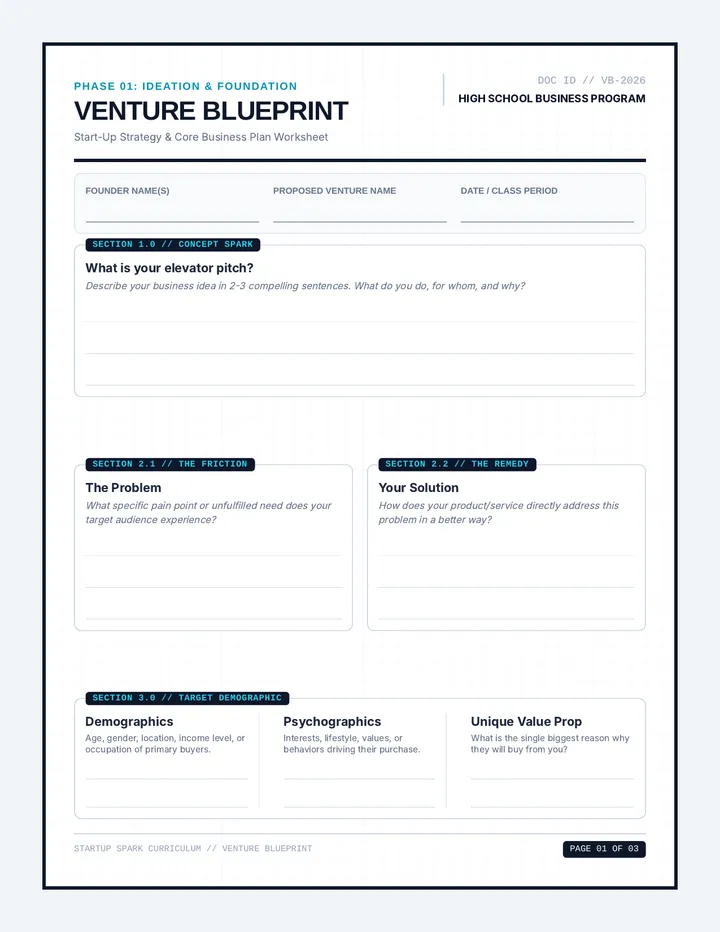
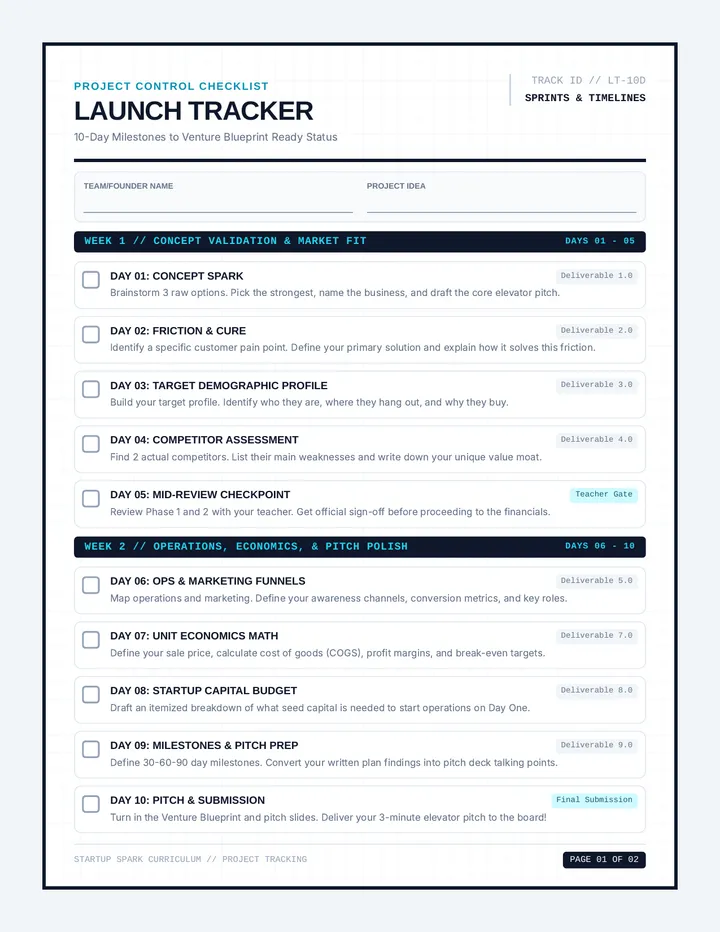
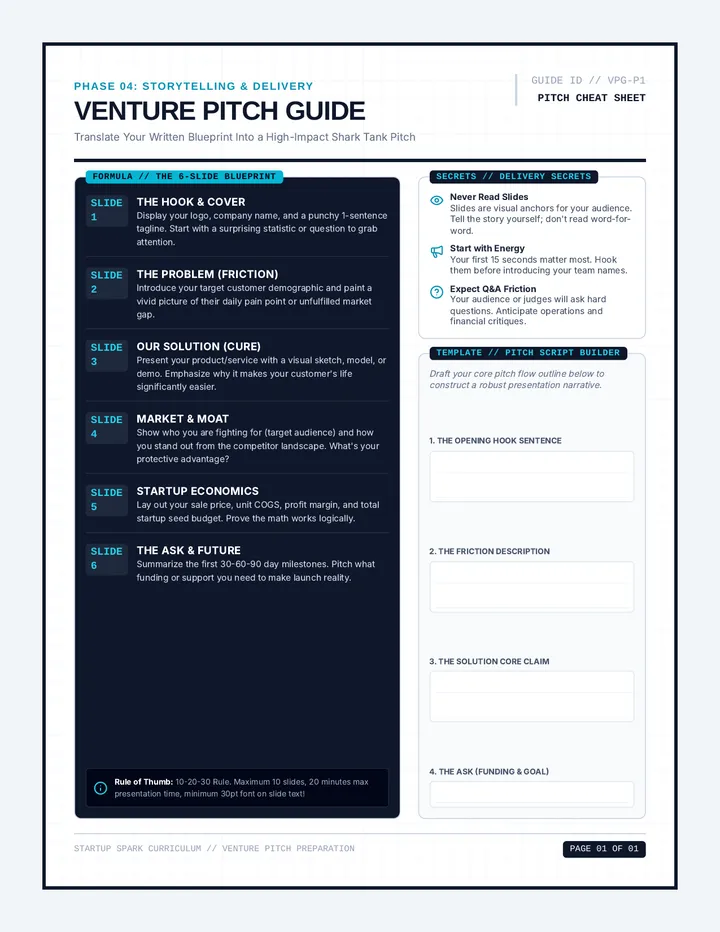
Visual slide deck for the 'Velocity Vanguards' lesson. Includes warm-up prompts, video embedding for acceleration concepts, and a guide for the graphing activity with real-world dragster data.
A finalized teacher answer key with a randomized multiple-choice key (to match the student worksheet) and specific exemplar responses for short-answer questions. Optimized for a single-page layout.
A revised set of question cards with sequential numbering, integrated writing lines, and a decorative 'back-side' template for double-sided printing. Optimized to align perfectly for double-sided document production.
A finalized student worksheet with randomized multiple-choice answer positions to ensure assessment validity. Features scientific diagrams, the Gloria's Garden story, and reflection questions.
A teacher answer key for the Equation Equilibrium worksheet, providing correct coefficients for all 15 chemical equations. Fixed spacing and alignment issues.
A drill-style worksheet for practicing balancing chemical equations, featuring basic and moderate complexity levels with clear coefficient lines. Fixed spacing issues and improved student writing areas.
Combined station worksheet for Zone 3: Biotech Lab. Integrates instructions, gel electrophoresis evidence, and student response areas into a single-page document. Focuses on fragment size analysis and molecular separation principles. Fixes layout cutoff issues and expands work areas.
Combined station worksheet for Zone 1: Pedigree Sleuth. Integrates instructions, pedigree evidence, and student response areas into a single-page document. Focuses on autosomal dominant inheritance and genotype deduction. Fixes pedigree line disconnections and page overflow.
Combined station worksheet for Zone 3: Biotech Lab. Integrates instructions, gel electrophoresis evidence, and student response areas into a single-page document. Focuses on fragment size analysis and molecular separation principles.
Combined station worksheet for Zone 2: Chromosomal Clinic. Integrates karyotype evidence (Patient 02-B) and structural mutation concepts with student response areas. Focuses on diagnosing aneuploidy and understanding structural changes.
Combined station worksheet for Zone 1: Pedigree Sleuth. Integrates instructions, pedigree evidence, and student response areas into a single-page document. Focuses on autosomal dominant inheritance and genotype deduction.
Advanced investigator worksheet for high-achieving students. Features DOK 3 level strategic thinking questions, including probability justification, evolutionary persistence of alleles, and a complex CER on meiosis errors. Updated to the 3-Zone structure. Fixes layout flow and adds evidence snippets for self-containment. Fixes work area contrast in the dark section.
Consolidated Human Genome investigation stations reduced from 4 to 3 focused 'Investigation Zones' (Pedigree, Chromosomes, and Biotech). This aligns perfectly with the 3 experiences in the Teacher Guide and reduces student/teacher confusion over station volume. Includes updated diagrams and clear alignment labels. Fixes pedigree line disconnections and page overflow issues. Added student response areas for functionality. Fixes affected legend icon to solid black.
High-impact presentation deck for Investigation 7, revamped to focus on Karyotypes, Chromosomal Mutations (Numerical and Structural), and Gel Electrophoresis. Matches the new station activities and anchoring phenomenon. Fixes text contrast and visual alignment issues. Added 3-Zone Investigation summary.
Comprehensive Master Answer Key for Investigation 7, updated to match the revamped 3-Zone station activities. Covers pedigree analysis, Trisomy 21 karyotype diagnosis, structural mutation logic, and gel electrophoresis fragment analysis. Fixes page breaks and contrast issues. Added Punnett labels.
Advanced investigator worksheet for high-achieving students. Features DOK 3 level strategic thinking questions, including probability justification, evolutionary persistence of alleles, and a complex CER on meiosis errors. Updated to the 3-Zone structure. Fixes layout flow and adds evidence snippets for self-containment.
Scaffolded investigator worksheet for students needing support. Updated to the 3-Zone structure (Pedigree, Chromosomes, and Biotech). Features simplified response areas and guided "hint" prompts for inheritance and mutation analysis. Fixes contrast issues in the biotech section and removes fixed height constraints.
Investigator Logbook for Investigation 7, updated to the 3-Zone structure (Pedigree, Chromosomes, and Biotech). Standard tier with clear response areas and Punnett square modeling. Aligned with the revamped station cards. Fixes page breaks and contrast issues in the biotech section. Added parent labels to Punnett square.
Consolidated Human Genome investigation stations reduced from 4 to 3 focused 'Investigation Zones' (Pedigree, Chromosomes, and Biotech). This aligns perfectly with the 3 experiences in the Teacher Guide and reduces student/teacher confusion over station volume. Includes updated diagrams and clear alignment labels. Fixes pedigree line disconnections and page overflow issues. Added student response areas for functionality.
Expanded Teacher Guide for Investigation 7, covering all 3 Experiences over 5 blocks. Includes preparation checklists, common misconceptions, and detailed monitoring feedback loops. Fixes page breaks. Updated to reflect the 3-Zone Investigation structure.
Comprehensive Master Answer Key for Investigation 7, updated to match the revamped 3-Zone station activities. Covers pedigree analysis, Trisomy 21 karyotype diagnosis, structural mutation logic, and gel electrophoresis fragment analysis.
The teacher's answer key for the HIM Decoded Worksheet, providing correct answers for the terminology matching, coding classification, and scenario analysis exercises.
A student worksheet focusing on Health Information Management terminology and medical coding. It includes matching exercises, classification tasks for ICD-10-CM and CPT codes, and a critical thinking scenario.
An instructional slide deck introducing Health Information Management (HIM). It covers the definition of HIM, key acronyms like HIPAA and PHI, and the fundamental differences between ICD-10-CM and CPT coding.
A comprehensive teacher answer key for the Thermochemisrty Study Guide. It provides detailed scaffolded logic for all 16 questions, including mathematical step-by-step breakdowns and pedagogical strategies for each section. All notation is simplified for clear, error-free printing. Layout condensed for 3-page efficiency.
A comprehensive 5-page student study guide for the thermochemistry unit. Features 16 distinct review tasks, standardized multiple-choice styling, and improved work areas for calculations. All chemical and mathematical notation uses ASCII text for perfect PDF rendering. Includes scaffolded "Guided Examples" for every section. Optimized for professional print and instructional clarity. Layout condensed for 5-page efficiency.
A teacher's guide for managing the Elemental Deep Dive project, including pacing suggestions, grading tips for technical scientific content, and a recommended slide deck structure.
A research organizer for students to gather and structure data on their chosen chemical element before creating their final presentation, aligned with the project's rubric categories.
A comprehensive point-based rubric for a student presentation on a chemical element, featuring technical blueprint styling and clear scoring criteria across five major scientific categories.
A revised teacher answer key for the pipe sizing worksheet, featuring high-contrast answers, corrected page breaks, and completed calculation examples.
A revised practice worksheet for pipe sizing, now with dedicated work areas for student calculations and corrected page breaks for better usability.
A revised reference document containing WSFU values and sizing tables from 248 CMR, optimized to fit on a single page for student use.
Introductory slides for plumbing pipe sizing based on Massachusetts 248 CMR, covering WSFU concepts, the difference between tank and flush valve systems, and the 4-step sizing process.
Une fiche d'exercices ultra-simplifiée "à trous" pour permettre à un débutant complet de construire ses premières requêtes SQL sans stress. Version révisée avec espaces d'écriture élargis et mise en page fixe.