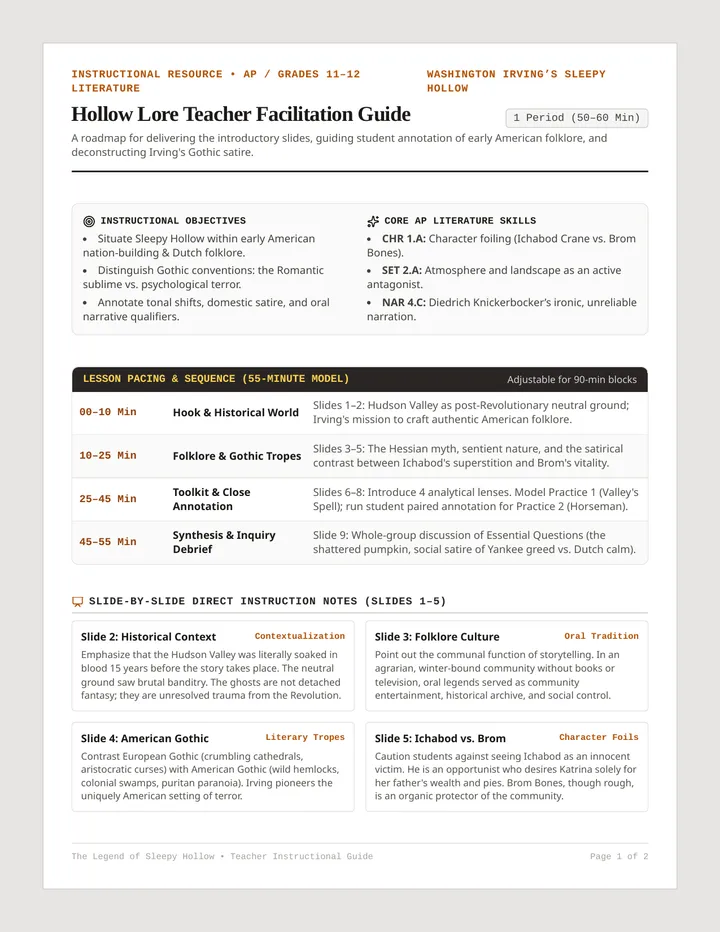
Sleepy Hollow Teacher Guide
American Romanticism & Early National Literature Grades 11–12 / AP Lit
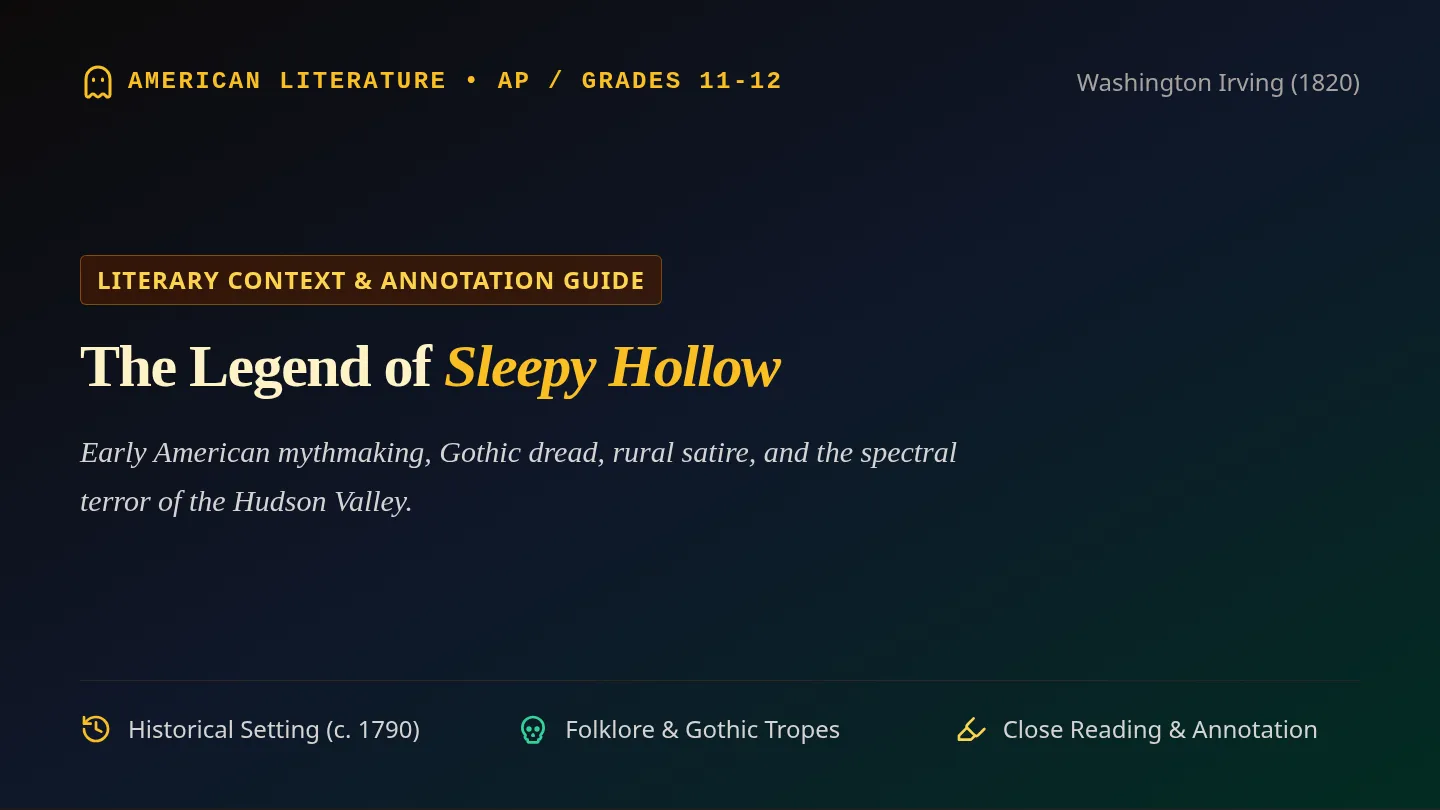
The Legend of Sleepy Hollow
Instructional Master Guide: Washington Irving (1820) | Satire, Folklore, & the American Psyche
Core Essential Inquiries
1. Reality vs. Myth: How does Irving exploit ambiguous narration to question whether terror originates in external ghosts or internal psychological projection?
2. Cultural Collision: In what ways does the clash between Ichabod and Brom dramatize the tension between Yankee intellectualism and agrarian frontier vigor?
Part I: Historical, Geographic, & Cultural Matrix
Post-Revolutionary Dutch Enclaves
Set circa 1790 in Tarrytown, NY. The Dutch-American farming community represents insular tradition, static agrarian peace, and distrust of outside modernization following British and Continental upheavals.
The Connecticut Yankee Archetype
Ichabod Crane embodies the restless, calculating New England pedagogue: pious, literate, yet economically ravenous, seeking to commodify rural tradition into portable personal wealth.
Hessian Mercenary Lore
The Headless Horseman stems from Revolutionary War history: a decapitated Hessian trooper. The specter represents unresolved national trauma and lingering military brutality haunting peaceful valleys.
Narrative Framing: The Diedrich Knickerbocker Persona
Irving presents the tale through layers of narrative mediation: written by the fictional Dutch antiquarian Diedrich Knickerbocker, who claimed to transcribe it from an elderly Dutchman at a Manhattan business meeting.
Layered Distance:
The reader is thrice-removed from events, warning against treating any supernatural claims as objective truth.
The Comic Burlesque:
Irving mocks grand epic conventions, applying mock-heroic elevated language to petty village gossip and domestic courtship.
Postscript Skepticism:
The narrator confesses he doesn't believe "half of it himself," destabilizing the text's didactic or moral certainty.
Thematic Polarities & Symbolic Tension
| Thematic Axis | Textual Vehicle / Symbolism | Critical Analysis Objective |
|---|
| Appetite & Gluttony | Ichabod's insatiable ingestion of pies, roasted pigs, and Cotton Mather's witchcraft accounts. | Connect literal voracity to intellectual and imperial consumerism: swallowing a town's resources without labor. |
| Imagination vs. Brute Reality | The shadowy forest roads of Sleepy Hollow vs. the raucous tavern and physical dominance of Brom Bones. | Evaluate how hyperactive fantasy renders vulnerable intellectuals incapable of navigating physical conflict. |
| Folk Defense Mechanism | The Galloping Hessian myth utilized to expel foreign threats to the community's domestic equilibrium. | Trace how folk communities weaponize superstitious traditions to protect socio-economic boundaries. |
Sleepy Hollow Master Teacher Guide • AP & Senior English Page 1 of 4 • Foundations & Context
Part II: Textual Mechanics Close Reading & Stylistic Lenses
Anchor Passages & Analytical Toolkits
Passage 1: The Liminal Spell of Sleepy Hollow
Lines 42–58
“A drowsy, dreamy influence seems to hang over the land, and to pervade the very atmosphere... The whole neighborhood abounds with local tales, haunted spots, and twilight superstitions; stars shoot and meteors glare oftener across the valley than in any other part of the country...”
Stylistic Devices:
Languid alliteration ("drowsy, dreamy"), hypnotic syntax, pathetic fallacy attributing deliberate psychological influence to the landscape itself.
Teacher Discussion Prompt:
Is the valley genuinely magical, or does Irving expose how isolated agrarian geography induces a collective cognitive susceptibility to delusion?
Passage 2: The Grotesque Caricature of Ichabod
Lines 112–134
“He was tall, but exceedingly lank, with narrow shoulders, long arms and legs, hands that dangled a mile out of his sleeves... To see him striding along the profile of a hill on a windy day, with his clothes bagging and fluttering about him, one might have mistaken him for the genius of famine descending upon the earth...”
Stylistic Devices:
Metaphorical burlesque ("genius of famine"), ornithological imagery (scarecrow/crane), hyperbolic visual proportions contrasting his voracious physical appetites.
Teacher Discussion Prompt:
How does Irving's physical description subvert traditional romantic heroic archetypes? What does his resemblance to a scarecrow reveal about his authority?
Passage 3: The Shattered Pumpkin & Sensory Dissolution
Lines 520–544
“Ichabod beheld the gallant horseman now spent, bearing off the goblin; but... he saw the figure in the gloom, gigantic in height, and muffled in a cloak, rising in the stirrups, hurling his head at him!... The next day... close beside the brook was found the hat of the unfortunate Ichabod, and close beside it a shattered pumpkin.”
Stylistic Devices:
Gothic chiaroscuro (shadow vs. flash), kinetic acceleration, abrupt bathetic collapse from mythological horror to base agricultural vegetable.
Teacher Discussion Prompt:
Why does Irving deny readers absolute empirical confirmation? What does the pumpkin symbolize in contrast to the mythical severed head?
Critical Theoretical Frameworks for Senior Seminar
Marxist / Economic Lens
Examine Ichabod’s gaze upon the Van Tassel estate not as affection, but as financial commodification—turning livestock directly into roasts and land into liquidated cash.
Gender & Performance
Contrast Brom's boisterous frontier hyper-masculinity with Ichabod's effeminate, domestic pretensions, analyzing Katrina Van Tassel's silent agency in weaponizing their rivalry.
Post-Colonial / Border Lens
Treat the Dutch settlement as an established sovereign territory repelling the expansionist, bureaucratizing Anglo-American immigrant through indigenous folk intimidation.
Sleepy Hollow Master Teacher Guide • AP & Senior English Page 2 of 4 • Textual Mechanics & Lenses
Part III: Discourse & Deliberation Socratic Seminar & Debate Protocol
High-Stakes Dialectics & Competing Theses
Seminar Protocol: The Fishbowl Evidence Exchange 45–55 Minutes • Grade 11/12
Divide class into inner (speakers) and outer (evidence trackers) circles. Inner students must ground every claim in textual citations; outer students track fallacies, ungrounded speculation, and synthesis moments.
Rule 1: No claim without citing page/paragraph.
Rule 2: Rebut opposing arguments with counter-citations.
Rule 3: Address Irving's satirical narrative framing.
Three Core Interpretive Controversies
Controversy A: The Epistemological Verdict Supernatural vs. Pragmatic Fraud vs. Psychological Collapse
Claim 1 (The Brom Hoax): Brom Bones engineered the chase using Daredevil, a pumpkin, and tavern superstition to eliminate his rival without legal consequence. (Cites: Brom's knowing laughs when pumpkin is mentioned; Daredevil's muddy tracks).
Claim 2 (The Internal Delusion): Ichabod’s terror was entirely an auto-suggestive panic caused by Cotton Mather’s lore, gluttonous indigestion, and emotional rejection by Katrina. (Cites: His delirium at Major André's tree prior to any pursuit).
Controversy B: The Ethical Hero / Villain Inversion Who is the True Antagonist of the Valley?
Ichabod as Parasite: A mercenary predator exploiting his clerical status, coveting Van Tassel’s wealth, abusing his students physically, and harboring disdain for the Dutch locals.
Brom as Bully: A belligerent ruffian enforcing territorial dominance through mob intimidation, animal cruelty, and psychological terrorism against a defenseless outsider.
Controversy C: Katrina Van Tassel's Agency Passive Trophy or Master Strategist?
The Coquette Gambit: Katrina deliberately flatters Ichabod to arouse Brom’s jealousy and force Brom into an immediate matrimonial commitment, discarding Ichabod the moment her trap springs.
The Patriarchal Pawn: Irving treats Katrina purely as a silent economic prize—described strictly through domestic garments, family silver, and edible livestock metaphors.
Teacher Counter-Push Stems for Stagnant Seminars
• "If Brom simply pranked him, why does the narrator report that Ichabod survived, became a lawyer, and served in the legislature?"
• "How does the Postscript's syllogism ('there is no situation in life but has its advantages') mock our desire for a neat moral?"
Sleepy Hollow Master Teacher Guide • AP & Senior English Page 3 of 4 • Discourse Protocols & Inquiry
Part IV: Assessment & Extension AP Literature Alignment & Synthesis
Summative Writing Tasks & Evaluation Rubric
AP Literature Aligned Essay Prompts
Option 1: Prose Fiction Analysis (AP Lit FRQ 2) Text Analysis
In a meticulously structured essay, analyze how Irving uses culinary imagery, mock-heroic diction, and physical caricature in the introduction of Ichabod Crane to establish a satirical critique of early American consumerism. Avoid mere plot summary; focus on the ideological conflict between Yankee materialism and communal folklore.
Option 2: Literary Argument (AP Lit FRQ 3) Thematic Argument
Literary works frequently utilize supernatural figures or folklore to address societal anxieties about change, invasion, or identity. Analyze how Irving constructs the Headless Horseman not merely as a gothic terror, but as an emblem of cultural self-defense against the encroachment of rationalist, speculative outsiders.
Analytic Evaluation Rubric (6-Point Scale)
| Criterion | Advanced (AP 5–6 / A-Band) | Proficient (AP 3–4 / B-Band) |
|---|
| Thesis (1 pt) | Articulates a defensible, nuanced interpretation explaining how formal techniques construct ideological or cultural commentary. | Presents a clear thesis that responds to the prompt but relies on descriptive or broad thematic summaries. |
| Evidence & Analysis (4 pts) | Integrates specific textual evidence; rigorously analyzes how literary devices (diction, framing, tone) directly produce complex meaning. | Provides sufficient textual evidence, but commentary occasionally explains what happened rather than how style develops meaning. |
| Sophistication (1 pt) | Demonstrates complex understanding, identifying narrative contradictions, ambiguities, or placing the text in broader historical dialogue. | Competent and well-organized, but exhibits a binary or simplistic view without acknowledging Irving's satirical subversions. |
Comparative Literature Pairings
Hawthorne: "Young Goodman Brown"
Contrast Irving's comic, folkloric woods with Hawthorne's moralistic, psychological Puritan nightmare of universal depravity.
Poe: "House of Usher"
Investigate how Poe constructs claustrophobic gothic terror from within, versus Irving’s pastoral, comic sunlit gothic exterior.
Miller: The Crucible (Act 1)
Compare Cotton Mather's real-world influence on Salem witchcraft trials to Ichabod’s superstitious ingestion of Mather's texts.
Sleepy Hollow Master Teacher Guide • AP & Senior English Page 4 of 4 • Assessments & Extensions