Haunted Hollow Slides
American Literature • AP / Grades 11-12
Washington Irving (1820)
Literary Context & Annotation Guide
The Legend of Sleepy Hollow
Early American mythmaking, Gothic dread, rural satire, and the spectral terror of the Hudson Valley.
Historical Setting (c. 1790)
Folklore & Gothic Tropes
Close Reading & Annotation
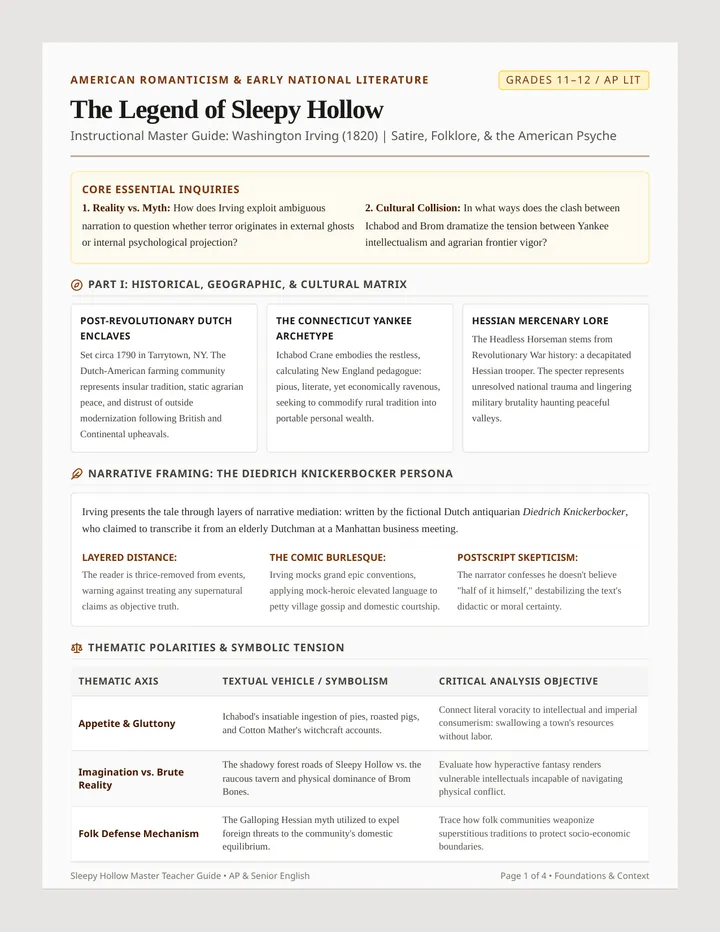
Historical Context: The Young Republic
PART 01
The Dutch Enclave
Set around 1790 in Tarrytown and the secluded glen of Sleepy Hollow, founded by Dutch settlers who preserved archaic customs, insulated from the rapid pace of American change.
A timeless pocket resisting modernization
Birth of American Myth
Published in 1820 in The Sketch Book. Irving proved American soil possessed its own legends, answering British critics who claimed America lacked history and lore.
First internationally acclaimed US author
Revolutionary Scars
The Hudson Valley was a contested neutral ground in the War of Independence, plagued by skirmishes, spies (Major John André), and Hessian mercenary troops whose violence haunted the collective memory.
Real battle trauma turned ghost story
Critical Lens: Notice how Irving contrasts the restless, ambitious Yankee mindset with the stable, sedentary Dutch tradition.
Folklore & The Hessian Horseman
PART 02
The Legend of the Hessian
The dominant ghost is said to be a Hessian trooper decapitated by a cannonball in a Revolutionary skirmish, buried in the churchyard.
He gallops nightly toward the battlefield in frantic quest of his missing head before daybreak summons him back to his grave.
"The ghost rides forth to the scene of battle in nightly quest of his head..."
Oral Storytelling Culture
Yarns swapped at fireside tea tables were treated as communal history rather than idle entertainment.
Transplanted Lore: German tales (Bürger’s Lenore, Wild Huntsman) adapted to American soil.
Psychological Suggestion: Shared superstition conditions the community to perceive monsters in shadows.
Notice who tells the stories: Dutch elders, veterans, and local yarn-spinners. QUESTION: Who controls the narrative?
Gothic Conventions in the Hollow
PART 03
Sentient Nature
The wilderness is alive, menacing, and responsive. Trees groan, brooks murmur warnings, and shadows shift with intent.
The Romantic Sublime
Ambiguity
Irving refuses a single answer: Is the Horseman an actual demonic specter, or Brom Bones wielding a pumpkin?
Supernatural vs. Rational
Psychological Fear
Terror is incubated in Ichabod's fevered brain. His obsession with witch lore makes him his own executioner.
Internal Paranoia
Haunted Thresholds
Crucial action occurs at liminal boundaries: Wiley's Swamp, Major André's Tree, and the old Dutch Church bridge.
Liminal Geographies
American Gothic replaces European castles with untamed forests, decaying homesteads, and colonial superstitions.
Character Foil: The Battle for Sleepy Hollow
PART 04
Ichabod Crane
The Yankee Pedant
- Physicality: Gaunt, lanky, scarecrow-like caricature; out-of-place pedant.
- Motivation: Gluttony and material avarice; courts Katrina to liquidate her father's estate.
- Mindset: Book-smart but credulous; steeped in Cotton Mather's witchcraft lore.
Brom Van Brunt
"Brom Bones"
- Physicality: Burly, roistering, broad-shouldered frontier vitality and equestrian skill.
- Motivation: Local pride, genuine affection for Katrina, mastery of community humor.
- Mindset: Frontier pragmatism; weaponizes superstition through bold theatrical cunning.
Irving's Narrative Irony: Diedrich Knickerbocker frames the story with playful satire. Neither Ichabod nor Brom represents pure virtue; both expose the comic absurdities of early American character types.
Annotation Toolkit: What to Mark
PART 05
LENS 1
Tone & Satire in Folk Etymology
Mark where domestic humor deflates solemn history (e.g. how husbands "tarried" at taverns drinking beer, giving Tarry Town its name).
LENS 2
Hypnotic Atmosphere & Setting
Annotate diction conveying the tranquil, narcotic spell of the valley—how everyone feels sleepy and troubles are effortlessly forgotten.
LENS 3
Faith vs. Superstition Paradox
Flag the psychological contradiction in the settlers: believing strongly in God while simultaneously embracing ghosts, spirits, and forest music.
LENS 4
Hearsay & Oral Storytelling Rules
Track the mechanics of local folklore: phrases like "that is what they said" and the rigid ghostly rule to return before daybreak.
Apply these four lenses directly to the text excerpts on the next two slides. Active Annotation Challenge
Close Annotation: The Spell of the Valley
PRACTICE 01
Passage: Tarry Town & The Sleepy Glen
"On the eastern bank of the great Hudson River, in North America, there is a small town. Its name is Tarry Town... They stayed or 'tarried' in the town and they drank beer at the inns there. So people started to call the place Tarry Town."
"About two miles from Tarry Town is a little hollow... The valley is a very peaceful place. Everyone who goes there soon feels peaceful. They quickly forget their troubles. And everyone who lives there always feels sleepy."
"...They believed strongly in God. But they also believed very strongly in ghosts and spirits. They often saw strange things at night. They often heard music in the forest when nobody else was there."
Domestic Satire
Notice the playful explanation for "Tarry Town"—husbands lingering over beer instead of obeying their wives.
Hypnotic Diction
Repetition of "peaceful" and "sleepy" establishes an intoxicating, trance-like atmospheric spell over the setting.
The Spiritual Paradox
Piety coexists with supernatural dread—hearing phantom forest music reveals an imaginative, haunted worldview.
Annotation Question: Why does the author connect the peacefulness of nature with supernatural vulnerability? PAIR DISCUSSION
Close Annotation: The Headless Horseman
PRACTICE 02
Passage: The Cannonball & The Midnight Quest
"The most famous of these stories was about the ghost of a man on a horse. Lots of people saw the man - that is what they said. He rode a huge black horse, as fast as the wind... And there was something even more terrible about him. He had no head!"
"'The Headless Horseman is the ghost of a soldier,' they said... 'In this battle, the soldier's head was shot off by a cannonball from a British gun.'"
"'Every night, the Horseman rides back to the battlefield to look for his head. But he never finds it. And he always has to return to the graveyard before dawn. All ghosts have to go back to their graves before the daylight comes... That's why he rides so fast.'"
Oral Transmission Markers
"That is what they said"—mark the narrator's subtle distance from absolute fact, framing the terror as community legend.
Historical Violence Mythologized
Real Revolutionary war trauma (a decapitating British cannonball) is transformed into supernatural folklore.
Gothic Boundary of Dawn
The rigid curse: sunlight disarms supernatural power. The ghost's terrifying speed is born of desperation, not malice.
Annotation Task: Underline evidence showing how the community rationalizes the ghost's relentless speed. 5 MIN EXERCISE
Essential Questions for Reading
SYNTHESIS
The Culprit & The Pumpkin
Why does Irving conclude with the shattered pumpkin and Brom's knowing smile, yet leave the townspeople convinced of the supernatural?
Truth vs. Folklore
Puritan Greed vs. Pastoral Peace
How does Irving critique Connecticut Puritanism and commercial materialism through Ichabod's hunger to convert land into cash?
Social Satire
The Function of Ghost Stories
In a newly established nation without castles or ancient ruins, why did early Americans urgently construct their own hauntings?
National Identity
Next Step: Begin Chapter 1 Reading with Annotation Toolkit active. Due for Next Class
Hollow Lore Teacher Guide
Instructional Resource • AP / Grades 11–12 Literature Washington Irving’s Sleepy Hollow
Hollow Lore Teacher Facilitation Guide
1 Period (50–60 Min)
A roadmap for delivering the introductory slides, guiding student annotation of early American folklore, and deconstructing Irving's Gothic satire.
Instructional Objectives
- Situate Sleepy Hollow within early American nation-building & Dutch folklore.
- Distinguish Gothic conventions: the Romantic sublime vs. psychological terror.
- Annotate tonal shifts, domestic satire, and oral narrative qualifiers.
Core AP Literature Skills
- CHR 1.A: Character foiling (Ichabod Crane vs. Brom Bones).
- SET 2.A: Atmosphere and landscape as an active antagonist.
- NAR 4.C: Diedrich Knickerbocker’s ironic, unreliable narration.
LESSON PACING & SEQUENCE (55-MINUTE MODEL) Adjustable for 90-min blocks
00–10 Min Hook & Historical World Slides 1–2: Hudson Valley as post-Revolutionary neutral ground; Irving's mission to craft authentic American folklore.
10–25 Min Folklore & Gothic Tropes Slides 3–5: The Hessian myth, sentient nature, and the satirical contrast between Ichabod's superstition and Brom's vitality.
25–45 Min Toolkit & Close Annotation Slides 6–8: Introduce 4 analytical lenses. Model Practice 1 (Valley's Spell); run student paired annotation for Practice 2 (Horseman).
45–55 Min Synthesis & Inquiry Debrief Slide 9: Whole-group discussion of Essential Questions (the shattered pumpkin, social satire of Yankee greed vs. Dutch calm).
Slide-by-Slide Direct Instruction Notes (Slides 1–5)
Slide 2: Historical Context Contextualization
Emphasize that the Hudson Valley was literally soaked in blood 15 years before the story takes place. The neutral ground saw brutal banditry. The ghosts are not detached fantasy; they are unresolved trauma from the Revolution.
Slide 3: Folklore Culture Oral Tradition
Point out the communal function of storytelling. In an agrarian, winter-bound community without books or television, oral legends served as community entertainment, historical archive, and social control.
Slide 4: American Gothic Literary Tropes
Contrast European Gothic (crumbling cathedrals, aristocratic curses) with American Gothic (wild hemlocks, colonial swamps, puritan paranoia). Irving pioneers the uniquely American setting of terror.
Slide 5: Ichabod vs. Brom Character Foils
Caution students against seeing Ichabod as an innocent victim. He is an opportunist who desires Katrina solely for her father's wealth and pies. Brom Bones, though rough, is an organic protector of the community.