Answer key for Lesson 3's RT60 Analysis Worksheet. Provides full numerical solutions for reverberation time calculations and conceptual design analysis.
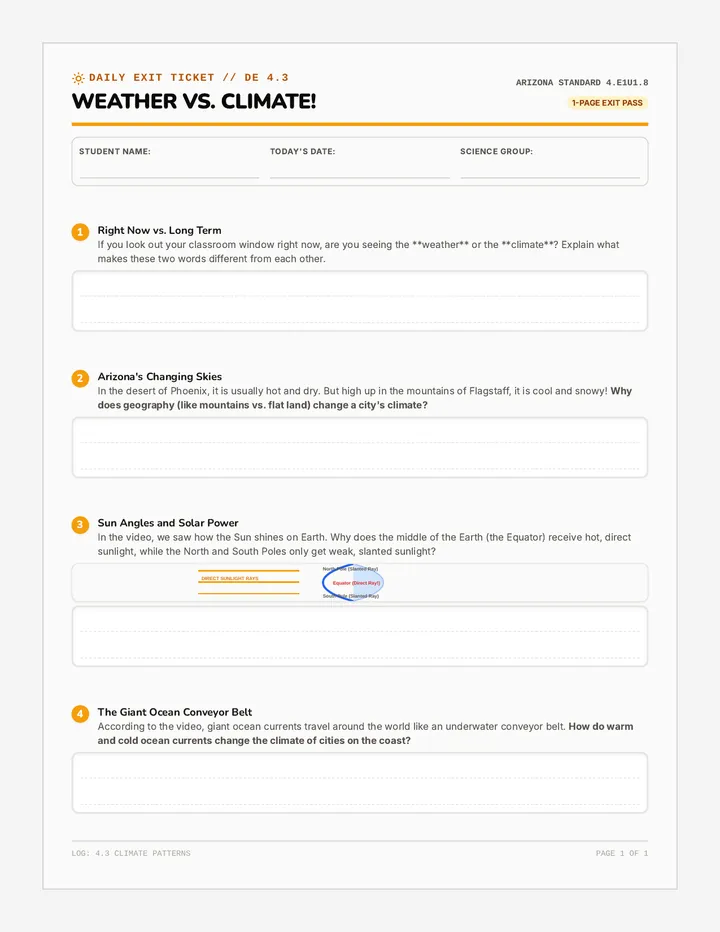
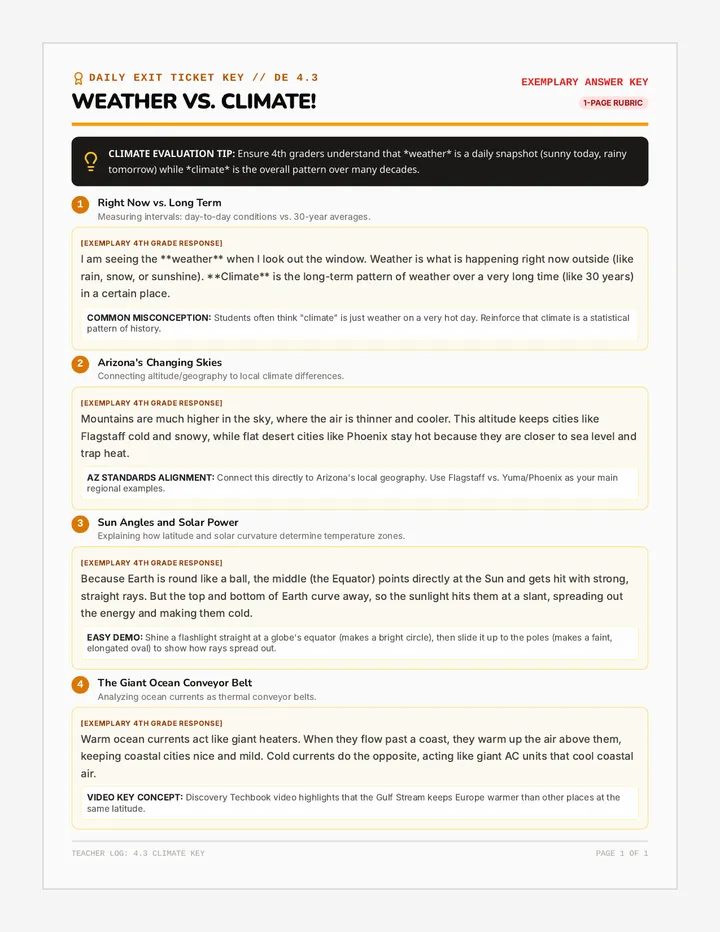
A teacher's answer key for the Heart Highway circulatory system worksheet, including standard alignment for each question and brief rationales. Consolidated for single-page printing.
A reading comprehension worksheet on the circulatory system for 3rd grade. Features a passage about the heart and blood vessels with 10 multiple-choice questions aligned to NC ELA standards for main idea, cause and effect, and vocabulary. Layout optimized for clean page breaks and condensed into 3 pages.
A teacher's answer key for the Lung Logistics reading comprehension worksheet, including standard alignment for each question and brief rationales for correct answers. Consolidated for single-page printing.
A reading comprehension worksheet on the respiratory system featuring a 3rd-grade level passage and 10 multiple-choice questions aligned to NC ELA standards for main idea, cause and effect, and academic vocabulary. Layout optimized for clean page breaks and condensed into 3 pages.
A comprehensive teacher answer key for the Thermochemisrty Study Guide. It provides detailed scaffolded logic for all 16 questions, including mathematical step-by-step breakdowns and pedagogical strategies for each section. All notation is simplified for clear, error-free printing. Layout condensed for 3-page efficiency.
A comprehensive 5-page student study guide for the thermochemistry unit. Features 16 distinct review tasks, standardized multiple-choice styling, and improved work areas for calculations. All chemical and mathematical notation uses ASCII text for perfect PDF rendering. Includes scaffolded "Guided Examples" for every section. Optimized for professional print and instructional clarity. Layout condensed for 5-page efficiency.
A teacher's guide for managing the Elemental Deep Dive project, including pacing suggestions, grading tips for technical scientific content, and a recommended slide deck structure.
A research organizer for students to gather and structure data on their chosen chemical element before creating their final presentation, aligned with the project's rubric categories.
A comprehensive point-based rubric for a student presentation on a chemical element, featuring technical blueprint styling and clear scoring criteria across five major scientific categories.
A revised teacher answer key for the pipe sizing worksheet, featuring high-contrast answers, corrected page breaks, and completed calculation examples.
A revised practice worksheet for pipe sizing, now with dedicated work areas for student calculations and corrected page breaks for better usability.
A revised reference document containing WSFU values and sizing tables from 248 CMR, optimized to fit on a single page for student use.
Introductory slides for plumbing pipe sizing based on Massachusetts 248 CMR, covering WSFU concepts, the difference between tank and flush valve systems, and the 4-step sizing process.
Une fiche d'exercices ultra-simplifiée "à trous" pour permettre à un débutant complet de construire ses premières requêtes SQL sans stress. Version révisée avec espaces d'écriture élargis et mise en page fixe.
Un guide ultra-simplifié pour les débutants qui ne connaissent rien au SQL, utilisant des analogies concrètes (la commode, le restaurant) pour expliquer les bases. Version révisée avec exercices et mise en page optimisée.
Des slides d'introduction extrêmement visuelles et rassurantes pour un débutant complet, utilisant l'analogie du restaurant pour démystifier le SQL.
Une fiche d'exercices ultra-simplifiée "à trous" pour permettre à un débutant complet de construire ses premières requêtes SQL sans stress.
Un guide ultra-simplifié pour les débutants qui ne connaissent rien au SQL, utilisant des analogies concrètes (la commode, le restaurant) pour expliquer les bases.
An interactive network topology activity for the Dakar Breach Simulation, allowing undergraduate students to physically map out a secure 3-tier enterprise architecture.
The final project prompt for the Dakar Breach Simulation, tasking undergraduate students with redesigning an enterprise network architecture and proposing defensive protocols in a formal report format.
A student-facing analysis worksheet designed for cybersecurity undergraduates to dissect log data and identify attack vectors in a simulated network breach scenario.
Visual presentation slides for the Dakar Breach Simulation, featuring high-impact "Mission Control" styling to engage undergraduate students in incident response and vulnerability analysis.
A comprehensive instructional guide for the Dakar Breach Simulation, detailing learning objectives, required materials, and a 120-minute pacing guide for undergraduate cybersecurity lessons.
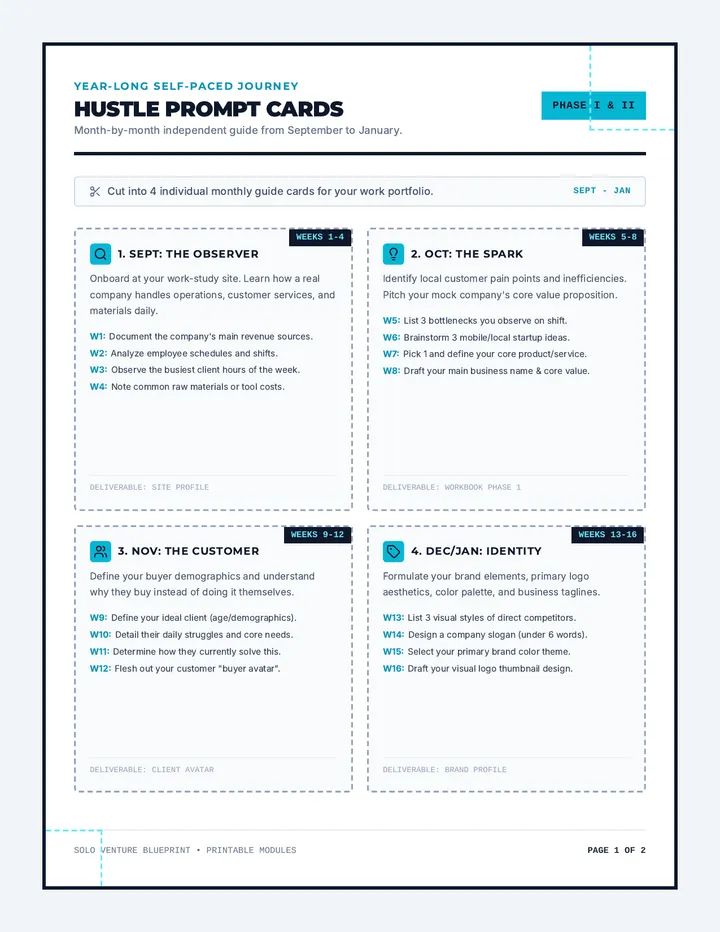
A student-facing 'Survival Guide' checklist for the 5-week Capstone project, summarizing weekly goals and the MVP mindset.
A comprehensive weekly milestone rubric for the 5-week Tech Capstone project, aligned with the Level 1-4 grading scale used in Nova Scotia schools.
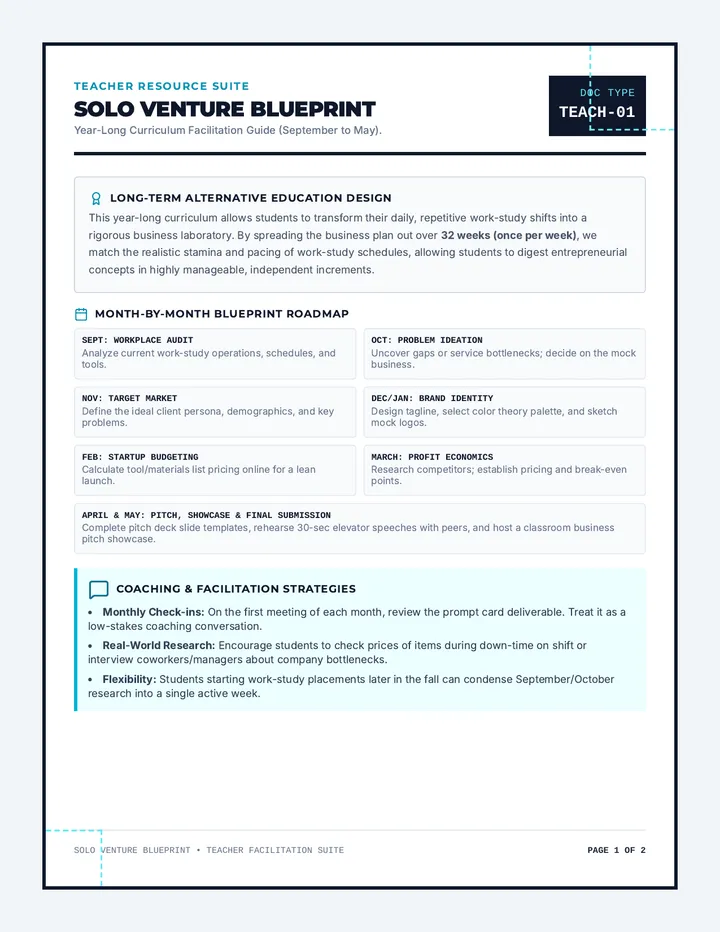
Teacher-facing evaluation and pedagogical explanation of the 5-week Tech Capstone project, including curriculum alignment for Nova Scotia Exploring Technology 10.
A student-facing Field Observation Journal for recording scientific inquiries. Includes sections for sketching local Indiana pollinators with detailed labeling, analyzing the symbiotic relationship between plants and animals, and reflecting on conservation efforts.
Fiche récapitulative SQL bilingue mais à titre principal en français, avec sections MySQL spécifiques et espace de notes. Version révisée.
A student-facing activity sheet for the pollination simulation. It guides students through a hands-on modeling exercise using cheese puffs to visualize pollen transfer, with designated spaces for drawing observations and reflecting on scientific results.
An engaging slide deck for the Pollinator Partners lesson, featuring high-contrast visuals, interactive mystery prompts, and clear explanations of the pollination process in the Indiana ecosystem.
Slides sur SQL pour Big Data et IA avec plan de cours, introduction aux CTE et conseils d'optimisation. Version révisée et complétée.
Slides sur les jointures SQL avec diagrammes de Venn SVG précis et exemples de code complets. Version révisée.
A comprehensive teacher facilitation guide for the Pollinator Partners lesson, including lesson objectives, material checklists, a detailed instructional sequence, and differentiation strategies.
Slides couvrant les fonctions d'agrégation et GROUP BY. Version révisée pour une meilleure symétrie visuelle.
Une fiche d'exercices pratique permettant aux étudiants d'appliquer les concepts SELECT, FROM et WHERE sur un scénario d'e-commerce réel. Version révisée avec zones de travail blanches.
Une fiche récapitulative élégante et dense regroupant toutes les commandes SQL essentielles pour un analyste de données, de la sélection de base aux jointures complexes.
Slides explorant le rôle crucial de SQL dans l'écosystème Big Data et l'IA, ainsi que les principes d'optimisation de performance.
Slides expliquant le fonctionnement des jointures SQL, la différence entre INNER et LEFT JOIN, et le concept de clés étrangères.
Slides couvrant les fonctions d'agrégation (SUM, AVG, COUNT) et la puissance de la clause GROUP BY pour l'analyse de données.
Slides expliquant comment trier les résultats avec ORDER BY, limiter le volume avec LIMIT et trouver des valeurs uniques avec DISTINCT.
Une fiche d'exercices pratique permettant aux étudiants d'appliquer les concepts SELECT, FROM et WHERE sur un scénario d'e-commerce réel.
Une présentation visuelle pour introduire les concepts de base de SQL (SELECT, FROM, WHERE) avec une esthétique technologique moderne.
Guide d'évaluation final pour l'instructeur, contenant la grille de correction et les solutions détaillées du projet de synthèse.
Projet final de synthèse demandant aux étudiants d'appliquer l'ensemble des connaissances SQL (SELECT, JOIN, Aggregations, Calculs) sur un cas réel d'IA.
Slides avancés introduisant les sous-requêtes et les CTE (Common Table Expressions) pour structurer des analyses complexes.
Corrigé détaillé pour les exercices de la leçon 2, incluant des explications sur la différence entre WHERE et HAVING.