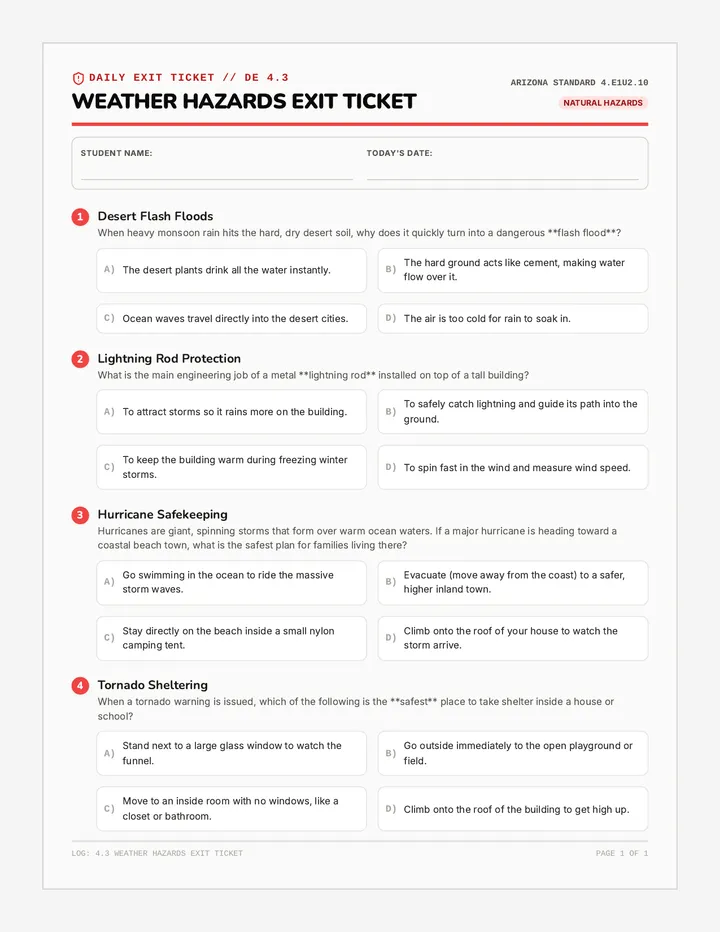
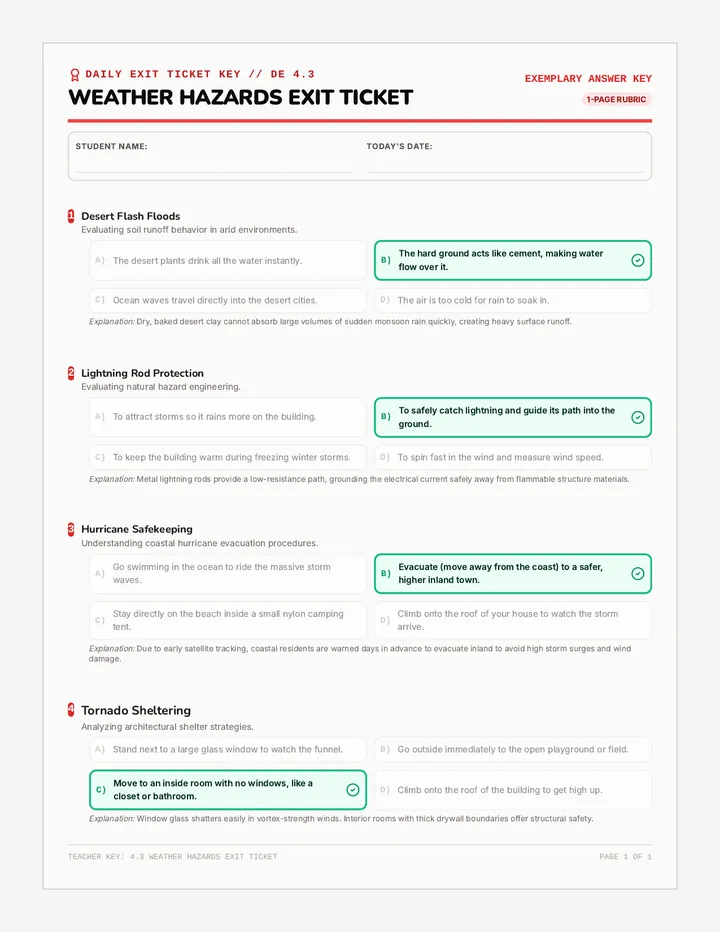
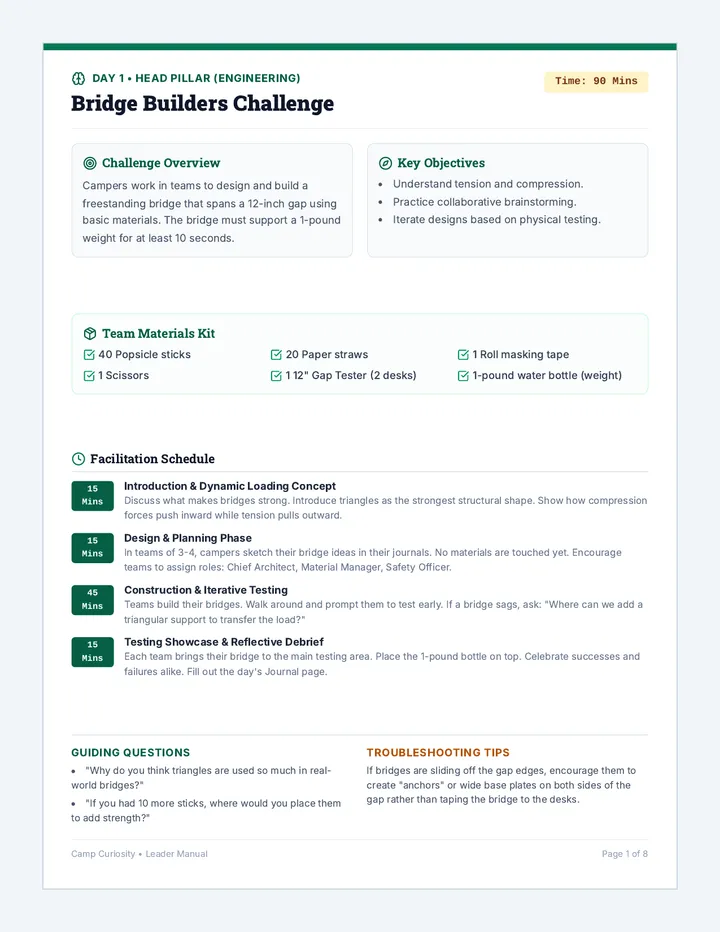
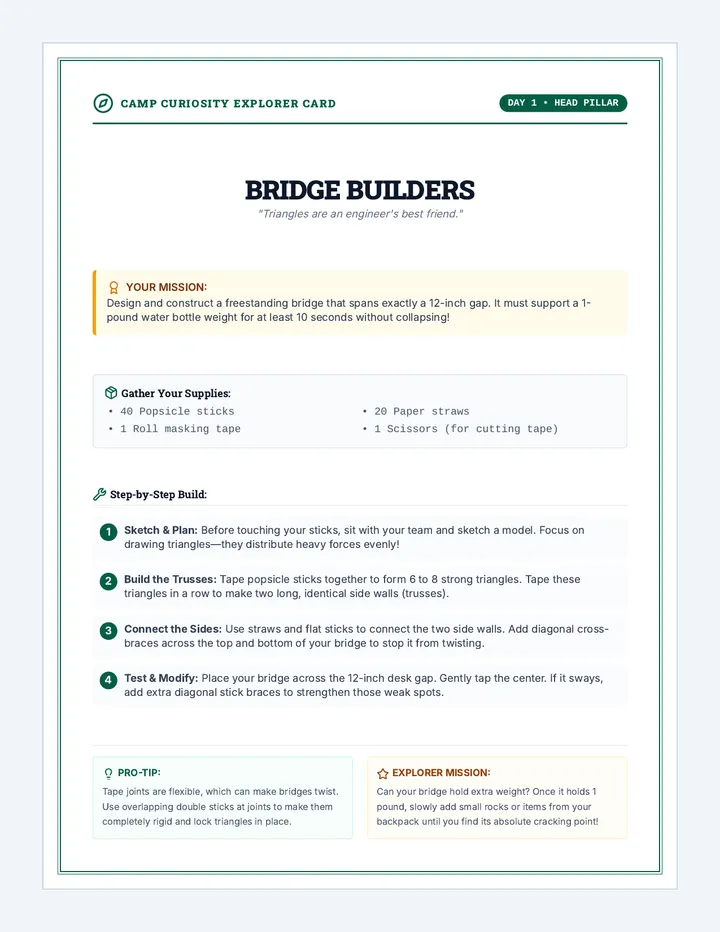
Instructional slides for the Robot Rescue Mission, featuring the Crash Course Kids video challenge, key engineering vocabulary, and activity instructions.
A streamlined, single-page rubric for assessing turbine engineering performance and scientific reasoning.
A student worksheet for recording hypotheses and data, condensed to fit perfectly on a single page.
A student-facing activity guide with clear, step-by-step instructions for constructing wind turbine blades, now condensed to a single page with a sketch area.
Engaging presentation slides introducing wind energy concepts, Vermont's renewable initiatives, and the engineering challenge.
A comprehensive teacher guide for leading the wind energy engineering lesson, featuring Vermont-specific context, instructional steps, and classroom management tips.
A set of six large vocabulary cards designed for a classroom word wall, featuring key plant science terms with clear definitions and icons.
A set of six visual instruction cards depicting the life cycle of a plant, from seed to dispersal, with botanist notes and key facts.
A detailed instructional guide for teachers to lead a STEAM lesson on plant life cycles, including hands-on activities and assessment strategies.
A polished 3-page worksheet for a virtual food web simulation. It features a clean lab notebook aesthetic with clear organism checklists, a structured graph area with axis labeling prompts, and reflection sections. Designed for 6th-grade Life Science with improved PDF rendering stability and better spatial organization.
A narrator script and facilitation guide for teachers to use when recording or delivering the Wave Watchers presentation.
A choice board offering students six different creative and analytical ways to demonstrate their understanding of wave properties.
Fill-in-the-blank guided notes designed to be completed while viewing the Wave Watchers presentation.
A reading comprehension passage about energy transfer in waves followed by a 4-question quiz for assessment.
An interactive student worksheet for practice identifying wave parts and understanding energy transfer concepts.
A self-guided 10-slide presentation introducing 4th graders to wave properties (amplitude, wavelength) and energy transfer using an ocean explorer theme.
An instructional guide for setting up the 'Pollination Path' classroom game. Includes clear setup steps, game rules for students, and printable station labels with different flower names.
A student recording sheet for the 'Pollination Path' simulation. Includes space for tallying nectar collection, tracking pollen transfer, and a drawing section to visualize the symbiotic relationship between bees and flowers.
A high-visual instructional slide deck for the 'Pollination Path' lesson. Features large text (min 24px), bold graphics, and a clear step-by-step breakdown of the symbiotic relationship between bees and flowers.
A comprehensive teacher lesson plan for Grades K-4 detailing the 'Pollination Path' simulation. Includes NGSS alignment, supply lists, step-by-step procedures, and high-quality discussion prompts for exploring symbiosis.
A "Post-Orbit Debrief" exit ticket that assesses student understanding of the relationship between planetary mass and gravitational pull through conceptual questions and matching.
Station cards for "The Gravity Games" activity, providing clear instructions for the three primary Olympic events and a template for students to design their own.
An "Event Scoreboard" worksheet where students record their Earth athletic records and calculate their performance on other planets using gravitational multipliers.
A high-energy slide deck for "The Gravity Games," introducing the science of gravitational pull, planetary G-factors, and the mathematical formulas for the activity.
A teacher's lesson plan for "The Gravity Games," outlining instructional steps, learning objectives, and the mathematical formulas needed for the activity.
A set of six sensory-focused task cards designed to guide students' exploration in nature, including specific prompts for sight, sound, touch, smell, and mindfulness.
A 3-page field journal for students to record their sensory observations during the Earth Day walk, featuring dedicated sections for sight, sound, touch, and smell, along with a scientist's reflection.
A visual presentation to introduce the Sensory Scientist concept, the four safe senses for observation, and practice with descriptive scientific language.
A comprehensive teacher's guide for the Sensory Scientist lesson, including instructional steps, sensory-inclusive design tips, and a descriptive vocabulary word bank.
Large-print station cards for the Wave Racer activity. Each card occupies one full 8.5x11 page for clear classroom display. Includes thematic colors, precision SVG wave diagrams, scaffolded guides with worked examples, and all 22 problems from the source material. Optimized for rendering and distance reading.
A comprehensive teacher answer key for the Wave Racer station activity. Includes full solutions, pedagogical rationales, and tips for addressing common student misconceptions across all 22 problems. Revised for better contrast and page flow. Corrected exponents for rendering.
A scaffolded station recording log for students to solve wave property problems. Includes thematic station sections with rationales, variable identification boxes, and step-by-step math scaffolds for all 22 problems. Revised for better layout and to include missing problems. Improved consistency with station cards.
A teacher's facilitation guide for the Lunar Lookout lesson, providing discussion prompts, key facts, and an answer key for the student worksheet.
A student worksheet designed to reinforce moon phase identification through matching, short-answer questions, and a drawing exercise based on current observations.
An introductory 7-slide presentation covering the four primary moon phases (New, First Quarter, Full, and Third Quarter) with clear visual diagrams and key characteristics of each.
A student-facing Field Observation Journal for recording scientific inquiries. Includes sections for sketching local Indiana pollinators with detailed labeling, analyzing the symbiotic relationship between plants and animals, and reflecting on conservation efforts.
A student-facing activity sheet for the pollination simulation. It guides students through a hands-on modeling exercise using cheese puffs to visualize pollen transfer, with designated spaces for drawing observations and reflecting on scientific results.
An engaging slide deck for the Pollinator Partners lesson, featuring high-contrast visuals, interactive mystery prompts, and clear explanations of the pollination process in the Indiana ecosystem.
A comprehensive teacher facilitation guide for the Pollinator Partners lesson, including lesson objectives, material checklists, a detailed instructional sequence, and differentiation strategies.
An informational reading passage for students about the meteorology of Indiana's tornadoes, the EF scale, and structural engineering principles for wind resistance. Revised for better page breaks and expanded writing space in the quiz.