Pitch Filter Reference Guide
Class Discussion Prep & Framework Guide
The 60-Second Pitch Blueprint
Core Prompt: Deciding what to keep/cut & building clear, persuasive messaging under extreme time limits.
Time Budget
01:00
1
The Information Triage: How to Decide What Stays vs. Goes
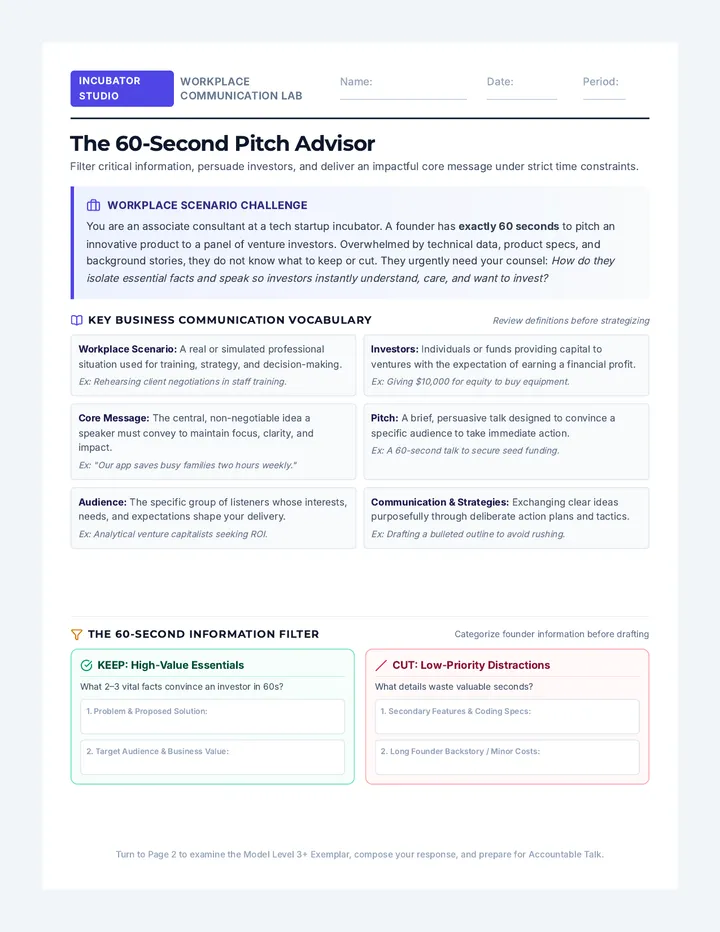
In 60 seconds (~130–150 spoken words), every sentence must survive a brutal filter: Does this build immediate conviction, or does it add cognitive noise?
WHAT TO KEEP (High Signal)
- • The Unbearable Pain: A real, urgent problem the listener instantly recognizes.
- • The Secret Sauce: The single mechanism that makes your solution 10x better.
- • Tangible Transformation: Concrete outcome (time saved, money gained, stress erased).
- • The Single "Ask": Exactly one effortless next step (demo, test drive, card swap).
WHAT TO CUT (Low Signal / Clutter)
- • Origin Story: "It all began 3 years ago when I was sitting in my dorm..." (Cut 100%).
- • Feature Laundry Lists: Technical specs, cloud architecture, and menu sub-items.
- • Pricing Mechanics: Tier structures and discounts belong in the follow-up meeting.
- • Corporate Jargon: "Synergistic paradigm-shifting AI-enabled workflows."
2
The 4-Beat Narrative Arc (How to Budget 60 Seconds)
0:00 – 0:10
The Hook
Interrupt attention with a startling metric, relatable pain point, or sharp question.
0:10 – 0:25
The Tension
Name the broken status quo. Show why current alternatives fail or cause headaches.
0:25 – 0:48
The Breakthrough
Introduce the product + one killer differentiator and the primary outcome delivered.
0:48 – 1:00
The Close (CTA)
Deliver a single friction-free ask that locks in curiosity and opens the door.
3
3 Psychological Persuasion Levers
1. High-Concept Anchor
Borrow familiarity instantly: "We are Airbnb for campus storage" or "Grammarly for spreadsheet formulas." Saves 20 seconds of explanation.
2. Contrast Framing
Juxtapose the agonizing Old Way vs. the frictionless New Way. Contrast triggers emotional urgency far faster than standalone praise.
3. Rule of One
One target avatar, one burning headache, one metric of proof. If you pitch to "everyone," you persuade nobody. Clarity equals credibility.
The Golden Rule of 60 Seconds
"The goal of a 60-second pitch is never to close the deal—it is solely to earn a second, longer conversation."
Target Pace
130 words / min
Pitch Architecture & Decision Rubric Page 1 of 2
Comprehensive Discussion Exemplars
In-Depth Class Comment Drop Answers
Full-length, analytically rigorous responses complete with behavioral theory and concrete pitch mechanics.
Comprehensive Grade A+
RESPONSE OPTION 1
The Theoretical & Strategic Analysis (~185 Words)
In-Depth Analytical
"When constrained to a 60-second window (approximately 130–140 words), information prioritization is governed by cognitive load theory: any mental energy the listener spends decoding technical specifications is energy stolen from persuasion. To decide what to keep versus leave out, I apply a strict 'Signal-to-Noise' triage. I eliminate founder origin stories, technical architectures, comprehensive feature lists, and pricing models—details that belong in subsequent due diligence. What remains are three non-negotiables: the visceral customer pain point, our single proprietary mechanism of relief, and measurable proof of transformation.
To make the core message clear and persuasive, I leverage three strategic psychological levers:
- High-Concept Anchoring: Borrowing familiarity (e.g., 'We are X for Y') instantly establishes mental schemas without wasting 20 seconds on definitions.
- Contrast Framing: Juxtaposing the painful friction of the status quo against the effortless simplicity of our solution triggers immediate loss aversion.
- A Frictionless Ask: The pitch does not attempt to close a deal; its sole objective is securing a scheduled 15-minute follow-up."
RESPONSE OPTION 2
The Applied Practitioner Teardown (~165 Words)
Applied Case Study
"I approach a 60-second pitch like a movie trailer: spotlight the villain, reveal the hero weapon, and cut to black with an irresistible hook. For example, pitching a student workflow app:
• 0:00–0:15 (The Problem): 'College students waste 5 hours every week manually cross-referencing syllabi and group project schedules.' (Cut: personal dorm room anecdotes).
• 0:15–0:40 (The Solution): 'SyncCampus uses intelligent calendar synthesis—snap a photo of any syllabus, and your semester deadlines auto-populate conflict-free.' (Cut: backend database architecture).
• 0:40–1:00 (Proof & CTA): 'In our 5 campus pilots, 87% of students avoided missed deadlines. Let’s set up 10 minutes this Thursday to walk through the dashboard.' (Cut: multi-tiered pricing matrices).
By trading feature checklists for concrete imagery and measurable outcomes, you convert sixty seconds into an open door."
Instructor Evaluation Criteria
Why This Answer Earns Top Marks
Addresses both prompt dimensions (selection methodology + persuasion psychology), cites cognitive mechanisms, and balances analytical principles with real-world execution.
100%
Rubric Match
Comprehensive Discussion Exemplars & Applied Teardowns Page 2 of 2