ILEARN Checkpoint Master Guide
IN
Indiana Academic Standards Checkpoint 1 (Sept–Nov)
Grade 3 ELA Master Pacing & Blueprint Guide
Target Items: 20–25 (CAT)
Testing Window: Weeks 8–10
Domain Focus: Reading Comprehension (Lit & Informational), Vocabulary, & Language Conventions
Grade 3 Assessment Framework
Checkpoint 1 Standard Blueprint & Priority Breakdown
(E) = Essential Standard (Tested for All Students)
| Indicator | Priority | Assessed Standard Description | Subdomain / Item Type |
|---|
| 3.RC.1 (E) | Essential | Ask and answer questions to demonstrate understanding of a text, referring explicitly to the text as the basis for the answers. | Reading Comprehension (EBSR / SCR) |
| 3.RL.2.2 (E) | Essential | Recount stories; determine the central message, lesson, or moral and explain how it is conveyed through key details in the text. | Literature (Multiple Select / EBSR) |
| 3.RL.2.3 | Standard | Describe characters in a story (e.g., their traits, motivations, or feelings) and explain how their actions contribute to plot events. | Literature (Table Match / MC) |
| 3.RN.2.1 (E) | Essential | Identify the main idea of a text; recount the key details and explain how they support the main idea. | Nonfiction (Part A / Part B) |
| 3.RV.2.1 (E) | Essential | Determine or clarify the meaning of unknown words using context clues, prefixes (un-, re-, pre-), suffixes, and root words. | Vocabulary (Context / Morphology) |
| 3.W.6.1 | Standard | Demonstrate command of capitalization, ending punctuation, regular/irregular plural nouns, and subject-verb agreement. | Language & Editing (Editing Tasks) |
9-Week Master Instructional Pacing Schedule
Weeks 1–3: Launch Foundations
- W1: 3.RC.1 Explicit questioning & locating text evidence in narrative prose.
- W2: 3.RL.2.3 Character traits, feelings, and actions driving plot.
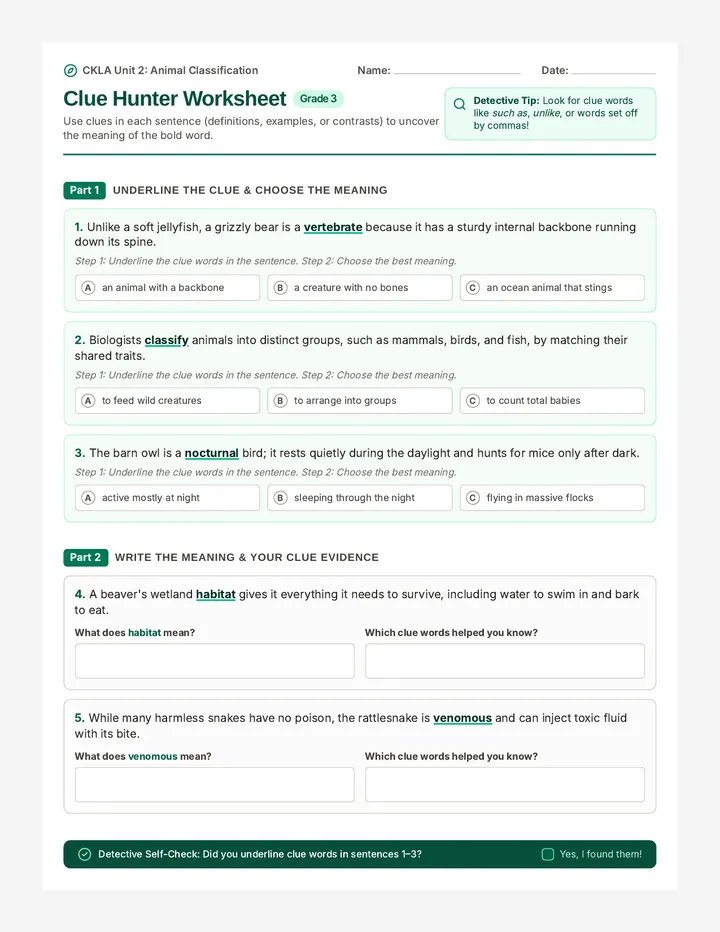
- W3: 3.RV.2.1 Context clues (definition & restatement clues) in literary passages.
🎯 Milestone: Baseline Evidence Quick-Check
Weeks 4–6: Core Depth Deep Analysis
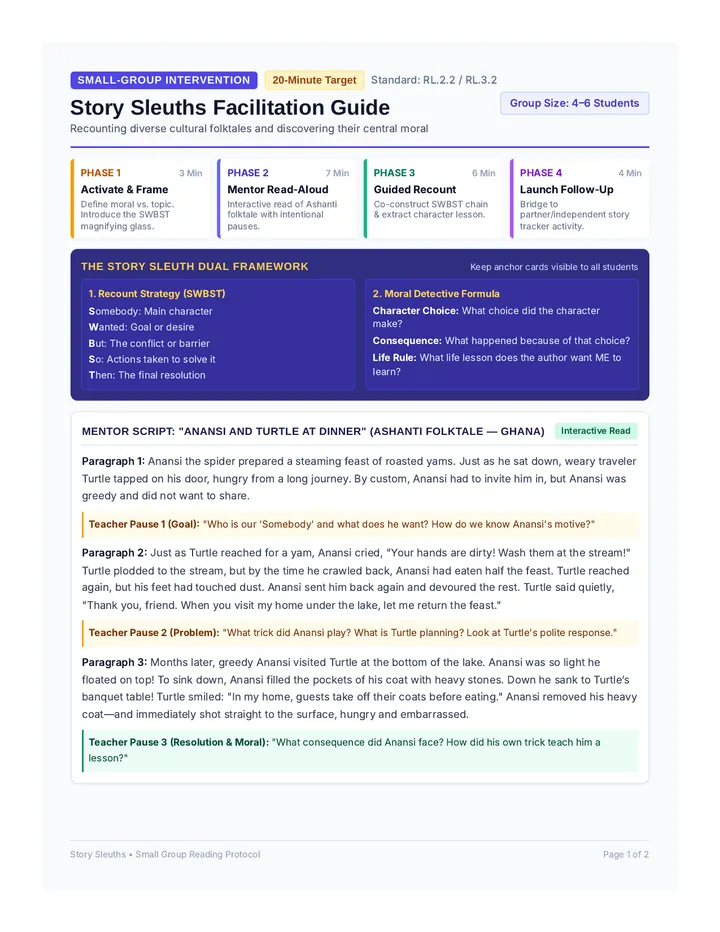
- W4: 3.RL.2.2 Central message, fables/folktales, and moral evidence.
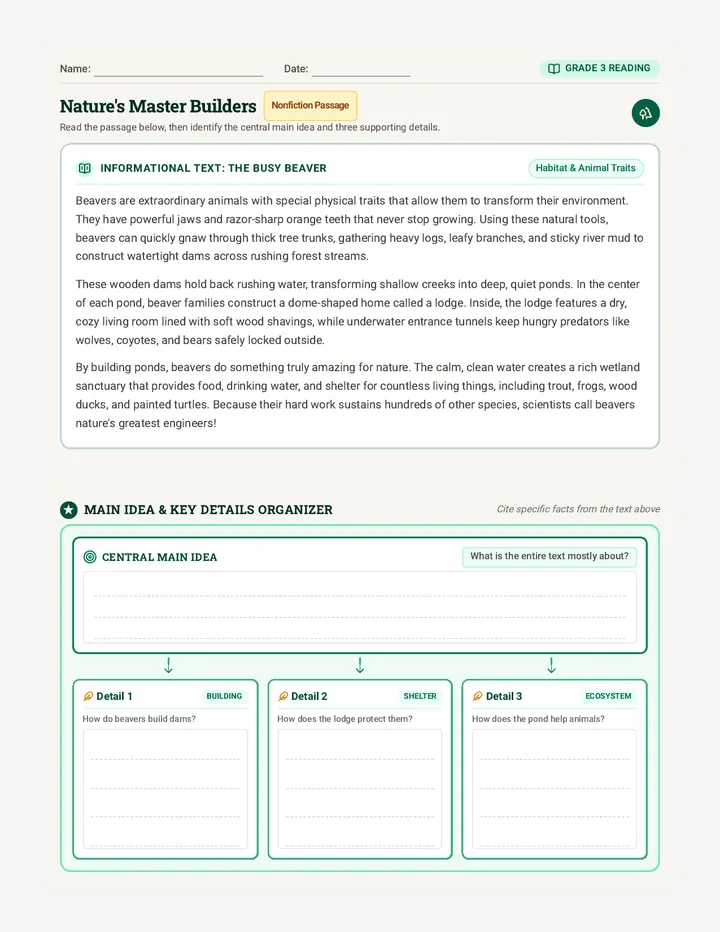
- W5: 3.RN.2.1 Informational text: Main idea vs. supporting details.
- W6: 3.RV.2.1 Prefixes (un-, re-, pre-) & suffix morphology with root words.
🎯 Milestone: Mid-Checkpoint Formative (EBSR)
Weeks 7–9: Review Test Readiness
- W7: 3.W.6.1 Editing for capitalization, plurals, and subject-verb agreement.
- W8: Paired passage integration (Lit + Nonfiction) & Part A/B mastery.
- W9: Checkpoint 1 Administration & Targeted Remediation Re-engagement.
🎯 Milestone: Official ILEARN Checkpoint 1
Indiana ILEARN Checkpoint 1 Instructional Framework • Grade 3 ELA Page 1 of 4
Teacher Toolkit & Unwrapping Matrix
Essential Standards Mastery Breakdown
DOK Levels 2 & 3 Focus
3.RC.1 Explicit Text Evidence & Questioning
Priority: Essential (DOK 2/3)
Student "I Can" Success Criteria:
- I can locate exact sentences in the text that prove my answer.
- I can explain why a piece of evidence supports my conclusion.
Common Misconceptions & Fix:
Students rely on prior memory or personal opinion instead of citing verbatim evidence from the passage. Prompt: "Point to the exact paragraph."
3.RL.2.2 Central Message, Lesson, or Moral
Priority: Essential (DOK 3)
Student "I Can" Success Criteria:
- I can state the universal life lesson the main character learns.
- I can connect key plot events directly to the story's moral.
Common Misconceptions & Fix:
Confusing the topic/summary (what happened) with the underlying moral (what the author teaches). Teach: "Theme = Life Lesson for the reader."
3.RN.2.1 Main Idea & Supporting Details (Nonfiction)
Priority: Essential (DOK 2/3)
Student "I Can" Success Criteria:
- I can identify the main point the author makes in the whole text.
- I can select 2 supporting facts that prove the main idea.
Common Misconceptions & Fix:
Selecting an interesting minor fact instead of the overarching main idea. Use the "Stool Leg" metaphor: main idea is the seat, details are legs.
3.RV.2.1 Context Clues, Affixes & Root Words
Priority: Essential (DOK 2)
Student "I Can" Success Criteria:
- I can use surrounding sentence clues to define unknown words.
- I can break words into prefix + root (e.g., re- + write = write again).
Target Checkpoint 1 Affixes:
Prefixes: un- (not/opposite), re- (again), pre- (before), dis- (not). Suffixes: -ful, -less, -ly, -able.
Checkpoint 1 High-Frequency Testing Vocabulary
Explicit / Evidence Stated directly in text; word-for-word proof.
Central Message The big lesson or moral the author wants readers to learn.
Recount / Summarize Retell key beginning, middle, and end events in order.
Motivate / Traits Why a character acts (reason) & personality qualities.
Indiana ILEARN Checkpoint 1 Instructional Framework • Grade 3 ELA Page 2 of 4
Item Bank: Section 1
Literature & Vocabulary Practice Stems
Standards: 3.RL.2.2, 3.RL.2.3, 3.RV.2.1
Passage 1 (Literature): "Maya and the River Rescue" Grade 3 Lexile: 560L
[1] Maya gripped the wooden paddle as the river current pulled against her canoe. Her younger brother, Leo, pointed nervously toward the rocky bend where a helpless duckling was trapped under tangled willow branches. [2] Maya wanted to turn back because her arms were exhausted, but she remembered her grandfather’s words: "True bravery means helping those in danger, even when you feel tired." [3] With determined strokes, Maya navigated the rough water, reached the branches, and gently freed the shivering duckling.
Item 1: Evidence-Based Selected Response (EBSR) — 3.RL.2.2 & 3.RC.1 Essential Standard
Part A: Which sentence best states the central message of the story?
A. Always listen to river warnings.
B. Helping others requires courage and perseverance.
C. Canoeing with family is fun.
D. Animals should always live in quiet rivers.
Part B: Which detail from the text best supports the answer to Part A?
A. "Maya gripped the wooden paddle..."
B. "Leo pointed nervously toward the rocky bend..."
C. "...she remembered her grandfather’s words..."
D. "...her arms were exhausted, but she navigated..."
Item 2: Multi-Trait Character Matrix — Standard: 3.RL.2.3 Table Match Item
Match each character action from the story to the character trait it demonstrates. (Select one box per row)
| Action from Story | Concerned | Brave | Wise |
|---|
| Leo points nervously at the duckling | 🔲 | 🔲 | 🔲 |
| Grandfather teaches that true bravery helps others | 🔲 | 🔲 | 🔲 |
| Maya paddles through rough water to save the duckling | 🔲 | 🔲 | 🔲 |
Item 3: Morphology & Prefix / Suffix Application — Standard: 3.RV.2.1 Essential Standard
Read the sentence:
"The duckling was helpless until Maya arrived to untangle the vines."
What does helpless mean? A. Able to help others
B. Without any help or power
C. Very helpful
What does untangle mean? A. To tangle again
B. To free from being tangled
C. Tangled before
Indiana ILEARN Checkpoint 1 Instructional Framework • Grade 3 ELA Page 3 of 4
Item Bank: Section 2
Informational Text, Multi-Select & SCR Stems
Standards: 3.RN.2.1, 3.RC.1, 3.W.6.1
Passage 2 (Informational): "The Remarkable Honeybee Worker" Grade 3 Lexile: 590L
[1] Honeybees have specialized jobs that keep their colony alive and healthy. Worker bees perform essential tasks inside and outside the hive. [2] Young worker bees clean the wax cells and feed the developing larvae. As they grow older, they fly miles away to collect nectar and pollen from blooming flowers. [3] Without the teamwork of every worker bee, the hive could not survive the cold winter months.
Item 4: Main Idea & Key Details (EBSR) — Standard: 3.RN.2.1 & 3.RC.1 Essential Standard
Part A: What is the main idea of "The Remarkable Honeybee Worker"?
A. Honeybees like to visit blooming flowers.
B. Worker bees do crucial jobs that allow the colony to survive.
C. Winter is cold for insects.
D. Young bees only clean wax cells.
Part B: Select the TWO details that best support the answer to Part A.
A. "Worker bees perform essential tasks inside and outside the hive."
B. "Young worker bees clean the wax cells and feed the developing larvae."
C. "...fly miles away..."
D. "...the cold winter months."
Item 5: Short Constructed Response (SCR) — Standards: 3.RC.1 & 3.RN.2.1 2-Point Item
Prompt: How does a worker bee’s job change as it gets older? Use two explicit details from the text to support your answer.
2-Point Rubric Criteria:
- States both young tasks (clean/feed) and older tasks (fly/collect nectar).
- Explicitly cites details from paragraph 2.
Sample 2-Point Response:
"When worker bees are young, they clean cells and feed larvae. When they grow older, they fly miles away to collect nectar."
Item 6: Language Conventions & Plural Nouns — Standard: 3.W.6.1 Editing Focus
Which sentence correctly uses irregular plural nouns and proper capitalization?
A. Many person visited the Indianapolis Zoo to see the wolves.
B. Many people visited the Indianapolis Zoo to see the wolves.
C. Many people visited the indianapolis Zoo to see the wolfs.
D. Many persons visited the Indianapolis zoo to see the wolfes.
Indiana ILEARN Checkpoint 1 Instructional Framework • Grade 3 ELA Page 4 of 4