A technical guide for 10th-grade chemistry students on how to use their scientific calculators effectively for Dimensional Analysis. Covers the 'One-Line' method, scientific notation (EE button), and proper use of parentheses.
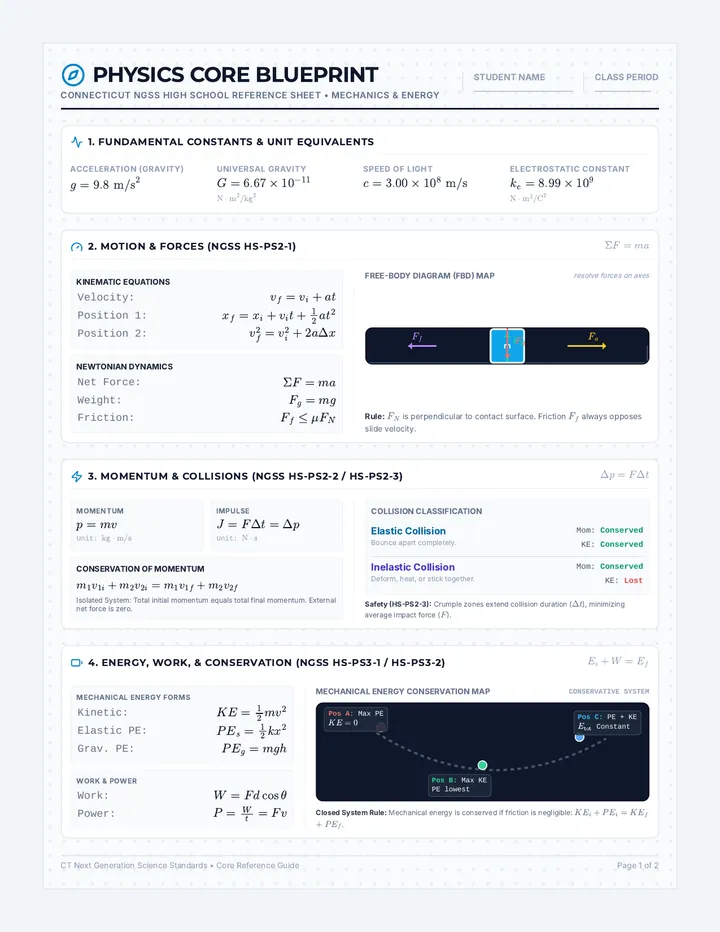
A teacher guide with standards, pacing, and pedagogical tips. Optimized for single-page use with improved contrast and layout.
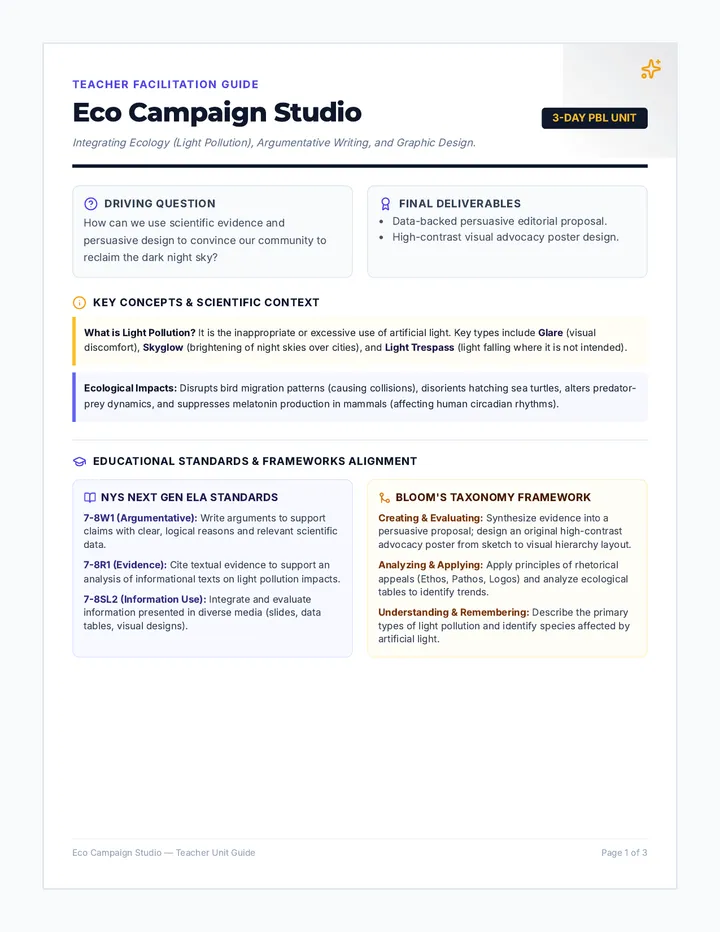
A structured planning document for advocacy projects. Optimized for 2-page printing with an expanded sketch area and clear checklist.
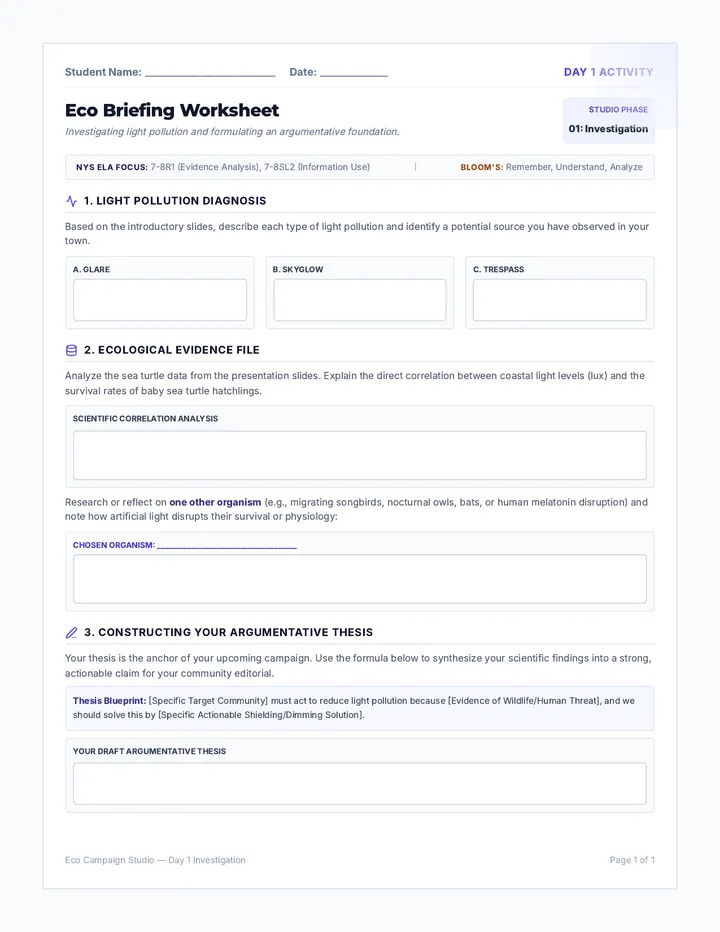
A research and analysis worksheet where students investigate environmental inequality. Optimized for 2-page printing with generous work areas and built-in visual aids.
A 6-slide presentation covering environmental justice concepts, the Flint water crisis, urban air pollution data, and potential community solutions.
A teacher-facing facilitation guide for the Waste Wise project, including learning objectives, pacing, safety notes, and discussion prompts.
A detailed grading rubric for the Trash to Treasure video project, focusing on scientific accuracy, creative execution, and technical quality.
A comprehensive project guide and rubric for high school students to create a video documentary or performance art piece focused on waste management and upcycling, inspired by Shoji Yamasaki.
A research primer for students explaining the mechanics of bioaccumulation and biomagnification, providing inquiry questions and scientific vocabulary to support their lab report research.
A formal grading rubric for teachers to assess the Plastic-Free Project lab report, focusing on research depth, challenge integrity, and scientific writing standards.
A two-week tracking log for students to document their single-use plastic encounters, attempted alternatives, and difficulty levels as part of their Zero Waste Quest project.
A comprehensive project guide for the Zero Waste Quest, detailing the challenge rules, research requirements on bioaccumulation, and the specific structure for the final formal lab report.
A student planning worksheet for the Portfolio Showcase. Includes a draft area for a professional bio, an asset inventory checklist for all Unit 4 projects, and a final launch area for the live URL. Optimized for single-page printing.
A facilitation guide for teachers covering Lesson 42-43: The Portfolio Showcase. Includes instructional scripts for the 'digital resume' hook, technical curation tips, and professional farewell notes. Optimized for single-page printing.
A celebratory and professional slide deck for the Portfolio Showcase. Guides students through the transition from students to founders, the philosophy of curation, and the technical steps to publish their work as a professional digital studio.
A student drafting worksheet for Lesson 41: The Business Reflection. Includes a SWOT analysis matrix for the pitch, space for a 3-paragraph strategic reflection (The Pivot Document), and an end-of-semester proud moment exit ticket. Optimized for single-page printing.
A teacher facilitation guide for Lesson 41: The Business Reflection. Includes instructional scripts for the 'famous pivot' hook, SWOT analysis instruction, and professional context on business retrospectives. Optimized for single-page printing.
A reflective slide deck for Lesson 41. Covers famous business pivots, introduces the SWOT analysis framework for performance evaluation, and guides students through drafting a 3-paragraph strategic reflection.
A student evaluator rubric and investment log for the two-day "Big Pitch" event. Includes a boardroom scoring table for peer feedback on visual design, data, and delivery, plus the final "Class Cash" investment decision. Optimized for printing.
A two-day facilitation guide for the Unit 4 Capstone: The Big Pitch. Includes room setup instructions, the 3+2 minute timing rules, and instructional scripts for the "Shark Tank" Q&A and final "Class Cash" investment reflection. Optimized for single-page printing.
A high-stakes presentation slide deck for the Unit 4 Capstone: The Big Pitch. Includes "Founder's Circle" hooks, 3+2 pitch rules, scoring criteria for design, data, and delivery, and the final "Investor's Choice" exit ticket.
A student rehearsal log and peer-feedback worksheet for Lesson 38. Includes a non-verbal fundamentals checklist, space for partner feedback on projection and filler words, and an exit ticket for self-correction. Optimized for single-page printing.
A facilitation guide for teachers covering Lesson 38: Public Speaking with Media. Includes instructional scripts for non-verbal communication, projection coaching tips, and professional speaking context. Optimized for single-page printing.
A high-impact slide deck for Lesson 38: Public Speaking with Media. Covers non-verbal communication, the speaker's toolkit (eye contact, posture), projection techniques, and a rehearsal roadmap.
A student planning and checklist worksheet for Lesson 37. Includes a data proof strategy section, a slide asset checklist for the final five slides of the pitch deck, and a project self-audit checklist. Optimized for printing.
A comprehensive teacher facilitation guide for Lesson 37: Building the Deck. Includes pacing, simplification strategies for data slides, animation techniques, and professional context on financial scrutiny. Optimized for single-page printing.
A professional slide deck for Lesson 37 focusing on data integration and presentation flow. Covers chart simplification, animation for storytelling, and provides a final project checklist for the full pitch deck. Corrected numbering and syntax.
A student drafting and checklist worksheet for Lesson 36. Includes brand alignment fields for HEX codes and typography, a slide asset checklist for the first five slides, and a professional audit section for visual consistency. Optimized for printing.
A comprehensive teacher facilitation guide for Lesson 36: Building the Deck. Includes instructional scripts for the 'Death by PowerPoint' hook, technical tips for master slides/frames, and professional marketing context.
A high-impact slide deck for Lesson 36 focusing on visual consistency in pitch decks. Covers the 'Death by PowerPoint' concept, master slide/branding techniques, and provides a clear checklist for the first five slides of the final project.
A student drafting worksheet for Lesson 35: The Anatomy of a Pitch. Includes space for scripting the 'Pain Point' hook, identifying key data points from research, outlining the solution/reveal, and crafting a 20-word elevator pitch. Optimized for single-page printing.
A comprehensive teacher facilitation guide for Lesson 35: The Anatomy of a Pitch. Includes instructional scripts for the Shark Tank hook, Guy Kawasaki structure notes, and pacing for the analog scripting activity. Optimized for single-page printing.
A professional slide deck for Lesson 35: The Anatomy of a Pitch. Covers the problem-solution story arc, the 10-Slide Rule, 'invisible' slide transitions, and provides an activity roadmap for drafting a script.
A student layout and planning worksheet for Lesson 34: The Print Ad. Includes sections for headline drafting, technical print specs, a horizontal billboard sketch area with safety zones, and a final export checklist.
A teacher facilitation guide for Lesson 34: The Print Ad. Includes technical instruction on CMYK subtractive color modes, bleed/margins, and facilitation notes for the 'Drive-By Test' hook.
A high-impact slide deck for Lesson 34: The Print Ad. Covers the 'Drive-By Test' for glanceability, RGB vs CMYK color modes, bleed/margins for production, and billboard design requirements.
A student planning and checklist worksheet for Lesson 33. Includes drafting space for hooks and CTAs, a vertical layout sketch area with safe zones, and a production checklist for Canva.
A teacher facilitation guide for Lesson 33: The Social Media Ad. Includes pacing, discussion prompts, and success criteria for student-designed ads.
A high-energy slide deck for Lesson 33 focusing on creating social media ads. Includes the Thumb-Stop Test hook, anatomy of a scroll-stopper ad, 9:16 safe zones, and animation techniques in Canva.
A student drafting worksheet for creating and refining Value Propositions. Includes a formula guide, space for three drafts, a 'Hero Copy' finalization area, and the 'Grandma Test' check.
A facilitation guide for teachers covering Lesson 32: The Value Proposition. Includes timing, instructional scripts, observation checklists, and professional marketing context.
A slide deck for Lesson 32 focusing on the Value Proposition, defining the 'Secret Formula', exploring text hierarchy, and introducing the 'Grandma Test' for marketing clarity.
Dynamic slides for Lesson 27, teaching students how to sort, filter, and apply conditional formatting to identify market segments. Includes the 'Needle Test' hook and visual logic demonstrations. Fixed tracking and contrast issues.
A professional student reference sheet for sorting, filtering, and identifying market trends. Includes visual examples of conditional formatting and a step-by-step segment search guide. Fixed exit ticket placeholder.
Detailed teacher guide for Lesson 27, teaching students how to sort, filter, and apply conditional formatting to survey data to identify market trends.
Dynamic slides for Lesson 26, exploring the power of spreadsheet formulas. Covers the equals sign, cell referencing vs. static numbers, and the Big Three functions (=SUM, =AVERAGE, =COUNT). Fixed minor typographical and contrast issues.
A high-quality technical reference sheet for spreadsheet formulas (=SUM, =AVERAGE, =COUNT). Includes visual guides for cell referencing and the fill handle.
Comprehensive teacher guide for Lesson 26, focusing on introductory spreadsheet formulas (=SUM, =AVERAGE, =COUNT) and the concept of cell referencing. Fixed minor spacing issues in pacing list.
Dynamic slides for Lesson 25, explaining real-time data syncing between forms and sheets, the importance of file organization, and the technical steps for freezing header rows. Fixed tracking and spacing issues in headers and action items.
A student technical reference for Lesson 25, explaining the automated link between forms and spreadsheets, the concept of the 'database chain', and a checklist for the Data Sprint activity.
A detailed teacher facilitation guide for Lesson 25, focusing on linking forms to spreadsheets, the concept of real-time syncing, and the technical skill of freezing rows for data management.